Tips for improving Google Ads performance

“Nutshell is super user-friendly and intuitive
“I would highly recommend Nutshell
“Easy to use and... wait for it ... 100% buy in!
“Nutshell is both simple and powerful
Google Ads remains one of the most powerful digital advertising tools available today. These ads can be displayed in various formats and locations across Google’s search results pages, offering tremendous flexibility and visibility potential. Unlike traditional display ads or intrusive pop-ups, Google Ads blend naturally into search results, which consistently drives higher click volumes.
Like other digital marketing channels such as SEO or SEM, Google Ads performance can be systematically optimized and refined. To help you boost your campaign effectiveness, we’ve collaborated with eight industry experts to share their most effective Google Ads strategies for enhancing PPC ROI, plus six fundamental best practices applicable to every Google Ads campaign.
You improve Google Ads performance by focusing on ROI-driving metrics like customer acquisition cost and attributed revenue rather than vanity metrics like raw clicks. Precision tactics such as geo-targeting, negative keywords, and ad extensions help you reach the right audience efficiently, while aligning PPC with SEO, optimizing landing pages, and regularly testing ad variations keeps results improving over time.


Take our guided tour to explore Nutshell’s incredible features!
Invest in professional marketing services from WebFX and kick your company’s growth into high gear.

It always helps to have a professional opinion on how to optimize your PPC marketing. So, we’ve gathered eight tips for making the most of your Google Ads, according to marketing experts.
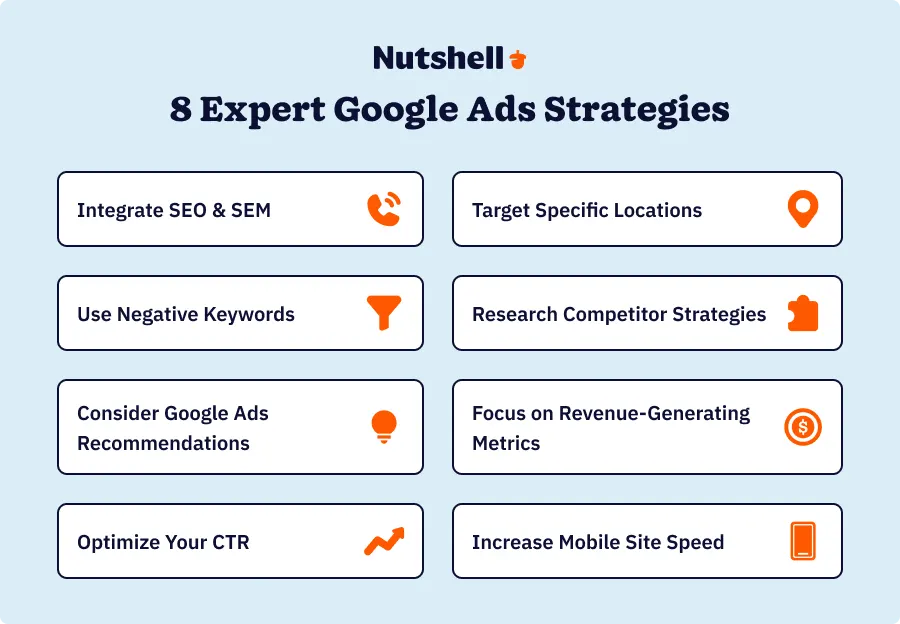
Many marketers treat SEO and SEM as separate, competing channels. However, these approaches work much more effectively when integrated.
To enhance your PPC campaigns, examine your organic search performance. You’ll likely discover valuable insights about click-through patterns in your organic listings and how that translates to your paid ad copy. Similarly, high-performing keywords in your PPC campaigns may indicate new opportunities to strengthen your SEO content strategy.
For instance, if a paid search ad for a specific keyword achieves exceptional click-through rates, that’s a signal to revisit and strengthen the meta descriptions on related organic content targeting the same term.
Brett Farmiloe, Markitors
Geographic precision is crucial for effective ad spend management. In competitive verticals like legal services, costs can skyrocket to $150−$200 per click. The solution? Extremely granular location targeting.
Use Google Maps functionality within Google Ads to identify and target only the specific geographic areas where you actually provide services. This geographic accuracy directly improves conversion rates and maximizes your budget’s impact.
Court Will, Will & Will
Negative keywords enable advertisers to exclude specific search terms from advertising campaigns, allowing you to focus on only the search terms that matter to your business. By monitoring campaign activity and adding in negative keywords, campaigns can achieve better targeting with an increase in your return on investment.
For example, there are 125 Cruise America rental centers in the United States, Canada, and Alaska from which you can depart. But Hawaii is not one of those locations. By adding “Hawaii” as a negative keyword, we can make sure our ads stay relevant to the locations we service.
Randall Smalley, Cruise America
The fundamental goal of pay-per-click advertising is straightforward: invest dollars and receive returns. Yet many marketers become obsessed with optimizing preliminary funnel metrics like click-through rate, cost-per-click, or cost-per-acquisition—metrics that don’t necessarily correlate to actual revenue.
Instead, shift your focus to metrics that truly matter: attributed revenue and customer acquisition cost (CAC). If impressive click-through rates don’t translate to bottom-line revenue, is that metric worth optimizing? Probably not.
Janelle Amos, Head of Demand Gen
Take our guided tour to explore Nutshell’s incredible features!
Few people use the “recommendations tab” in Google Ads, where you can get recommendations for optimizing your campaign. There, you will also observe the “optimization score,” which is powered by a machine-learning algorithm to produce a score about how well your campaign is optimized for performance. Select and act on the recommendations that you find to be relevant.
Rameez Ghayas Usmani, PureVPN
The best tip I can give is to research what your competitors are doing and use that as a basis for your strategy. There is absolutely no reason to reinvent the wheel when it comes to PPC. Plenty of tools like Ahrefs or iSpionage let you see the copy, image, and landing pages of competing ads. Even better is when you find an ad that has been running for a while, as it almost always means it is delivering results.
Quincy Smith, ESL Authority
The best way to improve a Google Ads performance is by optimizing the Click-Through-Rate (or CTR). I suggest putting promotion extensions that highlight deals, exclusive offers, and discounts on your site. Customers are likely to click on ads if they know your business is doing a promotion.
Highlighting any discounts, sales, or exclusive offers in your ads helps entice customers to learn more about your ad, increasing their likelihood of clicking on it. The increased CTR rate for visitors to your promotion page translates to higher revenue.
Yaniv Masjedi, Nextiva
Mobile site speed directly impacts both user experience and conversion rates. Effective optimization strategies include:
These optimization efforts can dramatically reduce load times (some companies achieve sub-one-second loading on blog pages). The payoff is substantial: one company saw a 20% increase in blog traffic after implementing speed improvements, which cascaded into higher sales opportunities.
Brian Lim, INTO THE AM
Join our 200K+ subscribers to learn more about how to grow your small business with exclusive marketing strategies, tips, and ideas from the top-rated experts at WebFX.

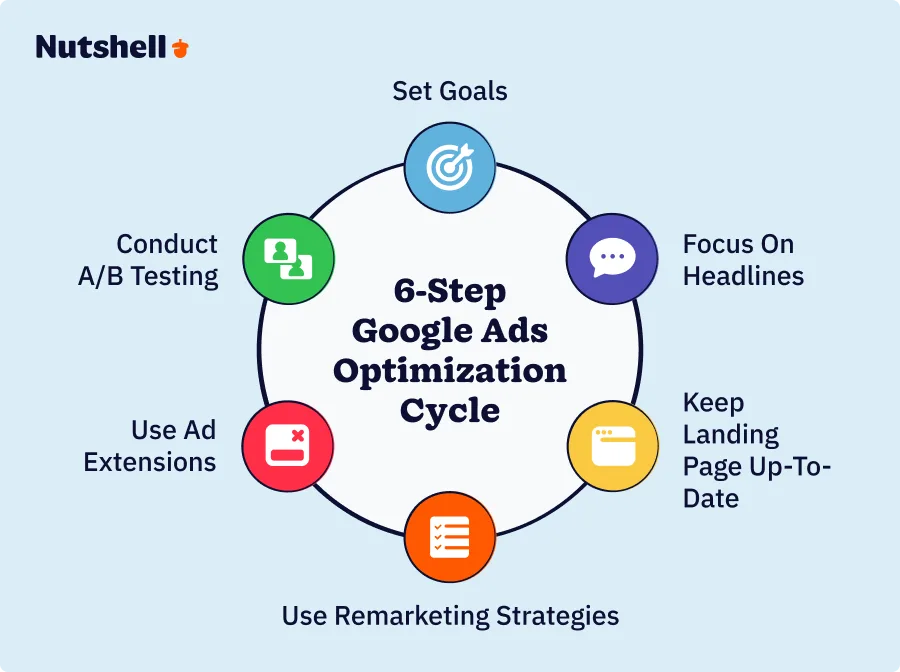
In addition to the expert-given Google Ads tips, here are a couple of additional best practices for crafting an effective Google Ads campaign.

Having concrete SMART goals for your campaign is the first step to mastering Google Ads. Any digital marketing campaign you plan needs an aspirational but doable goal, and a Google Ads campaign is no different.
Think about what you want to achieve with your campaign. Do you want to earn more leads, increase your click-through rate, or improve your conversions?
Once you have a general idea of what you want to gain from using Google Ads, turn that goal into a number – something that can be measured. This will be the measuring stick and compass for guiding your PPC efforts.
With a small window of opportunity to make an impression, your headline needs to be clickworthy. Focus on using sound copywriting techniques to appeal to the reader’s desires, emotions, and curiosity through your headline.
A good metric to measure your headline writing is the 4U formula, as follows:
If your headline hits at least one of these points, it’s miles ahead of those that don’t. If you hit three or four, you’re almost guaranteed a growth in click-through rate.
A frequent mistake: advertising one promise while delivering something different. When the landing page fails to match the ad’s promise, users bounce immediately—they feel misled.
Your landing page must accurately reflect your ad’s message, and any updates to your ads should be mirrored on the page. Beyond messaging, invest in modern, visually appealing design. Numerous free and paid design tools make this accessible, or consider hiring professional design support.
Not every first click converts. But that click signals genuine interest. Retargeting campaigns help keep your brand visible to users who clicked away but need time to decide.
By strategically showing ads to users who’ve previously engaged with your site, you ensure interested prospects remain engaged throughout their decision-making process—maximizing your return on ad spend while preventing warm leads from going cold.
In your Google Ads dashboard, you can add extensions to your ad that show readers more information about your business, such as your location, products, contact information, and current promotions.
Using these extensions strategically can optimize your conversion rate by giving readers the information they need to convert without having to look for it on the landing page.
For example, if a person is looking for garden equipment rentals and needs to rent as soon as possible, having your phone extension allows them to connect with you from their phone immediately. Promotions and guarantees, such as ‘Same-day rentals,’ can also assure them that you’re the business they can turn to.
Embrace experimentation when it comes to your ads. Test different visuals, headlines, CTAs, and more to find the sweet spot that leads to the highest conversions and helps you reach your goals faster.
You can do this through A/B testing, also known as split testing. This method allows you to run different versions of your ad concurrently and gather data on what may be working for your ads, allowing you to pivot and adjust your strategy as needed.
For years, Google Ads optimization meant manually tweaking bids, testing ad copy, and digging through search term reports. It was tedious work—important work, but tedious.
In 2025, that’s starting to change. Google’s rolling out AI-powered agents designed to do a lot of that work for you.
In December 2025, Google made two new AI tools available to all English-language accounts:
Ads Advisor (available in Google Ads)
Think of it as an intelligent partner inside your Google Ads account. Ads Advisor can:
Analytics Advisor (available in Google Analytics)
This one works in your analytics data. It can:
Both use Google’s Gemini AI models and are designed to save you time, especially if you’re managing multiple accounts or running frequent experiments.
Here’s what’s important: these tools don’t replace human judgment. They’re assistants, not autopilot.
A home theater installer tested Google’s earlier AI matching feature (AI Max) and found that the AI initially wanted to show ads for competitor brands and services the business didn’t even advertise. The AI was stretching too far, trying to find every possible customer.
His team caught it and added negative keywords. The AI adjusted. The result? 8 additional qualified leads per month at a reasonable cost.
The lesson: AI tools work best with human oversight. Use them to surface ideas and handle routine optimization tasks. But keep an eye on search terms, competitor brands, and anything that doesn’t align with your business. That’s where human smarts still win.
This is a shift in how you approach optimization. Instead of you hunting for improvements, the AI is actively helping you find them. You just need to stay engaged and make the final calls.
Google Ads success doesn’t happen by accident—it requires strategic thinking, precise targeting, continuous optimization, and a willingness to experiment. By implementing these expert strategies and best practices, you’ll develop more efficient campaigns that attract qualified traffic and deliver measurable returns on your advertising investment.
Let your sales team learn from the masters with our Sell to Win Playbook, packed with 55 top tips from some of the best sales experts around!



Table of Contents

Even with so many online ad options available, Google Ads is still an excellent option for generating cold traffic. If managed correctly, a well-targeted Google Ad campaign can deliver significant ROI on your initial investment.
The pricing for Google Ads depends on various factors, such as your industry, keyword targeting, competition, and ad network. That said, Google Ads costs generally range from $100 to $10,000 per month, and most businesses will pay $0.11 to $0.50 per click.
Generally, it takes about 3 months for a Google Ad campaign to mature and 4 to 12 months to develop into a profitable campaign. This number can vary, with some businesses seeing quicker results than others. Patience is the key to seeing results.
Quality Score is Google’s 1-10 rating of your ad quality based on three factors: expected click-through rate (CTR), ad relevance, and landing page experience. A higher score means lower costs—scoring a 10 can cut your cost-per-click in half compared to a score of 5. Focus on writing relevant ad copy, tightening keyword groups, and optimizing landing pages to improve this metric and maximize your ad budget efficiency.
Start by analyzing performance data to identify your highest-converting campaigns, then allocate more budget to winners. You can use individual daily budgets for each campaign or try shared budgets to flexibly distribute funds where they perform best. Monitor results weekly and adjust—pause underperformers and reinvest savings into campaigns delivering strong ROI. This data-driven approach ensures every dollar works harder for your business.