The sales landscape is experiencing its biggest transformation since cloud-based CRM systems arrived nearly two decades ago. AI isn’t emerging anymore—it’s reshaping how sales teams operate every single day.
From automating lead scoring to generating personalized customer communications, AI sales tools are becoming fundamental to how modern organizations compete. But despite the compelling productivity gains for early adopters, widespread implementation reveals a more nuanced story: Success with AI in sales requires far more than just acquiring new technology.
Nutshell has observed this evolution firsthand, and the data tells a clear story about where the industry stands in 2026 and where the real challenges lie.
The market for AI-powered CRM systems is experiencing unprecedented growth. The overall CRM market is projected to reach $320.99 billion by 2034, growing at a compound annual growth rate (CAGR) of 12.4%.
This adoption is not evenly distributed across departments. Marketing departments lead in AI adoption at 77%, while sales teams lag behind at just 51%. The gap is significant, suggesting that while marketing teams have embraced AI-powered campaigns and personalization, sales organizations are still navigating the implementation curve.
Over half of generative AI budgets in enterprises are dedicated to sales and marketing tools, indicating that organizations view AI sales tools as a core revenue driver. Leading platforms are embedding generative AI throughout their systems—from lead scoring to email drafting to sales forecasting—transforming what’s possible in customer relationship management.
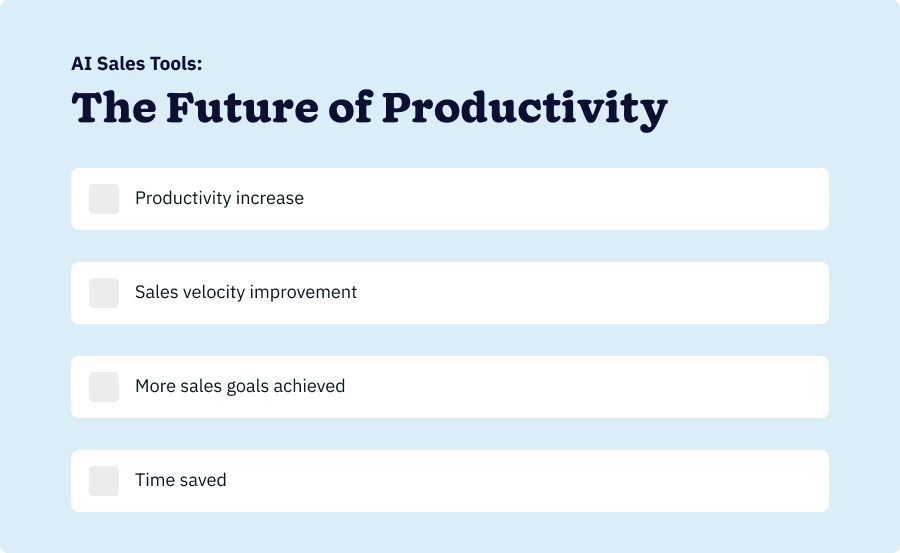
The business case for AI in sales is compelling when measured by productivity metrics. Organizations implementing AI sales tools report significant measurable gains across multiple dimensions.

Businesses using generative AI in their CRM are 83% more likely to exceed their sales goals, creating an undeniable link between AI adoption and sales performance. Beyond hitting targets, the tools themselves are changing how sales reps work.
Sales productivity increases by up to 5% of existing global sales expenditures with AI implementation. More impressively, 47% of AI users report being more productive and saving an average of 12 hours per week. At an organizational level, this translates to hundreds of hours reclaimed each week—time that moves from administrative tasks back to strategic selling activities.
The practical applications of AI in sales operations demonstrate why productivity gains are possible. AI-driven lead scoring can increase conversion rates significantly, scientifically predicting which leads are most likely to convert. Instead of sales reps spending time investigating lead quality, AI systems surface the highest-probability opportunities first.
On the forecasting front, AI can also improve sales forecast accuracy. This relates directly to revenue operations and financial planning, where forecast accuracy influences business decisions. With the help of AI, sales leaders can set realistic targets rather than relying on historical patterns that may not reflect current market conditions.
Despite these gains, the disparity between marketing and sales adoption rates suggests that sales organizations face unique implementation challenges. The fact that marketing departments lead in AI adoption at 77%, while sales teams lag behind at just 51% further illustrates this. The gap likely reflects differences in how easily AI integrates into different workflows, as well as varying levels of organizational readiness within sales departments.
Despite these productivity gains, adoption is not universal. Understanding the barriers reveals why many organizations are still in early stages of their AI sales transformation.
One of the most significant obstacles to successful AI implementation involves data quality. Companies often abandon projects because they lack employees with the necessary tech skills, demonstrating that technology adoption requires more than just purchasing new software.
The data challenge runs deeper. Many organizations only use a fraction of the data they actually have available, with the remaining data scattered across disconnected systems or trapped in unstructured formats. This “data silos” problem prevents AI systems from developing a comprehensive customer understanding.
Common data challenges include:
Beyond data, implementing AI sales tools requires organizational readiness that many teams haven’t developed. Some predict that in 2026, nearly half of new CRM-related investment will go into data architecture and AI infrastructure, rather than directly into AI capabilities themselves. This suggests that the hidden costs of implementation—infrastructure, data cleaning, integration—likely often exceed the cost of the technology itself.
Training and change management present another barrier. Sales teams accustomed to traditional workflows may struggle with AI-assisted processes. The shift from independent decision-making to AI-informed prioritization requires both skill development and a mindset shift within the organization.
Organizations succeeding with AI sales tools follow a consistent set of implementation patterns, grounded in realistic expectations about what technology can achieve.

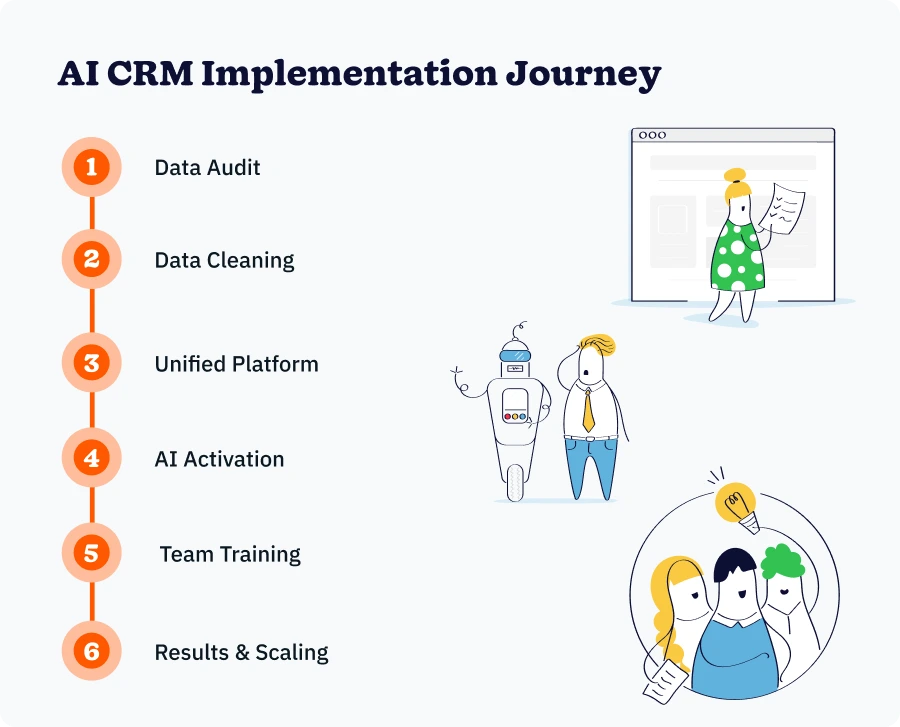
The most critical first step involves addressing data quality. Rather than launching with AI features, successful implementations begin with a data audit and cleansing initiative. This includes identifying and removing duplicates, standardizing field formats across teams, enriching incomplete records, and establishing data governance processes that prevent future degradation.
Rather than attempting to activate every AI feature simultaneously, organizations that succeed typically identify one or two high-impact use cases to pilot first. This might mean starting with AI-driven lead scoring before moving to email generation, or implementing churn prediction before rolling out recommendation engines.
This phased approach allows teams to develop AI literacy, demonstrate value, and build internal support before scaling implementation across the entire organization. Success with one use case creates advocates who drive the adoption of additional AI capabilities.
Customer expectations have evolved beyond single-channel interactions. Successful AI implementations ensure that customer interactions are unified across multiple channels—email, text, phone, messaging apps, and social media—with consistent information and personalization.
This multi-channel integration creates what some organizations refer to as a “single customer view.” When AI systems can access complete interaction history across all channels, personalization becomes more sophisticated, and customer experience improves measurably.
Successful AI implementations invest heavily in training approaches that work for sales professionals. Rather than theoretical instruction about machine learning algorithms, effective training is practical, role-specific, and continuous rather than one-time. Sales reps learn how to interpret AI recommendations, override predictions when appropriate, and integrate AI insights into their existing workflows.
Training should teach teams to trust AI predictions once they understand how they’re generated, provide hands-on experience with actual company data, and create ongoing support mechanisms rather than relying on initial workshops alone.
An often-overlooked factor in sales productivity involves the access method. Salespeople using a mobile CRM typically achieve their sales quotas more often than those who do not. This dramatic difference reflects the reality that modern sales teams operate in the field, not at desks.
Mobile-first CRM design becomes even more critical when AI is introduced. Sales reps need immediate access to AI-generated insights—lead prioritization, next-best-action recommendations, and customer context—at the moment they’re engaging with prospects. That’s why businesses implement mobile CRM systems to enhance their sales strategies, which has become a fundamental expectation rather than a nice-to-have feature.
The inflection point the CRM industry is experiencing suggests that 2026 will be a year of maturation rather than experimentation. Organizations without agentic AI strategies risk falling behind competitors who are already capturing productivity gains and market share advantages.
The competitive advantage in 2026 doesn’t belong to organizations that adopt AI first—it belongs to organizations that implement it correctly. This distinction matters enormously. A company that implements AI sales tools with poor data quality, inadequate training, and unclear use cases will experience minimal return on investment and may even damage productivity initially.
Conversely, organizations that invest in data architecture, establish clear implementation roadmaps, train teams appropriately, and measure outcomes systematically are creating sustainable competitive advantages. The question has shifted from “should we adopt AI sales tools?” to “how do we implement them to drive measurable business results?”
No. Most leading CRM platforms have integrated AI capabilities that work within existing systems. Rather than replacing your CRM, focus on upgrading to a plan that includes AI features and ensuring your data is clean enough for AI to function effectively.
Many organizations layer AI onto their existing CRM infrastructure, making replacement unnecessary unless your current system is severely outdated or lacks API integration capabilities.
Implementation timelines vary significantly based on data quality and organizational readiness. Basic AI features can be activated in weeks, but comprehensive implementation—including data cleaning, team training, and optimization—typically takes 3-6 months for mid-market organizations. Enterprise implementations often require 6-12 months.
Predictive AI analyzes historical data to forecast future outcomes—like lead scoring, churn prediction, and sales forecasting. Generative AI creates new content, such as personalized emails, call summaries, and meeting notes.
Most modern AI sales tools combine both: predictive AI identifies which leads to prioritize, while generative AI helps reps engage those leads more effectively. Understanding this distinction helps organizations identify which AI capabilities address their specific bottlenecks.
Key metrics include conversion rate improvements (target: 15-20% increase), forecast accuracy (target: 40%+ improvement), sales rep productivity (target: 25% increase or 10+ hours reclaimed weekly), and quota attainment rates (target: increase from baseline).
Beyond these, track adoption rates (what percentage of your team is actually using AI features), time-to-close reduction, and customer lifetime value improvements. Set baseline measurements before implementation, so you have clear before-and-after comparisons.
You don’t need perfect data to start, but you do need to address critical data quality issues first. Prioritize fixing the highest-impact problems: removing duplicates, standardizing key fields (like lead source and deal stage), and enriching incomplete contact information.
Many organizations implement AI on their cleanest data segments first (e.g., a specific region or customer segment), prove value, and then expand to other areas as data quality improves. This staged approach demonstrates ROI while you work on broader data governance.
The data reveals that AI in sales is simultaneously both transformative and complex. The productivity gains are real—organizations implementing AI properly are seeing productivity increases, improvements in forecast accuracy, and significant improvements in conversion rates. The predicted increase in adoption rate by 2026 suggests this is becoming table stakes for competitive sales organizations.
Yet the reality is also clear: technology adoption alone doesn’t drive these results. The organizations succeeding with AI sales tools are those that recognize implementation as an organizational challenge, not merely a technology purchase. They invest in data quality, implement incrementally, train continuously, and maintain realistic expectations about what AI can achieve.
For sales leaders evaluating AI sales tools and AI-powered CRM systems in 2026, the strategic question isn’t whether to adopt—it’s how to adopt in a way that creates lasting competitive advantage. The answer lies in understanding that technology is the easy part. Organizational readiness, data quality, team enablement, and clear strategic intent are the factors that separate successful implementations from expensive pilot projects.
The opportunity is real. The execution is everything.
Únase a más de 30.000 profesionales del marketing y las ventas. Suscríbase a nuestro boletín Vender para ganar.