The Smart Business Guide to Lead Generation That Actually Converts

-

Key takeaways
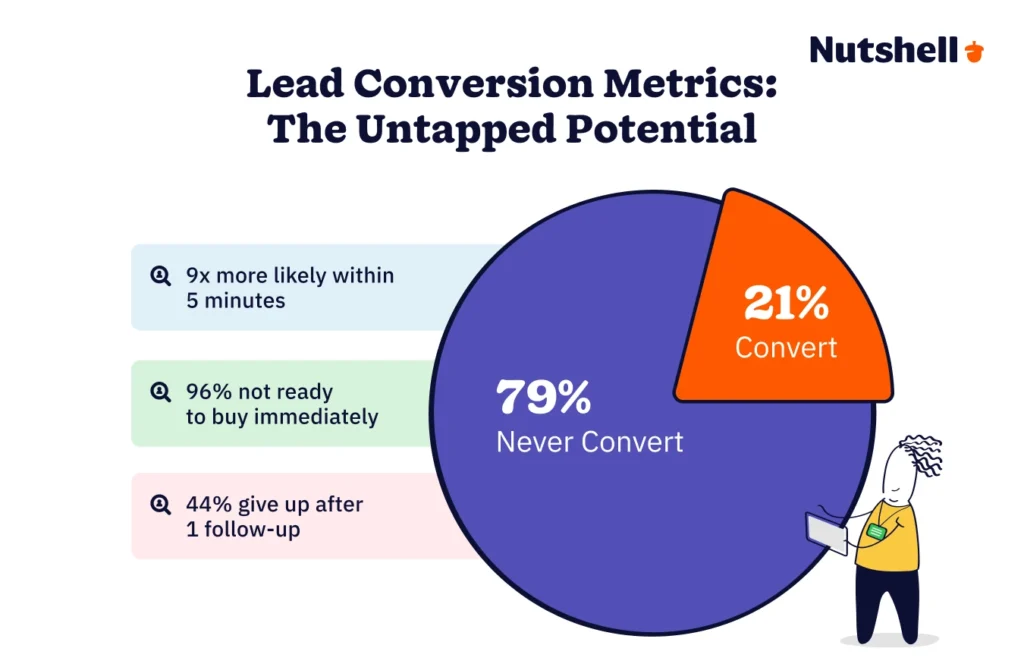
- Broken systems, not bad leads, kill conversion: 79% of leads fail because follow-up is inconsistent, not because lead generation is weak
- A CRM isn’t optional for small teams: Automation increases qualified leads by 451% and lets one person manage what used to require a full sales team
- Measure what matters: Cost per qualified opportunity beats lead volume—focus on revenue impact, not vanity metrics
Lead generation can return $36 for every $1 invested, yet 79% of marketing leads never convert to sales. While 91% of marketers rank lead generation as their most important goal, most small businesses are solving the wrong problem entirely.
Here’s the uncomfortable truth: you probably don’t need more leads. You need a system to convert the ones you already have. Most content focuses on generating leads—the flashy part that shows quick wins in your metrics. The real crisis? Converting those leads into paying customers.
For small businesses running on less than $500 monthly marketing budgets with no dedicated staff, scattered tools make this nearly impossible. This guide offers a systematic approach to the lead-to-customer pipeline that actually works for resource-constrained businesses—because we know that’s most of you.
This isn’t another list of lead generation tactics. It’s a systematic approach to building a lead conversion system that actually works when your team is small and your budget is tight.
Table of Contents
Why 79% of small business leads never convert
The conversion crisis isn’t a lead generation problem—it’s a lead management problem. And understanding where systems break down is the first step to fixing them.
The follow-up failure
Response speed is brutal in its simplicity. Leads reached within five minutes are 9x more likely to convert than those contacted after 30 minutes. Yet most small businesses don’t have systems in place to respond that fast, because they’re juggling leads across email, forms, social media messages, and phone calls without a central nervous system coordinating the effort.
Here’s what happens in reality: a prospect fills out a form on your website at two PM while you’re in a meeting. By the time you see it, they’ve moved on mentally—they’re no longer in “buying mode,” they’re back to their regular work. The window closes.
Even worse, 44% of salespeople give up after one follow-up. They send an initial email, get no response within a day or two, and move on. They don’t realize that most buying decisions require multiple touches—sometimes five or more—before a prospect is ready to commit. Without a systematic follow-up sequence built into your CRM, those leads just disappear into the void.
Small businesses often lack the infrastructure for consistent follow-up. You might have one person managing leads part-time alongside their other responsibilities. Without automation and clear processes, follow-up becomes inconsistent, sporadic, and ultimately ineffective. A single missed day means dozens of leads age out of the conversion window.
The resource reality gap
Budget constraints are the backdrop for every small business decision. Most small businesses with fewer than ten employees operate on less than $500 monthly marketing budgets, and most have no dedicated marketing employees. One person is doing sales, marketing, customer support, and everything else.
When you’re stretched that thin, tool fragmentation becomes a silent killer—one that directly damages your conversion rates. Your leads might come from your website, email campaigns, social media, local directories, and referrals—but they’re scattered across five different platforms. Information enters one system, gets duplicated in another, and falls through the cracks in a third. By the time you’re trying to follow up with someone, you’ve lost context about where they came from, what they’ve engaged with, or where they are in the buying journey.
This fragmentation doesn’t just waste time—it actively damages conversion rates. A prospect receives inconsistent messages across channels. Your follow-up references information they never gave you in that specific context. The experience feels disjointed and unprofessional.
The staffing crisis compounds this. Without a dedicated marketing staff, you’re relying on one person to manually manage everything. They’re inherently limited: they can’t respond to every lead within five minutes, maintain consistent follow-up sequences, or segment audiences for personalized nurturing. The math simply doesn’t work.
The measurement blind spot
Most small businesses obsess over lead volume. “How many leads did we generate this month?” becomes the main metric. But this is a vanity metric that masks the real problem.
96% of website visitors aren’t ready to buy immediately. They’re in the awareness or consideration stage. But most businesses treat all leads the same, applying the same follow-up approach regardless of where someone actually is in their buying journey. This one-size-fits-all approach wastes resources nurturing cold prospects the same way you nurture hot leads. A cold prospect gets the same treatment as someone who’s been engaging with your content for months.
This leads to a measurement blind spot: focusing on cost per lead instead of cost per qualified opportunity. You might celebrate generating one hundred leads at $50 each ($5,000 spent), but if only five of those convert to a customer, your actual cost per customer is $1,000. Meanwhile, a more targeted approach generating thirty leads might result in ten customers, making your cost per customer only $500—but the volume looks worse on paper.
Another blind spot: channel effectiveness. You’re running campaigns across multiple channels, but without proper tracking in your CRM, you don’t know which channels actually drive conversions. You might be investing heavily in a channel that generates cheap leads but converts poorly, while underinvesting in a channel that generates fewer leads but closes at much higher rates.
The solution isn’t generating more leads—it’s systematically converting the ones you already have through faster response, better organization, and smarter measurement.
The small business lead generation reality check
Before diving into solutions, let’s get real about what lead generation actually costs, which channels work best, and what’s realistic for tight budgets.
What lead generation actually costs
Lead acquisition costs vary dramatically by industry and channel. General B2B lead generation ranges from $40 to $200 per lead, while high-ticket B2B can exceed $400 per lead. For small businesses, this matters enormously because your entire monthly budget might buy you ten to twenty-five leads, depending on your strategy.
The channel breakdown reveals why strategy is crucial. Some channels are inherently more expensive but deliver higher-quality leads. Others are cheap but require much higher follow-up investment to convert.
For a small business operating on a less than $500 monthly budget, every dollar counts. You can’t afford to spray and pray across multiple channels simultaneously. Instead, you need to choose one or two channels where your ideal customers actually spend time and where you can be consistent month after month.
The ROI timeline is equally important to understand: most sales require up to five follow-ups for conversion. This isn’t about being pushy—it’s the reality of how buying decisions work. Prospects need time to evaluate, compare, and build confidence. Your budget needs to account not just for lead generation but for the follow-up and nurturing required to move leads toward conversion.
This is where many small businesses fail. They invest their entire budget in generating leads, then have nothing left for follow-up and nurturing. They’re essentially buying leads and throwing them away.
The channel selection framework
Not all lead generation channels work equally well for small budgets, and channel selection is perhaps the most important decision you’ll make.
Content marketing generates 3x more leads than outbound marketing, and it compounds over time. Your first blog post might generate zero leads, but after fifty posts addressing your audience’s specific problems, you’re generating twenty to thirty leads per month organically. The challenge is that content marketing requires six to twelve months to show real results, which is hard for small businesses to stomach when they need revenue now.
Email marketing is often overlooked but remains one of the most cost-effective channels for small businesses. If you have an existing audience—customers, past prospects, or people who’ve engaged with your content—email can nurture these relationships at nearly zero marginal cost per message.
Social media requires consistency more than budget. The stat that matters: companies posting fifteen or more times per month on social average about one thousand two hundred new leads per month. But this requires discipline and systems. Posting sporadically won’t move the needle.
Local SEO becomes increasingly important for small service businesses. If you serve a geographic area, getting found in local search results can drive consistent, qualified leads with minimal ongoing investment.
The point isn’t to do everything—it’s to choose the channel where your audience actually hangs out and commit to consistency. Success isn’t about doing everything; it’s about doing the right things systematically.
The CRM-first lead generation system
This is where the transformation happens. A CRM isn’t a nice-to-have tool for large sales teams—it’s essential infrastructure for any business serious about converting leads into customers.
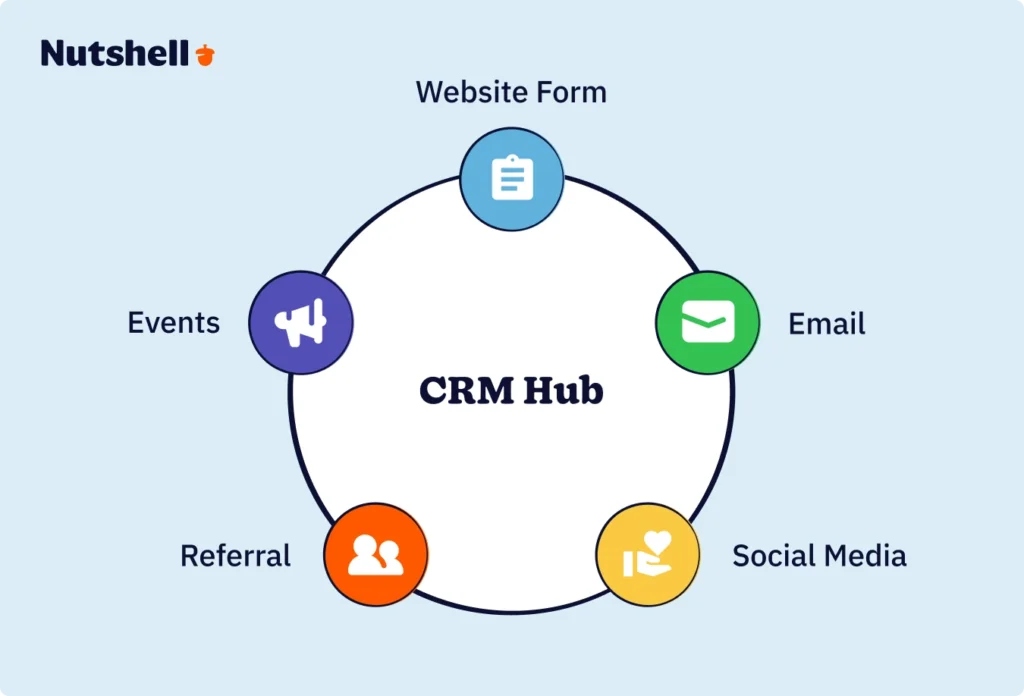
Why CRM is infrastructure, not optional
Think of your lead generation system like a city’s infrastructure. Individual tactics—content marketing, email, social media, events—are like roads. But without central plumbing (water system), electrical grids, and traffic management (coordination system), having good roads doesn’t help much. Everything breaks down.
A CRM is your central nervous system. It connects all your lead generation efforts and coordinates the response.
Here’s what happens without it: a prospect comes in through your website form (one system), you reach out via email (another system), they reply asking a question on social media (third system), and somewhere in this chaos, you lose track of where they are in the buying process. With a CRM, every interaction feeds into one complete record. You see the entire customer journey at a glance.
The integration benefit is dramatic. When a prospect comes in, your CRM immediately tags them by source so you can measure channel effectiveness, assigns them to a sales rep or triggers an automated follow-up, begins tracking their engagement with your content and emails, segments them based on their interests and behavior, and nudges you if they haven’t been contacted in twenty-four hours.
Without integration, all of this becomes manual work that doesn’t happen at scale.
The automation capability is where CRM delivers financial returns. Companies using marketing automation see a 451% increase in qualified leads. This isn’t because automation is magical—it’s because automation makes consistency possible. You’re no longer relying on someone remembering to follow up. The system does it automatically, at scale, twenty-four hours a day, seven days a week.
For small businesses, this is transformational. One person can now manage the follow-up work of a full sales team because the CRM is doing the repetitive, non-negotiable parts: immediate notifications, follow-up sequences, nurturing workflows, and measurement. Tools like Nutshell offer mobile apps that let your team update information from anywhere, responding to leads within minutes even when away from the office.
Need a user-friendly CRM to boost sales and team efficiency?
Take our guided tour to explore Nutshell’s incredible features!

The five-minute response system
You now understand why five minutes matters: leads contacted within that window are 9x more likely to convert. So how do you actually achieve this when your team is small and you’re not sitting by your desk waiting for leads to arrive?
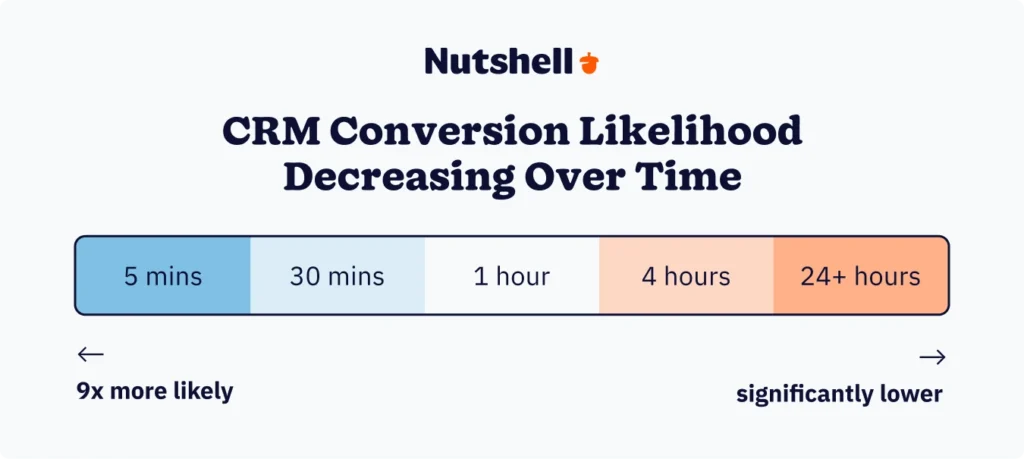
Automated notifications are the foundation. When someone fills out a form on your website, completes a contact request, or engages with your email, your CRM immediately alerts the relevant person—ideally via text or push notification that interrupts whatever they’re doing. Five minutes is achievable if someone knows a lead just arrived.
Response templates are your next layer. You don’t want to waste those precious five minutes typing a response from scratch. Pre-written templates that are personalized create the best of both worlds: speed and personal touch. A template might be: “Hi [First Name], thanks for reaching out about [their specific interest]. I’m [Your Name], and I’d love to learn more about what you’re looking for. Quick question: are you looking to [specific use case]?”
The template saves you five minutes of thinking and typing. You add one or two personal details and hit send. The response still feels human, but you’ve gained crucial time. Pre-written response templates configured in your CRM mean you’re ready to personalize and send a message in under sixty seconds—without sacrificing the human touch.
Follow-up sequences handle the ninety-six percent of prospects who aren’t ready to buy immediately. Maybe they needed information and are in research mode. Maybe they like you but aren’t ready to make a purchase decision yet. Your CRM automatically sends them valuable content, gentle reminders, and periodic check-ins—all without you manually managing each one. After the first contact, the system takes over the nurturing work.
Tracking and optimization close the loop. Your CRM records response times, tracks which sequences perform best, and shows you conversion rates by response template. Over time, you optimize. Maybe you discover that a different opening line gets faster responses. Maybe you find that sending the first follow-up at nine AM the next day works better than immediately. The data drives improvement.
Integrated lead scoring and nurturing
Not all leads are created equal, but without a system for differentiating them, you treat them the same. Lead scoring fixes this.
Qualification criteria go beyond just basic contact information. A lead who fits your ideal customer profile (right company size, industry, geography, and needs) is more valuable than a lead who’s just curious. But beyond profile fit, behavior matters enormously. Someone who’s opened five of your emails, visited your pricing page twice, and downloaded your case study is vastly more interested than someone who filled out a form once and disappeared.
Behavioral tracking inside your CRM captures all of this. Website activity (which pages they visited, how long they spent), email engagement (opens, clicks), content consumption (downloads, webinar attendance), and direct interactions (calls, meetings) all feed into a score. Over time, you can see who’s genuinely interested and who filled out a form on a whim.
Segmentation strategy takes this further. Instead of one follow-up sequence for everyone, you create micro-segments. New prospects get a different nurture sequence than returning customers. Prospects interested in Feature A get different content than those interested in Feature B. High-fit prospects get personal outreach, while lower-fit leads get automated nurturing until they signal deeper interest.
This segmentation feels personal to the recipient because it is. They’re getting information relevant to their specific situation and stage in the buying journey. This dramatically improves conversion rates compared to one-size-fits-all follow-up.
Nurturing sequences are the automated backbone of this system. Once someone is scored and segmented, the CRM automatically sends them a series of emails over weeks or months—each one providing value, building trust, and gently moving them toward a buying decision. The sequence pauses if they book a call or make a purchase. It accelerates if they show high engagement. It’s automated, but it’s responsive to their behavior.
This isn’t just lead generation anymore—it’s lead conversion architecture.
Need more Leads?
Invest in professional marketing services from WebFX and kick your company’s growth into high gear.

High-impact strategies for small business budgets
Knowing you need a CRM system is one thing. Understanding which tactics integrate with that system to actually generate and convert leads into customers is another. These strategies are specifically designed for small budgets and work best when fed into your CRM.
Content marketing that converts
Content is the most scalable lead generation tool available to small businesses, but only if it’s strategic. Random blog posts won’t cut it. You need topic clusters—a core theme you’re known for, with multiple supporting posts around that theme.
Let’s say you’re a bookkeeping service for freelancers. Your core theme might be “financial management for freelancers.” Within that, you create content around specific problems: “How to Set Aside Taxes as a Freelancer,” “The Freelancer’s Guide to Quarterly Estimated Taxes,” “Tracking Business Expenses Without Losing Your Mind.” Each post supports the others and establishes you as the authority on this specific problem.
Lead magnets offer value exchange—you give something genuinely useful (a template, checklist, guide) in exchange for their email address. The key is integration with your CRM. When someone downloads your lead magnet, they’re automatically added to your nurture sequence for that topic. They tagged themselves as interested in a specific problem, and your CRM knows this.
SEO strategy builds long-term authority. These content pieces are optimized for the questions your ideal customers are actually searching for. Over six to twelve months, you start ranking for these questions. Prospects find you because they’re actively searching for solutions, making them high-intent leads.
The content-to-CRM pipeline is seamless. Form submissions from blog posts, email captures from lead magnets, and gated content all feed directly into your CRM with automatic tagging. You immediately know which content attracted them and can nurture them accordingly.
Local and referral leverage
For service-based businesses, local presence and referrals are often underutilized lead sources—yet they’re relatively cheap and deliver high-quality leads.
Local event participation means showing up where your customers are. Trade shows, chambers of commerce meetings, networking events, community gatherings. You collect contacts, feed them into your CRM, and immediately begin nurturing. Being the person who shows up consistently builds recognition and trust.
Referral program automation makes this systematic. You set up incentive structure in your CRM—maybe a $50 credit for every referred customer who signs up. Clients know about the program because it’s automated. When they make a referral, the referred prospect is automatically tagged with their name. When that prospect becomes a customer, the referral credit is automatically awarded. You’re no longer managing this manually; the system does it.
Community partnerships create ongoing referral relationships. Partner with complementary businesses (not competitors) where you can mutually refer. A bookkeeper might partner with a tax accountant. A business coach might partner with a web designer. Your CRM tracks these partnerships and the referrals coming from them.
Geographic targeting becomes possible with CRM data. You can see which locations are driving the most business, which referral sources are most productive, and where to double down. You’re no longer guessing about local strategy—the data guides it.
Email and social media systems
Email marketing lives in your CRM. Drip campaigns are triggered by CRM behaviors. Maybe someone downloads your lead magnet and automatically gets a three-email sequence. Someone attends your webinar and gets a different sequence. Someone abandons a shopping cart and gets yet another sequence. These are all configured once in your CRM and run automatically.
Social media scheduling prevents the “post sporadically” trap. You’re not trying to post in real-time all day—you’re batching content creation and scheduling it in advance. Consistency matters more than spontaneity for social media lead generation.
Cross-platform integration means all touchpoints feed your CRM. Someone clicks a link in your Instagram post and lands on a landing page—tracked. Someone emails you after seeing your LinkedIn post—logged. Someone messages you on Facebook—captured. All of this creates a complete picture of how different channels work together.
The statistic that matters: companies that blog consistently generate 67% more leads than those that don’t. But “blog consistently” requires a system—editorial calendar, content creation, promotion, and lead capture—all working together. Your CRM coordinates this system.
Every tactic connects back to the CRM system for maximum efficiency. You’re not running separate lead generation campaigns that live in isolation. Everything feeds the same system, and that system is designed to convert.
Measuring what actually matters
Most small businesses measure the wrong things, then wonder why their lead generation feels like it’s not working. It’s not that the leads are bad—it’s that they’re measuring vanity metrics instead of revenue metrics.
Beyond lead quantity
Lead quality metrics matter far more than volume. This means understanding your qualification criteria and consistently measuring against them.
A qualified lead has specific characteristics: they fit your ideal customer profile (right industry, company size, needs), they have a real problem you solve, and they have budget and authority to make a decision. A lead that doesn’t meet these criteria might convert eventually, but the cost and time invested will be higher.
Conversion rate by source reveals which channels actually work. Maybe your paid ads generate cheap leads that almost never convert. Maybe your referral program generates expensive leads (you pay a referral fee) but they convert at fifty percent. Maybe your content marketing generates leads slowly but at a twenty percent conversion rate. These numbers tell you where to allocate budget next month.
The data point that changes behavior: companies with mature lead generation processes operate more efficiently than those without systematic approaches. This isn’t because they have more leads—it’s because every lead is more likely to convert, and they’re investing in the right channels.
The long game metrics
Customer lifetime value is understanding the true worth of a lead. Maybe you acquire a customer for $500, they pay you $2,000 in year one, and stay for three years paying $2,000 annually. Their lifetime value is $8,000. Against that benchmark, a $500 cost to acquire them is tiny.
But if you’re only looking at initial sale value ($2,000), the $500 acquisition cost feels expensive. Wrong metric, wrong decision.
Pipeline velocity measures how long it takes to move a lead from entry to customer. Fast velocity (thirty days) means your CRM system is working well—leads are moving through quickly. Slow velocity (one hundred eighty days) suggests bottlenecks. Maybe follow-up is inconsistent. Maybe your nurture sequences need work. Maybe you’re trying to sell to unqualified leads. The CRM data reveals where the slowdown is.
Retention and expansion metrics matter because a customer you keep generates far more revenue than a customer you lose. Your CRM tracks repeat purchases, upsells, and expansion revenue. If you’re so focused on new lead generation that you’re ignoring customer success and retention, you’re building a leaky bucket.
System ROI is measuring the return on your CRM investment. If your CRM costs $500 per month and it enables your small team to manage one hundred qualified leads instead of thirty, and your conversion rate improves by twenty percent as a result, the math is clear. The system pays for itself many times over.
The goal isn’t more leads—it’s more customers from the leads you generate.
Implementation roadmap for small businesses
Theory is useful. Execution is everything. Here’s how to actually build this system without overwhelming yourself.
Month one: Foundation setup
- CRM implementation means choosing your platform (Nutshell is built for small businesses exactly like yours), setting it up, and training your team. Don’t over-complicate this. You need the basics: lead capture forms, contact records, and a way to track who’s responsible for each lead. You don’t need every feature available on day one.
- Lead capture optimization means making sure every possible entry point feeds your CRM. Your website forms, landing pages, contact sheets, even business card scans should all create records in your system. If a lead comes in through any channel and doesn’t end up in your CRM, you’ve lost money.
- Response system setup automates the five-minute rule. Set up immediate notifications (email, text, or in-app alert) when a new lead arrives. Create your first response template. Assign leads to responsible parties. This is your foundation for fast follow-up.
Months two to three: Strategy integration
- Content calendar means planning what you’ll create and how it connects to your CRM. Maybe you create one blog post per week targeting a specific search term, optimized with a lead magnet to capture emails. Or maybe you create one email sequence per month nurturing an audience segment. The key is consistency and integration.
- Automation sequences expand beyond the initial response. Maybe new prospects get a five-email nurture sequence. Maybe webinar attendees get a different sequence. Maybe abandoned opportunities get a re-engagement sequence. Configure these once and let them run automatically.
- Tracking implementation means setting up your key metrics and dashboards. You want to see at a glance: How many leads came in this week? Which sources generated them? How many converted? What’s your cost per qualified opportunity? Which nurture sequences have the highest engagement? These metrics should be visible to your whole team.
Ongoing optimization
- Monthly review cycles mean looking at the data and asking: What worked? What didn’t? Where should we double down? This isn’t about vanity metrics—it’s about revenue metrics. Which sources generated the most qualified leads? Which nurture sequences had the highest conversion rates? Where are we losing leads in the pipeline?
- A/B testing makes small improvements that compound. Maybe your response template gets a twenty percent improvement by changing the opening line. Maybe your nurture sequence gets better engagement by sending emails at nine AM instead of six AM. Small improvements across multiple areas add up to significant gains.
- Scale planning means recognizing when you’ve optimized your current system and need to expand. Maybe you’ve maxed out your current content marketing channel and need to add social media. Maybe your one salesperson is overwhelmed and you need to hire another. The CRM data tells you when you’ve hit capacity and it’s time to scale.
Start simple. Build systematically. Scale intelligently.
From lead generation to customer generation
You’ve heard that lead generation can return $36 for every $1 invested. That’s possible. But it requires a system. It requires speed. It requires consistency. And it requires measurement focused on results, not vanity.
The core insight is simple but transformative: lead generation without conversion systems wastes money. You can generate a thousand leads, but if your follow-up is inconsistent, your messaging is scattered, and your measurement is focused on the wrong metrics, you’ve just wasted your budget.
CRM integration transforms scattered efforts into systematic success. Every lead goes into one place. Every interaction is recorded. Every nurture sequence runs automatically. Your team stays coordinated. Your data stays clean. Your decision-making stays grounded in reality instead of guesses.
Small businesses don’t need more leads. You need to convert the ones you already have at higher rates, faster, and with less wasted effort. You need a system designed for your reality—small teams, lean budgets, and the need for every dollar to move the needle.
That system is built on a foundation of CRM infrastructure combined with deliberate channel strategy, fast response, systematic nurturing, and revenue-focused measurement.
451% increase in qualified leads. 9x higher conversion rates within five minutes. These aren’t theoretical numbers—they’re the result of small businesses that built systems instead of chasing tactics.
The question isn’t whether you can afford to implement this system. It’s whether you can afford not to. Every month without systematic lead management is another month leaving revenue on the table.
Stop leaving revenue on the table. Start your free 14-day Nutshell trial today and build the lead conversion system your business deserves.
Frequently asked questions
-
1. How long does it take to see results from a CRM system?
Most small businesses see measurable improvements within 30-60 days of implementing a CRM. Initial wins come from faster response times and better follow-up consistency. Significant conversion rate improvements typically appear within 90 days as your automation sequences mature and you refine your lead scoring. The key is consistent execution from day one—don’t expect results if you’re not actively using the system.
-
2. Do I really need a CRM if I’m a solo founder or have a small team?
Yes, especially if you’re solo or small. A CRM solves the exact problem small teams face: managing too much manually. One person using a CRM can handle the follow-up work of a traditional sales team because the system automates repetitive tasks. For solo founders, a CRM is what allows you to scale without hiring immediately.
-
3. What’s the difference between a “lead” and a “qualified lead”?
A lead is anyone who expresses interest in your business—they fill out a form, email you, or contact you on social media. A qualified lead is someone who fits your ideal customer profile (right industry, budget, needs) and has genuine buying intent. Not all leads are qualified, which is why measuring cost per qualified opportunity matters more than total lead count.
-
4. Can I use multiple lead generation channels at once, or should I focus on one?
Start with one channel and master it before adding others. Trying to do everything (content, social media, paid ads, referrals) simultaneously dilutes your efforts and budget. Pick the channel where your ideal customers actually spend time, commit to consistency for 6-12 months, then expand once you’ve proven ROI. Quality execution in one channel beats scattered effort across five.
-
5. How much does a CRM system cost, and is it worth the investment?
CRM pricing ranges from $50 – $500+ per month, depending on features and team size. Nutshell is designed for small businesses and starts at affordable price points. The ROI is straightforward: if your CRM costs $500/month and helps you close 2-3 additional deals per month, it pays for itself. Most small businesses recoup their CRM investment within the first month or two of improved conversion rates.
See Nutshell in action!
Try Nutshell free for 14 days or let us show you around before you dive in.
 BACK TO TOP
 Written by
Ready to try
Nutshell for Free?Thank you! Your submission has been received!Oops! Something went wrong while submitting the form.




What Is Revenue Intelligence? An All-Encompassing Guide
Published on: January 24, 2024Highly Effective Strategies for Elevating Sales Team Performance
Published on: November 10, 2022Join 30,000+ other sales and marketing professionals. Subscribe to our Sell to Win newsletter!