Here is Nutshell’s guide to understanding how to measure and optimize CRM ROI, with a focus on what actually matters: Getting measurable business value from the tools your team actually uses.
For sales managers, marketing managers, business owners, and anyone responsible for CRM implementation, the challenge isn’t finding a powerful system. It’s finding one that your team will consistently use and one where you can clearly track results. This guide covers both.
Key takeaways
Simple CRM systems deliver strong ROI when properly measured and adopted, often outperforming complex alternatives through higher user adoption rates
Focus measurement on core metrics that directly impact business outcomes, such as sales performance, customer retention, user adoption, and time savings—not feature counts
Easy-to-use CRM implementation succeeds when paired with clear business objectives, deliberate adoption strategies, and realistic timelines that account for team transition
When most people think about CRM ROI, they picture a simple equation: More sales equals better return. But genuine CRM ROI is broader and more nuanced.
True CRM ROI includes:
Revenue gains from increased sales, larger deal sizes, and improved win rates
Cost savings from reduced manual data entry, fewer redundant tools, and lower customer acquisition costs
Time savings from automation of routine tasks, reducing the administrative burden
Customer retention improvements from better relationship visibility and proactive engagement
Operational efficiency from streamlined processes and improved team collaboration
A well-implemented, easy-to-use CRM addresses all of these areas. The key advantage of choosing a simple CRM is that it’s more likely to achieve strong adoption, which directly enables these ROI drivers.
Why simplicity matters for ROI achievement
It might surprise you to learn that businesses earn $3.10 in ROI for every $1 spent on CRM. But many organizations fail to reach this benchmark. Why? Because they underestimate the role of user adoption in ROI realization.
Consider this statistic: Sales representatives spend only 28% of their time engaged in actual selling activities. The remaining 72% goes to administrative tasks, research, and coordination. An easy-to-use CRM directly impacts this ratio by automating routine work and eliminating friction.
When a CRM is difficult to navigate, has a steep learning curve, or requires extensive customization, adoption suffers. Sales teams resist using it. Data quality declines. Opportunities slip through the cracks. The system becomes expensive software that doesn’t deliver its promised value.
An easy CRM sidesteps these problems. It gets out of the way, letting your team focus on what they do best: Building relationships and closing deals.
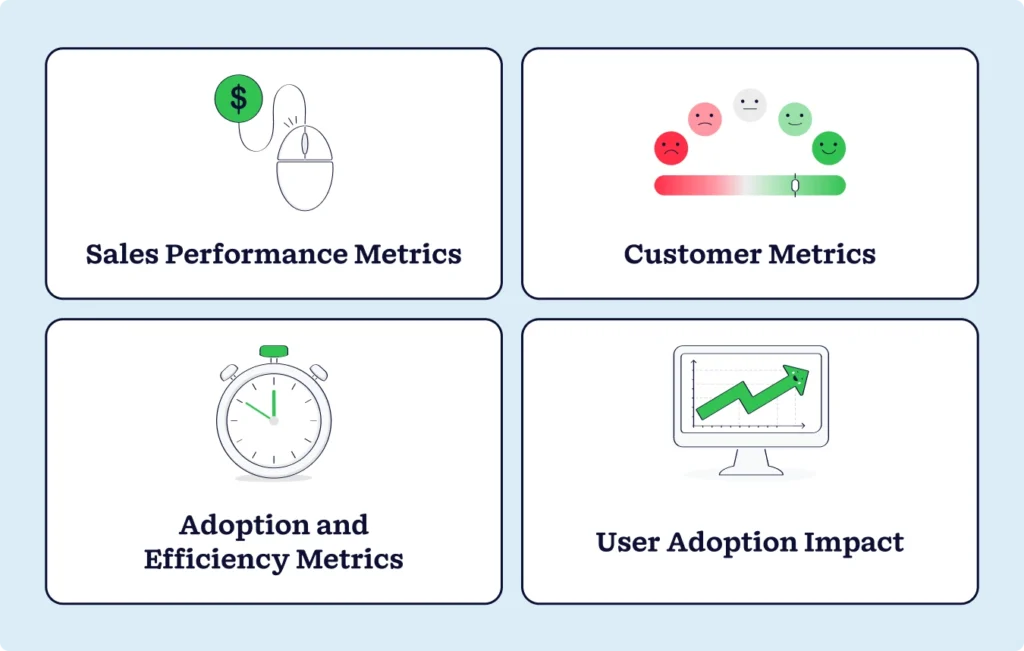
Essential metrics for measuring easy CRM ROI
Not all metrics matter equally. Focus on tracking these core areas.
Sales performance metrics
Conversion rate: The percentage of leads that move to the next stage (or close as customers)
Sales cycle length: The average time from first contact to closed deal
Average deal size: The dollar value of closed opportunities
Win rate: The percentage of opportunities that close successfully
Customer metrics
Customer retention: Businesses using CRM systems see a 25-40% improvement in customer retention by maintaining centralized customer data and enabling more personal interactions
Customer lifetime value: Total revenue expected from a customer over their relationship with your company
Customer satisfaction: Measured through surveys or feedback mechanisms
Adoption and efficiency metrics
Daily active users: How many team members actively use the CRM each day
Data entry frequency: How consistently your team updates customer information
Task completion rates: The percentage of assigned activities completed on time
Time saved on manual tasks: Hours per week freed up by automation
User adoption and training impact
Research shows that 53% of CRM users report major improvements in customer satisfaction after adopting CRM systems. This improvement correlates directly with adoption quality. When your team uses the system consistently and correctly, customer outcomes improve—and ROI follows.
Adoption happens most naturally when the CRM is easy to learn and use. Look for platforms that:
Require minimal training to get started
Have intuitive, clean interfaces
Reduce manual data entry through automation
Provide clear visibility into deals, tasks, and customer history
Work seamlessly on mobile devices
Implementation best practices for maximum ROI
Getting the most from an easy-to-use CRM requires deliberate strategy.
Define clear objectives first
Before selecting or implementing a CRM, establish specific, measurable goals. Are you trying to shorten sales cycles? Improve customer retention? Reduce administrative workload? Different goals guide different implementation priorities.
Start with core features, expand later
Avoid the temptation to customize extensively from day one. An easy CRM works best when you leverage its out-of-the-box features first. Once your team is comfortable and adoption is strong, you can add customizations that enhance your specific workflows.
Establish baseline metrics
Measure your starting point before implementation. How many deals are in your pipeline? What’s your current conversion rate? How much time do reps spend on administration? These baselines allow you to quantify improvements later.
Invest in adoption, not just features
The best CRM feature set means nothing if your team doesn’t use it. Dedicate time to training, provide ongoing support, and create accountability around adoption. Quick wins in the first 30-60 days build momentum and team confidence.
Measuring success: The ROI calculation
The basic formula for CRM ROI is straightforward:
ROI = (Gains – Investment) / Investment × 100
Where:
Gains = revenue increases + cost savings (in dollars)
Investment = software costs + implementation + training + your team’s time
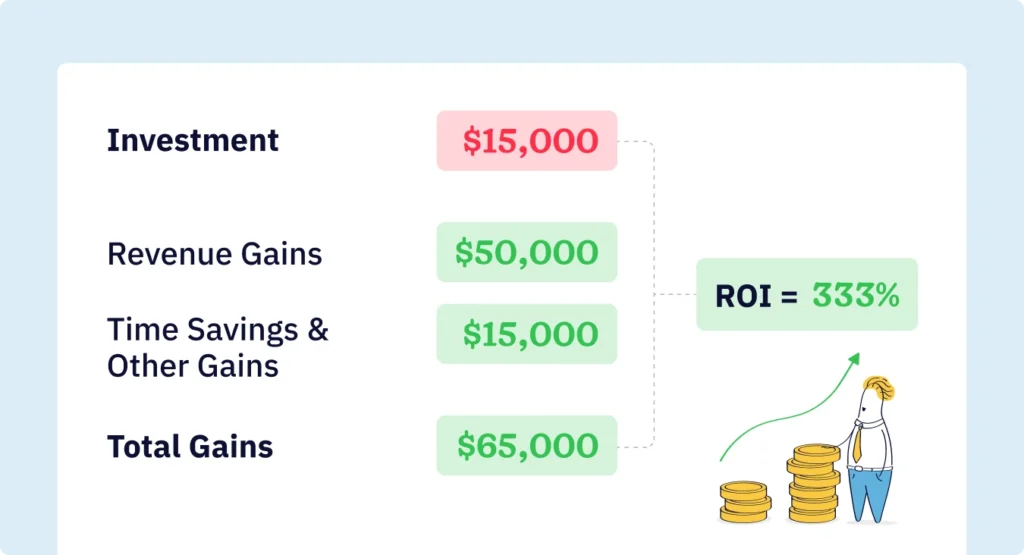
Here’s a practical example:
Software cost (year one): $10,000
Implementation and training: $5,000
Revenue increase from improved win rate: $50,000
Time savings from automation (in dollars): $15,000
Total gains: $65,000
Total investment: $15,000
ROI = ($65,000 – $15,000) / $15,000 × 100 = 333%
This represents $3.33 in return for every dollar invested in the first year. As adoption deepens and your team becomes more skilled with the system, these returns typically improve in subsequent years.
Avoiding common ROI measurement mistakes
Several pitfalls can distort your CRM ROI calculations.
Expecting immediate returns
CRM ROI rarely appears overnight. Most organizations see meaningful impact in months two to four as adoption settles and processes stabilize. Don’t judge success based on the first 30 days.
Tracking too many metrics
Metrics overload creates confusion instead of clarity. Focus on five to seven key metrics that directly align with your implementation goals. You can expand later.
Not accounting for adoption challenges
Your easy CRM can’t deliver ROI if your team isn’t using it. Account for the reality of change management: some team members will adopt faster than others. Plan for this in your timeline.
Ignoring non-financial benefits
Time saved, improved collaboration, better customer visibility, and reduced stress aren’t easily monetized—but they’re real. Document these wins alongside financial metrics.
Missing the role of clear processes
A CRM is only as good as the processes it supports. If your sales process is undefined or inconsistent, your CRM can’t fix that. Clarify your process first, then let the CRM enforce it.
The market perspective on CRM ROI
The CRM market continues to expand rapidly. The global CRM market is projected to grow from $126.17 billion in 2026 to $320.99 billion by 2034, growing at a compound annual growth rate of 12.4%. This growth reflects increasing recognition of CRM’s business value.
What’s driving this growth? Organizations recognize that simplicity and ease of use are competitive advantages. Teams are moving away from bloated enterprise systems toward solutions that balance power with usability. Easy-to-use CRM platforms are capturing growing market share because they deliver measurable ROI without the burden of complexity.
Frequently asked questions
1. How long does it typically take to see ROI from a CRM implementation?
Most organizations begin seeing meaningful ROI within two to four months of implementation, though the timeline varies based on team size, adoption quality, and baseline processes. Quick wins in the first 60 days—such as reduced administrative time or improved data accuracy—build momentum. However, full ROI potential typically emerges in months four to twelve as adoption deepens and team efficiency increases. Set realistic expectations: simple CRMs often show faster returns than complex systems due to faster adoption.
2. What’s more important: choosing the most feature-rich CRM or the easiest to use?
Feature richness matters far less than actual usage. A CRM with 100 features that your team ignores delivers zero ROI. An easy-to-use CRM with 20 core features that your team consistently uses delivers measurable returns. Prioritize solutions your team will actually adopt and use daily. You can always add features later, but overcomplicating the initial implementation almost always slows adoption and delays ROI.
3. How do we measure the value of time savings from CRM automation?
Calculate the hourly cost of your team members’ time, then multiply by the hours freed up weekly. For example, if a sales rep earning $50/hour saves five hours per week on manual data entry, that’s $250/week or roughly $13,000/year in recovered time. Aggregate across your entire team and include this as part of your “gains” in the ROI calculation. These time savings are among the most reliable and measurable ROI sources.
4. What should we do if adoption is slower than expected?
Slow adoption typically signals one of three issues: inadequate training, unclear value proposition, or poor process fit. Address each: provide targeted training on underutilized features, create visible quick wins (like faster deal closes), and revisit whether the CRM aligns with actual workflows. Assign a CRM champion to drive engagement, offer ongoing support, and don’t expect 100% adoption overnight—plan for 30-60 days of transition before full adoption and ROI realization.
5. Can a simple CRM really deliver ROI comparable to enterprise solutions?
Yes, if properly implemented. Simple CRMs often deliver superior ROI because of higher adoption rates, faster implementation, and lower total cost of ownership. An enterprise CRM might offer more features, but if it requires extensive training and customization, and your team only uses 20% of those features, you’re not capturing its value. Focus on choosing a solution that aligns with your actual needs and budget, then measure outcomes. The simplest system your team will consistently use will outperform the most complex system they resist.
The path forward: Building your CRM ROI foundation
Maximizing ROI with easy-to-use CRM software comes down to three fundamentals: selecting a platform your team will actually adopt, measuring the right metrics, and maintaining focus on business outcomes rather than feature counts.
Simplicity isn’t a limitation—it’s a feature. When your CRM is easy to use, your team adopts it faster, your data stays clean, and your metrics tell a clear story. And when you have clean data and genuine adoption, ROI follows naturally.
The question isn’t whether a simple CRM can deliver strong returns. The data confirms that it can. The real question is whether you’ll commit to using one well—measuring consistently, adjusting continuously, and letting clear metrics guide your strategy. That commitment transforms a CRM from a nice-to-have tool into the strategic asset your business needs.