What the Best Email Newsletter Examples Actually Have in Common
-
Many marketers have witnessed great email newsletters that elicit significant engagement. Their first thought is often, “We should make ours look more like this.” So, they analyze its layout and format to build a similar template. But after sending the new design out to their mailing list, they’re often stunned to find its results don’t match those of the original. Why?
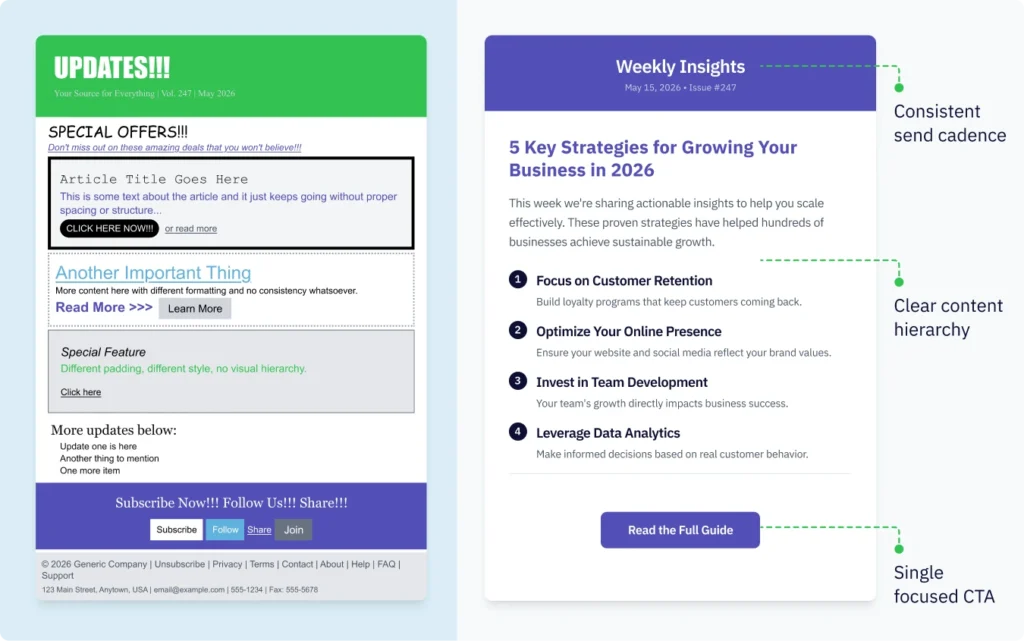
The really good email newsletter examples you’ve seen aren’t necessarily successful because of the way they look. What typically matters more is the recipient, the value of your email content to that audience, and the success signals you choose to measure.
Success signal misalignment is a common challenge. In fact, Litmus stated in its 2024 State of Email Trends Report that although email is deemed the most effective marketing channel, 72% of marketers are unable to determine their email ROI.
This Nutshell guide includes an analysis of key factors separating high-performing newsletters from those that don’t quite hit the mark. It also provides a framework for identifying where your own email newsletter campaign might fall short.
Key takeaways
- There’s a common structural and behavioral logic trend across top-performing email newsletter examples that many marketers miss. Visual style is not the core determinant of email newsletter success.
- Poor newsletter performance is typically attributed to gaps in segmentation, personalization, and measurement. The good news is that these gaps are easy to pinpoint and fix.
- Tracking the email open rate to determine newsletter performance is unreliable. The indicators that actually determine email performance are click-to-open rate (CTOR) and reply rate.
What makes an email newsletter different from other marketing emails?
What differentiates an email newsletter from other types of marketing emails is that it’s a value-first message sent at regular intervals to an audience that has specifically subscribed to receive it. On the other hand, a marketing email, like a campaign or broadcast email, is a message sent to a targeted audience with the purpose of driving a specific conversion action, such as a webinar registration or purchase.
Digging a little deeper, you’ll also discover that newsletters take on several different formats, including digest, editorial, curated link roundup, and product update newsletters. Regardless of how your email marketing platform handles these different formats, the underlying content logic still applies.
Knowing the difference between an email newsletter and other marketing messages helps you determine the performance expectations that matter for each. A key newsletter measurement is whether your subscribers continue to read your messages over time. For other marketing emails, the focus is more about whether your audience takes the desired action after opening and reading the email.
What do the best email newsletter examples actually get right?
Let’s examine three widely studied newsletters considered some of the top players in the world of email marketing. These marketing email newsletter examples aren’t successful because they incorporate a solid template—each is known to exhibit the core success principles that the data consistently confirms.

Morning Brew: Predictable cadence as a growth engine
Morning Brew has to be one of the most popular business newsletters. It was founded in 2015 and boasts over 2.5 million subscribers. How did the Morning Brew team do it? They focused on measuring their newsletter’s success based on unique opens instead of the size of their subscriber list.
Part of that strategy includes A/B testing email newsletter subject lines, which has helped them optimize and boost open rates. But the underlying principle supporting these tactics is the predictability of their newsletter cadence.
As a result, their readers know exactly when a newsletter from Morning Brew will land in their inboxes and what to expect from the newsletter. They’ve built a routine around it and cultivated an expectation of value, giving subscribers good reason to stay engaged.
Axios AM: Format clarity as a trust signal
Axios AM is a daily editorial newsletter sent out in the morning to business executives and professionals by a news outlet known as Axios. The Axios AM team formats its email newsletter based on a specific writing methodology the company has developed, called Smart Brevity.
Smart Brevity is all about front-loading the most vital information in the first sentence, incorporating bullet points to support context, and highlighting the “why” before the “how.” According to Axios HQ, applying the Smart Brevity approach results in email newsletters that are around 40% shorter than most, without losing any of the core information and context.
In this example, the foundational principle is providing clarity for the reader. Because Axios AM newsletters surface and deliver the core point of the message first, subscribers are able to gauge whether their attention will be rewarded. This clearly signals an overall respect for the audience’s time.
The Hustle: Editorial voice as retention
Founded in 2015, The Hustle is a popular business and technology email newsletter sent out daily to young professionals. A 2018 MediaPost article reported that the newsletter had reached 1 million subscribers (believed to be close to 2,5 million today) with an impressive open rate of nearly 50% at the time.
Here, the key principle supporting their email newsletter success has been delivering and maintaining a consistent editorial voice. The Hustle’s approach is to treat its audience like a smart friend, which has created subscriber identity and loyalty beyond what any email newsletter template could ever produce.
This approach produces a deeper connection with the audience through personalization. In fact, an Intuit Mailchimp study conducted in 2023 found that 87% of a brand’s audience is more likely to click into an email if it feels personalized to them.
The email newsletter performance gap framework
The common denominator between underperforming email newsletters is their gaps or misalignments. This newsletter performance gap framework aims to surface three key disconnects that paint a clearer picture of why newsletters that seem technically sound actually fail. With these gaps present, it becomes incredibly difficult to build your desired reader relationships.
Gap 1: The segmentation gap
Segmentation in email marketing is the practice of grouping subscribers based on specific shared characteristics for tailored marketing messages.
Litmus’s 2024 State of Email Trends Report indicates that 90% of email marketers have confirmed that effective audience segmentation boosts email performance. Despite this, a significant number of email newsletters are sent to undifferentiated lists.
Understanding that your mailing list is made up of audience members with different priorities is crucial. With this understanding, marketers can employ segmentation to their advantage, so the content they send out speaks directly to the audience they want to build a relationship with.
Gap 2: The personalization gap
Personalization in email marketing is the practice of tailoring email content—beyond the subscriber’s name—to make the reader feel like you’re speaking directly to them.
Part of this involves email subject line personalization, which is a measurable lever on its own. An analysis conducted by Belkins.io and Reply.io in 2025 found that personalized email subject lines resulted in open rates of up to 46%.
Personalizing the body of the email also drives email marketing success. In its 2024 State of Email Trends Report, Litmus also stated that advanced personalization, such as dynamic and real-time content, is proven to have improved email performance for more than 80% of the email marketers surveyed.
Gap 3: The measurement gap
Although many marketers use open rate as a key success metric, it’s not necessarily a reliable determinant of success, especially when it comes to Apple Mail.
Since the launch of Apple’s Mail Privacy Protection policy in September 2021, the company downloads email tracking pixels irrespective of whether the recipient opened the email. Unfortunately, email platforms register this as an open, skewing the open rate numbers for any mailing list with Apple Mail users.
Putting your eggs in the “open rate” basket is clearly no longer a sound approach. Focusing instead on different measurements can render a more accurate picture of your email newsletter success.
How should you measure email newsletter performance?
With the open rate off the table, the best way to monitor your email newsletter performance is to track your click-to-open rate (CTOR) and reply rate metrics.
What is the click-to-open rate (CTOR)?
The click-to-open rate is the ratio of unique email clicks to unique email opens. The fact that this metric tells you about the actions subscribers take makes it a cleaner content relevance signal.
It’s interesting to note that, after analyzing over 4.4 billion emails, GetResponse reported in their 2024 Email Marketing Benchmarks Report that the average CTOR across industries is 8.62%.
What is the reply rate?
The reply rate is any response received from the reader. An email newsletter response, even a one-word reply, is confirmation of real human engagement. One reply from the right subscriber can be far more valuable than thousands of opens, especially for newsletters in the B2B space.
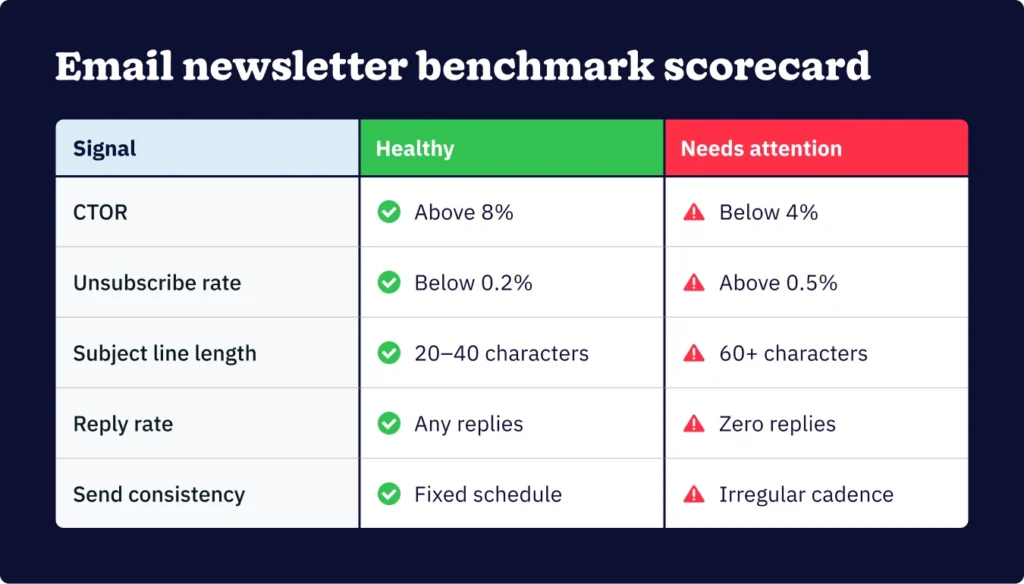
Email newsletter benchmark scorecard
Evaluate your email newsletter performance against healthy benchmarks using the scorecard below.

Although the unsubscribe rate benchmark is included in the scorecard above, it’s important to note that this is a lagging metric. If someone has unsubscribed, you’ve already lost them. In other words, using this measurement as a prime performance indicator could see you identifying problems long after the damage has already been done.
Keeping your eye on the CTOR and reply rate instead will give you a heads up when your content isn’t resonating with your subscribers before they decide to leave.
Ofte stillede spørgsmål
-
What are some examples of good email newsletters?
Morning Brew, Axios AM, and The Hustle are widely cited examples of high-performing newsletters. Each succeeds for different reasons—Morning Brew for its consistent cadence and engagement-first measurement, Axios AM for its Smart Brevity format that respects reader time, and The Hustle for its editorial voice and audience identity. What they share is a structural logic that goes well beyond email newsletter template design.
-
What is a good click-to-open rate for an email newsletter?
A CTOR above 8% is a healthy benchmark across industries, based on GetResponse’s analysis of over 4.4 billion emails. B2B newsletters in sectors like professional services and manufacturing can see CTOR in the 14–15% range. If your CTOR is consistently below 4%, the content relevance or CTA structure of your newsletter likely needs revision—not the visual design.
-
How often should a business send an email newsletter?
Consistency matters more than frequency. A newsletter sent on the same day every week builds subscriber expectation and habit. Monthly newsletters can work well for audiences who prefer depth over volume. The most damaging pattern is irregular sending—alternating cadence with no predictable rhythm. Establish a schedule you can sustain, then optimize from there.
-
Why are email open rates unreliable as a performance metric?
Apple’s Mail Privacy Protection, introduced with iOS 15 in September 2021, pre-downloads email content, including tracking pixels on Apple’s servers—regardless of whether the recipient opens the message. This causes Apple Mail users to register as opens even when they never viewed the email. Any list with significant Apple Mail users will show inflated open rates. CTOR and reply rate are more reliable indicators of genuine engagement.
-
What is the difference between segmentation and personalization in email marketing?
Segmentation is the practice of dividing your subscriber list into groups based on shared attributes—such as industry, role, or engagement history. Personalization is the practice of tailoring content within each email to individual subscriber data. Segmentation determines who receives which version of your newsletter. Personalization determines what they see inside it. Both are distinct strategies, and both independently improve performance—but most newsletters apply neither.
Your newsletter isn’t broken—your gaps are just visible now
A great template doesn’t make a great email newsletter example. The best newsletters are effective and successful because the marketing teams behind them made sound decisions regarding their audience, content, and how to measure performance. The trick is to build systems that consistently repeat those winning decisions.
Following the newsletter performance gap framework will direct you to where your program might be falling short. Perhaps you’re sending to lists that need revised segmentation, or delivering emails that require deeper personalization to spark a connection. Maybe all you need is an adjustment in the performance metrics you’re tracking.
Regardless of the fix, none of these gaps relates to an email newsletter design issue. These are all easily diagnosable gaps that, when closed, will contribute to better-performing email newsletters that actually support your business goals.
TILBAGE TIL TOPPENWritten by
Andy Fowler CEO & Co-Founder, NutshellKlar til at prøve
Nutshell gratis?Tak skal du have! Din indsendelse er blevet modtaget!Ups! Noget gik galt, da du indsendte formularen.
Unify Team Meeting Processes for Increased Productivity With Nutshell Scheduler Managed Meetings
Published on: May 16, 2025Hvad er de 3 bedste go-to-market-strategier?
Udgivet den: 10. november 2022Slut dig til mere end 30.000 andre professionelle inden for salg og marketing. Abonner på vores Sell to Win-nyhedsbrev!
- Produkt
- Nutshell Overview
CRM & Sales
Our powerful and easy-to-use flagship product.Markedsføring
Email marketing, forms, landing pages, and more.Engagement
Webchat, SMS, WhatsApp & more in your Omni-Channel Inbox.Efterforskning
Prospect for new leads and new contacts in your CRM.Quotes & Invoices
Quickly create quotes & invoices in your CRM.
AI
See why Nutshell is the leading AI CRM.Integrationer
Connect to Google/Microsoft and over 5,000 Apps.
RapporteringCreate reports and forecasts in an instant.CRM-rådgiver
Get a dedicated point of contact to get the most out of Nutshell.Partner Marketplace
Find trusted partners to help optimize your Nutshell CRM.
- Prissætning
Nutshell AI
- Ressourcer
- Kontakt os
Kontakt salgsafdelingen
Send us your questions or book a 1-on-1 demo.Deltag i en demo
Join a group demo for a general overview of Nutshell.
Kontakt support
Contact our support team via live chat in app or via email.Bliv partner
Refer businesses to Nutshell & earn commissions.
Contact Marketing
Questions about our website or our marketing opportunities?Karriere
Join our growing team! See current openings.