-

Every startup experiences a moment of reckoning: The point where the informal, relationship-driven approach to customer management becomes a liability rather than an asset.
When a founder can hold the entire customer database in their head, CRM seems unnecessary. But as the team expands beyond five people and the customer count exceeds a few dozen, that personal knowledge becomes fragmented across email inboxes, messaging platforms, and individual notebooks.
This is where many founders face a common misconception: That CRM is a tool for large enterprises, not scrappy startups. The reality is different. CRM maturity should evolve with your business. The system that works at the seed stage will likely not be the best fit at the Series A stage. And the solution you select at Series A may not scale effectively to Series B.
Here’s Nutshell’s perspective on selecting a CRM aligned with your business’s growth stage. The right CRM isn’t about finding the most powerful platform—it’s about finding the right platform for where your startup is right now, while building in the flexibility to grow beyond it.
Key takeaways
- CRM needs evolve with your startup’s stage: What works at the seed stage (simple contact management) becomes inadequate at Series A (automation and reporting) and Series B (advanced analytics and enterprise integration). Select a system for your current stage, not your imagined future.
- Alignment matters more than features: A CRM with 500 unused features will fail faster than a simple system your team actually uses. Involve your sales team in the selection, prioritize ease of adoption over feature richness, and focus on aligning with your actual workflow.
- Plan for migration as you grow: Most startups will use multiple CRM systems as they scale. This isn’t a failure—it’s natural. Reassess your CRM annually to identify when it’s constraining growth, recognizing that the total cost of ownership (implementation, training, integration) matters as much as monthly subscription fees.
Understanding when and why CRM matters
Before evaluating any specific CRM solution, founders must understand the fundamental purpose of CRM systems and when they become truly necessary.
A CRM isn’t primarily about automation or fancy dashboards. At its core, it’s about creating a single source of truth for customer interactions, ensuring that knowledge doesn’t live exclusively in individual team members’ heads.
Our current view of the startup landscape has evolved considerably. The global CRM market is projected to reach $112.91 billion, with 91% of companies already using these tools to manage customer relationships. What’s striking is the adoption gap by company size: while 94% of tech companies use CRM systems, only 71% of small businesses have adopted them.
This gap isn’t because small businesses don’t need CRM—it’s because many founders struggle to identify the right moment to implement one, or they select solutions misaligned with their growth stage.
The critical insight here is that CRM adoption should be driven by operational necessity, not industry trends. The question isn’t “should we have a CRM?” but rather “at what point does our current approach to managing customer relationships create risk?”
The three stages of CRM maturity
Startup growth isn’t linear, and neither is the evolution of its CRM needs. By understanding the three primary growth stages—and the specific operational characteristics of each—founders can make informed decisions about when and how to implement customer relationship management systems.
Pre-seed to seed stage: Building the foundation
The relationship-driven phase
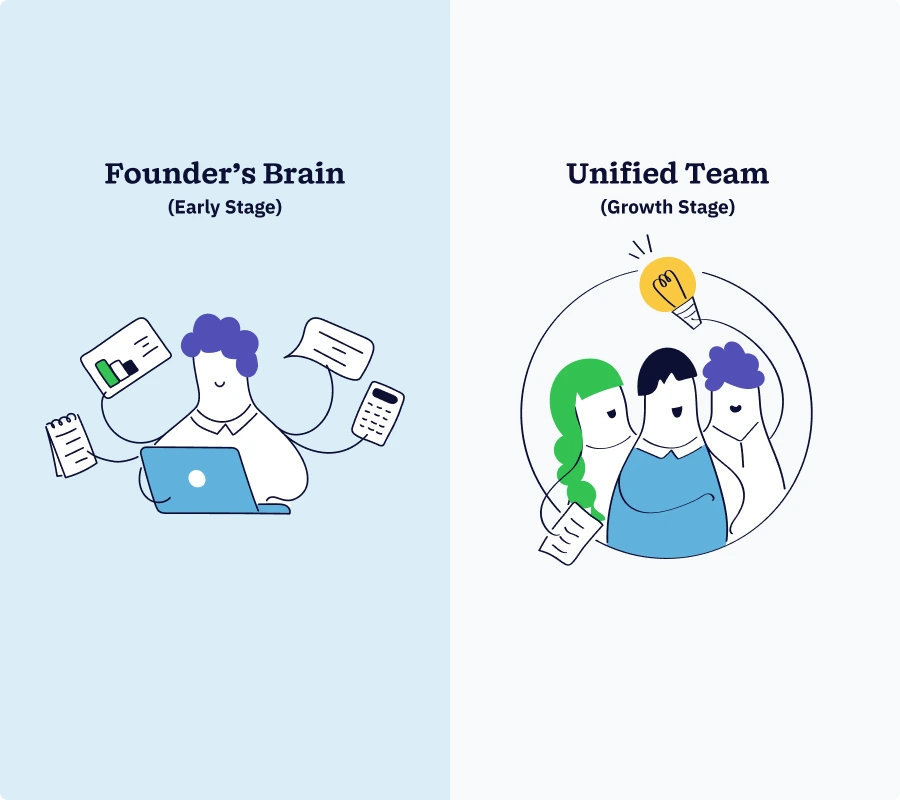
At the earliest stage, your startup is fundamentally relationship-driven. The founding team often has direct relationships with early customers. Communication happens through phone calls, coffee meetings, and personal emails. Data exists in multiple locations: a founder’s notebook, a shared spreadsheet, email threads, and the memories of individual team members.
This approach has genuine advantages. The founder maintains deep context about each customer’s needs, concerns, and potential. There’s no overhead from system administration or data entry. Decisions can be made quickly because information is readily accessible—albeit informally.
Many successful startups have scaled to $1 million or more in revenue using little more than organized spreadsheets and founder intuition. But this model breaks down at a predictable inflection point, typically when the team grows beyond five people or the customer count exceeds 50-100 accounts. At that point, information silos emerge.
A salesperson is unaware of what the founder discussed with a prospect. A customer service issue isn’t visible to the sales team. Critical follow-ups are forgotten because they existed only in one person’s calendar. The very strength of relationship-driven management—deep founder knowledge—becomes a bottleneck as the company scales.
CRM essentials at this stage
The CRM need at the pre-seed to seed stage is straightforward but often underestimated: Create a centralized repository for customer information and interaction history. This prevents customer context from being lost when team members are busy, on vacation, or focused on other priorities. It establishes the foundational discipline of documented customer relationships.
At this stage, focus on fundamentals such as:
- Simple contact database: A centralized place to store customer and prospect information
- Basic activity tracking: Notes on interactions, meetings, and follow-ups
- Minimal customization: Out-of-the-box functionality that works immediately
- Low cost or free: If cash is scarce, you need a solution that minimizes burn rate
- Mobile accessibility: Your team needs access to customer data from anywhere, anytime
The goal isn’t comprehensive automation or advanced analytics. The goal is to prevent customer information from slipping through the cracks and to establish foundational habits around customer communication.
What to prioritize at this stage
Ease of use is nonnegotiable. Your team lacks dedicated CRM administrators and extensive training resources. Any solution you choose must be intuitive enough that team members adopt it naturally, without extensive onboarding. This isn’t a limitation—it’s actually a strength. Systems that require minimal explanation tend to be genuinely useful rather than feature-bloated.
Cost often matters intensely at this stage. Many startups operate on seed funding or bootstrapped revenue. Look for solutions that offer free plans or affordable entry-level pricing.
According to CRM adoption research, few businesses adopt a CRM within their first year of operation, often because founders don’t recognize the need early enough. But when the need becomes acute, you need a solution you can implement immediately, not one that requires months of planning or significant capital.
Speed of setup is critical. You need to be operational within days, not weeks. Implementation timelines matter when your team is juggling multiple priorities and can’t afford to dedicate someone to a lengthy implementation project.
Evaluating options for early-stage startups
When researching CRM solutions at this stage, think beyond feature lists. Focus on whether the system enables your actual workflow by asking yourself:
- Can users get started without extensive configuration?
- Does the free or trial plan offer genuine functionality, or is it just a stripped-down demo?
- Is customer support available to help with setup, or are you limited to community forums?
- Can the system integrate with tools you already use (email, calendar, other productivity apps)?
- What does upgrading cost when you outgrow the free or entry-level plan? Is the pricing transparent and predictable?
Avoid solutions with steep learning curves, complex customization requirements, or pricing that jumps dramatically at the next tier. You’re looking for a system that grows with you, not one that forces you to switch platforms in 12 months.
Series A: Establishing processes and scale
The process-driven inflection point
Series A represents a qualitative shift in organizational maturity. You’ve demonstrated repeatable customer acquisition. Your team has grown to between 5 and 20 people, and multiple team members are now interacting with customers.
The informal coordination that worked at the seed stage becomes a bottleneck. Different team members are following different processes. Data quality is inconsistent. Sales forecasting becomes guesswork because pipeline visibility is poor.
At Series A, CRM transcends data repository and becomes a process enabler. You need visibility into the status of your deals. You must identify which leads are advancing and which are stalled. You need to spot patterns: Which products resonate with which customer segments? Which sales tactics are working? What’s your average sales cycle length?
The fundamental shift from seed to Series A is moving from ad-hoc relationship management to systematized, repeatable processes. At this stage, your CRM becomes the tool that enforces these processes and provides visibility into their execution. This is also where automation begins to matter. With a larger team, manual processes often fail to scale.
Advanced CRM features becoming essential
As your startup grows, new CRM capabilities become crucial for maintaining coordination across your expanding team, including:
- Sales pipeline management: Visual representation of deals in progress, stage definitions, and forecasting
- Lead scoring and automation: Automatic assignment of leads, follow-up reminders, and automated messaging
- Team collaboration features: Shared notes, task assignments, and communication history visible to the entire team
- Reporting and dashboards: Visibility into key metrics: conversion rates, sales cycle length, pipeline health
- Integration ecosystem: Connection with email, calendar, accounting software, and marketing automation tools
- Data synchronization: Automatic capture of customer interactions rather than manual data entry
Automation capabilities matter more as your business grows, because you can’t afford to have salespeople spending hours on administrative work. For example:
- When a lead arrives, someone needs to automatically assign it to the right salesperson.
- When a deal moves to a certain stage, you want it to trigger a follow-up task.
- When a customer email arrives, it should be automatically attached to the relevant account without requiring manual filing.
These aren’t nice-to-haves—they’re the difference between a sales team that scales and one that drowns in administrative overhead. And at Series A, data quality becomes a competitive advantage.
Research shows that 43% of CRM users only utilize half or fewer features of their platform, often because the system wasn’t configured to match their actual workflow. The right CRM at this stage is one that aligns with how your team actually works, not one that forces them to adopt rigid processes.
Key CRM decision factors
Several critical factors should guide your CRM selection at Series A, and these deserve deeper consideration than simple feature comparisons:
Scalability
Will the platform scale with your growing team and customer base? Can you add users, custom fields, and workflows without hitting architectural limits? This matters more than you might think. Some platforms that work beautifully for 10-20 users become sluggish at 50+ users. Others have hard limits on customization fields or workflow complexity. Ask the vendor directly about their largest customers of a similar size and whether they’ve reached scaling constraints.
Data integrity
How does the system prevent duplicate records and ensure clean data? As your team grows, data quality control becomes essential. One person might enter a prospect as “John Smith” while another enters “J. Smith” or “Jon Smith.” These end up as separate records, fragmenting your view of the customer. What deduplication tools does the platform offer? How easy is it to merge records?
Automation capabilities
Can the system automate repetitive tasks, such as lead assignment, follow-up reminders, and routine updates? This matters increasingly as your team expands. A manual process that worked with five salespeople becomes unmanageable with 15. You need workflows that handle routine escalations, automatically create tasks, and remind salespeople when follow-ups are due.
Reporting depth
What reports can you run? Can you segment data, drill down to individual rep performance, and forecast revenue accurately? Basic reporting (deals by stage, conversion rates) is a table-stakes requirement. Sophisticated reporting (sales cycle trends over time, win/loss analysis by product, forecast accuracy) is where you gain a competitive advantage.
Support quality
At Series A, you may need more than self-serve documentation. Assess the vendor’s support offerings, response times, and availability. When something breaks in your CRM during a critical period, can you get help quickly?
What to evaluate
The most effective evaluation approach at Series A involves getting past vendor demos. Request demos from multiple vendors, but don’t just watch the feature tour. Instead, walk through your actual sales process step by step. Can the system accommodate your workflow without significant workarounds? Will your team need to manipulate data post-entry, or does the system capture information the way you work?
Ask about implementation timelines. At Series A, you have more resources than pre-seed companies, but time is still limited. Typical implementations take 4-12 weeks, depending on complexity. Factor this into your planning.
Finally, talk to references. Better yet, talk to companies that are just barely outgrowing the system you’re considering. Ask them, “What started to break as you scaled? What limitations became apparent?” These conversations often reveal constraints that vendor demos won’t surface.
Series B and beyond: Optimizing for growth
The data-driven phase
By Series B, you’re no longer operating as a startup in the traditional sense. You’re a scaling company with 20-50+ employees, multiple revenue streams, or complex go-to-market strategies.
Your investors expect professional operations and data-driven decision-making. The personal involvement that characterized Series A leadership becomes impossible—you can’t attend every customer meeting or monitor every deal.
At this stage, CRM evolves from process enabler to analytical engine. You’re asking sophisticated questions, like:
- Which customer segments are most profitable?
- What’s our customer acquisition cost by channel?
- Which sales reps are performing well, and why?
- Can we predict which customers are at risk of churning?
- Can we identify the characteristics of our highest-value deals and systematically pursue similar opportunities?
Companies investing in CRM see an average ROI of $8.71 for every $1 spent, but realizing that return requires using CRM data strategically. Organizations can achieve up to 27% in customer retention rates by implementing effective processes and analytics.
However, these gains don’t materialize automatically. They require a CRM system that generates trustworthy data and provides the analytical tools to extract insights from it.
Critical CRM features for scaling
Enterprise-class CRMs offer capabilities that matter at scale:
- Advanced customization: Custom fields, custom modules, workflow builders, and logic-based automation
- Sophisticated analytics: Predictive analytics, pipeline forecasting, and AI-driven insights about customer behavior
- Multi-user permissions and workflow controls: Role-based access, approval processes, and audit trails
- Native & third-party integrations: Deep connections with accounting software, marketing automation, customer support systems, and business intelligence tools
- AI and machine learning: Lead scoring, next-best-action recommendations, and anomaly detection
- Scalable infrastructure: Multi-currency support, multi-language support, and the ability to handle large data volumes
- Dedicated support and professional services: Implementation teams, training programs, and ongoing optimization support
At Series B, you’re not just adopting a CRM—you’re building a data-driven sales engine. According to recent statistics, 83% of companies using generative AI in their CRM are more likely to exceed their sales goals. This represents a substantial competitive advantage if your organization can effectively harness these CRM AI capabilities.
CRM ROI considerations at scale
Here’s where the total cost of CRM ownership becomes genuinely important. Implementation costs can escalate significantly compared to earlier stages, including:
- Licensing fees: Multiply per-user costs across a larger team
- Implementation and customization: Professional services to configure the system for your processes
- Data migration: Moving customer data from legacy systems or spreadsheets
- Integration work: Connecting your CRM to accounting, marketing automation, and other business systems
- Training and change management: Ensuring your team adopts the system effectively
- Ongoing support and optimization: Monitoring system health, optimizing processes, and adding features
Budget $50,000 to $250,000, and more for a proper implementation, depending on the system’s complexity. That may sound exorbitant, but the payoff is significant. Organizations report a 17% increase in lead conversions, a 27% boost in customer retention, and a 21% rise in agent productivity after implementing CRM effectively.
The critical point is that at Series B, you can’t implement a CRM on a shoestring budget. The system needs to be deeply integrated into your business, which requires professional implementation, training, and change management. Cutting corners on implementation typically results in poor adoption, incomplete data, and unreliable analytics—which means you won’t achieve the ROI you expected.
CRM evaluation framework at Series B
At this stage, evaluation becomes more rigorous and forward-looking. You must consider factors such as:
- Track record with scale-ups and mid-market companies: Does the vendor have experience with companies of your size?
- Roadmap alignment: Are the vendor’s product priorities aligned with your future needs?
- Community and third-party ecosystem: Are there extensions and integrations available from partners?
- Long-term viability: Is this a stable vendor that will be around in 5-10 years?
- Flexibility without customization: Can the system adapt to future business changes without requiring custom development?
At Series B, you’re making a decision with longer-term implications. You’re not just deploying a tool for the next 12 to 18 months—you’re potentially building a system you’ll use for 3 to 5 years and more. This warrants a deeper examination of vendor stability, product direction, and ecosystem strength.
Key CRM selection criteria across all stages
Regardless of your startup’s stage, certain CRM selection criteria apply across the board, and they deserve careful consideration because they transcend the specific growth phase you’re in.
Data security and compliance
Your CRM will store sensitive customer and financial information. This isn’t an optional consideration. Evaluate the vendor’s security practices thoroughly:
- Encryption: Data in transit and at rest
- Compliance certifications: GDPR, HIPAA, SOC 2, or industry-specific standards
- Access controls: Role-based permissions and audit logs
- Backup and disaster recovery: How is your data protected if something goes wrong?
- Data residency: Where are servers located? Do you have control over data location?
Integration ecosystem
No CRM exists in isolation. You’ll need to connect it to email, calendar, accounting software, marketing tools, and other business systems. A CRM that works beautifully in isolation but doesn’t integrate well with your existing tech stack will create more problems than it solves. Evaluate these elements:
- Native integrations: What systems are connected out of the box?
- API quality: If you need custom integrations, how well-designed is the API?
- Third-party marketplace: Are there pre-built integrations from partners?
- Data synchronization: Is data synced in real time or batched?
Total cost of ownership
Look beyond monthly subscription fees. Hidden costs often exceed the visible software costs. Include these costs in your calculations:
- Implementation and setup costs
- Training and change management
- Data migration and integration work
- Ongoing support and maintenance
- Scaling costs as you add users and data
CRM vendor support quality
Good support matters more than most founders realize, especially once your team is dependent on the CRM for daily operations. As such, it’s important to assess support criteria, like:
- Response times: How quickly does the vendor respond to support requests?
- Support hours: Is support 24/7 or business hours?
- Knowledge base: Is there comprehensive documentation?
- Professional services: Does the vendor offer implementation and training support?
Ease of implementation and adoption
Studies show that only 40% of businesses achieve a 90% CRM adoption rate, with many struggling to unlock the full potential of their system. Implementation ease and team adoption matter more than raw features. Consider these factors:
- Time to first value: How quickly can your team be productive?
- Training requirements: How much onboarding does your team need?
- Configurability: Can the system adapt to your process without extensive customization?
Common CRM selection pitfalls to avoid
Even with the right framework, startups often make mistakes in selecting a CRM. Understanding these pitfalls can help you sidestep them.
Implementing too early without clear needs
Don’t adopt a CRM because “all startups use one.” Wait until you have a specific problem that needs to be solved. If your team consists of five people and everyone knows the customers personally, a formal CRM might not be the answer yet.
But once missed follow-ups start costing deals, once important customer details are lost when someone is unavailable, it’s time to act. The worst implementations occur when founders select a CRM proactively (which seems smart) but lack the operational maturity or team size to fully benefit from it.
Selecting based on feature lists rather than fit
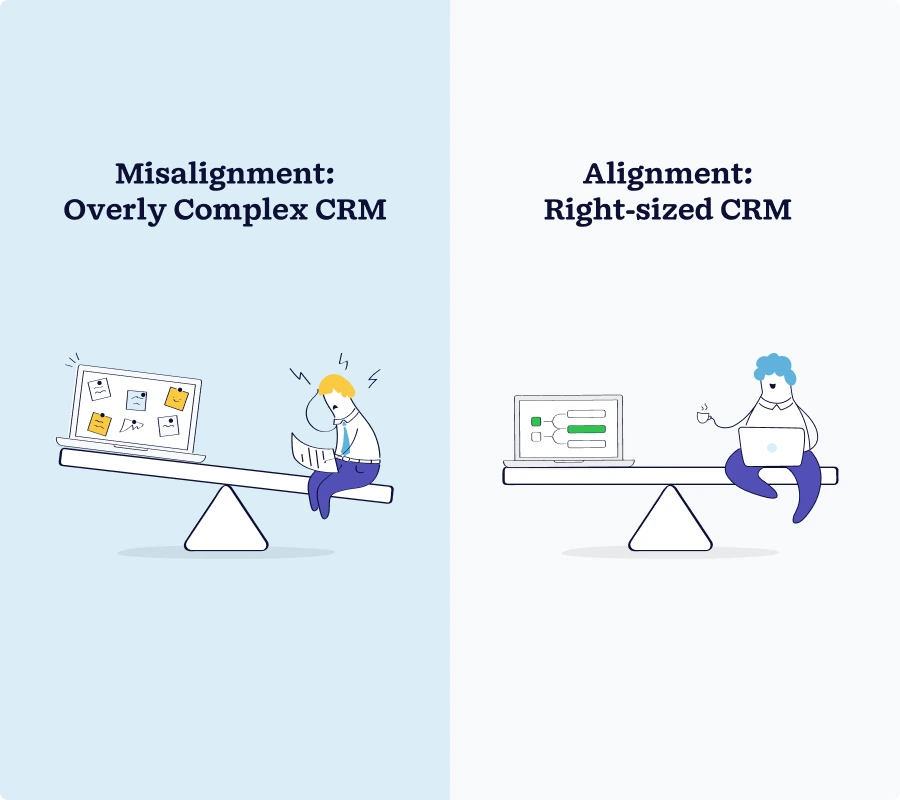
A CRM with 500 features is worthless if your team won’t use 80% of them. Only four in ten businesses utilize CRM software to its full potential, largely because the remaining six have selected a system that does not align with their processes.
The right question isn’t “What features do we want?” but rather “What system will my team actually use consistently?” Feature richness is a distant second to daily usability.
Overlooking the total cost of ownership
A cheap monthly subscription can become expensive once you factor in implementation, integration, training, and ongoing support. Many founders select based on price per user and are shocked when implementation costs exceed their software budget.
Conduct a comprehensive financial analysis before committing, including the cost of professional services, training, and the opportunity cost of your team’s time.
Implementing a CRM system without team input
Your sales team will utilize this system on a daily basis. Involve them in the vendor selection and demo process. If they’re not bought in, they won’t adopt it, regardless of how sophisticated the system is. The best CRM in the world will fail if salespeople perceive it as burdensome.
Postponing CRM migration indefinitely
Many startups continue to rely on spreadsheets or legacy systems for too long, missing out on the productivity gains that CRM offers. As your team grows, spreadsheets become increasingly unmanageable. Don’t wait for the “perfect” moment to migrate—recognize when the current approach is slowing you down and creating risk.
The path forward: Embracing evolution
Rather than thinking of CRM selection as a one-time decision, it’s more useful to think of it as a waypoint in your company’s evolution. Unless you sign up with one of the few CRMs capable of scaling with your business, you’ll likely use multiple CRM systems throughout your journey to scale. This isn’t a failure—it’s a natural part of the growth process for most businesses.
Successful founders select systems that work exceptionally well for their business’s current growth stage, implement them thoughtfully, and extract maximum value from them. They also remain attuned to when the system is constraining growth—a signal that it’s time to evaluate alternatives.
Key questions to revisit periodically (annually or every 18 months):
- Is our team using all the features that matter? Or are we constrained by missing capabilities?
- Are there processes we’ve created specifically to work around system limitations?
- How much time are we spending on manual data entry, reporting, or system administration?
- Are new hires struggling to get up to speed because the system is overly complex?
These signals indicate it’s time to re-evaluate. But if you’re getting value, if your team is engaged, if the system is supporting growth, there’s no need to change.
Startup CRM FAQs
-
1. At what point should a pre-seed startup actually implement a CRM?
Implement CRM when you don’t have one, and it starts negatively affecting customer experiences. Consider it when:
- You’ve lost a customer or deal because follow-up information wasn’t accessible
- Multiple team members are managing different pieces of the same customer relationship
- You’re spending more than an hour per week consolidating customer information from different sources
- You’ve scaled beyond the point where one person can hold all customer context in their head
If your team comprises two to three people with under 50 customers, a well-organized Google Sheet might suffice. Once these conditions are no longer true, CRM becomes necessary.
-
2. Why do so many startups abandon their CRM after implementation?
The main reasons are misalignment and poor configuration. When a founder selects a CRM without involving the sales team, the system often requires workarounds that don’t match actual workflows, and adoption fails.
Another reason is often that the CRM wasn’t customized to the startup’s specific sales process—it’s implemented “out of the box” without matching actual pipeline stages or deal structures.
Insufficient training can also be a factor, which means teams don’t see immediate value and revert to old processes.
Startups also often fail to reassess their CRM as their needs evolve from seed to Series A, resulting in the system becoming underutilized.
-
3. Can a startup really go from spreadsheets directly to a Series B-level CRM?
Technically, yes, but practically no. Enterprise CRM systems are built for established processes, larger teams, and complex requirements. If you’re using spreadsheets, implementing enterprise software typically results in poor data quality, underutilization (teams use 10-20% of features), implementation failure, and wasted capital.
The evolutionary path is more effective: Start simple at the seed stage (basic pipeline, activity tracking), upgrade to mid-market at Series A (add automation and reporting), then move to enterprise at Series B when you have process maturity. The total cost is actually lower than attempting a direct jump.
-
4. What’s the difference between startup CRM needs and enterprise CRM needs?
Startup CRM (Pre-Seed to Series A): Simple standardized process, small teams (under 20 people), limited customization required, focus on adoption over analytics, low implementation budget, and fast deployment needed.
Enterprise CRM (Series B+): Complex multi-process operations, large teams (50+ people), extensive customization needed, focus on analytics and insights, substantial implementation budget, and long timelines (3-6+ months).
The mistake is buying enterprise features for startup needs. You pay for complexity you don’t need and create friction for your team. Match the tool to your current reality, with intentional migration plans for future stages.
-
5. How do you balance CRM customization with keeping things simple?
Customize only what’s required to match your actual process, not what you might need in the future. Start with the system’s default structure—if it handles 80% of what you need, don’t customize the other 20% yet.
Only add customization when you hit genuine operational problems that the default system can’t solve. Every customization increases complexity and future migration costs. The paradox: the simpler you keep your CRM, the more likely your team will use it. An 80% utilized system is far more valuable than one with 500 features and 10% adoption.
Positioning your startup for sustainable growth through deliberate CRM selection
Choosing a CRM for your startup is fundamentally a question of alignment: between the tool’s capabilities and your current operational needs, between the system’s complexity and your team’s capacity to implement and manage it, and between the cost and the value you’ll extract at your current stage.
There’s no universally “best” CRM. The right choice depends on where you are in your growth journey. The system that’s perfect for a seed-stage company may be too constraining for a Series B business. The system that enables a Series B business could overwhelm a seed-stage team.
The founders who succeed are those who recognize this reality and make deliberate choices. They understand their current stage, recognize their pain points, and select solutions designed specifically for companies like theirs. They involve their teams in the decision. They plan for migration as they grow. And they focus on adoption and value extraction rather than accumulating unused features.
Your CRM is a tool that should enable growth, not constrain it. By choosing thoughtfully and implementing strategically, you position your startup to maintain the operational discipline that successful scaling requires.
BACK TO TOP Written by
Sam Poole Associate Content MarketerReady to try
Nutshell for Free?Thank you! Your submission has been received!Oops! Something went wrong while submitting the form.


Highly Effective Strategies for Elevating Sales Team Performance
Published on: November 10, 2022Establishing a System for CRM Data Entry and Management
Published on: April 11, 2023Introducing Nutshell Forms Spam Prevention
Published on: April 22, 2024Join 30,000+ other sales and marketing professionals. Subscribe to our Sell to Win newsletter!