Email Marketing Costs: Complete 2026 Pricing Guide for Small Businesses

-

Email marketing delivers a 36:1 return for every $1 spent—making it one of the most cost-effective marketing channels available. But here’s the catch: “Cost-effective” doesn’t mean free, and understanding the true investment required can make the difference between a thriving email marketing program and one that drains your budget without yielding results.
If you’re a small business owner or marketing manager evaluating email marketing solutions, you’ve probably noticed that the pricing options are all over the map. One platform may cost $15 per month, while another starts at $300 per month.
Freelancers charge by the hour, agencies quote five-figure retainers, and then there are all those hidden costs nobody mentions until you’re already committed. It’s enough to make your head spin.
By the end of this guide, you’ll understand exactly what email marketing costs in 2026—from DIY platform expenses to full-service agency support. We’ll break down pricing models, expose hidden costs, show you real-world examples, and most importantly, help you calculate whether email marketing makes financial sense for your business.
Key takeaways
- Email marketing costs range from $51–$1,000+ monthly for most small businesses, depending on whether you go DIY, hire freelancers, or work with an agency
- Platform pricing models vary widely—some charge per subscriber, others per send, and many use feature-based tiers
- Hidden costs like list cleaning, design, and compliance tools can easily add 20–30% to your platform fees
- Email marketing ROI averages 36:1, making it more cost-effective than most other marketing channels
- Integrating email marketing with your CRM reduces administrative costs and improves results, making your investment work harder
- The right solution depends on your business size, technical expertise, and growth goals—not just the lowest sticker price
Table of Contents
- What does email marketing really cost?
- Email marketing platform pricing: What to expect
- Email marketing service costs: DIY vs. professional help
- Email marketing costs by industry
- Hidden email marketing costs you need to know
- Email marketing ROI: Making the numbers work
- How to choose the right email marketing solution for your budget
- Next steps to determining email marketing pricing
- FAQs: Common email marketing cost questions
What does email marketing really cost?
Email marketing costs vary significantly depending on your approach. A solo entrepreneur running campaigns themselves might spend $15 to $50 monthly on a basic platform. A midsized business managing thousands of subscribers could spend $300 to $500 monthly on a more robust solution. And if you outsource to an agency, you’re looking at $1,000 to $10,000+ monthly, depending on the complexity of your campaigns.
The wide range exists because email marketing costs depend on several interconnected factors: the size of your subscriber list, the platform you choose, the number of campaigns you send, the features you need, and whether you’re handling everything in-house or hiring help.
Here’s what a typical cost breakdown looks like for small to medium-sized businesses:
Approach Monthly Cost Range Best For DIY with Basic Platform $10–$500 Solo entrepreneurs, startups, small teams managing <10K subscribers DIY with Advanced Platform $100–$1,000 Growing businesses, sophisticated segmentation needs, <50K subscribers Freelancer Support $500–$2,000 Businesses wanting occasional help without full-time commitment Email Marketing Agency $1,000–$10,000+ Enterprise-level campaigns, full-service management, complex integrations The key insight? You’re not just paying for the platform—you’re paying for the complexity, scale, and support level your business needs. A $30-per-month platform might be perfect for your friend’s boutique, while your manufacturing company needs enterprise-grade tools that cost $500 per month. Neither is wrong; they’re just different solutions for different problems.
Ready to maximize your email marketing ROI?
Nutshell combines powerful CRM and email marketing in one affordable platform—helping you reduce costs while increasing results.

Email marketing platform pricing: What to expect
Most email marketing platforms fall into one of three pricing models: subscriber-based, send-based, or feature-based tiers. Understanding these models helps you estimate what you’ll actually pay as your business grows.
How email marketing pricing models work
Subscriber-based pricing
This model charges you based on the number of email addresses on your list. Mailchimp, Constant Contact, and most mainstream platforms use this model. Your costs increase as your subscriber list grows—whether you’re sending one email per year or 100. This model works well if you’re focused on growing your list, since the cost is predictable.
Send-based pricing
When it comes to send-based pricing, you’re charged based on how many emails you actually send, not how many subscribers you have. If you have 50,000 subscribers but send only one campaign monthly, you pay significantly less than with a subscriber-based model. Send-based pricing favors businesses that send infrequently but to large lists.
Feature-based tiers
Feature-based tier models charge based on what features you unlock. A basic plan includes standard automation and segmentation, but advanced features, such as predictive sending or dynamic content, are available in premium tiers. This model allows you to start affordably but pay more as your sophistication increases.
Hidden platform costs to budget for
Beyond the base monthly fee, several expenses catch businesses off guard:
- Overage fees happen when you exceed your plan’s limits—sending too many emails in a month, adding more subscribers than your tier allows, or requesting more advanced support. Even a $50-per-month plan can increase to $150 or more if you exceed your send limits.
- Premium templates look professional but often cost $5–$20 each, adding up quickly if you’re launching multiple campaigns.
- Advanced automation features, such as conditional logic, predictive sending, and dynamic content, are typically locked in premium tiers ($100 and more monthly).
- List cleaning and verification services cost $0.003–$0.01 per email address. Cleaning a 10,000-person list can cost between $30 and $100, and it should be done annually.
- Third-party integrations for CRM, e-commerce, landing pages, or analytics may sometimes incur additional costs or require a higher-tier subscription to access.
- Premium support guarantees a response time beyond standard support and typically costs $20–$50 monthly or more.
Email marketing service costs: DIY vs. professional help
The real question isn’t “How much does email marketing cost?” but rather “How much does it cost me to do it well?” And that depends on whether you’re handling it yourself, hiring freelancers, or bringing in a professional agency.
DIY email marketing costs
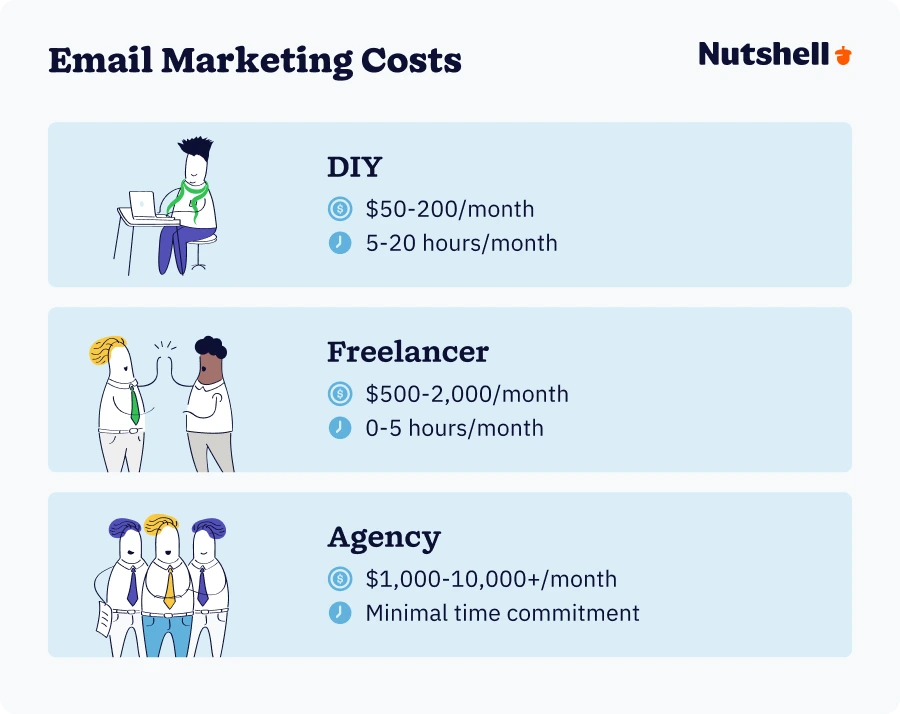
Going DIY is appealing because you’re only paying the platform fee—typically $50 to $200 per month. But there are real costs hiding in the shadows.
Platform fees
These are the obvious costs, ranging from $0 to $500+ per month, depending on your subscriber count and feature needs.
Time investment
What you’ll invest in time is the big one that most businesses underestimate. Setting up your platform, designing templates, writing copy, segmenting your list, analyzing results, and optimizing campaigns requires 5 to 20 hours a month, depending on your level of sophistication.
If you value your time at $30 to $75 per hour (a conservative estimate for a business owner or marketing manager), that’s $150 to $1,500 per month in labor costs you’re not counting.
Learning curve costs
This includes time spent learning email best practices, compliance requirements (such as CAN-SPAM, GDPR, and CASL), deliverability optimization, and utilizing platform features. Expect 10 to 30 hours your first month, tapering to 2 to 5 hours ongoing.
Tools and resources
What you use beyond your platform might include design software ($10 to $50 per month), landing page builders ($30 to $100 per month), list-building tools, and analytics dashboards. These add an additional $50 to $200 per month.
Real DIY cost calculation example
A $100-monthly platform, plus 10 hours monthly at $50 per hour labor = $600 per month in total. Suddenly, that “cheap” DIY solution turns out to be a $600 investment.
Freelancer costs
Hiring a freelancer gives you professional help without a full-time commitment or agency retainer.
Hourly rates
For email marketing freelancers, these rates typically range from $15 to $150 per hour, depending on experience and location. An experienced freelancer in a major market typically charges $75 to $150 per hour. Beginners charge between $15 and $35 per hour.
Project-based pricing
The cost for services such as campaign setup, template design, or list building typically ranges from $500 to $2,000 per project.
Monthly retainers
This would provide ongoing support (10 to 20 hours per month) and typically costs between $500 and $2,000 per month.
What freelancers typically handle
They’ll typically handle campaign copywriting and design, email template creation, segmentation strategy, list management, A/B testing setup, and basic analytics reporting.
When freelancers make sense
Consider a freelancer when you need occasional help (campaign creation, list cleaning) but don’t have enough regular work for a full-time hire. A freelancer charging $1,000 monthly for 15 hours of work is often cheaper than hiring a part-time employee ($2,000+ monthly in salary and taxes).
Email marketing agency costs
Full-service agencies handle everything—strategy, creative, execution, optimization, and reporting.
Monthly retainers
These typically start at $1,000 and scale to $ 10,000 or more per month, depending on the campaign volume, list size, and sophistication.
A small agency managing 2 to 3 campaigns per month for a mid-sized business might charge $1,500 to $3,000 per month. A larger agency handling enterprise-level work, including multiple campaigns, complex automation, and detailed reporting, could charge $5,000 to $15,000 per month.
What agencies include in their retainers
Agency retainers usually cover strategic planning, campaign calendar development, copywriting, design, list segmentation, automation setup, A/B testing, analytics and reporting, and monthly strategy calls.
When agencies make sense
Consider hiring an agency when your email program is business-critical, you lack in-house expertise, you need campaigns to drive significant revenue, or you simply don’t have time to manage it well. A $3,000-per-month agency fee pays for itself if it increases your email revenue each month.
Convert interested users into happy customers with WebFX email marketing services!
WebFX offers professional support for businesses looking to scale their email programs without hiring full-time staff. They combine strategic expertise with hands-on execution, helping businesses integrate email into their broader marketing strategy.

Email marketing costs by industry
Email marketing costs vary across different industries. A B2B SaaS company with 5,000 highly-engaged enterprise subscribers has different needs and costs than an e-commerce store with 100,000 subscribers.
Professional services
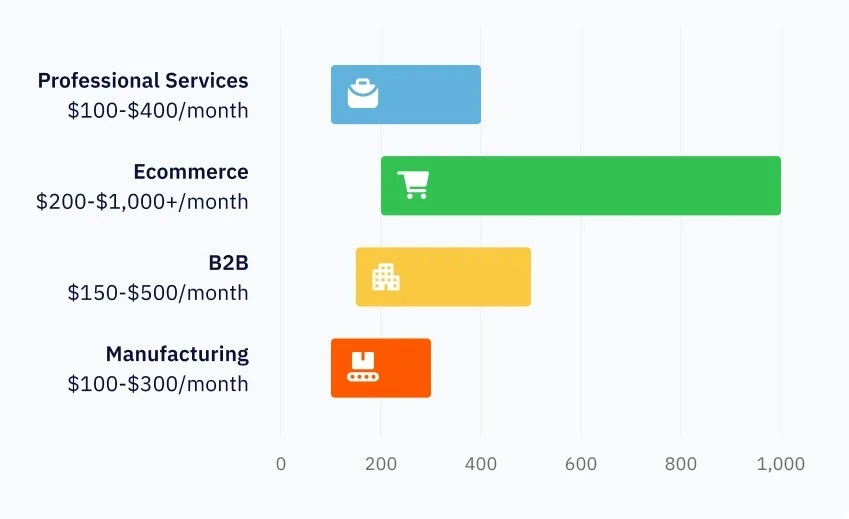
Professional services firms (e.g., accounting, consulting, law, and real estate) typically spend between $100 and $400 per month on email marketing. Why the relatively lower cost?
These businesses often have smaller, more targeted subscriber lists (1,000 to 10,000 contacts). They send fewer campaigns (2 to 4 per month), focusing on thought leadership and client nurturing rather than promotional blasts. The emphasis is on quality over quantity.
A professional services firm that utilizes Nutshell’s integrated CRM and email marketing has a major advantage: they track every client interaction in one system, automatically logging emails and ensuring that nothing falls through the cracks. This integration eliminates the cost and friction of managing separate tools.
Example
A 10-person consulting firm spending $150 monthly on email marketing + 5 hours monthly managing it ($250 in labor) = $400 total monthly investment. They utilize this to nurture past clients and generate referrals, resulting in over $ 50,000 annually in new business.
Ecommerce vs. B2B
Ecommerce businesses
Retail and ecommerce businesses typically invest $200 to $1,000+ monthly because they send frequent campaigns (daily to weekly), need sophisticated segmentation (by purchase history, browsing behavior, customer lifetime value), and require advanced automation (abandoned cart, post-purchase, upsell sequences).
An online retailer with 50,000 subscribers sending daily emails needs a robust platform ($200 to $500 monthly) plus a designer ($500 to $1,000 monthly) to keep campaigns fresh and conversion-focused.
B2B companies
B2B companies typically spend $150 to $500 per month on email marketing. They send less frequently (weekly to monthly) but invest heavily in segmentation and personalization because their buyer journey is longer and more consultative.
A B2B software company with 20,000 prospects on its email list might spend $200 monthly on platform fees, but another $1,000 to $2,000 monthly on copywriting and segmentation strategy because each email directly impacts deal closure.
Manufacturing and industrial
Manufacturing and industrial businesses typically spend $100 to $300 per month. They often have smaller email lists (focused on qualified leads and existing customers), send less frequently, and prioritize relationship-building over high-volume campaigns.
But here’s where integration matters: a manufacturing company using Nutshell integrates its email marketing with its sales pipeline, so every email campaign is tied to deal progress. This approach increases ROI and justifies the investment better than stand-alone email tools alone.
Hidden email marketing costs you need to know
Platform fees are just the beginning. Several less obvious expenses add up quickly, potentially increasing your total email marketing cost by 20 to 50%.
Common hidden costs
- List verification and cleaning ($0.003 to $0.01 per email) removes inactive subscribers and invalid addresses. Cleaning a 10,000-person list costs between $30 and $100 annually. Doing this quarterly or semiannually (best practice) could cost $60 to $400 per year.
- Design and template costs go beyond basic templates. Custom design work typically costs between $200 and $1,000 per template. If you’re creating 12 unique campaign designs yearly, that’s $2,400 to $12,000 in design costs.
- A/B testing tools for advanced split testing, which often go beyond what your platform includes, typically cost $20 to $50 per month.
- Advanced analytics and reporting for detailed attribution, revenue tracking, and predictive analytics can cost $50 to $200 per month or more.
- Compliance and deliverability tools ensure your emails reach inboxes. Services like authentication setup (DKIM, SPF, DMARC), spam testing, and compliance review cost $50 to $300 per month , depending on complexity.
- Integration costs connect your email platform to your CRM, e-commerce system, landing page builder, or analytics tools. Some integrations are free; others require paid add-ons or API access ($50 to $200 monthly).
- Training and onboarding for your team to use new platforms or adopt best practices may cost $500 to $2,000 one-time or $100 to $200 per month if you’re using an agency.
How to budget effectively for email marketing
Effective email marketing budgeting involves accounting for these hidden costs upfront and then tracking actual spending to refine your estimates.
Here’s a practical three-step process to budget effectively for email marketing:
Calculate your true monthly cost
- Platform fees: $________
- Labor (your time or freelancer): $________
- Hidden costs (list cleaning, design, compliance): $________
- Total Monthly Investment: $________
Determine your realistic email marketing budget
This can be done by working backward from the expected ROI. If email marketing should generate $50,000 in revenue annually and deliver 36:1 ROI, you can justify spending up to $1,389 monthly ($50,000 ÷ 36 = $1,389). If your current monthly spending is $300, you have room to invest in improvements. If it’s $2,000 monthly, you need to optimize your ROI.
Built-in growth room
Your costs will increase as your business grows. Plan for platform upgrades, higher freelancer fees as your volume increases, or agency support as complexity grows. A business growing at a 30% annual rate should budget for similar growth in email marketing investment.
Email marketing ROI: Making the numbers work
Here’s why email marketing costs matter less than you might think: the channel delivers exceptional returns.
Email marketing generates a 36:1 ROI for every $1 spent on average, making it the highest-ROI marketing channel for most businesses. This means a $1,000 monthly email marketing investment could generate $36,000 in revenue monthly if you’re executing well.
Of course, your actual ROI depends on several factors, including your industry, customer quality, email execution quality, and the products or services you’re selling. A B2B SaaS company might see 40:1 or higher ROI because high-ticket deals justify the investment. A consumer brand might see 20:1 because lower transaction values reduce revenue per email.
How to calculate your email marketing ROI
Step 1: Calculate revenue generated by email
Track which revenue came directly from email campaigns (purchases, meetings booked, deals closed). Most email platforms allow you to tag links to track clicks and attribute them to revenue.
Example: Your email campaigns drove $15,000 in sales last month.
Step 2: Identify all email marketing costs
Sum your platform fees, labor, freelancer costs, hidden costs, and everything else. Let’s say you spent $800 per month.
Step 3: Calculate ROI
Net ROI = (Revenue – Investment) ÷ Investment × 100
($15,000 – $800) ÷ $800 × 100 = 1,775% ROI
Or simplified: $15,000 ÷ $800 = 17.75:1 or $17.75 return for every $1 spent.
Even if you’re at half the industry average (18:1 instead of 36:1), email marketing is still driving strong returns.
Maximizing ROI with integrated tools
Here’s where platform choice becomes critical: Integrating your email marketing with your CRM eliminates friction and reduces the time required to execute campaigns effectively.
Manual workflow example without integration
- Pull list from CRM (30 minutes)
- Import into email platform (15 minutes)
- Segment and tag (45 minutes)
- Create campaign (2 hours)
- Send campaign (15 minutes)
- Wait for results (ongoing)
- Manually enter results back into CRM (1 hour)
Total time investment: ~5 hours. At $50/hour labor cost, that’s $250 in labor just to execute one campaign.
Integrated workflow example with Nutshell CRM
- Create campaign directly in CRM (2 hours)
- Segment by automation rules (already set up)
- Send (15 minutes)
- Results automatically populate in CRM contact records
Total time investment: 2.25 hours. That’s $112.50 in labor—a possible $137.50 cost savings and 2.75 hour time savings per campaign just from integration.
Over a year of sending monthly campaigns, integration saves you $1,650 in labor costs. That’s a concrete ROI advantage that gets better as your program grows.
How to choose the right email marketing solution for your budget
Choosing the right email marketing solution isn’t about finding the cheapest platform—it’s about finding the best fit for your specific situation. Here’s a framework to guide your decision:
If you’re a startup or solo business with <1,000 subscribers:
- Best choice: Free or low-cost platforms
- Monthly cost: $0 to $50
- Why: You don’t need advanced features; simplicity and low risk matter most
- DIY or help: Handle it yourself; you don’t have enough volume to justify hiring
If you’re a growing business with 1,000 to 10,000 subscribers:
- Best choice: Mid-range platforms or integrated CRM solutions
- Monthly cost: $50 to $300
- Why: You need better segmentation and automation than free tiers offer, but not enterprise features
- DIY or help: Consider freelancer support (5 to 10 hours monthly) for campaign optimization; estimate $200 to $500 monthly
If you’re an established business with 10,000 to 50,000 subscribers:
- Best choice: Advanced platforms or specialized solutions
- Monthly cost: $200 to $800
- Why: You need sophisticated automation, detailed analytics, and potentially multi-user access
- DIY or help: Hire a part-time email marketing person or dedicate 15+ hours monthly to the channel
If you’re an enterprise with 50,000+ subscribers or complex needs:
- Best choice: Enterprise platforms or full-service agency
- Monthly cost: $1,000 to $10,000+
- Why: Your volume and complexity justify premium tools and professional expertise
- DIY or help: Full-service agency or in-house email team essential
Key questions to ask when evaluating platforms
- How does the platform handle list growth? Will costs increase dramatically as you grow?
- What integrations matter to you? Does it connect with your CRM, e-commerce system, or analytics platform?
- How much support do you need? Free support, email-only support, or do you need phone/chat?
- What hidden costs aren’t mentioned in the pricing page? Ask directly about overage fees, premium features, and add-on costs.
- Can you scale without switching platforms? You don’t want to outgrow a platform after investing time and effort in building campaigns there.
- What does “included” really mean? A $300 platform that includes unlimited contacts might cost $500+ once you actually need the features you need.
Red flags to avoid
- Platforms that hide overage fees: If they don’t clearly explain what happens when you exceed limits, assume it costs extra.
- No transparent pricing: “Contact sales” usually means enterprise pricing that’s higher than published rates.
- One-size-fits-all approach. Email marketing needs differ wildly; platforms that treat everyone the same often fit nobody well.
- Integration challenges. If connecting to your CRM requires custom development or technical support, factor in $500 to $2,000 one time costs.
- Switching costs. Some platforms make exporting your data difficult or charge to help you leave—a bad sign.
Making the right platform choice is foundational to your success. For additional guidance on email marketing strategy, segmentation, and CRM integration best practices, explore Nutshell’s comprehensive marketing resources collection, which includes guides on drip campaigns, email automation, and leveraging CRM data for marketing effectiveness.
Next steps to determining email marketing pricing
- Step 1: Calculate your current email marketing costs (or estimated costs if you haven’t started yet) using the breakdown we covered. Include platform fees, labor, and hidden costs.
- Step 2: Determine what revenue email marketing should generate for your business based on your industry and goals. Use the 36:1 benchmark as a starting point, but adjust for your specific situation.
- Step 3: Evaluate whether your current (or planned) investment aligns with your ROI expectations. If you’re spending $300 monthly but email should generate $30,000 in revenue, you might be underspending. If you’re spending $5,000 monthly but email only generates $20,000 in revenue, you’re overspending on execution or technology.
- Step 4: Test and optimize. Start with a platform that fits your current needs and budget. Measure results carefully. Upgrade or adjust your approach based on what actually works for your business, not what you think should work.
FAQs: Common email marketing cost questions
-
1. Is there such a thing as free email marketing?
Yes, platforms like Mailchimp’s free tier serve up to 500 contacts with basic features. However, “free” doesn’t mean zero cost if you factor in your time. Expect to invest 5+ hours monthly managing campaigns and learning the platform.
-
2. What’s a realistic email marketing budget for a small business?
$100 to $500 monthly is realistic for most small businesses (under 50 employees). This typically includes platform fees ($50–$300) and either your time or freelancer support ($50–$200).
-
3. Does email marketing cost more if you need compliance (GDPR, CAN-SPAM)?
Compliance itself doesn’t cost extra, but ensuring you’re compliant might. Some platforms include compliance tools—others require paid add-ons. Budget an additional $25 to $100 monthly if you operate in regulated markets.
-
4. When should we switch from DIY to hiring help?
Consider hiring when email marketing should drive significant revenue ($20,000+ monthly), but your in-house team is understaffed. The time investment to execute well typically exceeds what in-house teams can deliver.
-
5. How does email marketing cost compare to other marketing channels?
Email delivers approximately 36:1 ROI compared to 8:1 for paid search, 5:1 for social media advertising, and 4:1 for display ads. It’s genuinely the most cost-effective channel for most businesses.
-
6. Can integrating with CRM actually reduce costs?
Yes. Integration eliminates duplicate data entry, reduces manual campaign setup time, and improves targeting accuracy. This translates to 2–3 hours of labor savings per month per campaign, which compounds significantly over the year.
Conclusion
Email marketing costs vary widely—from $50 monthly for a solo entrepreneur to $10,000+ monthly for an enterprise. However, here’s what we know: email marketing yields an approximately 36:1 return on investment, making it one of the most effective marketing channels available.
The real question isn’t “How much does email marketing cost?” but “Does the ROI justify the investment for my business?” For most businesses, the answer is yes—especially when you choose tools and approaches optimized for your specific situation.
Ready to streamline your email marketing with integrated CRM? Start your free Nutshell trial—combine email automation with sales pipeline management to maximize ROI and reduce administrative costs.Need professional support to scale your email program?Get a custom quote from WebFX and work with experts who understand email marketing inside and out.
 GET MY FREE PROPOSAL
WebFX Customers Get X Free Seats of Nutshell Pro!
BACK TO TOP Written by
Sam Poole Associate Content MarketerEdited by
Will Gordon Sr. Director of MarketingReviewed by
Andy Fowler Co-FounderReady to try
Nutshell for Free?Thank you! Your submission has been received!Oops! Something went wrong while submitting the form.





Episode #3: Building Company Culture and Branded Tents With Matt Bulloch
Published on: November 10, 2022Establishing a System for CRM Data Entry and Management
Published on: April 11, 2023Highly Effective Strategies for Elevating Sales Team Performance
Published on: November 10, 2022Introducing Nutshell Forms Spam Prevention
Published on: April 22, 2024Join 30,000+ other sales and marketing professionals. Subscribe to our Sell to Win newsletter!