

Sauter au contenu principal ↓

How to Handle Difficult Customers in Support

Customer support leader looking into the distance feeling calm and confident

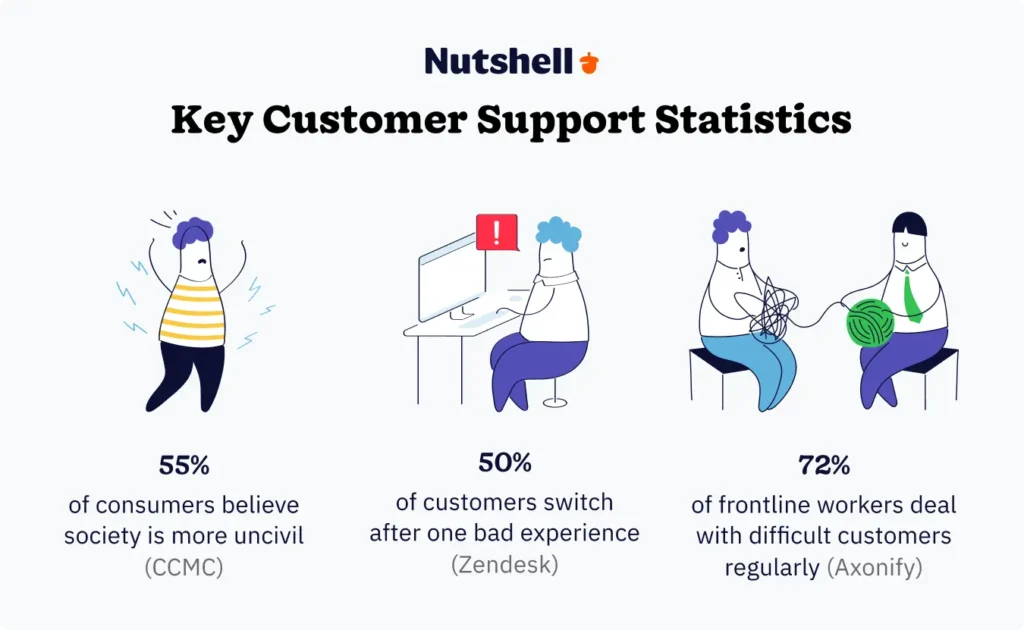
You might feel like the world is getting ruder. You are not imagining it. According to the 2025 National Customer Rage Study by CCMC, 55% of consumers believe society is becoming more uncivil. This shift means your support team is no longer just solving technical problems. They’re now the frontline defense against a growing wave of consumer frustration.

Support managers in small and mid-sized businesses face a difficult dual threat. You have to protect your revenue from churn while simultaneously protecting your people from burnout. Push too hard to please abusive customers, and you lose your best agents. Ignore customer frustration, and you lose your business.

Effective conflict resolution isn’t just about telling your team to “be nice” or “smile through it.” You need a systematic approach to three things: preparation, context, and recovery. You need a playbook that empowers your agents to de-escalate tension without sacrificing their dignity.

This guide provides that playbook. You will master a proven three-step framework for de-escalation. You will learn how CRM context prevents outbursts before they happen. You will also discover team recovery protocols that stop one bad call from ruining an entire week.

Why customer interactions are escalating

Understanding this landscape is critical. Customer interactions are escalating due to rising consumer expectations, economic frustration, and eroded patience. The stakes are clear: one bad experience costs you a customer, and repeated abuse costs you your best agents. But here’s what matters: you can’t control how customers arrive at your door—angry, impatient, or defensive. What you can control is how your team responds. That response begins long before the phone rings.

Graphic showing three statistics about difficult customer support interactions

What the data says

  • Data from Zendesk shows that 50% of customers will switch to a competitor after just one bad experience. The margin for error has effectively vanished. A single heated exchange doesn’t just ruin a day—it directly impacts your bottom line.
  • The Axonify Deskless Report reveals that 72% of frontline workers deal with difficult customers regularly. This constant exposure to hostility creates a high-stress environment that leads to rapid turnover. Agents who feel unsupported or ill-equipped to handle abuse will leave. Replacing them costs time, money, and institutional knowledge.

Preparing your team before conflict strikes

Most support failures happen because agents are forced to improvise. When an angry customer is shouting, adrenaline kicks in. Rational thought often shuts down. If your agent does not have a plan, they will react emotionally rather than strategically.

Preparation acts as a shield. It gives your team the confidence to handle aggression without taking it personally. Here are the three critical areas you’ll want to prepare your support team in:

Training emotional intelligence

You must teach your team to distinguish between types of anger. Passive anger often stems from disappointment or confusion. These customers might be sarcastic or short with their answers. Aggressive anger involves personal attacks, shouting, or threats.

Passive anger requires patience and clarification. Aggressive anger requires firm boundaries and de-escalation tactics. Training your team to spot the difference helps them choose the right tool for the job. They stop seeing the anger as an attack on them and start seeing it as a puzzle to be solved.

Standardizing responses

Instead of asking agents to draft emails under pressure, build a library of approved responses. Nutshell’s email templates – for example – let you create a framework your team can personalize instantly.

These templates shouldn’t sound like they came from a robot. They should provide a verified framework that the agent can make their own. If a customer is angry about a shipping delay, a template for shipping delays should acknowledge frustration, explain the cause, and offer the approved solution.

Building authority

Uncertainty breeds aggression. If an agent sounds unsure, the customer questions their competence—and their anger escalates. You need to arm your team with solid documentation and instant access to answers.

Access to accurate information allows agents to answer with authority. They don’t have to put the customer on hold to ask a neighbor. They don’t have to guess. They can state the policy or the solution clearly. This confidence is contagious. When the agent is calm and sure, the customer often calms down too.

Ready to give your team the context they need? Start your free 14-day trial with Nutshell and see how a unified knowledge base keeps everyone confident and in sync.

Download our guide to modern-age customer relationships  

By embracing AI and innovative CRM strategies, you can create lasting loyalty and drive your business forward. Download the full guide now to unlock the secrets to exceptional customer relationships.


Core techniques for handling difficult customers

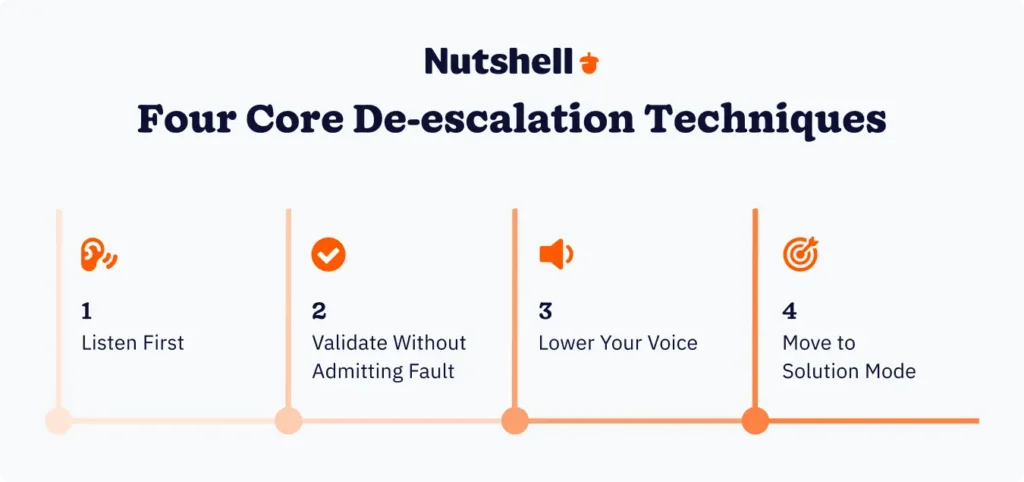
Once the call connects, your agent needs tactics to cool things down. These four core techniques work whether you’re on the phone, in chat, or anywhere else—and they’re designed to work together in sequence. Master them in order, and you’ll see how each one builds on the last.

Graphic that lists four core de-escalation techniques

1. The listen first protocol

The natural instinct when someone complains is to interrupt them with a solution. You want to fix it so they stop yelling. This tends to backfire.

Angry customers have an emotional need to be heard. If you interrupt them, even with good news, you deny them that release. They will often start over from the beginning because they feel you did not understand the gravity of their problem.

Teach your agents to wait. Let the customer finish their entire thought. Wait for a solid two seconds of silence before speaking. This pause signals that you were truly listening and not just waiting for your turn to talk.

2. Validating without admitting fault

Validation is not the same as taking the blame. You can validate a customer’s feelings without accepting liability for things out of your control. An apology is saying you’re wrong. Validation is saying their feelings make sense.

A phrase like “I can see why that is frustrating” is a powerful validation tool. It tells the customer that they are not crazy for being upset. It aligns the agent with the customer against the problem.

3. The lowering your voice tactic

This is a counterintuitive strategy for phone support. When a customer raises their voice, our instinct is to get louder to be heard. You must do the opposite.

Speak slightly quieter and slower than normal. This forces the angry customer to stop shouting so they can hear you. It breaks their rhythm and shows you’re staying calm. It also signals that you are in control of your own emotions. You are the steady anchor in the storm.

4. Moving to solution mode

You can’t stay in the listening phase forever. Once the customer has vented and felt heard, you must pivot. The goal is to move from “what went wrong” to “what we can do right now.”

Use bridging phrases to make this shift. “Now that I understand what happened, here is how we are going to fix it.” This separates the past negative experience from the future positive resolution. It gives the customer a concrete path forward.

Specific strategies for difficult customer interactions

Your core techniques handle most situations. But some interactions test those foundations—situations where you need advanced plays. These three strategies address the most challenging scenarios your team will face.

The professional boundary script

Abuse is never part of the job description. You must give your agents permission to protect themselves. If a customer becomes profane, personal, or threatening, the interaction needs to end.

Provide a script for this exact moment: “I want to help you, but I can’t continue if you keep using that language. Let’s stop and solve this together.”

If the behavior continues, the agent should have the authority to disconnect. Knowing they have this safety net reduces anxiety. They know they are not trapped.

Handling the “I want your manager” demand

This demand is often a power play. The customer feels the agent is a gatekeeper preventing them from getting what they want.

Don’t refuse right away. It causes escalation. Instead, validate the request and offer a faster alternative. “I can certainly get a manager for you. However, they will likely need to review the same information I have here. I might be able to resolve this for you right now while we wait.”

Often, the customer just wants the problem solved. If you can do it faster than a manager can, they will usually let you proceed.

Managing unreasonable requests

Sometimes customers want things you simply can’t give. They might demand a refund outside the policy window or a feature that doesn’t exist.

You must say no firmly but politely. The key is to offer the “next best alternative.” Don’t just leave them with a dead end.

“I can’t offer a full refund because of the time that has passed. What I can do is offer a 20% credit on your next month of service.” This gives the customer a win. They may not get exactly what they wanted, but they leave with something of value.

Technology as prevention: Using a CRM to manage challenging customer situations

The best ‘difficult customer interaction’ is the one that never happens. Technology prevents escalation by providing context, enabling collaboration, and deflecting routine issues before frustration builds. Your CRM should be more than just a database—it should be an engine for prevention.

The power of context

Nothing infuriates a customer more than repeating themselves. If they explained their issue to a chatbot, then to an agent, and then to a second agent, they will be furious by the time they reach a solution.

Nutshell’s timeline feature gives your agent a complete view of every interaction the customer has had with your company. They can see the emails, the previous calls, and the notes from other team members.

When an agent answers the phone and says, “I see you spoke with Sarah yesterday about your billing issue,” the tension drops immediately. The customer feels known. They feel valued. The timeline allows your team to pick up exactly where the last conversation ended.

Collaborative tagging

Putting an angry customer on hold is risky. The silence allows their anger to fester. They assume you are laughing at them or ignoring them.

Collaborative features like @mentions in Nutshell allow agents to get help without putting customers on hold. They can tag a manager or a technical expert in the internal notes of the ticket. The expert can provide the answer in real time.

The agent stays on the line. They maintain the connection. They deliver the expert answer as if it were their own. This makes your team look incredibly competent and unified.

Self-service deflection

A significant portion of support volume comes from simple, repetitive questions. If your agents are bogged down answering “how do I reset my password” all day, they will have no energy left for the difficult cases.

A robust FAQ or customer portal allows users to solve these simple problems themselves. This reduces the overall ticket volume. It ensures your agents are fresh and focused when a complex, emotionally charged issue arrives.

Give your team better tools. Nutshell’s timeline, templates, and collaboration features help your support team handle anything. Start free for 14 days.

Vous avez besoin d'un CRM convivial pour stimuler les ventes et l'efficacité de votre équipe ?  

Start a free 14-day trial of Nutshell—no credit card required.


Post-interaction recovery and learning

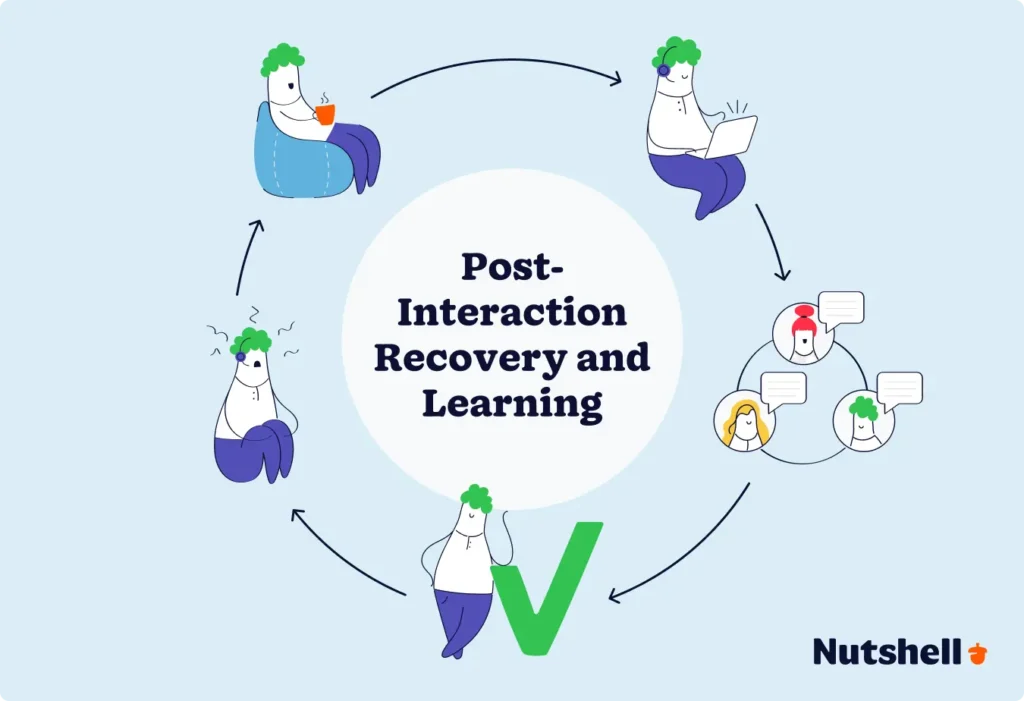
The interaction does not end when the customer hangs up. The residual stress stays with the agent. If you don’t manage this recovery phase, you invite burnout.

Graphic showing a customer support professional going through the cycle of post-interaction recovery and learning

The cool-down period

Give the agent a chance to cool down after a stressful customer interaction, instead of jumping straight into another call. They need a reset. Mandate a cooling-off period after high-stress interactions.

Give them five or ten minutes to walk away from the desk. Let them grab a coffee or just breathe. This small investment of time preserves their mental health. It ensures the next customer gets the best version of that agent, not the leftover frustration from the previous call.

The blameless post-mortem

Difficult calls are excellent learning opportunities. You should review them as a team. The goal is not to punish the agent for what went wrong—instead, use the call to find gaps in your process.

Maybe the customer was angry because a policy was unclear. Maybe the agent lacked the authority to solve the problem quickly. Review the call to find what went wrong. This turns a negative experience into a positive structural change.

Closing the feedback loop

Your support team knows more about your product flaws than anyone else. They hear the complaints every day. Use Nutshell’s engagement resources to aggregate this feedback and turn it into action.

When handling difficult customers reveals a recurring pain point, aggregate that data. Use it to petition your product or service teams for permanent fixes. Show them the churn risk. Show them the support volume.

When your agents see that their difficult calls lead to actual improvements, they feel empowered. They realize they are not just punching bags. They are contributing to the evolution of the company.

Turn conflict into opportunity

Conflict in customer support is inevitable. You work with humans, and humans are emotional. But chaos is optional.

You don’t have to let difficult interactions dictate the morale of your team or the retention rate of your business. By preparing your agents with the right training, equipping them with context-rich tools like Nutshell, and supporting them with recovery protocols, you change the dynamic.

Empowered agents don’t fear difficult customers. They handle them. They turn critics into advocates and problems into opportunities.

Start here. Give your team the context and tools they need to handle difficult customers with confidence. Try Nutshell free for 14 days—no credit card required.

Foire aux questions

  • 1. When should you escalate a difficult customer to a manager?

    Escalate when: (1) the customer explicitly requests a manager, (2) the solution requires authority beyond your level, (3) you’ve exhausted all available options without resolution, or (4) the customer makes threats or becomes abusive. Always explain the escalation benefit to the customer.

  • 2. What phrases should you avoid saying to angry customers?

    Never say “calm down,” “that’s our policy,” “you’re wrong,” “I don’t know,” or “there’s nothing I can do.” These phrases dismiss feelings and offer no solutions. Instead, acknowledge frustration, explain what you CAN do, and focus on resolution rather than limitations.

  • 3. How long should you spend trying to resolve a difficult customer interaction?

    Industry standard is 6 minutes for general support, but difficult cases may require 8-10 minutes. Focus on resolution quality over speed—a thorough fix prevents repeat calls. If you’re stuck after 10 minutes without progress, it’s time to escalate or bring in additional expertise.

  • 4. How can CRM data help prevent difficult customer interactions?

    Your CRM reveals patterns before problems escalate. Review customer history for past complaints, identify recurring issues across accounts, and flag at-risk customers showing frustration trends. Proactive outreach based on these signals can resolve concerns before they escalate, turning prevention into retention.

  • 5. What should you do immediately after a difficult customer call?

    Document the interaction details while fresh, including what triggered the escalation and your resolution steps. Tag the record for manager review if needed. Take a 5-minute break to decompress before your next interaction. Debrief with your team if the situation revealed process gaps.

Voir Nutshell en action !

Essayez Nutshell gratuitement pendant 14 jours ou laissez-nous vous faire découvrir le site avant de vous y plonger.

RETOUR AU HAUT DE LA PAGE

Rejoignez plus de 30 000 professionnels de la vente et du marketing. Inscrivez-vous à notre lettre d'information Vendre pour gagner !