Salesforce Alternatives: 6 Feature-Packed Competitor CRMs for Busy Sales Pros

-

Key takeaways
- While Salesforce offers extensive customization, it can be costly and complex, leading B2B teams to seek more affordable and user-friendly alternatives.
- Many Salesforce alternatives offer comparable automation and marketing capabilities at a fraction of the cost, with transparent pricing and easier setup.
- When choosing a CRM, carefully evaluate your team’s size, workflow complexity, and technical capacity, and prioritize a platform that aligns with your specific needs.
Salesforce offers multiple suites and its app market has more than 3,400 applications and plugins. It is arguably “the biggest CRM ever.”
But is a gigantic CRM really what salespeople and marketers need? Most CRM seekers are just asking for reliability, support, and just a handful of powerful integrations. And to buyers, Salesforce’s promise of 3,400 apps really translates into about 3,395 things your team is never gonna use. These factors are leading many users to seek Salesforce alternatives.
Keep in mind Salesforce began in 1999, back when technology was cumbersome, expensive, and difficult to pitch to enterprises. Salesforce was novel in that it was among the first few companies to provide software as a service (SaaS) as opposed to installable software. It was huge.
☝🤖 Fun fact: Amazon’s original user interface, a web page with multiple tabs, helped inspire Salesforce’s early design.
The idea behind SaaS was that, rather than having to install software onto a computer (like Outlook or Excel), customers could visit the software provider’s website and interact with it right there (like Gmail or Sheets). No downloads necessary.
Needless to say, the SaaS model was profoundly successful, and continues to be the model that most CRMs follow to this day.
Salesforce continued to grow, and very shrewdly launched AppExchange in 2006, which allows developers to create applications that plug into Salesforce, bolstering its functionality and allowing “the free market” to innovate and create their own apps that directly increase Salesforce’s value. Salesforce, plus all the possible apps, is simply a monstrous suite of software.
Unfortunately, using a monstrous CRM also comes with a monstrous price tag.

We’ll delve deeper into what Salesforce actually costs below. But first, let’s take a look at some of Salesforce’s core CRM features.
Salesforce CRM features
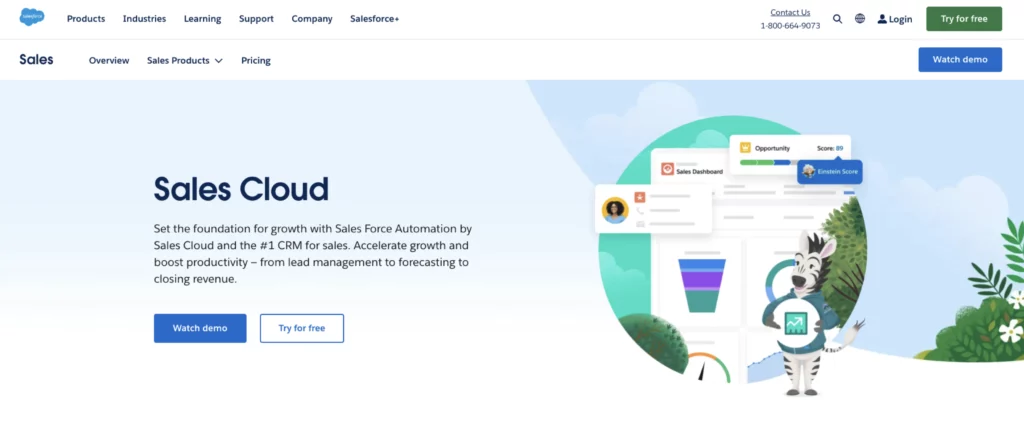
Starter: $25/mo
Full package: $500/mo
- Workflow customization tools
- Analytics
- Marketing leads management
- Sales team communication
Summary: Salesforce is a CRM that is supported by its “cloud platform” of apps and integrations. With enough add-ons, configuration, and customization ($$$), Salesforce can do just about anything.
Typical Salesforce customers require the hyper-configurability to handle things like adaptive customer journey-related workflows, plugin application builders, and tracking the exact dollar amount a webpage view in a specific location at a specific time is worth.
Watch out for: Salesforce charges double their enterprise price ($150/user) for the version with unlimited support.
According to user theories, this is because the software is extremely difficult to use and frequently requires support interactions.
Furthermore, the basic setup fee starts around $5,000, but if you want the above-mentioned functionality, your setup will start at $50,000.
Not every app on Salesforce’s App Exchange is worth bragging about. Why does this bulk delete app even exist? Is this not something users can already do?
Salesforce alternatives
The problem with Salesforce is that it’s so very expensive. Sure, they’ve got an enormous web of applications, and some ridiculously complicated features. But for the small-to-medium businesses who don’t need “custom object data modeling” and building schema tags into their contact databases, there are better Salesforce competitor CRMs to choose from.
Plus, not everyone has tens of thousands of dollars to spend on setup, or the development resources required just to maintain the CRM. 😬
Here are 6 Salesforce competitors that are worth considering:1. Nutshell
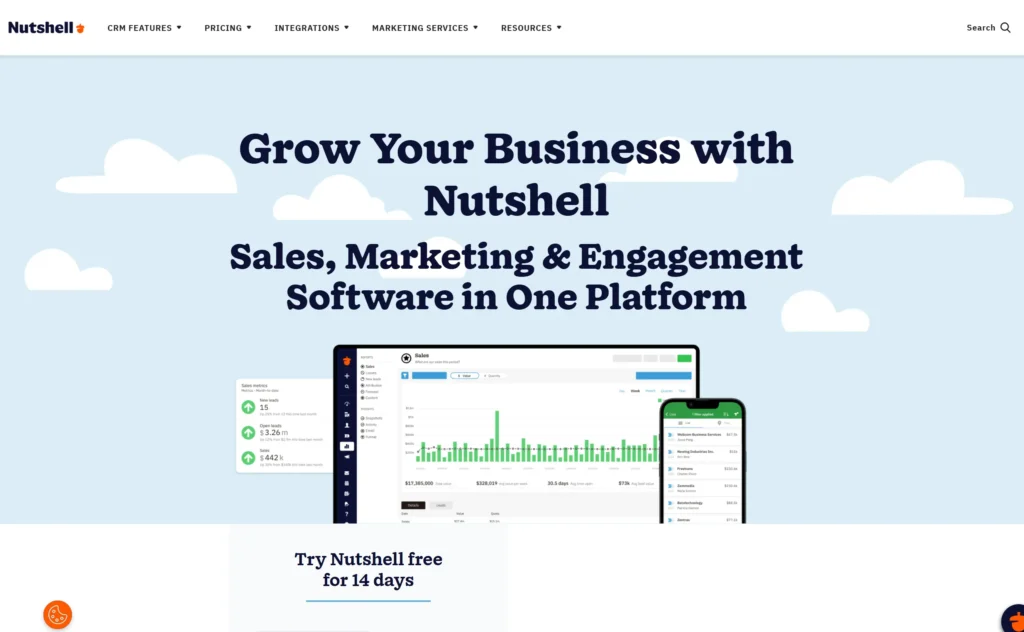
Starting package: Nutshell Foundation: $13/user/mo
Full package: Nutshell Enterprise: $79/mo
Notable features:
- Sales automation
- Flexible pipeline management
- Comprehensive “excel-style” filtering and sorting for leads and reporting
- Contact management
- Embeddable webforms
- Automated personal email sequences that can be triggered based on pipeline stage
- Built-in full-fledged email marketing suite
- Free onboarding assistance
- Transfer your Salesforce data automatically into Nutshell in just a few clicks, no setup required
- Free live support
Let’s examine an overview of what Nutshell’s Enterprise plan will cost you versus what Salesforce with set you back in your first year.
What you’ll spend in the first year for an Enterprise CRM with Marketing
Annual license cost for a 10-person team
 Pricing gathered from Hubpost.com and Salesforce.com
Email Sequences & Campaigns
Implementation costs
Source: BacancyTechnology.com
Full-time admin salary
Source: Talent.com
Live phone and chat support
Source: Salesforce.com
Fully functional mobile app
Source: G2.com
Data storage
One-click dialing and call recording
Year 1 Total
Let’s assume the average of the optional fees and one level of overage for 6 months of the year.
Year 2 and Beyond Totals
This assumes you don’t grow as a company and add more records…

$18,000
($150/user/month)
$34,680/year
(For up to 50,000 contacts level)
$10,000
(“one price fits all”)
$6,000 to
$38,400/year
(available, but not required)
$0
$0
$1,100/month
for going over 1 million total records
$50/month for 1,000 minutes
(3,000 minute limit)
$91,580
$78,580

$9,480
($79/user/month)
$4,680/year
(For up to 50,000 contacts level)
$0-$1,500
(available but not required)
$0 to
$18,000/year
(available to customers, but in no way required)
$0
$0
$0
unlimited storage at no extra cost
$0
On Pro plans and above
$23,910
$23,160
$19,800
($165/user/month)
$19,800/year
(For up to 50,000 contacts level)
$75,000 – $200,000
(has many factors)
$96,687/year
(if you’re lucky)
$5,940/year
(30% of software license)
$3,000
($25/user/month of software license)
$1,500/year
for every 500MB after the first 10GB ($125/month)
$3,600+/year
($30/month/user and an additional $15/month for every 1,000 minutes logged)
$284,452
$146,952
See how Salesforce pulls a bait and switch with their pricing model. Check out the real price of Salesforce.
Summary: Nutshell is an all-in-one CRM and email marketing platform that helps B2B organizations work together to win more deals.
Nutshell is solid enough to support any element of your business, yet simple enough to set up without the need for an IT department or paid admin. As the go-to alternative to Salesforce for small business, Nutshell is favored among SMBs who know better than to overpay for software they’ll never use.
Plus, Nutshell partners with about 50 other companies to provide integrations for:
- Email servers
- (Outlook, Exchange, Gmail, etc.)
- Marketing
- (Constant Contact, MailChimp, Hubspot, etc.)
- Websites and forms
- (123 Contact Form, Wufoo, etc.)
- Administration
- (Quickbooks, Google Drive, Exchange Calendars, Asana, etc.)
- Communication
- (Social media, Slack, Intercom, RingCentral, etc.)
And Nutshell connects with Zapier for custom integrations with just about any other software.
The more information we put into Nutshell, the more valuable it becomes.
Watch out for: Users indicate that the feel of the mobile application doesn’t match the PC interface with which they are familiar.
Nutshell Forms now allows users to create beautiful, custom forms to be hosted on any website or landing page. All information captured by Nutshell Forms is beamed directly into the CRM, completely hassle-free. How will you use forms?
2. Pipedrive CRM
Starter: $12.50
Full package: $99/mo
Notable features:
- Email sync
- Email automation
- One-click calling
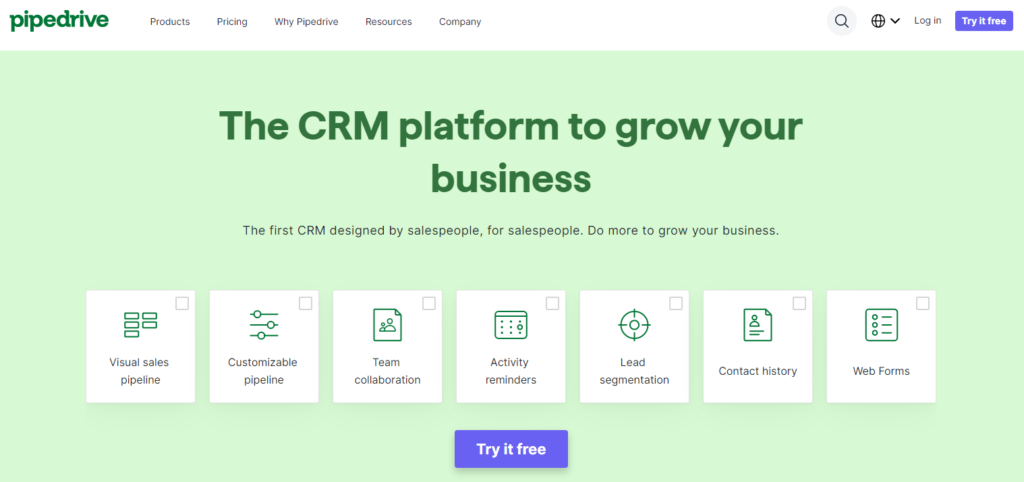
Summary: Pipedrive, a competitor to Salesforce, has a skimpy cheap version for $12.50 per month, which lacks most of the features salespeople are looking for in a CRM. In order to actually get anything done, users need to jump for the $50 version at a minimum.
The expensive version has good reviews, portraying the product as a well-rounded and easy-to-use CRM, with a straightforward user interface and a small learning curve.
Watch out for: Customers indicate that phone support and reporting features still leave something to be desired.
3. HubSpot
Starter: Free starter version
Full package: $150/mo (Sales Hub)
Notable features:
- Website landing page builder
- Customer journey-based workflows
- Sales and marketing email template builder
- Sales and marketing management tools
Summary: HubSpot’s free version is referred to as a non-starter. It provides just enough of a taste for the product to get users to open up their wallets. And when they open them, they need to open wide.
The paid version of HubSpot is a CRM with built-in marketing and customer support features. HubSpot allows users to create custom web pages, forms, and emails, and tie them into its CRM with its workflow automation capabilities.
HubSpot is a good Salesforce alternative for sales and marketing teams who can afford the big spend and don’t have the time, knowledge, or resources to integrate their CRM with other, cheaper tools.
Watch out for: The free version is basically an editable Excel workbook. If you want to use all of HubSpot’s features, it’s going to cost a small fortune. Even worse, those who aren’t HTML pros will need to hire a developer when they want to change things.
4. Zoho
Starter: $14/mo
Full package: $69/mo
Notable features:
- Integration with other Zoho apps
- In-CRM emailing (limited #/user)
- Dashboards and reporting
- Integrates with Microsoft and Outlook
- Workflow management
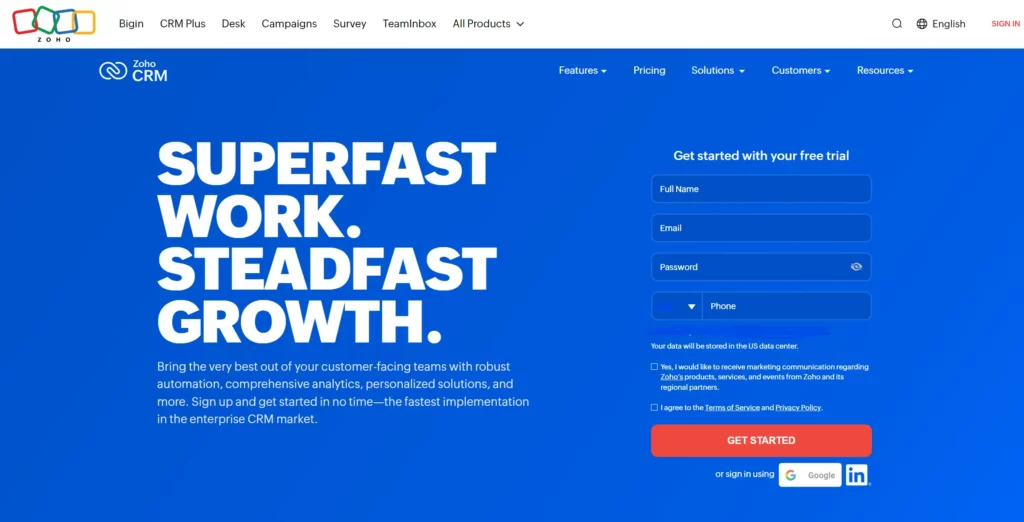
Summary: Zoho CRM is one of many applications in Zoho’s application ecosystem, which is similar to Salesforce’s appexchange. The reporting in Zoho’s CRM is solid, allowing users to report across products, locations, and applications.
Watch out for: Zoho’s apps are sold in bundles, which makes the purchasing process confusing and dubious. The bundle approach makes it difficult for potential buyers to figure out exactly which bundle they need, how much it’s going to cost, and if it’s even going to support all of their needs.
5. Insightly
Starter: $29/mo
Full package: $99/mo
Notable features:
- Integrates with Google Workspace, Microsoft, Mailchimp, and more
- Custom dashboards
- Custom pipeline builder
- Opportunity reports
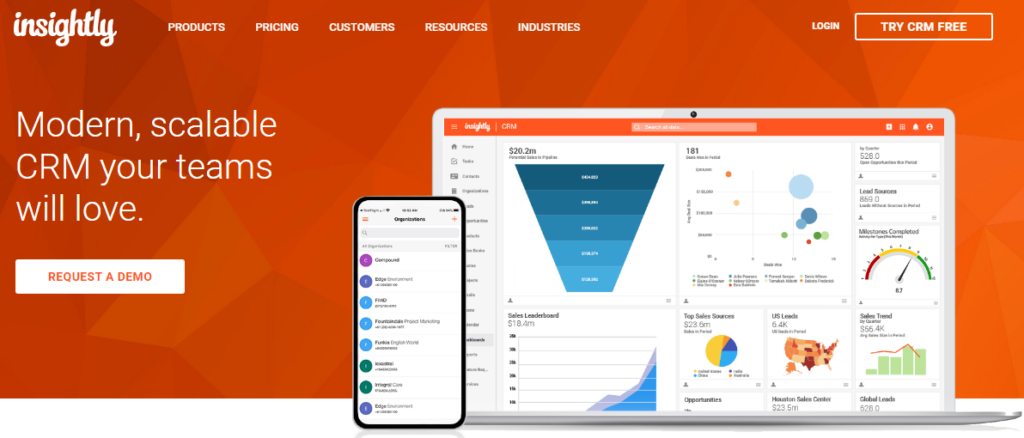
Summary: Insightly, a Salesforce competitor, is designed for companies with a straightforward sales process. It supports the creation of custom pipelines, and also provides a host of tools and functions to manage them. Users love Insightly’s filtering features, allowing large lists to be sorted into smaller, more manageable segments.
Watch out for: Insightly’s onboarding and support plans are very expensive, but customers are often unable to get started without them. Users also report crawling load times, dropped email attachments, and lackluster or unusable sales reports.
6. Copper
Starter: $9/mo
Full package: $99/mo
Notable features:
- A CRM that “sits on top of” Google
- Hangouts-based chatbot
- Chrome extension, Gmail inbox, and other Google Workspace app support
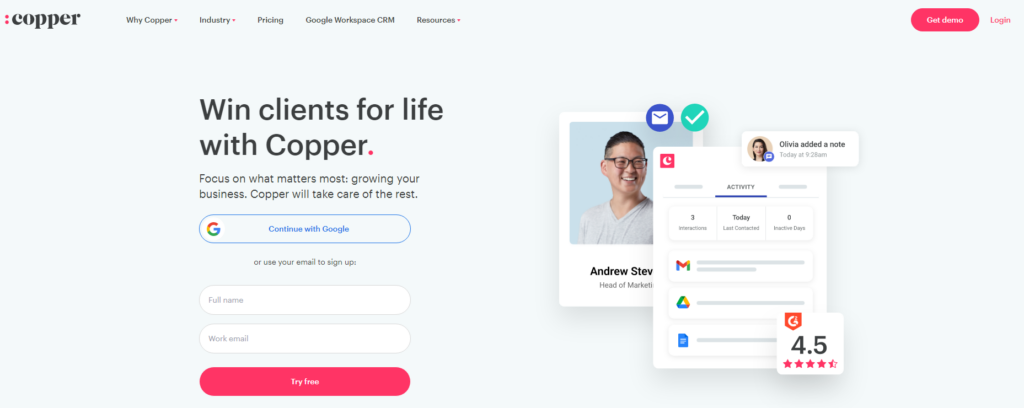
Summary: Copper CRM is an innovative approach to customer relationship management. Describing itself as a “relational CRM” as opposed to a “transactional CRM,” its focus is to exist solely in Google Workspace to facilitate faster and more effective use of the Google app suite.
Its Chrome extension comes in handy for scheduling meetings and creating follow-ups over email without going out of the way.
Watch out for: Copper’s onboarding is expensive and is only included in their most highest-cost package.
Real-life examples of companies that chose alternatives to Salesforce
Superfine! Art Fair
Superfine! Art Fair scrapped Salesforce after co‑founder James Miille found it “took about a month just to learn how to use, and that actually caused a huge dip in our sales.”
Once the team migrated to Nutshell’s more intuitive dashboard, their performance flipped: “A good week used to be $12,000— now a bad week is $12,000 and good weeks hit $40,000.”
Further reading: Learn more about Superfine! Art Fair’s experience
SafetySync
Calgary‑based SafetySync spent six years wrestling with Salesforce’s steep learning curve and admin overhead before calling it quits.
“The changeover was incredibly fast—I had my sales team ditching Salesforce after one week,” recalls Product Manager Matthew W.
Once the team moved to a leaner CRM with one‑click Gmail/Office 365 sync and free live support, adoption shot up, and reps could focus on selling instead of fighting the tool.
Further reading: Learn more about SafetySync’s experience
FAQs about Salesforce and its alternatives
-
1. What is the best alternative to Salesforce for small businesses?
For small businesses, the best Salesforce alternatives offer a balance of functionality, ease of use, and affordability without overwhelming complexity.
Platforms like Nutshell, Pipedrive, and Zoho provide the essential features small businesses need—contact management, pipeline tracking, and basic automation—with more transparent pricing and simpler interfaces. The ideal choice depends on your specific requirements, but these alternatives deliver core CRM capabilities without requiring dedicated administrators or expensive consultants.
-
2. Is there a free alternative to Salesforce?
Yes, several CRMs offer free options, including HubSpot CRM, Zoho CRM (up to three users), Bitrix24, and Agile CRM. However, these free versions typically come with significant limitations in features, user counts, or storage capacity. While they can work for very small teams or startups, most businesses quickly outgrow these constraints. More affordable paid alternatives like Nutshell provide better long-term value with complete feature sets, proper support, and regular updates at a fraction of Salesforce’s cost.
-
3. How much can I save by switching from Salesforce to an alternative CRM?
Switching from Salesforce to an alternative CRM can reduce your total costs by 60-90%. The savings come from multiple areas, including lower per-user license fees, eliminated need for dedicated administrators, and fewer add-on purchases.
-
4. What features should I look for in a Salesforce alternative?
Focus on features that directly impact your business rather than sheer quantity. Essential capabilities include contact and lead management, pipeline visualization, email integration, task management, basic reporting, and mobile accessibility. Depending on your needs, you might also prioritize email marketing, sales automation, proposal generation, or specific integrations with your tech stack.
The most important consideration isn’t feature count but alignment with your sales process and team adoption. A streamlined CRM that your team actually uses consistently delivers better results than a feature-rich platform that goes underutilized. Platforms like Nutshell, HubSpot, and Zoho offer different strengths depending on your specific priorities.
-
5. How difficult is it to migrate data from Salesforce to another CRM?
Migrating from Salesforce to another CRM is a straightforward process for standard implementations. The typical migration involves exporting your Salesforce data (contacts, leads, opportunities, accounts) as CSV files, mapping fields to your new CRM, importing the data, and verifying everything transferred correctly. This basic process often takes just a few days.
Many alternative CRMs simplify this further with Salesforce-specific import tools and migration assistance. For example, Nutshell offers specialized import functionality to streamline the transition. Only heavily customized Salesforce instances with custom objects or complex workflows require more extensive planning and support.
-
6. Do I need all the features Salesforce offers for my business?
Most businesses don’t use anywhere near Salesforce’s full feature set, effectively paying for capabilities they never implement. The most successful CRM implementations focus on solving specific business problems rather than maximizing feature count. Core functions like contact management, pipeline tracking, and basic reporting form the foundation of what most teams actually use daily.
Platforms like Nutshell, Pipedrive, and Zoho excel at providing streamlined experiences with essential functionality without overwhelming users. Remember that the “best” CRM isn’t necessarily the one with the most features—it’s the one your team will actually use consistently to drive better sales outcomes.
-
7. What are the hidden costs of Salesforce that alternatives might not have?
Salesforce’s published rates don’t reveal several significant expenses that dramatically increase total cost of ownership. These include implementation costs, dedicated administrators, training expenses, storage overages, add-on features, contract escalations upon renewal, and complex integration costs. Many alternative CRMs feature more transparent pricing with fewer hidden costs.
Should you use Salesforce or an alternative?
Salesforce is a big, expensive commitment for companies to make. If one expenditure deserves extra scrutiny before buying, it’s Salesforce CRM. In some cases, where extreme customization is required, Salesforce and its developer-friendly platform might be the best way to go.
Here are the things Salesforce doesn’t tell you:
- Your subscription price can significantly increase on renewal
- Salesforce can terminate your contract and delete your data with only a few days’ notice
- Salesforce won’t let you change your seat-count during a term
- Your integrations could be canceled at any time
Read more: Salesforce contracts, explained: 7 things you didn’t know were in your Salesforce user agreement
Another potential pitfall is that customers shopping for Salesforce competitor CRMs are easily hypnotized into believing that Salesforce is the only one with customizable automation. It’s not, not by a long shot, but it feels like it because Salesforce is everywhere. We therefore encourage you to explore competitors to Salesforce to make an informed decision about the best CRM for your business.
More than 150,000 organizations use its software. The company employs 35,000 people and brings home 20 billion dollars annually. It’s truly hard to escape the Salesforce craze.

They should quit playing and make this their slogan. So how are customers supposed to choose the best CRM for their business?
The best way to choose a Salesforce competitor CRM
The only way to make a well-informed decision is by attending demos. Each of the seven CRMs outlined in this post has representatives on standby to walk you through their products.
Attending a demo will also give you an opportunity to ask unique questions about how your business specifically can benefit from the CRM, which is much more informative than trying to ascertain it through support articles.
Free trials are great, but they simply don’t explain it all. So register for those demos, ask all the questions you can think of, and compare and contrast accordingly, because purchasing a shiny new CRM is a big deal. Especially if it has a Salesforce-sized price tag.
And, of course, you are invited to register for our demo 👇 below. We’d love to have you.

Let’s Talk
Have a question? Need a volume discount? Send us a message or book a meeting with a Sales rep to start the conversation.
 BACK TO TOP
 Written by
Jewell July Marketing SpecialistEdited by
Will Gordon Sr. Director of MarketingReviewed by
Andy Fowler Co-FounderReady to try
Nutshell for Free?Thank you! Your submission has been received!Oops! Something went wrong while submitting the form.








What Is Revenue Intelligence? An All-Encompassing Guide
Published on: January 24, 2024Highly Effective Strategies for Elevating Sales Team Performance
Published on: November 10, 2022Join 30,000+ other sales and marketing professionals. Subscribe to our Sell to Win newsletter!