Saltar al contenido principal ↓

Cómo gestionar una cartera de ventas para PYME

una pequeña empresaria hablando por teléfono con una tableta y cajas delante

Key Takeaways

Small and midsize businesses thrive when their sales pipeline is organized, actionable, and aligned with clear follow-up strategies.

Without the right tools, it’s easy to lose deals to missed tasks, inconsistent tracking, or poor visibility into next steps.

The takeaway? A simplified, centralized CRM helps SMBs stay focused, forecast accurately, and close more deals with less chaos.

Managing a sales pipeline might sound simple, but here’s the reality: 69% of B2B sales reps missed quota in 2025, and one of the biggest culprits? Poor pipeline management.

For SMBs especially, the stakes are high. You can’t afford missed quotas. You don’t have the luxury of long sales cycles or manual workarounds. And you certainly don’t have budget for expensive enterprise CRMs or bloated sales teams.

The good news? A well-organized sales pipeline is your secret weapon. It’s the difference between chaos and clarity—between wondering where your deals are and knowing exactly what to do next. When your pipeline is clean, transparent, and actionable, your team closes more deals, faster, and your business grows predictably.

In this guide, we’ll walk you through everything you need to know: why pipelines matter for SMBs, the concrete benefits you’ll see, the five best practices that actually work, and how to implement them starting today. Whether you’re managing your pipeline in spreadsheets or a CRM, these strategies will tighten your process and move more revenue through your door.

Let’s dive in.

DESCARGAR

¿Quiere aprender de los maestros?

El libro de jugadas Vender para ganar recopila 55 de los mejores consejos de expertos en ventas que hemos publicado. ¡Descárguelo hoy mismo!

CONSIGA EL LIBRO DE JUGADAS

the Sell to Win playbook 55 consejos de expertos en ventas para impulsar su éxito

La importancia de los canales de ventas para las pequeñas y medianas empresas

Cuando se dirige una pequeña o mediana empresa, es fundamental asegurarse de no malgastar valiosos recursos en cosas que podrían subcontratarse o automatizarse. Y eso es especialmente importante en las ventas.

Por eso, un proceso de ventas es imprescindible para los equipos pequeños. Ayuda a los miembros de tu equipo de ventas a entender y ejecutar su próxima acción, a comprender en qué punto del recorrido del comprador se encuentra el cliente y a dedicar más tiempo a construir relaciones con los clientes que a realizar tareas mundanas que no empujan la aguja.

Es posible que ya disponga de un canal de ventas, ya sea intuitivo o en papel (si tuviera que elegir entre los dos, sin duda elija el papel). Puede maximizar el potencial de su proceso de ventas aplicando las mejores prácticas, que analizaremos a continuación. En primer lugar, veamos los beneficios de tener un proceso de ventas bien gestionado para tu PYME.

Ventajas de un proceso de ventas bien gestionado para las PYME

Dedicar tiempo a gestionar adecuadamente su cartera de ventas puede suponer una gran diferencia para su pequeña o mediana empresa. Las ventajas de un proceso de ventas bien gestionado son numerosas:

  • Mayor organización y productividad: Se acabó el retorcerse los dedos y preguntarse qué hacer a continuación. Cuando dispones de un canal de ventas optimizado que consultar, tu equipo siempre sabrá qué hacer a continuación para concretar la venta e impulsar tu negocio.
  • Ahorre tiempo y recursos: Cuando sepa qué tareas puede automatizar (normalmente tareas administrativas y tediosas), podrá automatizarlas o subcontratarlas. De este modo, tus talentosos comerciales podrán centrarse en lo que mejor saben hacer: vender.
  • Escalabilidad: Su canal de ventas crecerá, evolucionará y se fragmentará a medida que su empresa crezca. Un proceso de ventas bien gestionado puede adaptarse a sus necesidades cambiantes a medida que su pequeña empresa se convierte en una organización empresarial.

Mejores prácticas para gestionar su cartera de ventas como PYME

a lady who is writing with a text overlay of the best practices for managing your SMB sales pipeline

The 5 essential best practices

Before we dive into the details, here are the five core practices that will transform your SMB sales pipeline:

  • Define your pipeline stages – Create a clear, step-by-step sales process your team can follow consistently
  • Keep your sales cycle short – Reduce time-to-close by targeting better leads and removing friction
  • Automate your sales pipeline tasks – Free up rep time for high-value activities by automating repetitive work
  • Keep your pipeline clean – Maintain data quality by regularly removing stale opportunities and updating deal information
  • Use a CRM to manage your pipeline – Leverage technology for real-time visibility, automation, and forecasting

Each of these practices builds on the others. Together, they create a sales machine that works for you—not against you.

Defina las etapas de su proceso

The foundation of everything. If you want to optimize your sales pipeline, you need to understand what it looks like. Your team may already be following an intuitive sales process, but if it’s not documented and standardized, results will be all over the place. Some reps close deals in weeks. Others take months. There’s no consistency, no predictability, and no way to coach people to better performance.

Why it matters for SMBs: Without defined stages, you can’t forecast accurately. You can’t identify bottlenecks. You can’t coach reps on where they’re struggling. And honestly, your team gets confused about what they’re supposed to be doing at each point in the customer journey. Defined stages fix all of this.

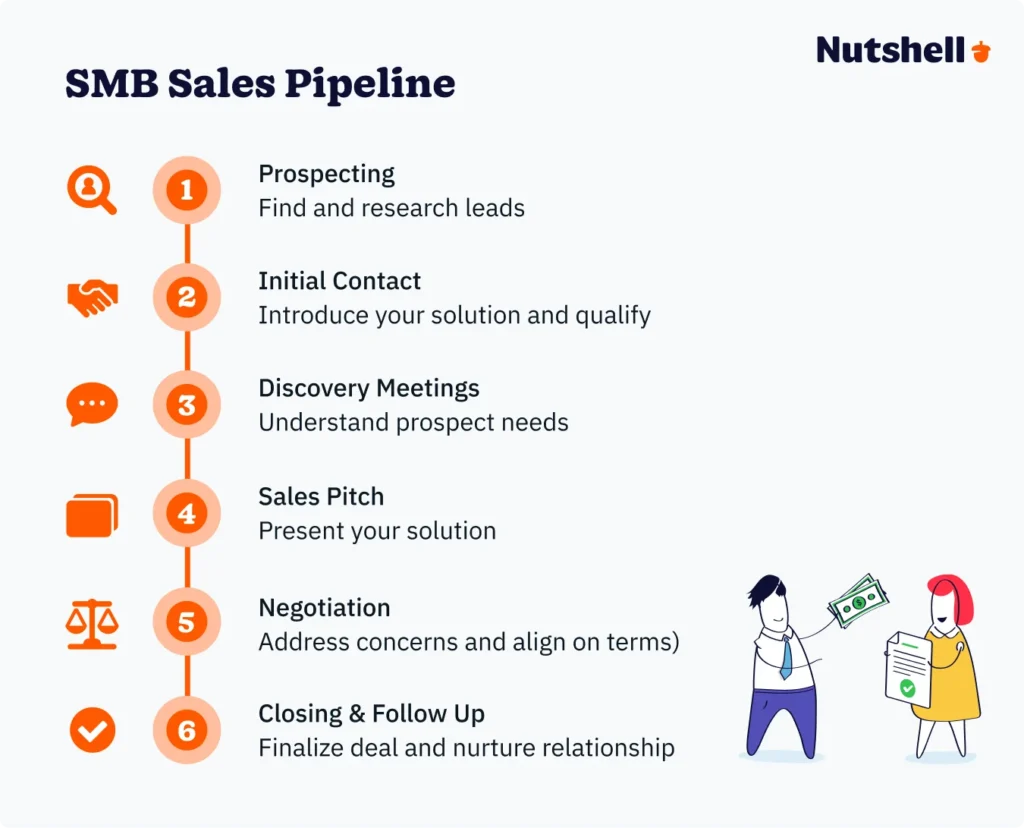
En términos generales, el canal de ventas de las PYME suele incluir estas etapas:

  • Prospección
  • Contacto inicial
  • Reuniones o llamadas de descubrimiento
  • El argumento de venta
  • Negociación
  • Cierre y seguimiento

Your process may differ slightly depending on your business model and the product or service you offer. When you clearly define the stages of your SMB sales pipeline, you get an objective step-by-step sales process that your team can follow, standardized to make it easier to observe customer behavior and sales rep performance.

horizontal flowchart showing six stages of an SMB sales pipeline from left to right with connecting arrows.

Which task should your sales reps be completing at each stage in the sales process?


If you’re unsure, our list of 101 Task Ideas for Any Sales Process


Downloadable resource image

Reduzca el ciclo de ventas

Speed is your competitive advantage. As a small business, you can’t afford long, drawn-out sales cycles. While you’re waiting 90+ days to close one deal, your competitors might be closing three deals in the same timeframe. Plus, your prospects get frustrated by slow processes. The longer your cycle, the more likely they are to choose a faster-moving competitor.

Un ciclo de ventas largo también significa que sus ventas se ralentizan, junto con sus ingresos. Las ventas son cruciales para el crecimiento de tu empresa, por lo que es imprescindible que tu proceso de ventas sea lo más eficiente y ágil posible.

Existen varios métodos para reducir la duración de su ciclo de ventas:

  • Improve your audience targeting: Don’t chase every lead. Focus on prospects that match your ideal customer profile. Look at your best customers and identify what they have in common: industry, company size, revenue, use case, buying triggers. Then target more leads like them. Higher-fit prospects move through your pipeline faster because their needs align better with your solution.
  • Address your leads’ pain points: What slows down deals in your world? Maybe prospects complain about long response times. Maybe they’re confused about pricing. Maybe your demos are too long. Identify the friction points and remove them. If response time is an issue, implement a 24-hour response SLA. If pricing clarity is the problem, publish your pricing or create a simple pricing guide. Small changes to your process can shave weeks off your cycle.
  • Automate tedious sales tasks: Manual follow-up emails, repetitive reminders, and data entry eat up rep time. Automate these tasks so reps can focus on conversations, not busywork. When a lead takes an action (downloads a resource, visits your pricing page), auto-send them a follow-up email. Set up automatic reminders when no activity in 7 days. Auto-log emails and meetings. These automations keep deals moving without adding work for your reps.

Expected results when you shorten your sales cycle:

  • Average sales cycle reduces from 60+ days to 35-45 days
  • More deals close per rep per quarter (easier quota attainment)
  • Better cash flow (revenue comes in faster)
  • Higher prospect satisfaction (faster turnaround time)
  • Competitive advantage (you’re faster than competitors)

Automatice las tareas del proceso de ventas

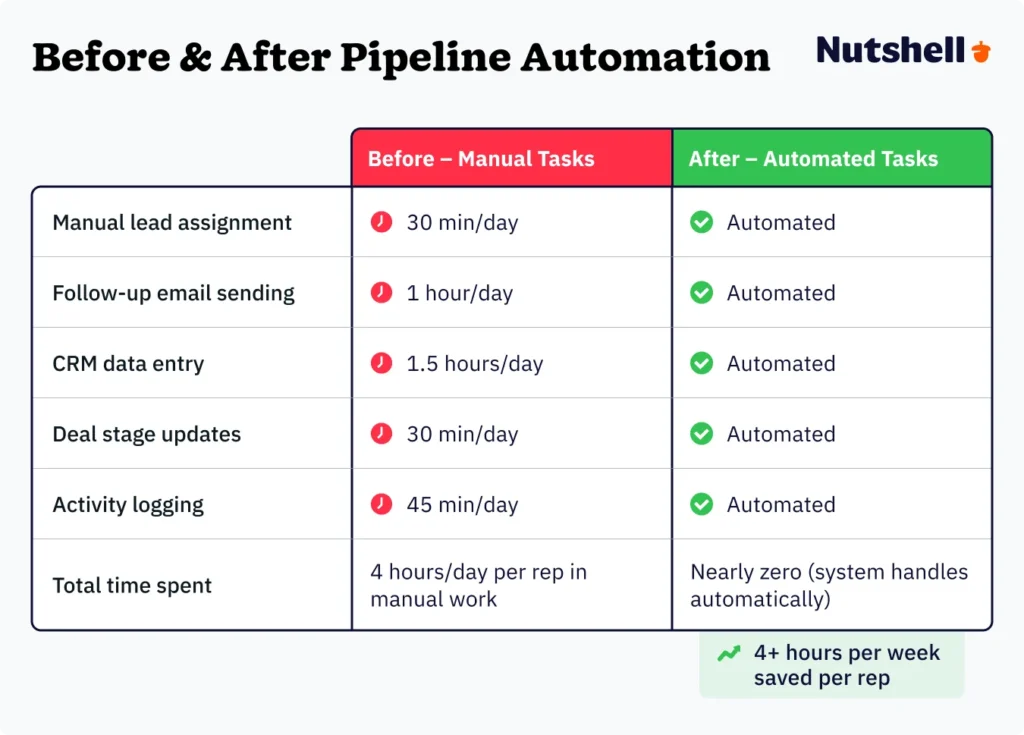
Let your CRM do the busywork. Here’s the reality of SMB sales: your reps wear multiple hats. They’re doing sales, customer service, maybe some marketing. Time is their scarcest resource. When they spend 2+ hours daily on manual data entry, sending follow-up emails, and logging activities, that’s time they’re NOT selling.

Automation fixes this. By identifying repetitive tasks and automating them, you free up your team to focus on high-value activities—discovery calls, negotiating deals, closing business.

Why it matters for SMBs: With limited team size, you can’t afford to waste rep time on busywork. Automation isn’t cold or impersonal—it’s about being smart with your resources. Let the CRM be your team’s assistant, handling the repetitive stuff, while reps focus on what only humans can do: building relationships, understanding complex needs, and closing deals.

How to automate your pipeline—five key opportunities:

Lead assignment. When a new lead comes in, manually assigning it to a rep is slow and subjective. Instead, set up automatic round-robin assignment. New leads automatically go to the next available rep based on a distribution rule you define. This prevents bottlenecks and ensures fair workload distribution.

Trigger-based workflows. Set up workflows that move deals forward automatically based on prospect actions. Example: A lead downloads your pricing guide → auto-move them to the “evaluation” stage → auto-send them a “comparison to competitors” email. These micro-automations keep deals flowing without rep intervention.

Follow-up reminders. Sales reps are human—they forget to follow up. Set up automatic reminders: if a deal has no activity in 7 days, send the rep a reminder to check in. If a deal hasn’t moved in 14 days, escalate it to a manager. These automations ensure nothing falls through the cracks.

Email sequences. Create multi-touch email sequences that trigger automatically when a prospect enters a certain stage. When someone enters your “nurture” stage, they automatically receive a 3-email sequence over two weeks. Each email is personalized with their name and company, but it goes out automatically. Reps don’t have to manually send anything.

Data logging from email/calendar. The biggest time suck for reps? Manual CRM data entry. You can eliminate this. Set up integrations that auto-log emails from Gmail/Outlook, auto-log calendar meetings, auto-add contacts. Reps focus on selling; the system handles data capture.

Expected results when you automate your pipeline:

  • Reps save 5+ hours per week on admin work
  • No deals fall through the cracks (automations catch them)
  • Faster response times (automated emails go out instantly)
  • Better data quality (no manual entry errors)
  • Reps spend 80% of their time selling, 20% on admin (instead of the reverse)

Keep your pipeline clean

You’ve defined your stages, shortened your cycle, and set up automations. Now, here’s the thing that most SMBs get wrong: they let their pipeline data decay.

Over time, deals go stale. Contacts have outdated information. Opportunities have no clear next steps. The longer this goes on, the less useful your pipeline becomes. You can’t forecast accurately. You can’t identify bottlenecks. You don’t know which deals are truly viable.

Pipeline hygiene—keeping your data clean and current—is what separates SMBs that predictably hit quota from those that constantly struggle.

Why it matters for SMBs: A clean pipeline means accurate forecasts, visible bottlenecks, better rep coaching, faster decision-making, and improved win rates. A dirty pipeline means inaccurate forecasts, lost deals, wasted rep time, poor coaching, and slower growth.

How to keep your pipeline clean—weekly and monthly habits:

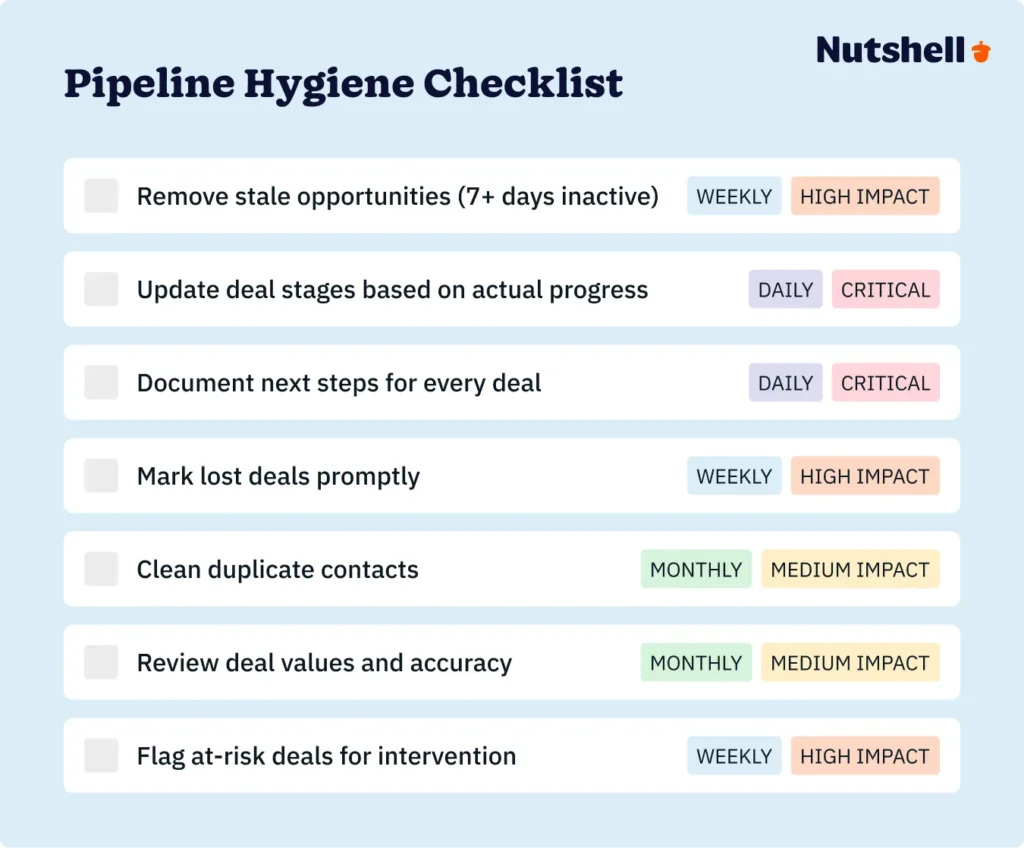
Weekly pipeline review (30 minutes): Are there deals with no activity in 7+ days? Flag them for follow-up. Are deals moving to the next stage on schedule? If not, why? Does every deal have a clear “next step” with a date? Add one if missing. Check your “stale” opportunities: remove or revive them.

Monthly pipeline audit (1 hour): What’s your conversion rate between stages? Identify the weak stage. Where are deals getting stuck (longest average duration)? What’s causing delays? How’s your average sales cycle trending? Improving or getting longer? Which lead sources produce the fastest closes? Invest more there. What’s your win/loss ratio? If declining, investigate why.

Quarterly deep review (2 hours): Has your business model changed? Update pipeline to reflect it. Should any stages be renamed or restructured? Are there new market conditions? Update your process accordingly. Do reps need new coaching? Identify skill gaps.

One critical health check: If your team marks zero deals as “lost” in a given week, it’s a red flag. It usually means deals are staying in the pipeline longer than they should, or reps aren’t being honest about what’s dead. A healthy pipeline should show some deals moving to “lost” each week—that’s how you know it’s accurate.

Expected results when you maintain pipeline hygiene:

  • Forecasts become 85%+ accurate (vs. 50-60% with dirty data)
  • Bottlenecks become visible and fixable
  • Reps stay more engaged (they see the impact of their work)
  • Win rates improve (better follow-up on viable deals)
  • You hit quota more consistently
a pipeline hygiene checklistSales pipeline hygiene checklist showing seven key maintenance tasks

Revise y actualice periódicamente su cartera de proyectos

A veces, las acciones y procesos de venta que funcionaron bien el año anterior no funcionarán el siguiente. 

O una acción de venta podría optimizarse con una nueva tecnología. 

O tal vez esté viendo un cuello de botella de clientes potenciales con los que su equipo tiene dificultades para avanzar, y necesita solucionar el problema.

Estos son sólo algunos ejemplos que indican la importancia de revisar periódicamente su canal de ventas. Es importante programar informes y auditorías periódicas para comprobar la salud de su proceso de ventas. Busca oportunidades para optimizar tu ciclo de ventas o actualizarlo para reflejar los cambios en tu modelo de negocio o producto.

Puede obtener una visión precisa del rendimiento de su canal de ventas con un CRM que disponga de funciones de elaboración de informes y análisis.

Utiliza un CRM para automatizar las fases del proceso de ventas

El software de gestión de las relaciones con los clientes (CRM) puede ser un salvavidas para gestionar el proceso de ventas de su PYME. El software CRM permite definir las etapas y acciones de venta, automatizar tareas y revisar informes sobre los cuellos de botella y el rendimiento de los comerciales.

pipeline automation before/after comparison"Side-by-side before-and-after comparison of sales pipeline task automation

With a CRM like Nutshell, you can create the perfect sales pipeline that meets your business goals and attracts your ideal customer. Go DIY with your pipeline for complete customization, or launch a Nutshell pipeline starter pack for a rapid start, ensuring your time is spent on selling, not pipeline setup.

Some of the benefits of using Nutshell CRM for your small to medium business include:

Además, si utiliza Nutshell, no tendrá que gastar mucho dinero en costosas herramientas de marketing. NutshellLos complementos nativos de se integran a la perfección con su sistema cuando desea enviar campañas de marketing por correo electrónico, crear páginas de destino y realizar análisis de la competencia, entre otras tareas de marketing cruciales.

Con modelos de precios asequibles y un sinfín de opciones de personalización e integración, Nutshell es un excelente CRM para las PYMES que desean gestionar sus flujos de ventas e impulsar el crecimiento de su negocio.

Preguntas frecuentes

  • 1. How can Nutshell help SMBs overcome common resource and time constraints in sales pipeline management?

    SMBs often operate with lean teams and limited time, making efficient sales pipeline management crucial. Nutshell is designed with these constraints in mind. It centralizes all your customer data, communications, and sales activities in one intuitive platform, eliminating the need to juggle multiple spreadsheets and tools. Features like automated task reminders, customizable sales processes, and quick data entry mean your team spends less time on administrative overhead and more time selling. By streamlining workflows and providing a clear overview of your pipeline, Nutshell empowers SMBs to maximize their existing resources and focus on high-impact activities.

  • 2. What are the most critical sales pipeline metrics SMBs should focus on in Nutshell, and how can they track them effectively?

    For SMBs, understanding which metrics truly matter can drive significant growth. In Nutshell, focus on these critical sales pipeline metrics:

    • Conversion Rate by Stage: Identify where leads are dropping off in your pipeline to pinpoint areas for improvement.
    • Average Sales Cycle Length: Understand how long it typically takes to close a deal, helping with resource allocation and forecasting.
    • Win Rate: The percentage of opportunities that turn into closed-won deals, indicating overall sales effectiveness.
    • Pipeline Value: The total potential revenue of all active deals, giving you a snapshot of future income.
    • Lead Source Performance: Track which marketing channels generate the most qualified leads and ultimately, the most revenue.

    Nutshell’s customizable dashboards and reporting tools allow you to visualize these metrics in real-time, helping you make informed decisions and optimize your sales strategy without complex data analysis.

  • 3. How does Nutshell enable SMBs to maintain a personalized sales approach while leveraging automation in their pipeline?

    SMBs often pride themselves on their personal touch, and Nutshell helps you scale that without losing authenticity. You can use Nutshell’s automation features to handle repetitive tasks, freeing up your sales team to focus on meaningful, personalized interactions. For example:

    • Automated Email Sequences: Set up personalized email drip campaigns that automatically send at specific pipeline stages, but still allow for individual customization.
    • Smart Lists for Segmentation: Segment your contacts based on specific criteria (e.g., industry, interest, last interaction) to ensure your outreach is always relevant and tailored.
    • Activity Reminders: Automate reminders for follow-up calls or meetings, ensuring no lead falls through the cracks, while still allowing your reps to craft unique messages.
    • AI-Powered Insights: Leverage Nutshell’s AI features to quickly summarize interactions or suggest next steps, giving your reps more context for personalized conversations.

    This balance of automation and personalization ensures your customers feel valued, not just processed, leading to stronger relationships and higher conversion rates.

  • 4. What are the best practices for an SMB to accurately forecast sales using Nutshell’s pipeline data?

    Accurate sales forecasting is vital for SMBs to plan resources, manage cash flow, and set realistic goals. Nutshell provides the tools to make this process more reliable:

    • Define Clear Pipeline Stages: Ensure each stage in your Nutshell pipeline has well-defined entry and exit criteria. This consistency is key for accurate data.
    • Assign Probability to Stages: Work with your sales team to assign realistic close probabilities to each pipeline stage. Nutshell can then use these probabilities to calculate weighted forecasts.
    • Regularly Update Deal Information: Encourage your team to keep deal values, close dates, and stage progressions current. Outdated information leads to inaccurate forecasts.
    • Analyze Historical Data: Use Nutshell’s reporting features to review past sales cycles, win rates, and seasonal trends. This historical context helps refine future predictions.
    • Leverage Nutshell’s Forecast Reports: Utilize the built-in forecasting tools to generate reports based on your pipeline data, allowing you to compare actuals against projections and adjust as needed.

    By maintaining a clean, up-to-date pipeline in Nutshell and regularly analyzing the data, SMBs can significantly improve their sales forecasting accuracy.

  • 5. As an SMB grows, how can Nutshell’s sales pipeline features scale to support increasing sales volume and team size?

    Growth is exciting, and Nutshell is built to scale with your SMB. As your sales volume increases and your team expands, Nutshell’s features adapt to support your evolving needs:

    • Customizable Pipelines: Easily add new stages or create multiple pipelines for different products, services, or sales teams as your business diversifies.
    • Team Management & Permissions: Assign roles and permissions to new team members, ensuring everyone has access to the right information while maintaining data security.
    • Lead Assignment Rules: Implement automated lead assignment to distribute new opportunities fairly and efficiently among a growing sales force.
    • Advanced Reporting & Analytics: As your data grows, Nutshell’s robust reporting capabilities provide deeper insights into team performance, market trends, and overall sales health.
    • Integration Ecosystem: Connect Nutshell with a wider array of marketing, support, and business intelligence tools as your tech stack expands, ensuring seamless data flow across your organization.

    Nutshell ensures that your sales pipeline remains organized, efficient, and effective, no matter how big your SMB gets.

Gestione su canal de ventas para PYME con Nutshell

Nutshell CRM es una solución todo en uno con un objetivo sencillo: ayudar a su empresa a realizar más ventas.

Si eso es lo que quieres, regístrate hoy mismo para probar gratis durante 14 días Nutshell, sin tarjeta de crédito ni datos de pago. 

Le ayudaremos a empezar lo antes posible con la importación de contactos, demostraciones en directo y visitas guiadas para que pueda empezar a trabajar de inmediato. Pruebe Nutshell hoy mismo.

Headshot

Let’s Talk

¿Tiene alguna pregunta? ¿Necesita un descuento por volumen? Envíenos un mensaje o concierte una cita con un representante de ventas para iniciar la conversación.

VOLVER ARRIBA

Únase a más de 30.000 profesionales del marketing y las ventas. Suscríbase a nuestro boletín Vender para ganar.