Overslaan naar hoofdinhoud ↓

Hoe een verkooppijplijn beheren voor KMO's

een kleine bedrijfseigenaar aan de telefoon met een tablet en dozen voor haar neus

Key Takeaways

Small and midsize businesses thrive when their sales pipeline is organized, actionable, and aligned with clear follow-up strategies.

Without the right tools, it’s easy to lose deals to missed tasks, inconsistent tracking, or poor visibility into next steps.

The takeaway? A simplified, centralized CRM helps SMBs stay focused, forecast accurately, and close more deals with less chaos.

Managing a sales pipeline might sound simple, but here’s the reality: 69% of B2B sales reps missed quota in 2025, and one of the biggest culprits? Poor pipeline management.

For SMBs especially, the stakes are high. You can’t afford missed quotas. You don’t have the luxury of long sales cycles or manual workarounds. And you certainly don’t have budget for expensive enterprise CRMs or bloated sales teams.

The good news? A well-organized sales pipeline is your secret weapon. It’s the difference between chaos and clarity—between wondering where your deals are and knowing exactly what to do next. When your pipeline is clean, transparent, and actionable, your team closes more deals, faster, and your business grows predictably.

In this guide, we’ll walk you through everything you need to know: why pipelines matter for SMBs, the concrete benefits you’ll see, the five best practices that actually work, and how to implement them starting today. Whether you’re managing your pipeline in spreadsheets or a CRM, these strategies will tighten your process and move more revenue through your door.

Let’s dive in.

DOWNLOAD

Wil je leren van de meesters?

Het Sell to Win Playbook verzamelt 55 van de beste verkooptips die we ooit hebben gepubliceerd. Download het vandaag nog!

KRIJG HET DRAAIBOEK

het Verkopen om te Winnen-playbook 55 verkooptips van experts om uw succes te vergroten

Het belang van verkooppijplijnen voor kleine en middelgrote bedrijven

Als je een klein tot middelgroot bedrijf runt, is het cruciaal om ervoor te zorgen dat je geen kostbare middelen verspilt aan zaken die uitbesteed of geautomatiseerd kunnen worden. En dat is vooral belangrijk in de verkoop.

Daarom is een verkooppijplijn een must voor kleine teams. Het helpt je salesteamleden om hun volgende actie te begrijpen en uit te voeren, te begrijpen waar de klant zich bevindt in het kooptraject en meer tijd te besteden aan het opbouwen van klantrelaties dan aan alledaagse taken die de naald niet verder helpen.

Misschien heb je al een verkooppijplijn - intuïtief of op papier (als je moet kiezen tussen de twee, zorg dan zeker voor papier). Je kunt het potentieel van je verkooppijplijn maximaliseren door best practices te implementeren. Laten we eerst eens kijken naar de voordelen van een goed beheerde verkooppijplijn voor je MKB.

Voordelen van een goed beheerde verkooppijplijn voor MKB's

De tijd nemen om je verkooppijplijn goed te beheren kan een wereld van verschil maken voor je kleine tot middelgrote bedrijf. De voordelen van een goed beheerde verkooppijplijn zijn talrijk en omvatten:

  • Verbeterde organisatie en productiviteit: U hoeft niet meer met uw vingers te draaien en u af te vragen wat u hierna moet doen. Wanneer je een geoptimaliseerde verkooppijplijn hebt om te raadplegen, zal je team altijd weten wat het nu moet doen om tot de verkoop te leiden en de naald voor je bedrijf te duwen.
  • Bespaar tijd en middelen: Als je begrijpt welke taken je kunt automatiseren (meestal administratieve, vervelende taken), heb je de macht om ze te automatiseren of uit te besteden. Dit betekent dat je getalenteerde verkopers zich kunnen concentreren op wat ze het beste kunnen: verkopen.
  • Schaalbaarheid: Uw verkooppijplijn zal groeien, evolueren en versplinteren naarmate uw bedrijf groeit. Een goed beheerde verkooppijplijn kan worden aangepast aan uw veranderende behoeften wanneer u uw kleine bedrijf uitbreidt tot een enterprise organisatie.

Best practices voor het beheren van je verkooppijplijn als MKB-bedrijf

a lady who is writing with a text overlay of the best practices for managing your SMB sales pipeline

The 5 essential best practices

Before we dive into the details, here are the five core practices that will transform your SMB sales pipeline:

  • Define your pipeline stages – Create a clear, step-by-step sales process your team can follow consistently
  • Keep your sales cycle short – Reduce time-to-close by targeting better leads and removing friction
  • Automate your sales pipeline tasks – Free up rep time for high-value activities by automating repetitive work
  • Keep your pipeline clean – Maintain data quality by regularly removing stale opportunities and updating deal information
  • Use a CRM to manage your pipeline – Leverage technology for real-time visibility, automation, and forecasting

Each of these practices builds on the others. Together, they create a sales machine that works for you—not against you.

Definieer je pijplijnfasen

The foundation of everything. If you want to optimize your sales pipeline, you need to understand what it looks like. Your team may already be following an intuitive sales process, but if it’s not documented and standardized, results will be all over the place. Some reps close deals in weeks. Others take months. There’s no consistency, no predictability, and no way to coach people to better performance.

Why it matters for SMBs: Without defined stages, you can’t forecast accurately. You can’t identify bottlenecks. You can’t coach reps on where they’re struggling. And honestly, your team gets confused about what they’re supposed to be doing at each point in the customer journey. Defined stages fix all of this.

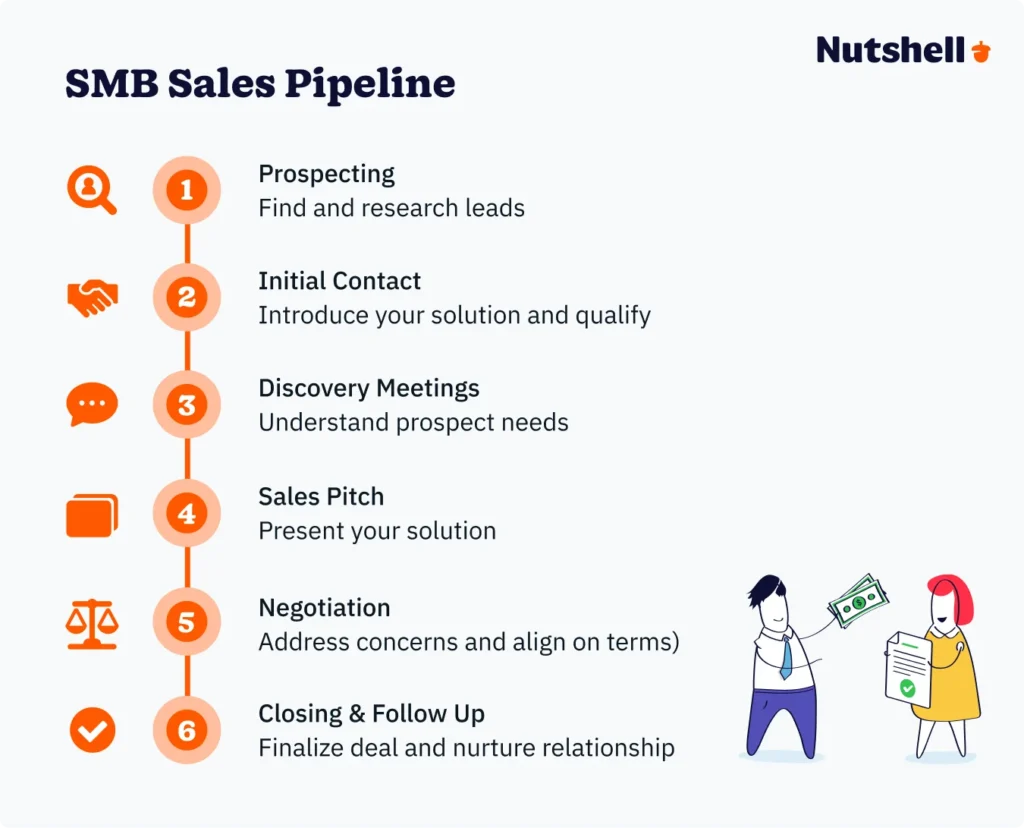
Over het algemeen omvat de verkooppijplijn voor het MKB deze fasen:

  • Prospectie
  • Eerste contact
  • Ontdekkingsbijeenkomsten of -gesprekken
  • Het verkooppraatje
  • Onderhandeling
  • Afsluiten en dan opvolgen

Your process may differ slightly depending on your business model and the product or service you offer. When you clearly define the stages of your SMB sales pipeline, you get an objective step-by-step sales process that your team can follow, standardized to make it easier to observe customer behavior and sales rep performance.

horizontal flowchart showing six stages of an SMB sales pipeline from left to right with connecting arrows.

Which task should your sales reps be completing at each stage in the sales process?


If you’re unsure, our list of 101 Task Ideas for Any Sales Process


Downloadable resource image

Houd uw verkoopcyclus kort

Speed is your competitive advantage. As a small business, you can’t afford long, drawn-out sales cycles. While you’re waiting 90+ days to close one deal, your competitors might be closing three deals in the same timeframe. Plus, your prospects get frustrated by slow processes. The longer your cycle, the more likely they are to choose a faster-moving competitor.

Een lange verkoopcyclus betekent ook dat je verkoop vertraagt, samen met je omzet. Verkoop is cruciaal voor de groei van je bedrijf, dus is het noodzakelijk om je pijplijn zo efficiënt en slank mogelijk te maken.

Er zijn een paar methoden om de lengte van je verkoopcyclus te verkorten:

  • Improve your audience targeting: Don’t chase every lead. Focus on prospects that match your ideal customer profile. Look at your best customers and identify what they have in common: industry, company size, revenue, use case, buying triggers. Then target more leads like them. Higher-fit prospects move through your pipeline faster because their needs align better with your solution.
  • Address your leads’ pain points: What slows down deals in your world? Maybe prospects complain about long response times. Maybe they’re confused about pricing. Maybe your demos are too long. Identify the friction points and remove them. If response time is an issue, implement a 24-hour response SLA. If pricing clarity is the problem, publish your pricing or create a simple pricing guide. Small changes to your process can shave weeks off your cycle.
  • Automate tedious sales tasks: Manual follow-up emails, repetitive reminders, and data entry eat up rep time. Automate these tasks so reps can focus on conversations, not busywork. When a lead takes an action (downloads a resource, visits your pricing page), auto-send them a follow-up email. Set up automatic reminders when no activity in 7 days. Auto-log emails and meetings. These automations keep deals moving without adding work for your reps.

Expected results when you shorten your sales cycle:

  • Average sales cycle reduces from 60+ days to 35-45 days
  • More deals close per rep per quarter (easier quota attainment)
  • Better cash flow (revenue comes in faster)
  • Higher prospect satisfaction (faster turnaround time)
  • Competitive advantage (you’re faster than competitors)

Automatiseer je verkooppijplijn taken

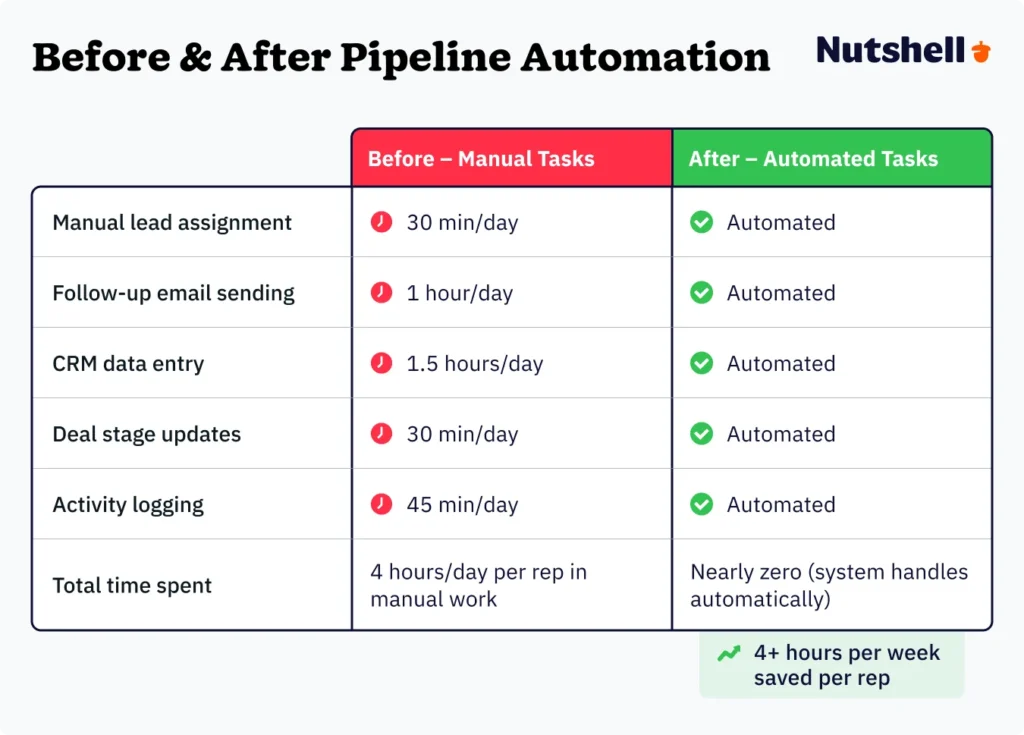
Let your CRM do the busywork. Here’s the reality of SMB sales: your reps wear multiple hats. They’re doing sales, customer service, maybe some marketing. Time is their scarcest resource. When they spend 2+ hours daily on manual data entry, sending follow-up emails, and logging activities, that’s time they’re NOT selling.

Automation fixes this. By identifying repetitive tasks and automating them, you free up your team to focus on high-value activities—discovery calls, negotiating deals, closing business.

Why it matters for SMBs: With limited team size, you can’t afford to waste rep time on busywork. Automation isn’t cold or impersonal—it’s about being smart with your resources. Let the CRM be your team’s assistant, handling the repetitive stuff, while reps focus on what only humans can do: building relationships, understanding complex needs, and closing deals.

How to automate your pipeline—five key opportunities:

Lead assignment. When a new lead comes in, manually assigning it to a rep is slow and subjective. Instead, set up automatic round-robin assignment. New leads automatically go to the next available rep based on a distribution rule you define. This prevents bottlenecks and ensures fair workload distribution.

Trigger-based workflows. Set up workflows that move deals forward automatically based on prospect actions. Example: A lead downloads your pricing guide → auto-move them to the “evaluation” stage → auto-send them a “comparison to competitors” email. These micro-automations keep deals flowing without rep intervention.

Follow-up reminders. Sales reps are human—they forget to follow up. Set up automatic reminders: if a deal has no activity in 7 days, send the rep a reminder to check in. If a deal hasn’t moved in 14 days, escalate it to a manager. These automations ensure nothing falls through the cracks.

Email sequences. Create multi-touch email sequences that trigger automatically when a prospect enters a certain stage. When someone enters your “nurture” stage, they automatically receive a 3-email sequence over two weeks. Each email is personalized with their name and company, but it goes out automatically. Reps don’t have to manually send anything.

Data logging from email/calendar. The biggest time suck for reps? Manual CRM data entry. You can eliminate this. Set up integrations that auto-log emails from Gmail/Outlook, auto-log calendar meetings, auto-add contacts. Reps focus on selling; the system handles data capture.

Expected results when you automate your pipeline:

  • Reps save 5+ hours per week on admin work
  • No deals fall through the cracks (automations catch them)
  • Faster response times (automated emails go out instantly)
  • Better data quality (no manual entry errors)
  • Reps spend 80% of their time selling, 20% on admin (instead of the reverse)

Keep your pipeline clean

You’ve defined your stages, shortened your cycle, and set up automations. Now, here’s the thing that most SMBs get wrong: they let their pipeline data decay.

Over time, deals go stale. Contacts have outdated information. Opportunities have no clear next steps. The longer this goes on, the less useful your pipeline becomes. You can’t forecast accurately. You can’t identify bottlenecks. You don’t know which deals are truly viable.

Pipeline hygiene—keeping your data clean and current—is what separates SMBs that predictably hit quota from those that constantly struggle.

Why it matters for SMBs: A clean pipeline means accurate forecasts, visible bottlenecks, better rep coaching, faster decision-making, and improved win rates. A dirty pipeline means inaccurate forecasts, lost deals, wasted rep time, poor coaching, and slower growth.

How to keep your pipeline clean—weekly and monthly habits:

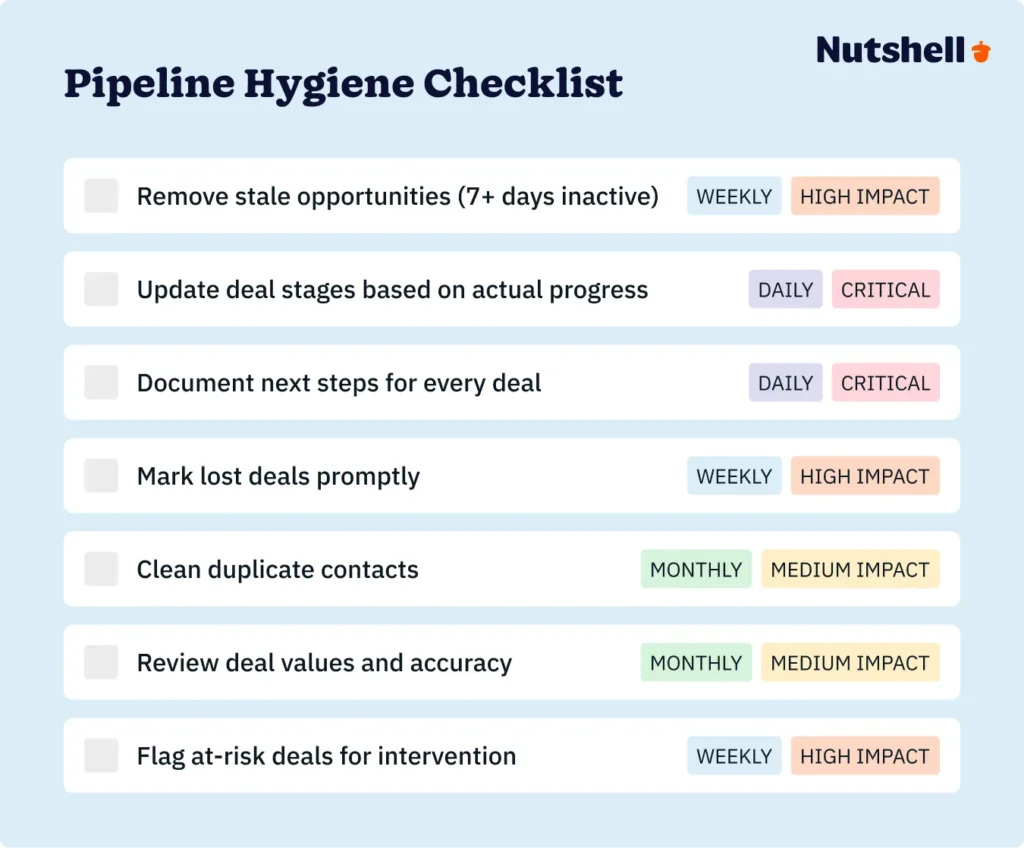
Weekly pipeline review (30 minutes): Are there deals with no activity in 7+ days? Flag them for follow-up. Are deals moving to the next stage on schedule? If not, why? Does every deal have a clear “next step” with a date? Add one if missing. Check your “stale” opportunities: remove or revive them.

Monthly pipeline audit (1 hour): What’s your conversion rate between stages? Identify the weak stage. Where are deals getting stuck (longest average duration)? What’s causing delays? How’s your average sales cycle trending? Improving or getting longer? Which lead sources produce the fastest closes? Invest more there. What’s your win/loss ratio? If declining, investigate why.

Quarterly deep review (2 hours): Has your business model changed? Update pipeline to reflect it. Should any stages be renamed or restructured? Are there new market conditions? Update your process accordingly. Do reps need new coaching? Identify skill gaps.

One critical health check: If your team marks zero deals as “lost” in a given week, it’s a red flag. It usually means deals are staying in the pipeline longer than they should, or reps aren’t being honest about what’s dead. A healthy pipeline should show some deals moving to “lost” each week—that’s how you know it’s accurate.

Expected results when you maintain pipeline hygiene:

  • Forecasts become 85%+ accurate (vs. 50-60% with dirty data)
  • Bottlenecks become visible and fixable
  • Reps stay more engaged (they see the impact of their work)
  • Win rates improve (better follow-up on viable deals)
  • You hit quota more consistently
a pipeline hygiene checklistSales pipeline hygiene checklist showing seven key maintenance tasks

Bekijk en update je pijplijn regelmatig

Soms werken verkoopacties en -processen die het vorige jaar goed werkten, het volgende jaar niet meer. 

Of een verkoopactie kan worden geoptimaliseerd met nieuwe technologie. 

Of misschien zie je een knelpunt met leads waar je team moeite mee heeft en moet je het probleem oplossen.

Dit zijn slechts een paar voorbeelden die aangeven hoe belangrijk het is om je verkooppijplijn regelmatig te controleren. Het is belangrijk om regelmatig rapporten en audits in te plannen om de gezondheid van je verkooppijplijn te controleren. Zoek naar mogelijkheden om je verkoopcyclus te optimaliseren of je pijplijn aan te passen aan veranderingen in je bedrijfsmodel of product.

Je kunt een nauwkeurig beeld krijgen van de prestaties van je verkooppijplijn met een CRM met rapportage- en analysefuncties.

Gebruik een CRM om je verkooppijplijnfasen te automatiseren

Software voor klantenrelatiebeheer (CRM) kan een redder in nood zijn voor het beheren van de verkooppijplijn van uw MKB. Met CRM-software kunt u verkoopfasen en -acties definiëren, taken automatiseren en rapporten bekijken over knelpunten in de pijplijn en de prestaties van verkopers.

pipeline automation before/after comparison"Side-by-side before-and-after comparison of sales pipeline task automation

With a CRM like Nutshell, you can create the perfect sales pipeline that meets your business goals and attracts your ideal customer. Go DIY with your pipeline for complete customization, or launch a Nutshell pipeline starter pack for a rapid start, ensuring your time is spent on selling, not pipeline setup.

Some of the benefits of using Nutshell CRM for your small to medium business include:

Bovendien hoef je geen dure marketingtools te kopen als je Nutshell gebruikt. NutshellDe native add-ons integreren naadloos met uw systeem wanneer u e-mailmarketingcampagnes wilt verzenden, landingspagina's wilt bouwen en concurrentieanalyses wilt uitvoeren, naast andere cruciale marketingtaken.

Met betaalbare prijsmodellen en eindeloze aanpassings- en integratiemogelijkheden is Nutshell een uitstekende CRM voor KMO's die hun verkooppijplijnen willen beheren en hun bedrijfsgroei willen stimuleren.

Veelgestelde vragen

  • 1. How can Nutshell help SMBs overcome common resource and time constraints in sales pipeline management?

    SMBs often operate with lean teams and limited time, making efficient sales pipeline management crucial. Nutshell is designed with these constraints in mind. It centralizes all your customer data, communications, and sales activities in one intuitive platform, eliminating the need to juggle multiple spreadsheets and tools. Features like automated task reminders, customizable sales processes, and quick data entry mean your team spends less time on administrative overhead and more time selling. By streamlining workflows and providing a clear overview of your pipeline, Nutshell empowers SMBs to maximize their existing resources and focus on high-impact activities.

  • 2. What are the most critical sales pipeline metrics SMBs should focus on in Nutshell, and how can they track them effectively?

    For SMBs, understanding which metrics truly matter can drive significant growth. In Nutshell, focus on these critical sales pipeline metrics:

    • Conversion Rate by Stage: Identify where leads are dropping off in your pipeline to pinpoint areas for improvement.
    • Average Sales Cycle Length: Understand how long it typically takes to close a deal, helping with resource allocation and forecasting.
    • Win Rate: The percentage of opportunities that turn into closed-won deals, indicating overall sales effectiveness.
    • Pipeline Value: The total potential revenue of all active deals, giving you a snapshot of future income.
    • Lead Source Performance: Track which marketing channels generate the most qualified leads and ultimately, the most revenue.

    Nutshell’s customizable dashboards and reporting tools allow you to visualize these metrics in real-time, helping you make informed decisions and optimize your sales strategy without complex data analysis.

  • 3. How does Nutshell enable SMBs to maintain a personalized sales approach while leveraging automation in their pipeline?

    SMBs often pride themselves on their personal touch, and Nutshell helps you scale that without losing authenticity. You can use Nutshell’s automation features to handle repetitive tasks, freeing up your sales team to focus on meaningful, personalized interactions. For example:

    • Automated Email Sequences: Set up personalized email drip campaigns that automatically send at specific pipeline stages, but still allow for individual customization.
    • Smart Lists for Segmentation: Segment your contacts based on specific criteria (e.g., industry, interest, last interaction) to ensure your outreach is always relevant and tailored.
    • Activity Reminders: Automate reminders for follow-up calls or meetings, ensuring no lead falls through the cracks, while still allowing your reps to craft unique messages.
    • AI-Powered Insights: Leverage Nutshell’s AI features to quickly summarize interactions or suggest next steps, giving your reps more context for personalized conversations.

    This balance of automation and personalization ensures your customers feel valued, not just processed, leading to stronger relationships and higher conversion rates.

  • 4. What are the best practices for an SMB to accurately forecast sales using Nutshell’s pipeline data?

    Accurate sales forecasting is vital for SMBs to plan resources, manage cash flow, and set realistic goals. Nutshell provides the tools to make this process more reliable:

    • Define Clear Pipeline Stages: Ensure each stage in your Nutshell pipeline has well-defined entry and exit criteria. This consistency is key for accurate data.
    • Assign Probability to Stages: Work with your sales team to assign realistic close probabilities to each pipeline stage. Nutshell can then use these probabilities to calculate weighted forecasts.
    • Regularly Update Deal Information: Encourage your team to keep deal values, close dates, and stage progressions current. Outdated information leads to inaccurate forecasts.
    • Analyze Historical Data: Use Nutshell’s reporting features to review past sales cycles, win rates, and seasonal trends. This historical context helps refine future predictions.
    • Leverage Nutshell’s Forecast Reports: Utilize the built-in forecasting tools to generate reports based on your pipeline data, allowing you to compare actuals against projections and adjust as needed.

    By maintaining a clean, up-to-date pipeline in Nutshell and regularly analyzing the data, SMBs can significantly improve their sales forecasting accuracy.

  • 5. As an SMB grows, how can Nutshell’s sales pipeline features scale to support increasing sales volume and team size?

    Growth is exciting, and Nutshell is built to scale with your SMB. As your sales volume increases and your team expands, Nutshell’s features adapt to support your evolving needs:

    • Customizable Pipelines: Easily add new stages or create multiple pipelines for different products, services, or sales teams as your business diversifies.
    • Team Management & Permissions: Assign roles and permissions to new team members, ensuring everyone has access to the right information while maintaining data security.
    • Lead Assignment Rules: Implement automated lead assignment to distribute new opportunities fairly and efficiently among a growing sales force.
    • Advanced Reporting & Analytics: As your data grows, Nutshell’s robust reporting capabilities provide deeper insights into team performance, market trends, and overall sales health.
    • Integration Ecosystem: Connect Nutshell with a wider array of marketing, support, and business intelligence tools as your tech stack expands, ensuring seamless data flow across your organization.

    Nutshell ensures that your sales pipeline remains organized, efficient, and effective, no matter how big your SMB gets.

Beheer je verkooppijplijn voor MKB's met Nutshell

Nutshell CRM is een alles-in-één oplossing met een eenvoudig doel voor ogen: uw bedrijf helpen om meer te verkopen.

Als dat klinkt als iets wat je wilt, meld je dan vandaag nog aan voor een 14-daagse gratis proefversie van Nutshell- geen creditcard of betalingsgegevens vereist. 

We helpen je zo snel mogelijk op weg met het importeren van contactpersonen, live demo's en rondleidingen, zodat je meteen aan de slag kunt. Probeer Nutshell vandaag nog!

Headshot

Let’s Talk

Heb je een vraag? Volumekorting nodig? Stuur ons een bericht of boek een afspraak met een vertegenwoordiger om het gesprek aan te gaan.

TERUG NAAR BOVEN

Sluit je aan bij 30.000+ andere verkoop- en marketingprofessionals. Schrijf je in voor onze Sell to Win nieuwsbrief!