Let’s Talk
Vous avez une question ? Vous avez besoin d'une remise sur le volume ? Envoyez-nous un message ou prenez rendez-vous avec un représentant pour entamer la conversation.
Small and midsize businesses thrive when their sales pipeline is organized, actionable, and aligned with clear follow-up strategies.
Without the right tools, it’s easy to lose deals to missed tasks, inconsistent tracking, or poor visibility into next steps.
The takeaway? A simplified, centralized CRM helps SMBs stay focused, forecast accurately, and close more deals with less chaos.
Managing a sales pipeline might sound simple, but here’s the reality: 69% of B2B sales reps missed quota in 2025, and one of the biggest culprits? Poor pipeline management.
For SMBs especially, the stakes are high. You can’t afford missed quotas. You don’t have the luxury of long sales cycles or manual workarounds. And you certainly don’t have budget for expensive enterprise CRMs or bloated sales teams.
The good news? A well-organized sales pipeline is your secret weapon. It’s the difference between chaos and clarity—between wondering where your deals are and knowing exactly what to do next. When your pipeline is clean, transparent, and actionable, your team closes more deals, faster, and your business grows predictably.
In this guide, we’ll walk you through everything you need to know: why pipelines matter for SMBs, the concrete benefits you’ll see, the five best practices that actually work, and how to implement them starting today. Whether you’re managing your pipeline in spreadsheets or a CRM, these strategies will tighten your process and move more revenue through your door.
Let’s dive in.
Le manuel Sell to Win Playbook rassemble 55 des meilleurs conseils d'experts en vente que nous ayons jamais publiés. Téléchargez-le dès aujourd'hui !
Lorsqu'on dirige une petite ou moyenne entreprise, il est essentiel de veiller à ne pas gaspiller de précieuses ressources dans des tâches qui pourraient être externalisées ou automatisées. C'est particulièrement important dans le domaine de la vente.
C'est pourquoi un pipeline de vente est indispensable pour les petites équipes. Il aide les membres de votre équipe de vente à comprendre et à exécuter leur prochaine action, à comprendre où se trouve le client dans son parcours d'achat et à passer plus de temps à établir des relations avec les clients qu'à effectuer des tâches banales qui ne font pas avancer les choses.
Vous disposez peut-être déjà d'un pipeline de vente, qu'il soit intuitif ou sur papier (si vous deviez choisir entre les deux, optez sans hésiter pour le papier). Vous pouvez maximiser le potentiel de votre pipeline de vente en mettant en œuvre les meilleures pratiques, que nous allons explorer dans un instant. Tout d'abord, examinons les avantages d'un pipeline de vente bien géré pour votre PME.
Summarize this content with AI:
Prendre le temps de gérer correctement votre pipeline de vente peut faire toute la différence pour votre petite ou moyenne entreprise. Les avantages d'un pipeline de vente bien géré sont nombreux :

Before we dive into the details, here are the five core practices that will transform your SMB sales pipeline:
Each of these practices builds on the others. Together, they create a sales machine that works for you—not against you.
The foundation of everything. If you want to optimize your sales pipeline, you need to understand what it looks like. Your team may already be following an intuitive sales process, but if it’s not documented and standardized, results will be all over the place. Some reps close deals in weeks. Others take months. There’s no consistency, no predictability, and no way to coach people to better performance.
Why it matters for SMBs: Without defined stages, you can’t forecast accurately. You can’t identify bottlenecks. You can’t coach reps on where they’re struggling. And honestly, your team gets confused about what they’re supposed to be doing at each point in the customer journey. Defined stages fix all of this.
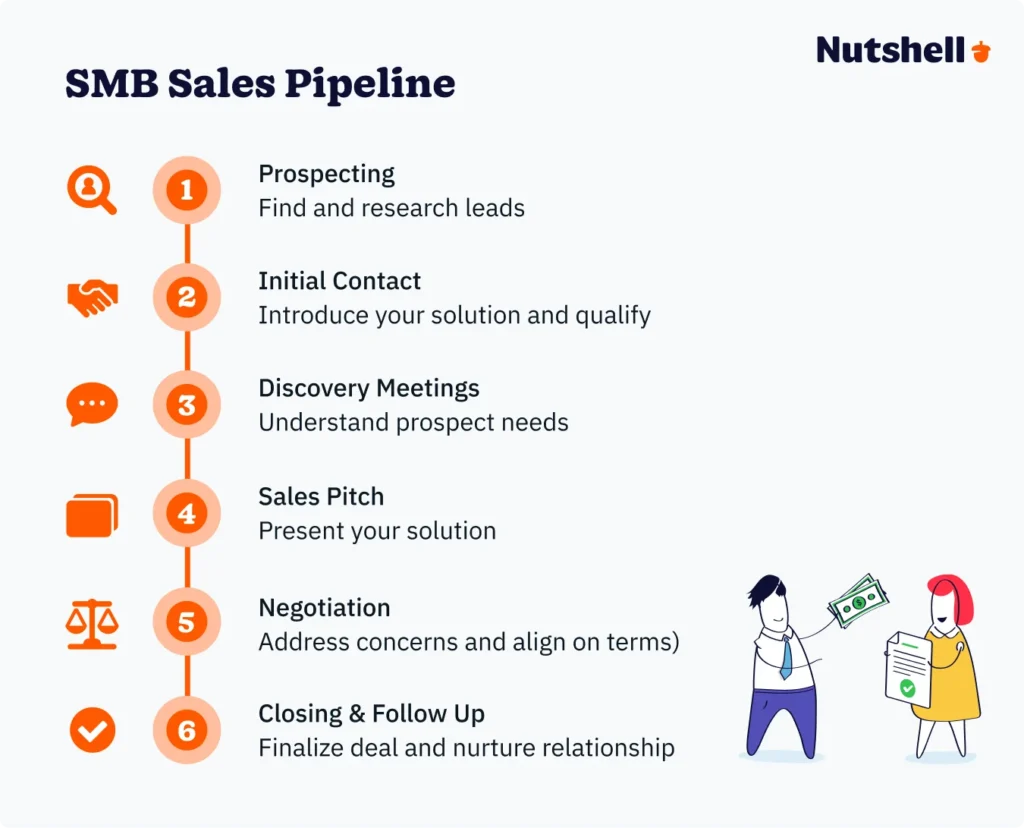
D'une manière générale, le pipeline de vente des PME comprend habituellement les étapes suivantes :
Your process may differ slightly depending on your business model and the product or service you offer. When you clearly define the stages of your SMB sales pipeline, you get an objective step-by-step sales process that your team can follow, standardized to make it easier to observe customer behavior and sales rep performance.

If you’re unsure, our list of 101 Task Ideas for Any Sales Process
Speed is your competitive advantage. As a small business, you can’t afford long, drawn-out sales cycles. While you’re waiting 90+ days to close one deal, your competitors might be closing three deals in the same timeframe. Plus, your prospects get frustrated by slow processes. The longer your cycle, the more likely they are to choose a faster-moving competitor.
Un cycle de vente long signifie également que vos ventes ralentissent, de même que votre chiffre d'affaires. Les ventes sont essentielles à la croissance de votre entreprise, il est donc impératif de rendre votre pipeline aussi efficace et léger que possible.
Il existe plusieurs méthodes pour réduire la durée de votre cycle de vente :
Expected results when you shorten your sales cycle:
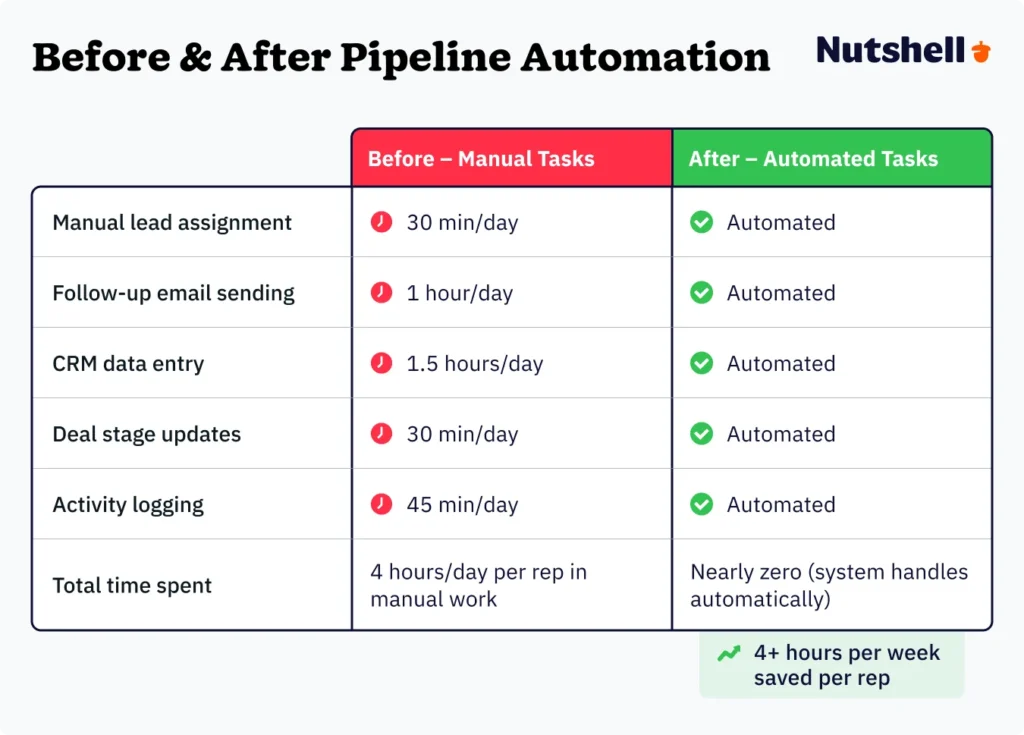
Let your CRM do the busywork. Here’s the reality of SMB sales: your reps wear multiple hats. They’re doing sales, customer service, maybe some marketing. Time is their scarcest resource. When they spend 2+ hours daily on manual data entry, sending follow-up emails, and logging activities, that’s time they’re NOT selling.
Automation fixes this. By identifying repetitive tasks and automating them, you free up your team to focus on high-value activities—discovery calls, negotiating deals, closing business.
Why it matters for SMBs: With limited team size, you can’t afford to waste rep time on busywork. Automation isn’t cold or impersonal—it’s about being smart with your resources. Let the CRM be your team’s assistant, handling the repetitive stuff, while reps focus on what only humans can do: building relationships, understanding complex needs, and closing deals.
Lead assignment. When a new lead comes in, manually assigning it to a rep is slow and subjective. Instead, set up automatic round-robin assignment. New leads automatically go to the next available rep based on a distribution rule you define. This prevents bottlenecks and ensures fair workload distribution.
Trigger-based workflows. Set up workflows that move deals forward automatically based on prospect actions. Example: A lead downloads your pricing guide → auto-move them to the “evaluation” stage → auto-send them a “comparison to competitors” email. These micro-automations keep deals flowing without rep intervention.
Follow-up reminders. Sales reps are human—they forget to follow up. Set up automatic reminders: if a deal has no activity in 7 days, send the rep a reminder to check in. If a deal hasn’t moved in 14 days, escalate it to a manager. These automations ensure nothing falls through the cracks.
Email sequences. Create multi-touch email sequences that trigger automatically when a prospect enters a certain stage. When someone enters your “nurture” stage, they automatically receive a 3-email sequence over two weeks. Each email is personalized with their name and company, but it goes out automatically. Reps don’t have to manually send anything.
Data logging from email/calendar. The biggest time suck for reps? Manual CRM data entry. You can eliminate this. Set up integrations that auto-log emails from Gmail/Outlook, auto-log calendar meetings, auto-add contacts. Reps focus on selling; the system handles data capture.
Expected results when you automate your pipeline:
You’ve defined your stages, shortened your cycle, and set up automations. Now, here’s the thing that most SMBs get wrong: they let their pipeline data decay.
Over time, deals go stale. Contacts have outdated information. Opportunities have no clear next steps. The longer this goes on, the less useful your pipeline becomes. You can’t forecast accurately. You can’t identify bottlenecks. You don’t know which deals are truly viable.
Pipeline hygiene—keeping your data clean and current—is what separates SMBs that predictably hit quota from those that constantly struggle.
Why it matters for SMBs: A clean pipeline means accurate forecasts, visible bottlenecks, better rep coaching, faster decision-making, and improved win rates. A dirty pipeline means inaccurate forecasts, lost deals, wasted rep time, poor coaching, and slower growth.
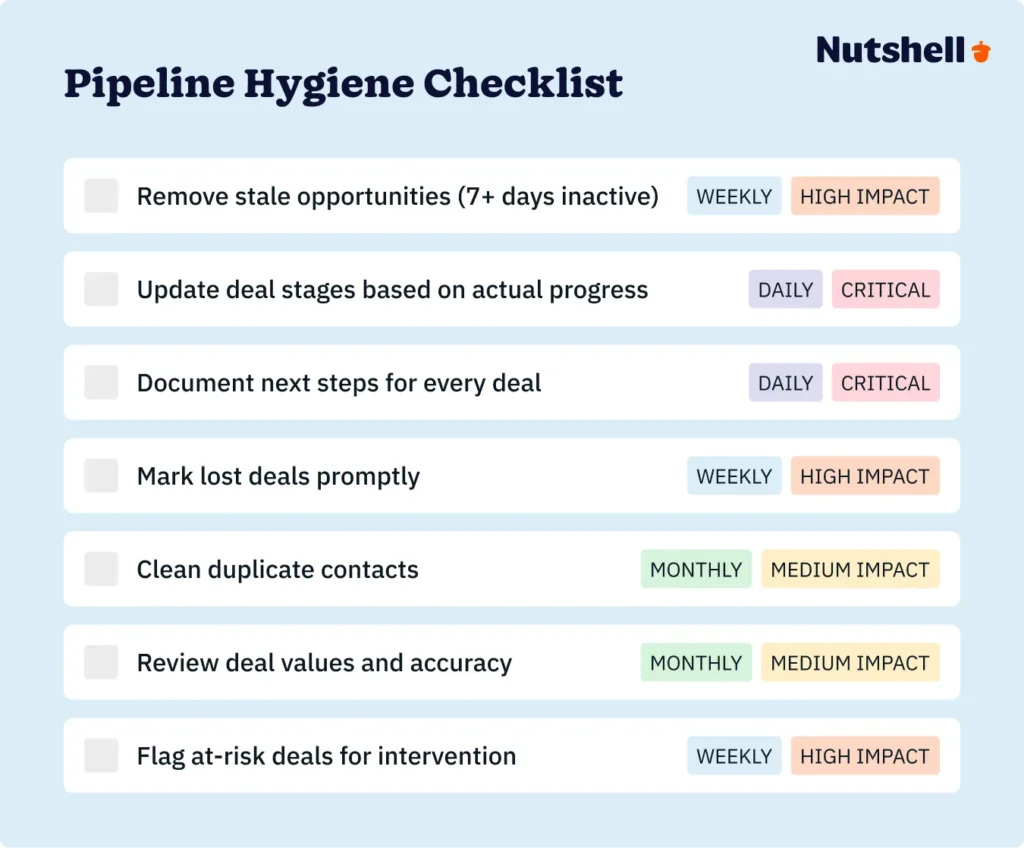
How to keep your pipeline clean—weekly and monthly habits:
Weekly pipeline review (30 minutes): Are there deals with no activity in 7+ days? Flag them for follow-up. Are deals moving to the next stage on schedule? If not, why? Does every deal have a clear “next step” with a date? Add one if missing. Check your “stale” opportunities: remove or revive them.
Monthly pipeline audit (1 hour): What’s your conversion rate between stages? Identify the weak stage. Where are deals getting stuck (longest average duration)? What’s causing delays? How’s your average sales cycle trending? Improving or getting longer? Which lead sources produce the fastest closes? Invest more there. What’s your win/loss ratio? If declining, investigate why.
Quarterly deep review (2 hours): Has your business model changed? Update pipeline to reflect it. Should any stages be renamed or restructured? Are there new market conditions? Update your process accordingly. Do reps need new coaching? Identify skill gaps.
One critical health check: If your team marks zero deals as “lost” in a given week, it’s a red flag. It usually means deals are staying in the pipeline longer than they should, or reps aren’t being honest about what’s dead. A healthy pipeline should show some deals moving to “lost” each week—that’s how you know it’s accurate.
Expected results when you maintain pipeline hygiene:

Parfois, les actions et processus de vente qui ont bien fonctionné l'année précédente ne fonctionneront pas l'année suivante.
Ou encore, une action de vente pourrait être optimisée grâce à une nouvelle technologie.
Ou peut-être constatez-vous un goulot d'étranglement au niveau des pistes que votre équipe a du mal à traiter, et vous devez résoudre le problème.
Ce ne sont là que quelques exemples qui montrent l'importance d'un examen régulier de votre pipeline de vente. Il est important de prévoir des rapports et des audits réguliers pour vérifier l'état de votre pipeline de vente. Cherchez à optimiser votre cycle de vente ou à actualiser votre pipeline pour tenir compte des changements apportés à votre modèle d'entreprise ou à votre produit.
Vous pouvez obtenir une vision précise des performances de votre pipeline de vente grâce à un système de gestion de la relation client (CRM) doté de fonctions de reporting et d'analyse.
Les logiciels de gestion de la relation client (CRM) peuvent être d'une aide précieuse pour la gestion du pipeline de vente de votre PME. Il vous permet de définir les étapes et les actions de vente, d'automatiser les tâches et de consulter des rapports sur les goulets d'étranglement et les performances des commerciaux.

With a CRM like Nutshell, you can create the perfect sales pipeline that meets your business goals and attracts your ideal customer. Go DIY with your pipeline for complete customization, or launch a Nutshell pipeline starter pack for a rapid start, ensuring your time is spent on selling, not pipeline setup.
Some of the benefits of using Nutshell CRM for your small to medium business include:
En outre, lorsque vous utilisez Nutshell, vous n'avez pas besoin d'acheter des outils de marketing coûteux. NutshellLes modules complémentaires natifs de s'intègrent parfaitement à votre système lorsque vous souhaitez envoyer des campagnes de marketing par courrier électronique, créer des pages d'atterrissage et effectuer des analyses de la concurrence, entre autres tâches de marketing cruciales.
Avec des modèles de prix abordables et des options de personnalisation et d'intégration infinies, Nutshell est un excellent CRM pour les PME qui souhaitent gérer leurs pipelines de vente et stimuler la croissance de l'entreprise.
SMBs often operate with lean teams and limited time, making efficient sales pipeline management crucial. Nutshell is designed with these constraints in mind. It centralizes all your customer data, communications, and sales activities in one intuitive platform, eliminating the need to juggle multiple spreadsheets and tools. Features like automated task reminders, customizable sales processes, and quick data entry mean your team spends less time on administrative overhead and more time selling. By streamlining workflows and providing a clear overview of your pipeline, Nutshell empowers SMBs to maximize their existing resources and focus on high-impact activities.
For SMBs, understanding which metrics truly matter can drive significant growth. In Nutshell, focus on these critical sales pipeline metrics:
Nutshell’s customizable dashboards and reporting tools allow you to visualize these metrics in real-time, helping you make informed decisions and optimize your sales strategy without complex data analysis.
SMBs often pride themselves on their personal touch, and Nutshell helps you scale that without losing authenticity. You can use Nutshell’s automation features to handle repetitive tasks, freeing up your sales team to focus on meaningful, personalized interactions. For example:
This balance of automation and personalization ensures your customers feel valued, not just processed, leading to stronger relationships and higher conversion rates.
Accurate sales forecasting is vital for SMBs to plan resources, manage cash flow, and set realistic goals. Nutshell provides the tools to make this process more reliable:
By maintaining a clean, up-to-date pipeline in Nutshell and regularly analyzing the data, SMBs can significantly improve their sales forecasting accuracy.
Growth is exciting, and Nutshell is built to scale with your SMB. As your sales volume increases and your team expands, Nutshell’s features adapt to support your evolving needs:
Nutshell ensures that your sales pipeline remains organized, efficient, and effective, no matter how big your SMB gets.
Nutshell Le CRM est une solution tout-en-un dont l'objectif est simple : aider votre entreprise à réaliser davantage de ventes.
Si cela vous tente, inscrivez-vous dès aujourd'hui pour un essai gratuit de 14 jours sur Nutshell- aucune carte de crédit ou information de paiement n'est requise.
Nous vous aiderons à démarrer le plus rapidement possible grâce à l'importation de contacts, à des démonstrations en direct et à des visites guidées, afin que vous puissiez vous lancer rapidement. Essayez Nutshell dès aujourd'hui !
Vous avez une question ? Vous avez besoin d'une remise sur le volume ? Envoyez-nous un message ou prenez rendez-vous avec un représentant pour entamer la conversation.
Rejoignez plus de 30 000 professionnels de la vente et du marketing. Inscrivez-vous à notre lettre d'information Vendre pour gagner !