Power up your consultative selling with Nutshell!
Try Nutshell free for 14 days or let us show you around before you dive in.
Consultative selling is often regarded as one of the most effective sales strategies. Yet, a majority of sellers don’t have the requisite skills to execute it effectively—and for good reason. In today’s B2B landscape, buyers have fundamentally changed how they want to engage with salespeople.
B2B buyers spend approximately 70% of their buying journey doing their own research before ever talking to a vendor. They’ve already read reviews, compared competitors, and formed initial preferences. When they do reach out, they don’t want another product pitch—they want a trusted advisor who understands their challenges.
The numbers back this up. Research shows that 86% of business buyers are more likely to purchase if companies understand their goals, yet 59% say most sales reps don’t take the time to understand them. That gap? It’s your competitive advantage.
This is where consultative selling powered by customer insights becomes essential. It’s not just about asking better questions—it’s about combining genuine curiosity with data-driven insights to guide prospects toward solutions that actually solve their problems.
In this guide, we’ll show you how to master consultative selling and leverage customer insights to transform your sales team into trusted advisors.
Consultative selling (or “needs-based selling”) is a sales approach where the salesperson acts as a consultant or advisor to the customer. The primary goal is to build a relationship with the customer and understand their needs before recommending a product or service.
The process involves asking the right questions, then using their responses to ask even more pertinent questions that help you hone in on the perfect solution.
One of the challenges of consultative selling is that the conversation is steered by your customers—as it should be. While this allows you to gather useful insights about customer problems, you may not always have the right solutions to offer during the first call. Consequently, SDRs are often forced to go back to the drawing board in order to formulate the right solution, creating a delay in the sales cycle that could potentially lose them a customer.
This problem could be avoided by integrating consultative selling with what is known as insights selling. Here, the salesperson is more in control of the conversation and provides the potential customer with information and facts that serve to enrich their understanding of their industry, your product, and the way you would solve their business’s problems.
The integrated consultative-insights selling process typically works like this: The SDR asks the potential buyer a series of questions to get deeper insights into their problems and needs, and nurtures discussion through an insights-based approach. This way, you can continue to ask questions that help you understand customer problems while retaining control over the conversation itself.
The sales landscape has fundamentally shifted. Traditional product-focused selling—where reps lead with features and push for quick closes—is becoming obsolete. Here’s why consultative selling is now essential:
Modern B2B buyers are self-educated. They’ve done their research. What they lack is clarity about their own challenges, the real costs of their problems, and which solution will get them there fastest. They want a partner who understands their business, not a salesperson hawking features.
Companies that adopt a consultative approach see measurable results:
With 61% of B2B buyers preferring a “rep-free” buying experience, you might think sales teams are becoming obsolete. The opposite is true. When reps transform into consultative advisors—rather than pushy vendors—they become more valuable than ever. They fill the gap between self-directed research and confident decision-making.
Research shows that consumers are 1.7x more likely to purchase more from brands they trust. For B2B sales, this means building genuine relationships based on understanding, not manipulation. Consultative selling naturally builds this trust because it’s fundamentally about helping the customer succeed, not just closing a deal.
In saturated markets, the difference between winning and losing often comes down to buyer experience. Organizations that master consultative selling create relationships that stick around—through multiple deals, over years. That’s a competitive advantage that can’t be easily replicated.
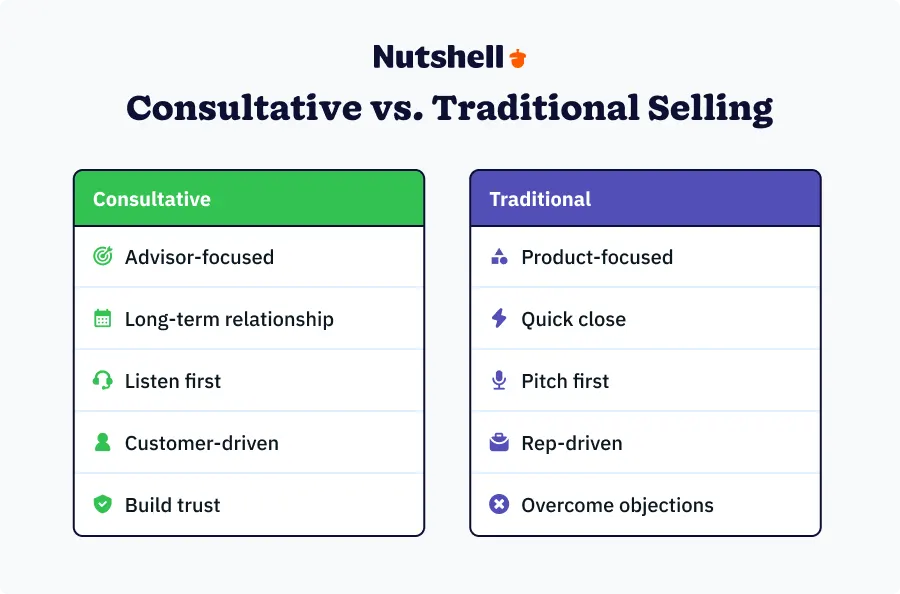
It’s helpful to understand how consultative selling differs from traditional, transactional sales approaches:
| Aspect | Consultative Selling | Traditional Selling |
| Primary Goal | Build long-term relationship and understand customer needs | Close the deal quickly |
| Focus | Customer’s challenges and success | Product features and benefits |
| Conversation Style | Customer-led; rep asks questions and listens | Rep-led; rep delivers pitch |
| Sales Cycle | Longer, but more predictable and larger deals | Shorter, but more competitive and smaller deals |
| Objection Handling | Addresses underlying concerns through dialogue | Overcomes objections through rebuttals |
| Trust-Building | Earned through genuine understanding and advice | Built on product credibility |
| Customer Loyalty | High; customers become advocates | Variable; transactional relationships |
| Rep Role | Trusted advisor and partner | Product expert and closer |
| Measurement | Customer satisfaction, retention, referrals, deal size | Win rate, sales velocity, quota attainment |
The Sell to Win Playbook collects 55 of the best expert sales tips we’ve ever published. Download it today!
Traditional selling can close deals quickly, but consultative selling builds relationships that generate repeat business, referrals, and larger deals over time. In today’s market where 70% of the buying journey happens without you, consultative selling positions you for sustainable revenue growth.
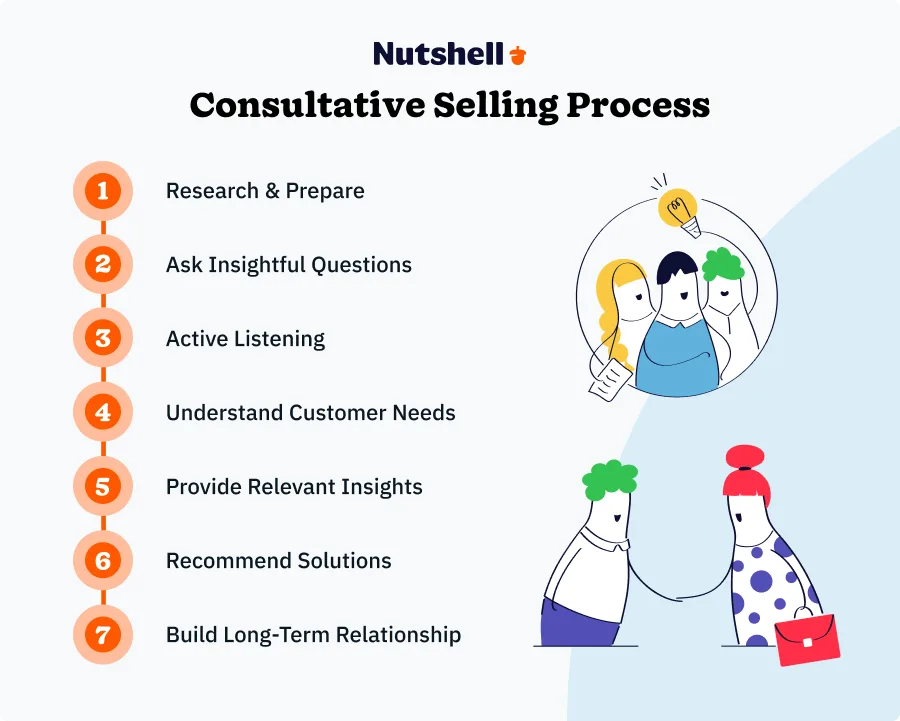
While consultative selling isn’t about following a rigid script, there is a natural rhythm to how successful consultative conversations flow. Here’s how to structure your approach:
Before any conversation, do your homework. Understand the prospect’s industry, company size, recent news (funding, new hires, mergers), and their likely challenges based on similar companies you work with. Use LinkedIn, company websites, and industry publications to build context.
Open your conversation with thoughtful, open-ended questions designed to uncover their real situation. Avoid “yes or no” questions. Instead, ask:
This is where most salespeople fail. They listen just enough to find a hook for their next talking point. Instead, practice genuine active listening. Take notes. Notice emotional cues. Read between the lines for unstated needs.
Why it matters: Active listening reveals both stated and hidden problems. It builds rapport and gives you the real information you need to offer relevant solutions.
Reflect back what you’ve heard to confirm understanding: “It sounds like you’re dealing with three main issues: [A], [B], and [C]. Do I have that right?” This accomplishes two things—it proves you were listening, and it clarifies priorities.
Now it’s your turn to add value. Share insights from your experience with similar companies. Provide data or context they may not have considered. Example: “Many companies we work with discover that 15% of their users leave because they can’t reach a live person for support. Have you looked at that metric?”
Only now—after understanding their situation and providing insights—should you recommend solutions. And here’s the key: your recommendation should feel like a natural conclusion to the conversation, not a hard sell. The prospect should feel that you’ve recommended what’s best for them, even if they ultimately choose a competitor.
Training your sales force to leverage customer insights for and from the buyer may not always be easy. One reason for this is that insights selling is still an emerging area of sales training and there aren’t many trainers who have adequate experience with it.
While it may not be possible to derive insights about specific customers without access to their internal data, you can still gather insights at a demographic or category level. These insights become the foundation for smarter consultative conversations.
For instance, if your business sells accounting software, you may have recognized that the accounting tool features requested by small and medium business clients differ significantly from what enterprise clients seek. Such insights can be derived through user analytics data from your own website, marketing assets, and customer conversations.
But merely providing these insights to your sales team isn’t sufficient. Proper sales training involves enabling your sales force to deploy them tactfully within a consultative context. Here are proven ways to do this:
Success in consultative selling depends on asking the right questions at the right time. The most optimal way to build a question bank is to create a database of questions your SDRs have asked over time, along with the responses they received.
Tag each question with context: the prospect’s industry, company size, and primary pain points. Over time, you’ll build not just a sizeable database of effective questions, but also data showing which questions have the highest impact on conversion rates.
Once you identify questions that consistently generate great responses, work backward to build actionable customer insights surrounding those questions. These become the talking points your consultative sellers use in real conversations.
Example: If “What percentage of your team spends time on manual data entry?” consistently leads to strong discovery conversations, that tells you that manual processes are a pain point in your target market. You can then research industry benchmarks (e.g., “Average sales teams spend 6 hours per week on manual CRM entry”), which becomes an insight you share to reframe how prospects think about their processes.
Consultative selling demands that SDRs actively listen to stated problems and expectations, then infer unstated needs. A successful execution relies on asking follow-up questions that address these implicit concerns.
Example: A prospect says, “We’ve had poor user retention this year.” A basic response is “That sounds challenging.” A consultative response might be: “You mentioned poor retention. Do you know how many users leave specifically because they couldn’t reach someone for support?” Most times, your buyer won’t have that specific data. This opens the door for you to provide an insight: “Our internal studies show that 15% of website visitors close a site when they’re unable to chat with someone live. It’s often one of the biggest retention drivers.”
Notice what happened: You didn’t push your product. You provided context that helped them see their problem differently. You positioned yourself as someone with expertise and perspective.
Ready to become the best sales manager for your team? Get 70+ leading tips and strategies from the experts for sales management success with our Sales Manager’s Survival Guide.
Trust isn’t given—it’s earned through consistent demonstration that you have the prospect’s best interests in mind. In consultative selling, trust-building is baked into every interaction.
Remember details from previous conversations. When you reference something a prospect mentioned in a past call—their specific challenge, their timeline, their team structure—it signals that you were truly listening. This small gesture demonstrates respect and builds credibility.
Admit what you don’t know. Paradoxically, saying “I don’t know, but I’ll find out and get back to you” builds more trust than overconfident speculation. It shows intellectual honesty and commitment to helping, not just closing.
Provide value before asking for anything. Share relevant insights, industry benchmarks, or helpful resources even when there’s no immediate opportunity for a sale. This generosity positions you as a partner, not a vendor squeezing them for money.
Follow through on commitments. If you say you’ll send something by Tuesday, send it Monday. If you commit to a call at 2 PM, be ready at 1:55 PM. Reliability compounds trust over time.
Listen more than you speak. Research shows that reps who spend more time listening than pitching build stronger relationships. Aim for a 70/30 rule: 70% listening, 30% speaking.
Focus on their success, not your commission. Sometimes the most consultative thing you can do is recommend they wait, invest in internal capabilities first, or choose a competitor’s solution because it’s genuinely better for their situation. This counterintuitive approach builds enormous trust and often results in future opportunities.
Here’s what matters for your bottom line: Companies that prioritize trust-building through consultative selling see measurable results. Higher win rates on qualified opportunities, larger average deal sizes, stronger customer retention, and more referrals. Trust converts.
In an environment where 61% of buyers want to avoid sales conversations, trust is what makes them want to talk to you.
Most times, your buyer may not have specific data related to these questions, which allows you to provide insights to steer the conversation in the direction you want to move towards. In the example above, you could follow this question with an insight like, “Our internal studies show that 15% of website visitors close a site when they are unable to chat with sales support.”
Sales force training is ultimately an exercise in training your SDRs to think from the perspective of their customers. Understanding a customer’s pain point and knowing what could potentially satisfy them goes a long way in not only formulating the best consultative-insights based sales approach, but also in providing your product team with the customer insights that could help them build a better solution for your buyers.
Author Bio: Anand Srinivasan is the founder of Hubbion, a suite of free apps and resources. Hubbion’s project management app has been ranked among the top 20 apps in its category by Capterra.
Try Nutshell free for 14 days or let us show you around before you dive in.
Consultative selling focuses on asking questions to understand customer needs, then recommending solutions. Insight selling goes further by proactively bringing new perspectives and data-backed ideas that challenge the buyer’s assumptions. The best approach combines both: use consultative questions to understand needs while leading with insights that reframe how customers think about their challenges.
Track customer satisfaction scores, retention rates, and repeat purchase frequency alongside traditional metrics. Monitor average deal size, sales cycle length, and win rates. Key indicators include customer referrals, cross-sell opportunities, and the quality of relationships built. Calculate ROI by comparing revenue from consultative deals against training and implementation costs to demonstrate long-term value.
Teams often talk too much instead of listening, focus on product features rather than customer problems, or fail to build genuine rapport. Other pitfalls include asking surface-level questions without digging deeper, neglecting follow-up after discovery, and lacking the business acumen to provide valuable insights. Overemphasis on product knowledge without understanding the customer’s industry context also undermines consultative effectiveness.
Initial training typically takes 3 months for reps to be ready to interact with buyers using consultative techniques. Expect 9 months for competent performance and 15 months to reach top-performer status. This timeline shortens significantly with strong sales management, ongoing coaching, reinforcement activities, and a structured curriculum. Organizations with robust enablement programs can cut ramp-up time by 50% or more.
Look for CRMs with robust contact management to track conversation history, customer analytics to identify patterns and trends, and pipeline management to monitor deal progression. Essential features include activity tracking for follow-ups, reporting dashboards for insights, and integration with data sources. Nutshell’s CRM offers these capabilities plus AI-powered tools to help reps personalize outreach and maintain context across every customer interaction.
Join 30,000+ other sales and marketing professionals. Subscribe to our Sell to Win newsletter!