Zum Hauptinhalt springen ↓

What is Quote Management Software, and Does Your Small Business Need It?


Abstract illustration representing quote management software approval workflow

Key takeaways

  • Speed is the deciding factor: 35% to 50% of B2B deals go to the vendor who responds first—prospects contact multiple vendors simultaneously and buy from whoever gets there first.
  • Quote management software automates the workflow: The create → send → track → accept process happens inside one tool, cutting turnaround from hours to minutes and eliminating duplicate data entry between systems.
  • CRM integration is the real differentiator: Standalone quoting tools speed up document creation, but CRM-integrated quoting connects your quotes directly to your pipeline, lead records, and follow-up sequences—so the entire deal lifecycle lives in one place.
  • The inflection point is real: Brothers Leather Supply, a Michigan-based leather goods brand, was running entirely on spreadsheets before switching to Nutshell—and achieved 40% month-over-month growth by 2016. Most small businesses hit a similar wall before they act.
  • Flat-fee pricing makes it accessible: Nutshell’s Quotes & Invoices add-on is currently priced at $67 per month for your entire company—not per seat—making professional quoting affordable even for small and growing teams.

If you’re building quotes in Word, emailing PDFs with no tracking, and following up by guessing, you’re not just losing time—you’re losing deals you don’t even know you’re competing for.

Research from Google and the Corporate Executive Board shows that 35% to 50% of B2B deals go to the vendor who responds first. In markets where prospects are contacting three to four vendors simultaneously, your quoting speed is a direct competitive variable—not a back-office inconvenience.

Quote management software fixes this by centralizing every step of the quoting process—creation, delivery, tracking, and acceptance—inside a single system connected to your sales data. In this guide, we’ll cover what quote management software actually is, how to recognize when you’ve outgrown manual quoting, what features matter most for small businesses, and how to get up and running without a complicated IT project.

As Chris Cain, VP of Product Development at Nutshell, wrote in the Nutshell Quotes launch post: “In sales, speed matters. Delivering quick, professional quotes impresses your prospects and gives your team a head start in winning the business.

What is quote management software?

Quote management software is a tool that enables sales teams to create, send, track, and receive acceptance on price quotes—all within a single system. Rather than assembling documents manually and waiting to hear back, quote management software automates the routine steps so reps can focus on the conversation, not the paperwork. The best solutions connect directly to a CRM, pulling in lead, contact, and product data to populate quotes automatically.

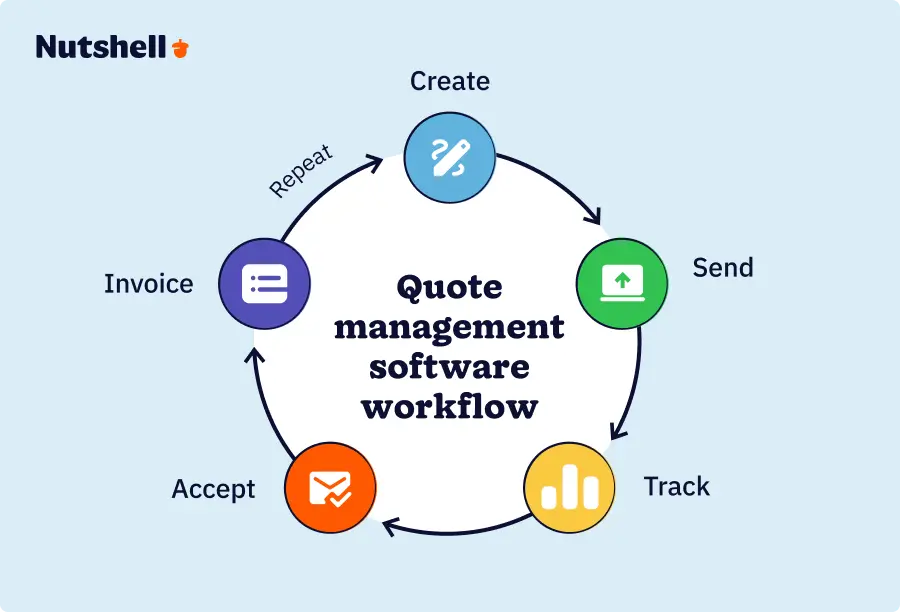
Here’s how the end-to-end workflow unfolds:

  1. Create: Build a professional, branded quote using a template pre-populated with CRM data; no copy-pasting from spreadsheets or digging for pricing.
  2. Send: Deliver the quote via email, shareable link, or PDF download directly from your sales platform, without switching tools.
  3. Track: Receive real-time notifications when the prospect opens, views, or engages with the quote, so you know exactly where it stands.
  4. Accept: The prospect approves with a click or e-signature, and the deal moves forward in your pipeline automatically.
Diagram showing the quote management software workflow from creation to invoice

Here’s how that compares to the manual approach most small businesses start with:

Manual quotingQuote management software
Word/Excel templatesBranded templates with auto-fill
Email attachment, no trackingShareable link with open/view/accept alerts
Follow up by guessingFollow up when prospect engages
Separate from CRM dataPulls directly from CRM lead records
Invoice created separatelyQuote converts directly to invoice

Signs your small business has outgrown manual quoting

You’re ready for quote management software when your current process is costing you time, consistency, or deals you should be winning. Manual quoting tends to work fine at first—a few quotes a week, a template that mostly holds up, a rhythm that feels manageable. But there’s a specific moment when the friction stops being inconvenient and starts being expensive. Here are the clearest signals you’ve reached it:

  • You’re spending 45-plus minutes per quote: Manual quoting is one of the most time-intensive tasks in a small business sales process. Multiply that across 10 to 15 quotes per week and you’re looking at more than eight hours—an entire workday—spent on document assembly instead of selling.
  • You have no visibility after hitting send: Once a PDF leaves your outbox, you don’t know if the prospect opened it, forwarded it to a decision-maker, or let it sit unread for a week. Without engagement data, you’re guessing at the right moment to follow up—and guessing wrong costs deals.
  • Your reps are quoting inconsistently: When every rep builds from their own version of the template, pricing discrepancies and off-brand presentations become inevitable. Inconsistent quoting creates internal confusion and signals disorganization to the prospects who notice.
  • Your data lives in three or more tools: If customer information is in your CRM, pricing is in a spreadsheet, and quotes are being drafted in Word, you’re re-entering the same data every time. That repetition isn’t just friction—it’s a recurring source of error that erodes trust with prospects.
  • You’re following up by guessing: Without knowing whether a prospect has even opened your quote, follow-up is a coin flip. Reaching out before they’ve looked signals impatience; waiting too long means the conversation has cooled. Neither outcome serves you.

Sound familiar? Moving from spreadsheets to a CRM is often the first step—and the impact shows up quickly once everything lives in one place. We’ll look at a real example of this in the next section.

Ready to upgrade from spreadsheets to a CRM?  

Try Nutshell free for 14 days—no credit card required.


What to look for in quote management software

Not all quoting tools are built the same, and for small businesses, the difference between a standalone tool and a CRM-integrated solution is significant. The right platform eliminates friction across the entire deal lifecycle—not just the document creation step. Here are the features that matter most:

  • CRM integration: Quotes should auto-populate from existing lead and contact data in your CRM. No manual data entry means fewer errors, faster turnaround, and a single source of truth from first contact through closed deal.
  • Branded templates: Professional, consistent presentation signals credibility. Every quote your team sends should look like it came from the same business—not a patchwork of individually styled documents that vary by rep.
  • Real-time tracking and notifications: Reps should know the moment a prospect opens, views, or accepts a quote. This turns follow-up from guesswork into a well-timed conversation that happens when engagement is highest.
  • One-click acceptance or e-signature: Friction at the “yes” moment costs deals. The simpler it is for a prospect to approve, the faster the deal closes.
  • Quote-to-invoice continuity (the ability to convert an accepted quote directly into an invoice without re-entering data): When a deal is won, it shouldn’t restart. Quote-to-invoice software keeps pricing, scope, and payment in the same system from first proposal through final payment.
  • Flat or predictable pricing: Per-seat pricing scales painfully for small teams as headcount grows. Flat-fee or team-based pricing keeps costs predictable regardless of how many people are sending quotes.

Here’s how standalone tools compare to CRMs with quoting built in:

FeatureStandalone quoting toolCRM-integrated quoting (e.g., Nutshell)
Branded templates
CRM data auto-fill
Real-time engagement alertsSometimes
Pipeline stage automation
Quote-to-invoiceSometimes
Flat-fee SMB pricingVariiert✓ (currently $67/month)

The column that matters most for small businesses is CRM data auto-fill. Every standalone quoting tool requires you to manually enter information already sitting in your CRM—which is exactly the kind of duplicated work that slows teams down and introduces pricing errors.

What real small businesses experience

Brothers Leather Supply, a Michigan-based leather goods brand, achieved 40% month-over-month growth by 2016 after moving from spreadsheets to Nutshell—results that reflect the operational clarity that comes when customer data, communications, and deal pipeline all live in one place. It’s worth noting that these results reflect Brothers Leather Supply’s overall adoption of Nutshell CRM, not quoting in isolation.

Before Nutshell, Founder & CEO Adam Kail was manually managing customer emails, wholesale inquiries, and vendor outreach across disconnected tools while simultaneously trying to design new products and run the business. The spreadsheet system worked until it didn’t—and then it started costing deals. As Kail put it directly:

“We were running on spreadsheets and that was becoming unsustainable. We needed a better solution.”

– Adam Kail, Founder & CEO, Brothers Leather Supply

After switching, the entire team had real-time visibility into the same customer data. Brothers Leather scaled from a basement side business to a six-figure brand with retail presence across 25-plus stores nationwide. Kail’s verdict:

“We definitely would’ve lost sales without it.”

Third-party research reinforces what Nutshell customers experience firsthand. A 17% increase in lead conversion rates is one of the documented outcomes for organizations using integrated quoting tools, according to SuperOffice research cited by CPQ Integrations.

Separately, companies using non-integrated quoting tools take 73% more time to produce and move quotes through their process than those using automated solutions. The pattern is consistent: speed and integration compound each other—faster quotes sent from accurate data, tracked in real time, produce better outcomes than slower quotes sent from disconnected systems.

How quote management software helps you close deals faster

35% to 50% of B2B deals go to the vendor who responds first—not the one with the best price or the strongest track record. That’s the environment your quoting process operates in. When prospects are contacting multiple vendors at once, your sales quoting tool is a direct determinant of whether you’re the first voice in the inbox or an afterthought.

The speed advantage is well-documented. Non-CRM quoting users take 73% more time to produce and move quotes through approval. NetSuite’s CPQ ROI research confirms that speed and accuracy improvements in automated quoting consistently produce shorter, more predictable sales cycles. Quote management software doesn’t just help you work faster—it helps you move deals through your pipeline with less friction at every stage.

There’s also a psychological dimension to this that goes beyond the numbers. Buyers interpret response speed as a signal of how a vendor operates after the sale. A quote that arrives in five minutes communicates that you’re organized, responsive, and ready to deliver. A quote that arrives in two days sends the opposite message—before a single conversation about your actual product or service has happened.

Quote management software doesn’t just speed up your workflow; it changes how prospects perceive your business from the very first touchpoint.

How Nutshell brings quote management into your CRM

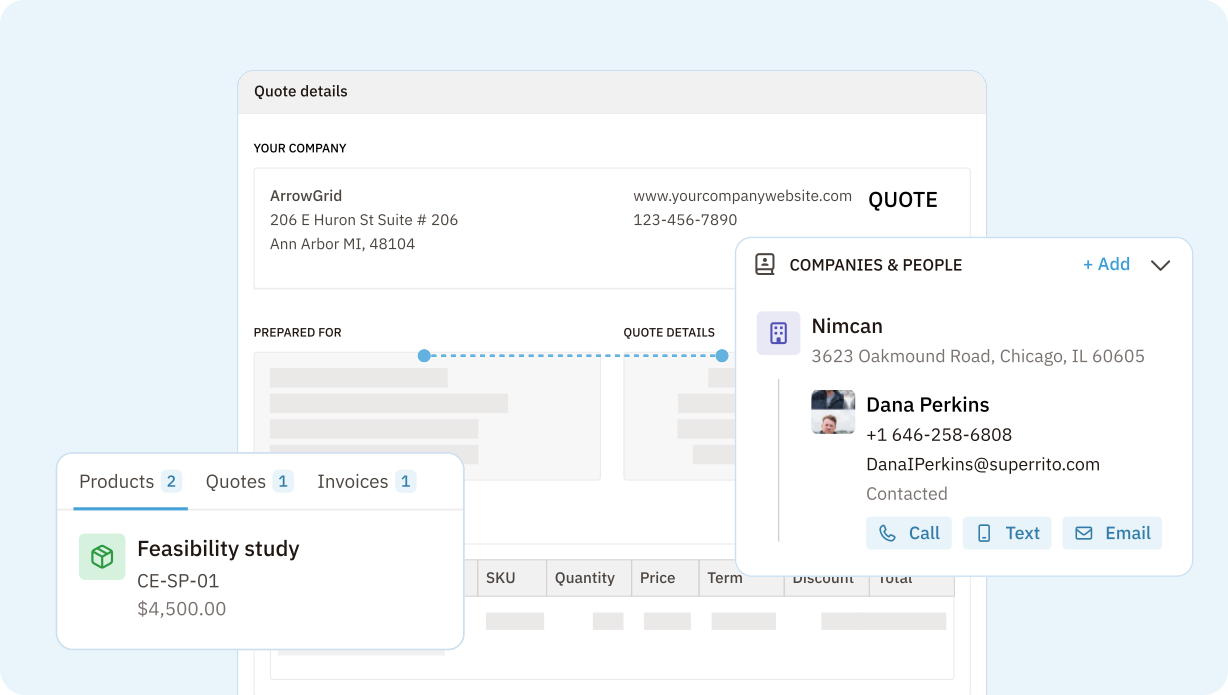
Nutshell quotes and invoices in-app view

Nutshell Quotes is a fully integrated add-on for Nutshell CRM that lets your team create, send, track, and manage quotes without leaving the platform. Every feature is built around eliminating the steps that slow small teams down—specifically, the duplicate data entry, the app-switching, and the post-send silence that characterizes most manual quoting workflows. Here’s what the tool includes, based on confirmed features from the Nutshell Quotes product page and launch post:

  • Branded templates with CRM auto-population: Lead name, company, and product data populate automatically from existing CRM records. Reps build a professional, on-brand quote in a few clicks without touching a spreadsheet.
  • Three delivery methods: Send directly via email from within Nutshell, share via a trackable link, or download as a PDF—whichever fits the prospect’s preference or the rep’s workflow.
  • Real-time engagement notifications: Nutshell alerts reps instantly the moment a prospect opens, views, or accepts a quote. Follow-up happens at peak engagement, not days later when interest has faded.
  • Pipeline stage automation: Quote activity can trigger automatic pipeline progression, so your CRM stays accurate without manual stage updates after every interaction. Nutshell’s built-in automation can also trigger a follow-up task the moment a prospect views your quote—so no deal sits unattended.
  • Quote-to-invoice continuity: The deal continues in the same system after acceptance—no re-entering scope, pricing, or contact details into a separate invoicing tool.
  • Flat $67/month pricing: The entire Quotes & Invoices add-on is one flat fee for the whole company—not per seat. For quoting software for small business teams that are growing, that pricing model is a meaningful differentiator.

Nutshell can also automatically log call notes and meeting summaries with Nutshell Notetaker, so quote context never gets lost between conversations.

Getting started doesn’t require an IT team or a lengthy implementation. Most small businesses are up and running with their first branded template within a day.

Give Nutshell Quotes a try! Start your free 14-day trial today!  

Quote management software vs. CPQ: What small businesses actually need

Enterprise-grade CPQ (configure, price, quote) tools like Salesforce CPQ and Oracle CPQ exist for a reason—businesses with large product catalogs, complex, tiered pricing structures, approval hierarchies, and product configurator logic that can span hundreds of variables. For a manufacturer with 10,000 SKUs and a global dealer network, that infrastructure makes sense.

Most small businesses aren’t that business.

Is CPQ software the right choice for small businesses? For the majority of small B2B companies, CPQ software is over-engineered for their actual needs. What small businesses need is speed, visibility, and a system that doesn’t require double data entry—not a configure-price-quote engine built for enterprise sales teams. A modern proposal software or quote management tool covers template creation, delivery, tracking, and acceptance without the implementation overhead, training requirements, or per-seat costs that come with a full CPQ system.

Nutshell’s integrated approach is right-sized for small business evaluators who’ve looked at CPQ and found it more than they need—powerful enough to automate and track the full quoting workflow, simple enough to set up without a dedicated admin, and priced for teams that can’t absorb enterprise licensing costs.

How to implement quote management software in your small business

Setting up quote management software doesn’t have to be a project. For most small businesses, it’s a configuration exercise that takes a few hours, not weeks. Nutshell is built to get teams live in days. Here’s a straightforward framework:

Step 1: Audit your current quoting process

Before choosing a tool, map where time is being lost. How long does it take to build a quote from scratch? How often do reps send inconsistent pricing? Where do quotes typically stall or disappear? This baseline gives you a clear picture of which features will have the biggest impact—and it takes less time than you’d expect.

Step 2: Identify your must-have features

Use the feature checklist from the “what to look for” section above as your evaluation guide. Prioritize CRM integration, real-time tracking, and flat-fee pricing—the three factors that most directly affect small team productivity and cost predictability.

Step 3: Connect to your CRM

Prioritize tools that integrate with or are built into your existing CRM. A quoting tool that sits outside your CRM creates the same duplicate data entry problem you’re trying to solve. CRM-integrated quoting means your lead records, contact data, and deal history are all in the same place.

Step 4: Build your first branded template

Before sending your first quote, set up a professional, on-brand template with your company logo, contact details, standard line items, payment terms, and T&Cs. This is the one-time investment that pays off on every quote that follows.

Step 5: Set up engagement notifications

Configure alerts so you know the moment a prospect opens or views your quote. This is the feature that transforms follow-up from guesswork into a well-timed conversation—and it takes about two minutes to enable.

If the idea of implementing new software feels daunting, keep this in mind: you’re not building a custom integration or migrating a complex data warehouse. You’re enabling an add-on, uploading a logo, and adding your pricing. That’s a configuration, not an implementation.

Common quoting mistakes small businesses make—and how to fix them

Most quoting problems aren’t caused by bad sales reps—they’re caused by systems that weren’t built for speed or consistency. These are the mistakes we see most often, along with the fix for each:

  • Sending quotes too slowly: The longer a quote takes to build and deliver, the more time a competitor has to fill the gap. Fix: automate template population so core fields are filled in before the rep even opens the document. Quotes that used to eat up 45-plus minutes should take under five.
  • No follow-up system after sending: Without engagement data, follow-up is arbitrary. Too early signals impatience; too late signals indifference. Fix: Use real-time engagement notifications to trigger follow-up at the exact moment a prospect is actively reviewing your quote.
  • Inconsistent pricing across reps: When reps build quotes independently, discounts and line items vary—sometimes in ways that cost margin, sometimes in ways that confuse prospects. Fix: standardize with locked templates and CRM-connected product catalogs that enforce pricing rules across the team.
  • No branded template: A plain Word document or generic PDF signals that your quoting process—and possibly your entire operation—is improvised. Fix: a clean, branded quote communicates that you’re organized and capable before a word of follow-up is exchanged. Professional presentation is a credibility signal, full stop.
  • Quoting outside the CRM: Every quote sent through a tool that isn’t connected to your CRM is a data gap. You lose the engagement history, the follow-up context, and the pipeline visibility that makes the next conversation easier. Fix: keep the entire deal lifecycle in one system. The Brothers Leather Supply story is a clean example of what becomes possible when customer data, communications, and deal status all live together.

How much does quote management software cost?

Pricing transparency is a genuine gap in most quoting software conversations—so here’s a straightforward breakdown of what you’ll typically encounter across three tiers:

Free tools: Free quoting options exist—Google Docs templates, basic free tiers in standalone tools—and they work fine for businesses sending a handful of quotes per month. The tradeoff is significant: no CRM integration, no real-time tracking, no engagement notifications, and no automation. Free tools handle document creation; they don’t handle deal management.

Per-user standalone tools: Many dedicated quoting platforms charge per seat, which feels manageable early on. As your team grows from two sales reps to five to ten, however, per-seat pricing compounds quickly and can make a “simple” quoting tool surprisingly expensive at scale.

CRM-bundled flat-fee options: The most cost-predictable model for small businesses is a quoting tool that’s bundled into or offered as a flat-fee add-on to an existing CRM. Nutshell’s Quotes & Invoices add-on is currently priced at $67 per month for the entire company—not per user. For a five-person team, that’s $13.40 per person per month for quote-to-invoice software that’s fully integrated with your CRM. For a ten-person team, the per-person cost drops further.

The flat-fee model also makes budget planning simple. Your quoting cost doesn’t change when you hire your next rep—which matters when you’re running a lean operation and watching every line item.

FAQs

  • 1. What is the difference between a quote and a proposal?

    A quote focuses on pricing and scope for a specific product or service—it’s a concrete offer with a number attached. A proposal is broader, typically including background, methodology, timeline, and terms in addition to pricing. For most small B2B businesses, a professional quote is sufficient to move a deal forward.


  • 2. Can I use free software to manage quotes?

    Free quoting tools exist—including basic templates in Google Docs or free tiers of standalone tools—but they typically lack CRM integration, real-time tracking, and engagement notifications. For businesses sending more than a handful of quotes per month, the time saved and deals won with a paid, integrated solution quickly outweigh the cost.


  • 3. Do I need a CRM to use quote management software?

    Stand-alone quoting tools work without a CRM, but CRM-integrated quoting eliminates duplicate data entry, connects quotes directly to your pipeline, and gives you a single source of truth from first contact through closed deal. If you’re already using a CRM, look for a solution that lives inside it rather than alongside it.


  • 4. How long does it take to set up quote management software?

    Most modern quoting tools—including Nutshell—are designed to get small businesses up and running in days, not weeks. Setup typically involves connecting your CRM data, building a branded template, and configuring your notification preferences. There’s no IT department required.


  • 5. What’s the difference between quote management software and CPQ?

    CPQ (configure, price, quote) software is designed for complex enterprise sales environments with large product catalogs, multi-tier pricing rules, and approval workflows. Quote management software is right-sized for small businesses—it handles template creation, delivery, tracking, and acceptance without the implementation overhead of a full CPQ system.


  • 6. How do I know when a prospect has viewed my quote?

    Quote management software with real-time engagement tracking sends an automatic notification the moment a prospect opens, views, or accepts your quote. Nutshell, for example, alerts reps instantly—so follow-up happens at the exact moment a prospect is most engaged, not days later when the conversation has gone cold.


Stop losing the deals you don’t know you’re losing

Manual quoting is costing small businesses deals they never see slip away—because by the time a slow quote arrives, a faster competitor has already started the conversation. The fix isn’t complicated: get quotes out faster, know when prospects engage, and keep the entire deal lifecycle in one system that doesn’t require re-entering data every time a lead moves forward.

The first vendor in the inbox wins the conversation. CRM integration eliminates the friction that slows small teams down. And at $67 per month for the entire company, professional quoting doesn’t have to come with a per-seat price tag that grows every time you hire.

Join 30,000+ other sales and marketing professionals  

Testen Sie Nutshell 14 Tage lang kostenlos oder lassen Sie sich von uns herumführen, bevor Sie loslegen.


ZURÜCK NACH OBEN

Schließen Sie sich 30.000+ anderen Vertriebs- und Marketingexperten an. Abonnieren Sie unseren Sell to Win-Newsletter!