Skip to main content ↓

How to assess CRM vendor reliability before you sign


Written by
Will Gordon director of Marketing at Nutshell
Will Gordon Sr. Director of Marketing
Last updated on: July 31, 2026
Business professional reviewing a vendor evaluation checklist at a desk with a laptop open in the background

Quick answer: How do you assess CRM vendor reliability before committing?

Assessing CRM vendor reliability comes down to three things: The vendor’s financial health, how frequently they ship and document product updates, and long-term viability signals like ownership structure and contract terms. Score every shortlisted vendor across these dimensions before you reach the demo phase.

Teams evaluating CRM solutions typically follow a similar process, including assessing features, pricing, and integrations, booking a demo, and testing through a free trial. A key component that’s often overlooked is whether the company behind the CRM will be the same or better a few years down the line.

The worldwide CRM software market grew by 13.4% in a year, reaching $107.5 billion in 2023, according to an analysis by Gartner in 2024. That makes CRM one of the fastest-growing segments in all of enterprise software. 

Vendors could be acquired, restructured, and even rebranded. Their product roadmaps could shift, taking on a completely different direction, and their support team members could leave to explore other opportunities. In these situations, the businesses reliant on these chosen platforms are sometimes left managing fallout they had never anticipated.

Assessing CRM vendor reliability tells you the degree to which that vendor can be trusted to remain financially stable, actively invest in its product, and deliver consistent support over the long term.

This Nutshell guide provides the methodology for assessing CRM vendor reliability before you commit. The framework covers three core dimensions, including financial health, update frequency, and long-term viability signals.

Key takeaways

  • The best way to assess CRM vendor reliability is through the company’s financial stability, product update cadence, and ownership structure.
  • The CRM market is one of the fastest-growing sectors in business software, which makes vendor reliability a crucial evaluation factor.
  • Employing a five-point vendor reliability scorecard offers teams a repeatable, objective vendor comparison tool to establish dependability before signing.

What does CRM vendor reliability mean?

CRM vendor reliability is a gauge of how consistent a vendor is when it comes to delivering on its commitments. This doesn’t only apply to the point of sale. Vendor reliability is measured across the full life cycle of the vendor-client relationship.

Think of all that CRM implementation actually involves, including data migration, workflow redesign, team training, and the time and effort it takes to ensure adoption. Selecting a vendor that is later acquired, puts a hold on its product roadmap, or undergoes a massive pricing change, can unravel all of that, making vendor reliability an active risk factor.

How do you evaluate a CRM vendor’s financial health?

Because the cornerstone of vendor reliability is financial health, it’s the most crucial element of the evaluation process. You can consider a CRM vendor financially healthy when the company generates consistent revenue, carries manageable debt, and noticeably invests in its own product instead of directing resources to sales growth alone.

A financial stability evaluation framework designed by Venminder in 2025 identifies five questions worth asking when assessing vendors:

  • How does it generate and sustain revenue?
  • Does it have sufficient capital for ongoing operations?
  • What is its debt-to-worth ratio?
  • What is its tangible net worth relative to goodwill and intangibles?
  • Can it sustain operations at its current cash level?

When it comes to publicly traded vendors, you’ll find the answers to those questions in publicly accessible SEC filings and quarterly earnings reports. In the case of private vendors, your most useful proxy would be the ownership structure.

Founder-led and bootstrapped CRM vendors will display a more predictable product trajectory than those backed by private equity firms, often maximizing valuation to ensure a seamless transition for potential buyers.

A 2026 vendor risk analysis by ERP Implementation stated that vendor financial solidity is rarely scrutinized during software evaluations, even though a PE-acquired vendor can turn a successful project into a forced migration just a few years after go-live.

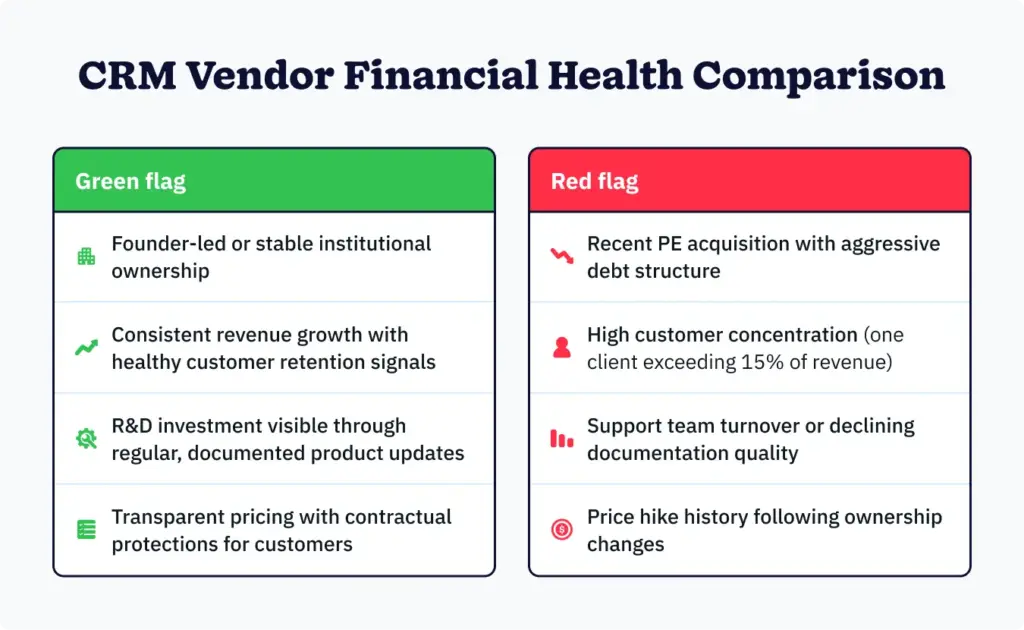
The following table highlights the key differences between vendor financial stability and instability.

Side-by-side visual comparison of financially stable versus financially at-risk CRM vendor indicators

Why is update frequency a sign of vendor investment?

CRM update frequency refers to the cadence at which a vendor ships new product features and improvements. The update frequency shows you whether there’s any real investment in product research and development (R&D).

If a vendor regularly launches product features and updates, and documents them well, it’s a clear sign that it’s investing in its platform. When vendors are silent for extended periods, they likely aren’t investing much back into their product, and that’s not a confidence-inspiring sign.

An example of a strong update cadence is when a vendor releases updates in waves, like quarterly or biannually, and publishes detailed documentation about the feature, potentially providing sandbox testing windows for customers. 

On the other hand, irregular, unannounced releases without a visible changelog and no planned roadmap present are all warning signs of a weak vendor update frequency, and potentially little to no investment.

Teams evaluating CRMs should ask vendors whether they provide any of the following:

  • A release history or changelog that’s publicly accessible
  • Advanced notice of future feature releases and updates (ideally two to four weeks’ notice)
  • Sandbox or staging environments for testing updates before they go live
  • A product roadmap available to the public that highlights future releases at least three months ahead
  • Feature launches and updates that happen on a consistent basis

If a vendor is unable to share its feature release and product update history, it’s a telltale sign that there’s either zero investment or they’re hiding something they don’t want you to see.

What long-term vendor viability signals should you consider when selecting a CRM?

Long-term vendor viability is all about whether partnering with the vendor will meet the customer’s business needs. For instance, teams should prioritize fair vendor terms, customer support consistency and reliability, and signs of recent or potential structural changes that could prove expensive later.

A good sign of long-term viability is when a vendor remains independent and actively invests in its platform over the duration of the customer life cycle. Vendors that display these characteristics typically ensure ownership stability, contract protection, data portability, and customer retention.

When assessing your options, consider these viability signals:

  • Community health: A growing community of users in trusted review platforms like G2 and Capterra is a positive signal. Negative reviews typically spike when there are business or structural changes and are the first signs of a service level decline. Look beyond the rating and focus on the review patterns.
  • Data portability: The ability to easily move your data from the platform without incurring costs should be a given. Ask the vendor what data you can export and in what formats. If they have any restrictions, it’s a negative sign.
  • Contract terms: Change of control clauses, limits on price increases, and notice periods for changes of service are important terms of a contract. Reputable vendors publish their terms publicly. It’s prudent to read the terms of the agreement thoroughly before signing the contract.
  • Real-world evidence: Look for examples of customers who have seen success since using the platform. Vendors should have testimonials or case studies available to view. If these are not on the vendor website, ask them for some real-world customer examples.

How do you compare CRM vendors on reliability?

The best way to measure and compare vendor reliability is to apply a consistent scoring framework across all prospective vendors. 

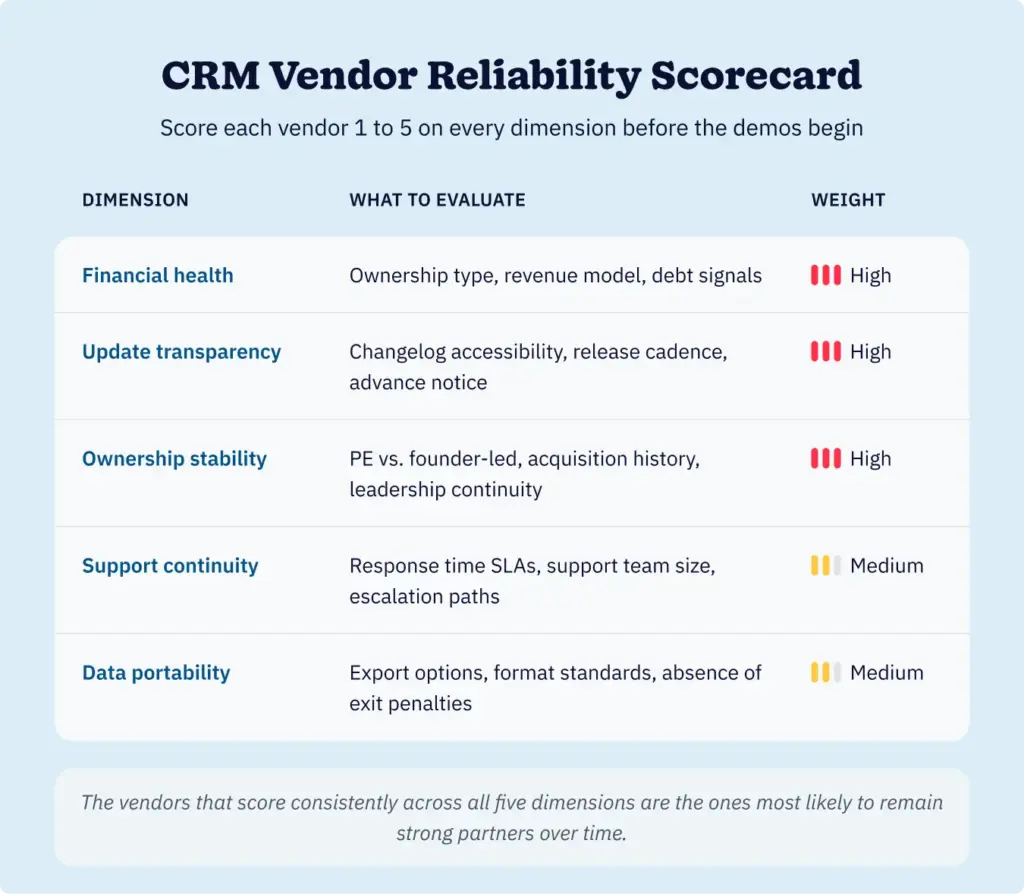
The five dimensions that follow are the most predictive of reliable, long-term CRM vendors.

Five-dimension CRM vendor reliability scorecard showing evaluation criteria and weighting for each dimension

Each of these dimensions should be scored on a scale of 1 to 5. Vendors that score consistently across all five dimensions are the ones that are most likely to be strong long-term partners.

Reliability is the real evaluation criterion

Choosing a CRM solution is a critical, long-term business decision. The features that impress in a vendor demo aren’t necessarily the ones that determine whether investing in the CRM will be a success. However, the vendor’s overall stability is almost always a solid indicator.

Teams that take the time to evaluate financial health, update cadence, and long-term viability signals before committing to a vendor are the ones making a smarter, more informed selection. These are the businesses choosing a partner with their sights on a lasting, mutually beneficial relationship.

The best partners are those still standing strong many years later. They’re the CRM vendors that are still investing, improving, and maintaining their responsiveness. This level of reliability is the most important, especially for any business building the foundation of its operations on its CRM platform.

Frequently asked questions about CRM vendor reliability

  • 1. What is the biggest risk of choosing an unreliable CRM vendor?

    The biggest risk is forced platform migration. When a CRM vendor is acquired or experiences financial distress, customers often face sudden price increases, frozen product roadmaps, or end-of-support notices. Migrating to a new CRM, including data transfer, retraining, and workflow rebuilding, is a high operational cost that a strong up-front vendor evaluation can prevent.

  • 2. How often do CRM vendors get acquired?

    Very often. Gartner documented more than 50 acquisitions in the CRM market between 2009 and 2012, and noted 30-plus notable acquisitions in 2015 alone. The global CRM market has more than tripled in value since then, increasing the financial incentive for acquisitions. That’s why it’s important to treat ownership stability as an active risk factor.

  • 3. Is a well-known CRM vendor automatically more reliable?

    No. Market share indicates popularity, not stability. Some of the most disruptive platform changes in enterprise software history have come from large vendors, including Oracle and SAP, following acquisitions that altered roadmaps and support terms for thousands of customers. Evaluate any vendor, large or small, against the same financial and operational criteria.

  • 4. What contract terms protect against CRM vendor instability?

    Look for change-of-control clauses that trigger renegotiation rights if the vendor is acquired. Also negotiate caps on annual price increases, data export rights at no cost, and minimum notice periods for material service changes. These terms are standard in well-structured SaaS agreements, and any vendor unwilling to include them is worth questioning.

  • 5. How frequently should a reliable CRM vendor release updates?

    A healthy cadence typically includes major feature releases at least twice per year, regular security patches, and documented bug fixes on an ongoing basis. Frequency matters, but transparency matters as much. Advance notice, public changelogs, and sandbox environments that let customers test changes before they reach production are the hallmarks of a vendor that respects its customers’ operations.

BACK TO TOP
Join 30,000+ other sales and marketing professionals. Subscribe to our Sell to Win newsletter!