Skip to main content ↓

Personal Email Sequences: Definition, Examples & Templates

Written by
Kyle Pauling headshot
Kyle Pauling Senior Marketing Analyst
Last updated on: June 5, 2026
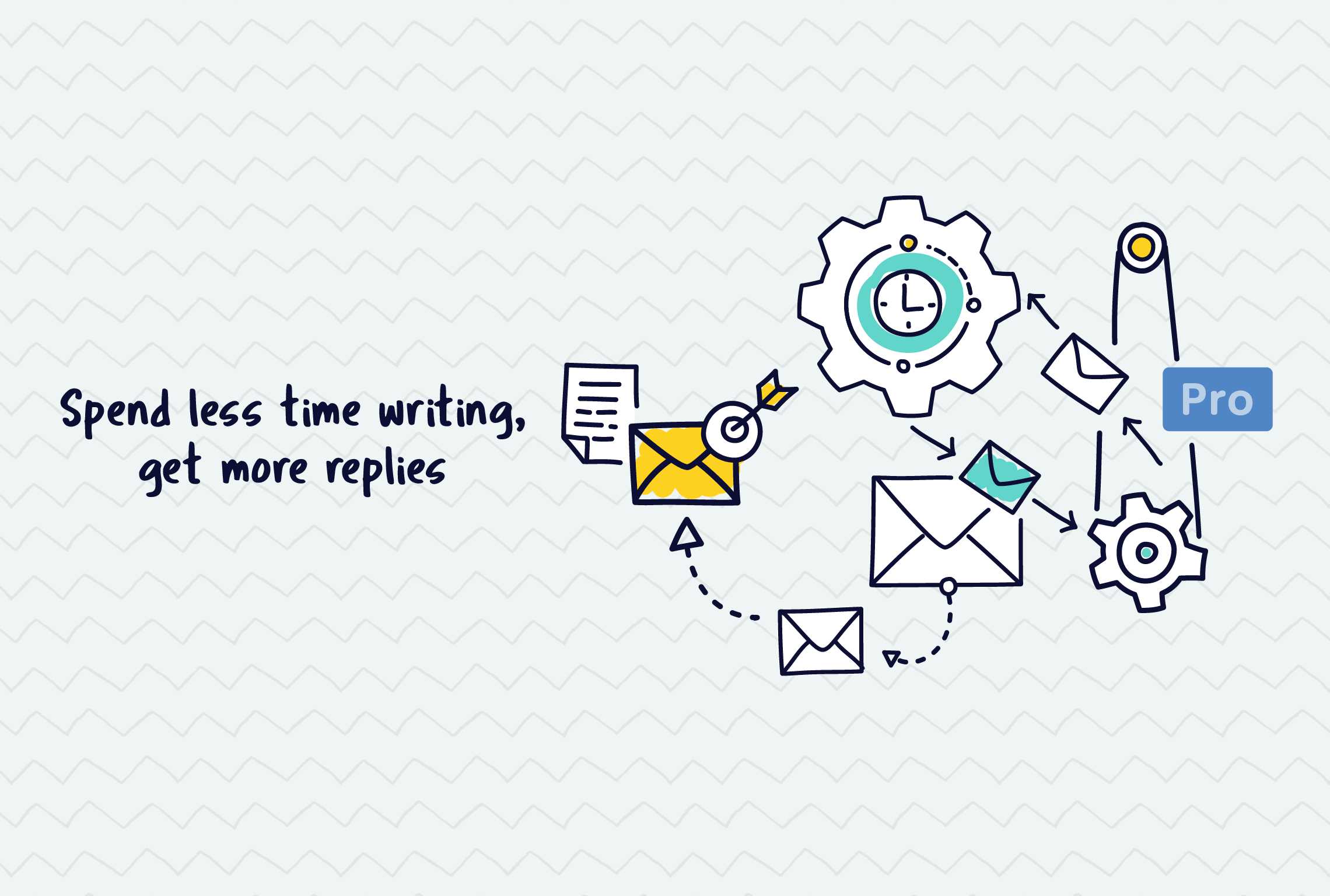
a drawing of gears and envelopes with the words spend less time writing get more replies

A personal email sequence is a series of automated emails sent to a lead or contact at scheduled stages to build a relationship, address questions, and progress the conversation. Unlike broadcast campaigns which send the same message to many people at once, personal email sequences are tailored 1-to-1 messaging. The email series are written for specific people, based on their context, and send at the right time based on CRM stages.

80% of sales take five or more follow-ups, but 44% of sales reps stop after their first. A personal email sequence closes that gap automatically without the rep needing to remember who to follow up with or when.

We’ll cover what personal email sequences are, how they differ from automated drip campaigns, use cases, and real email templates. We’ll also walk through building sequences in a CRM like Nutshell.

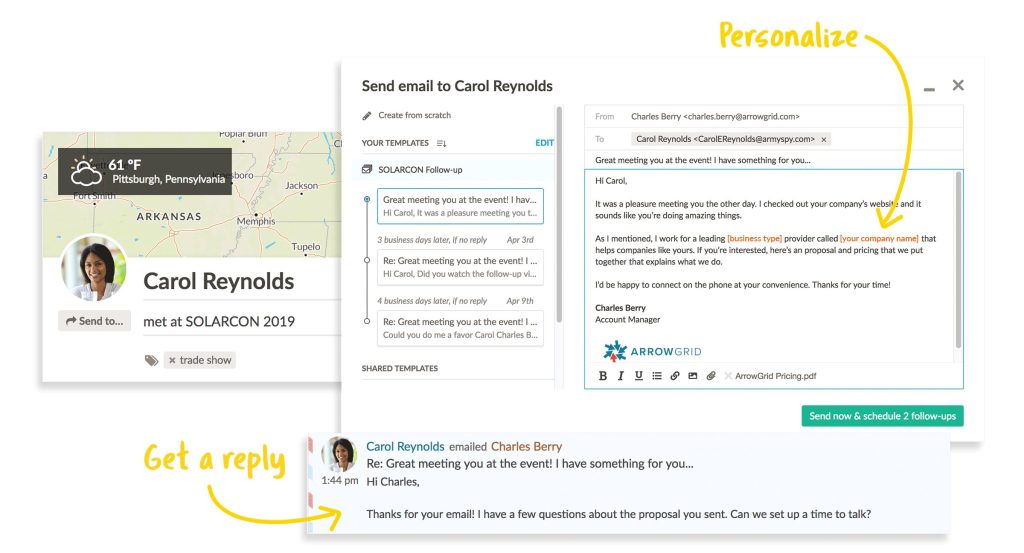
a screenshot of a web page showing how to personalize an email to carol reynolds

What is a personal email sequence?

A personal email sequence is a series of automated emails that you can send to a list of contacts over a set period of time. This allows you to have personal conversations with many people at once, while ensuring that no one slips through the cracks.

Personal email sequences originate from an individual sender (e.g., rep, account executive), landing in the recipient’s primary inbox, rather than the promotions tab, unlike marketing email sequences.

How long should a personal email sequence be?

Sequences with three emails had a reply rate of 9.2%, the highest from a Belkins analysis of 11 million outbound emails. Longer sequences can include four to seven emails across several weeks.

How are personal email sequences different from drip campaigns?

Personal email sequences are 1-to-1 emails that speak directly to a person. Drip campaigns reach a larger audience, segment, or list, and speak to a persona at scale.

Personal email sequenceDrip campaign
SenderIndividual repBrand or company
ToneConversational, first-personMarketing copy
RecipientSpecific leadAudience segment or list
InboxPrimary inboxPromotions tab
GoalStart or advance a conversationNurture, convert at scale
Triggered byRep action or CRM workflowForm fill, event, behavior
PersonalizationHigh (company, role, context)Moderate (name, segment)
Best forOutbound sales, deal follow-upLead nurture, onboarding, retention

What are the most common types of personal email sequences?

The type of email sequence a rep uses depends on the lead, where the lead is in the sales process, and the action the rep wants the lead to take.

Cold outreach is an email sequence for a lead who has had no prior contact with the rep or company. These can include four to six emails over two to three weeks. The first email usually serves as an introduction to a relevant problem, with the following emails offering proof, social validation, and an ask.

Follow-up sequences are used after a first touchpoint, such as a demo request or referral. These are shorter sequences with two to four emails and address existing context or interest.

Re-engagement sequences are designed to connect with a lead who has gone cold, stopped replying, or missed scheduled calls. These sequences can include three emails with a “final” email serving as a last-ditch touch to generate a reply.

Post-demo or proposal sequences keep a deal moving after a meeting or document has been shared. These sequences can address objections, offer additional support, and ask the lead to share feedback or a timeline.

Onboarding sequences transition a new customer from a signed contract to a successful setup. These can be owned by customer success teams and run alongside product sequences.

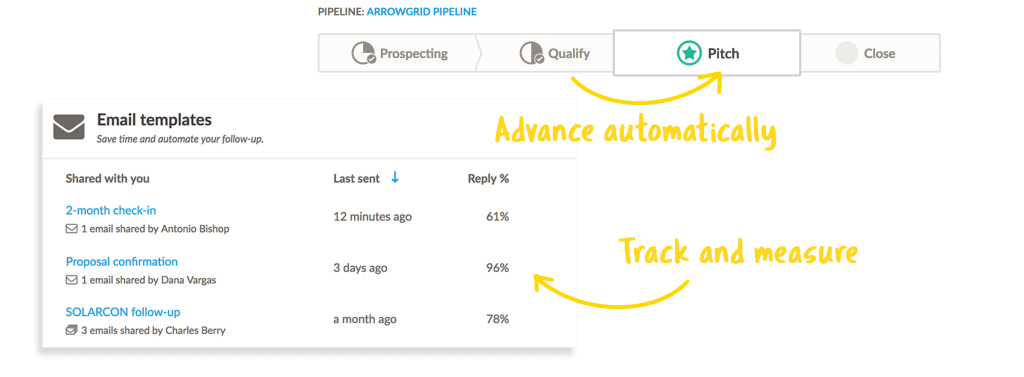
a screenshot of pipeline automation and tracking for arrowgrid

Personal email sequence templates by use case

Reference the templates below as starting points for personal email sequences. Adapt these to the specific rep, company, and lead, as the more context you add, the better your results will be.

Cold outreach sequence

Email 1 – Day 0: Relevant opener

Subject: Quick question about [Company]’s [relevant challenge]

Hi [First Name],

I came across [Company] while researching [industry or specific trigger], and I wanted to reach out because we’ve helped similar teams [specific outcome — e.g., “cut their follow-up time in half” or “book 30% more demos without adding headcount”].

I know you’re probably getting a lot of these, so I’ll keep it short: would it make sense to connect for 15 minutes to see if there’s a fit?

[Rep name]


Email 2 – Day 2: Relevant proof

Subject: How [similar company] solved [pain point]

Hi [First Name],

Just wanted to follow up on my note from Monday. I figured I’d share a quick example of what I was referencing.

[One to two sentences summarizing a relevant customer outcome — e.g., “One of our customers in [industry] was struggling with X. After switching to [product], they saw Y result within Z timeframe.”]

Worth 15 minutes to explore whether the same approach could work for [Company]?

[Rep name]


Email 3 – Day 5: Reframe

Subject: Different angle on [challenge]

Hi [First Name],

I’ve been thinking about [specific challenge you mentioned or implied in Email 1]. A lot of teams approach it by [common approach], but the ones we’ve seen have the most success usually [alternative approach or insight].

Happy to walk through what that looks like in practice — no pitch, just a conversation.

[Rep name]


Email 4 – Day 9: Low-friction ask

Subject: Still worth a look?

Hi [First Name],

I’ve reached out a few times and haven’t heard back — totally understand, your inbox is probably a war zone.

If the timing isn’t right, just say the word and I’ll give you space. But if [specific pain point] is still something you’re working through, I’d love to be a resource.

[Rep name]


Email 5 – Day 14: Final email

Subject: Closing the loop

Hi [First Name],

I don’t want to keep cluttering your inbox, so this will be my last note for now.

If [specific challenge] ever moves back up the priority list, I’ll be here. Otherwise, best of luck with everything you’ve got going on at [Company].

[Rep name]


Follow-up sequence

Email 1 – Day 0: Recap

Subject: Great connecting at [event/meeting] — next step

Hi [First Name],

Really enjoyed our conversation [at/about] [context]. Based on what you shared about [specific detail], I think we could genuinely help with [specific outcome].

I’ll [send over the resource/send a calendar link/follow up on X] as promised. Let me know if your timeline or priorities shift in the meantime.

[Rep name]


Email 2 – Day 3: Value add

Subject: One thing I forgot to mention

Hi [First Name],

Following up on my note from [day]. Wanted to share [relevant resource, case study, or insight] that came to mind after our chat — specifically around [detail they mentioned].

[Link or one-sentence summary of resource.]

Still think a 30-minute call would be worth your time. Would [specific date/time] work?

[Rep name]


Email 3 – Day 7: Direct ask

Subject: Are we still on your radar?

Hi [First Name],

I know things get busy. I wanted to check in one more time before I stop pestering you.

Is [the initiative / the evaluation / next step] still something you’re actively looking at? Even a quick “not right now” helps me know how to best support you.

[Rep name]


Re-engagement sequence

Email 1 – Day 0: Check-in

Subject: Did I lose you?

Hi [First Name],

It’s been a while since we last connected, and I wanted to reach out before closing out your file on my end.

Has [the initiative / the project / the evaluation] moved in a different direction? Or has timing just been tough? Either way, happy to reconnect whenever it makes sense.

[Rep name]


Email 2 – Day 4: New angle

Subject: Something that might change the conversation

Hi [First Name],

I’ve been thinking about what we discussed back in [month]. Since then, [relevant update — new feature, customer story, or market development] — and I think it actually addresses the concern you raised about [specific objection or hesitation].

Worth a quick revisit?

[Rep name]


Email 3 – Day 10: Breakup

Subject: Moving on — but leaving the door open

Hi [First Name],

I don’t want to keep reaching out if the timing isn’t right. I’ll leave it here for now.

If anything changes — new initiative, new budget cycle, new challenge — you know where to find me.

Thanks for your time, [First Name].

[Rep name]


What makes a personal email sequence effective?

The difference between an effective sequence and one that gets ignored usually comes down to a few factors.

  • Relevance over volume – Only 21% of sales reps fully personalize outbound emails, making personalized sequences stand out by being specific and relevant for the recipient.
  • A single ask per email – Every email in a sequence should have one clear ask. Multiple asks dilute your message and reduce the chance of any action at all.
  • Subject lines earn the open – Good subject lines are short and specific to the recipient or past context. Opt for a “real email” feel over marketing copy.
  • Meet the lead where they are – CRM tools like Nutshell let you trigger sequences based on pipeline activity and behavior, so emails are sent at the right time and feel natural rather than scheduled.
  • Exit strategy – Every sequence needs a final breakup email that gives the lead an out while keeping the relationship intact. Breakup emails often have the highest reply rates in a sequence.

How do you build a personal email sequence in a CRM?

To build a personal email sequence, start by setting your goal for a repeatable process and identifying the right contacts.

  1. Choose your sequence goal – Be specific about the outcome you want. Your goal determines the sequence length, tone, and ask.
  2. Choose your target contacts – Effective sequences are built around a defined audience. In Nutshell, you can filter leads by stage, industry, rep, or activity history, then add qualifying contacts to a sequence.
  3. Write your sequence emails – Use the recipient’s first name, company or context, and make each email’s purpose clear in the subject line.
  4. Set your schedule – Choose your email cadence. Cold outreach typically uses longer gaps with two to five days between emails. Post-demo follow-ups can move faster. In Nutshell, you can set delay windows so each email of your sequence sends at the right interval automatically.
  5. Configure triggers and exits – Set your sequence to pause automatically when a lead replies, books a meeting, or moves to a new pipeline stage.
  6. Review and optimize – After your sequence sends, review open rates and reply rates to see which step is performing and where leads are dropping off.

How does Nutshell make personal email sequences easier to manage?

Nutshell is a CRM that lets sales reps create, automate, and track personal email sequences without switching between separate sales engagement tools. Email sequences live in the same platform where reps manage leads, pipelines, and contact history, which means no data syncing, no manual logging, and no context-switching.

With Nutshell’s personal email sequences, reps can:

  • Write sequences once – Create a sequence template, assign it to a lead or list, and Nutshell handles the scheduling and delivery automatically.
  • Send from their inbox – Emails are sent through the rep’s connected Gmail or Outlook account, which means they have the rep’s email address (not a marketing domain) and land in the recipient’s primary inbox.
  • Pause automatically on reply – Nutshell pauses the sequence when a lead responds so the rep can take over the conversation manually without the risk of an automated follow-up crossing a live reply.
  • Track opens, clicks, replies – Nutshell’s email reporting shows how each email and sequence is performing, so reps can see what’s working and optimize over time.
  • Collaborate – Sequence templates are shareable, so the best-performing emails can be used across an entire sales team.

See how personal email sequences work in practice with our two-minute walkthrough.

Frequently asked questions about personal email sequences

  • 1. What is a personal email sequence?

    A personal email sequence is a series of emails sent from a specific rep on a scheduled cadence. Personal email sequences are designed to feel like direct, 1-to-1 communication and are used in B2B sales to initiate contact, follow up on leads, and advance conversations toward a meeting or decision.

  • 2. How many emails should be in a personal email sequence?

    Most high-performing sales sequences contain three to six emails. Three-email sequences produce the highest average reply rate of 9.2%. The right length depends on your deal size, sales cycle, and how warm the lead is at the start of the sequence.

  • 3. What’s the difference between a personal email sequence and a drip campaign?

    A personal email sequence is sent by an individual rep, reads like a direct one-to-one email, and is designed to start a conversation. A drip campaign is sent from a brand or marketing team, reads like marketing copy, and is designed to nurture or convert at scale. Both have a place in a CRM marketing strategy as they serve different stages and audiences.

  • 4. How do you personalize a sales email sequence?

    The highest-converting sequences reference the recipient’s company, role, industry, recent news, or a specific pain point relevant to their situation. In a CRM like Nutshell, merge fields and lead data make it easy to pull this context into every email automatically.

  • 5. When should an email sequence stop sending?

    An email sequence should stop sending after a lead replies, books a meeting, advances to a new pipeline stage, or asks to be removed. CRMs like Nutshell can pause or stop a sequence automatically based on these triggers to prevent automated emails from crossing an active conversation.

Ready to put your follow-up on autopilot?

Consistent, personal outreach that runs while you focus on the conversations that matter

NO CREDIT CARD REQUIRED

Want to kick the tires a bit?

No problem. To see if Nutshell is the right choice for your sales team, start a 14-day free trial today!


LET’S GO!

an illustration of a person in a green shirt standing in front of a group of people in the shadows
BACK TO TOP

Join 30,000+ other sales and marketing professionals. Subscribe to our Sell to Win newsletter!