Skip to main content ↓

Responsible AI Sales Ethics: A Guide to Maintaining Customer Trust


Professional reviewing customer data alongside visual representations of AI insights symbolizes the integration of human judgment and artificial intelligence in sales

As artificial intelligence increasingly becomes embedded in sales workflows, a paradox has emerged. Organizations are rushing to adopt AI tools that promise faster lead scoring, automated follow-ups, and predictive customer insights. Yet at the same time, customer concern about how AI is being used is growing rapidly.

According to recent research, 62% of consumers would trust brands more if they were transparent about their use of AI. Meanwhile, 80% of users would prefer to be notified if they’re communicating with an AI agent, and 61% of customers believe AI advancements make trustworthiness even more important. 

This creates a critical challenge: how can sales organizations leverage AI to improve efficiency and results while maintaining the customer relationships that depend on transparency and trust? As more organizations adopt AI sales ethics practices, a clear framework is emerging for how to implement responsible AI in sales while maintaining customer relationships. 

The answer to the adoption challenge lies in building responsible AI in sales from the ground up. Ethical AI sales practices aren’t restrictions on innovation—they’re strategic investments that strengthen customer relationships, reduce compliance risk, and drive sustainable revenue growth.

This article outlines Nutshell’s recommended approach to navigating the emerging ethical AI sales landscape, supported by current research and proven best practices.

Key takeaways

  • Transparency builds trust, not fear: 84% of consumers would trust AI more if it demonstrated explainability. Disclosing AI use in sales processes and explaining decision logic strengthens customer relationships rather than undermining them.
  • Human oversight is non-negotiable: Responsible AI in sales requires humans to review, validate, and override AI recommendations. This maintains accountability and prevents algorithms from overshadowing individual customer relationships.
  • Compliance and ethics aren’t optional: GDPR, CCPA, and emerging AI regulations already require documentation and transparency around automated decision-making. Ethical AI practices aren’t constraints on innovation—they’re foundational to sustainable adoption.


Understanding the AI ethics and trust paradox in sales

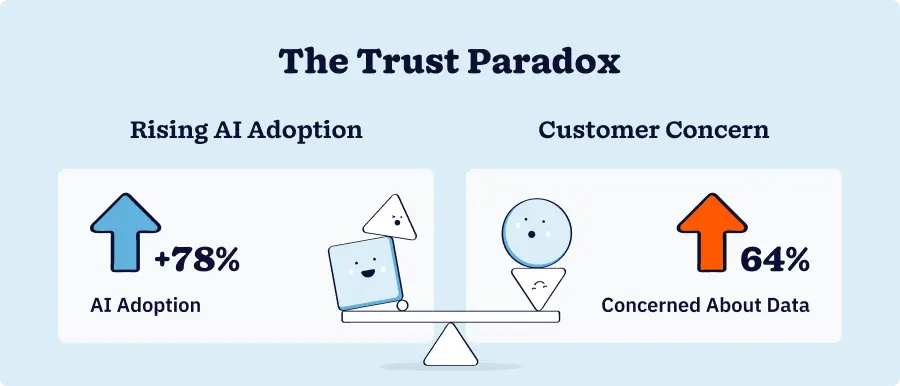
The numbers tell a compelling story. Nearly all survey respondents report that their organizations are using AI, and sales teams that utilize AI are 1.3 times more likely to experience revenue increases. Sales professionals are embracing the technology—78% agree that AI automation helps them dedicate more time to critical work.

Yet this enthusiasm masks a growing concern. The same customers who benefit from AI-driven personalization are increasingly skeptical about how their data is being used. 64% of customers believe companies are reckless with customer data, and this concern is intensifying as AI becomes more visible in customer interactions.

This is the AI sales ethics paradox: organizations need to adopt AI to remain competitive, but customers need reassurance that AI adoption won’t compromise their privacy or autonomy. The solution isn’t to avoid AI—it’s to implement responsible AI strategically in sales.

Infographic comparing rising AI adoption rates in sales with increasing customer concerns about data privacy and AI transparency, illustrating the trust paradox.

Building transparency into AI-powered sales processes

Transparency is the foundation of ethical AI sales practices. When customers understand how AI is being used to serve them, trust actually increases rather than decreases.

Research from RWS shows that 84% of consumers would have more trust in AI that demonstrates explainability—that is, AI which seeks to be transparent and understandable to humans. This finding has direct implications for how sales teams communicate with prospects. Clear disclosure matters. 

If a sales representative uses AI to analyze a prospect’s behavior and recommend next steps, that process should be explainable. Customers don’t necessarily need to understand the underlying algorithms, but they should understand that AI played a role and why it mattered to their interaction.

Practical approaches to building transparency include:

  • Disclosing AI use early: Rather than hiding AI involvement, explain it as a tool that helps deliver better service. “Our AI analysis shows your business might benefit from these features” is more transparent than allowing the customer to believe the recommendation came purely from human judgment.
  • Explaining decision logic: When AI scores a prospect as high-priority, help sales reps explain why. What signals led to that score? This transparency empowers reps to have more authentic conversations and builds customer confidence.
  • Documenting AI processes: Create clear documentation of where AI is used in sales workflows. This serves both compliance requirements and helps teams maintain consistency in how they communicate about AI.

Privacy regulations increasingly require this level of transparency. Organizations should review their privacy policies to ensure they clearly disclose when AI is involved in customer interactions and decision-making.

Implementing human-in-the-loop decision-making

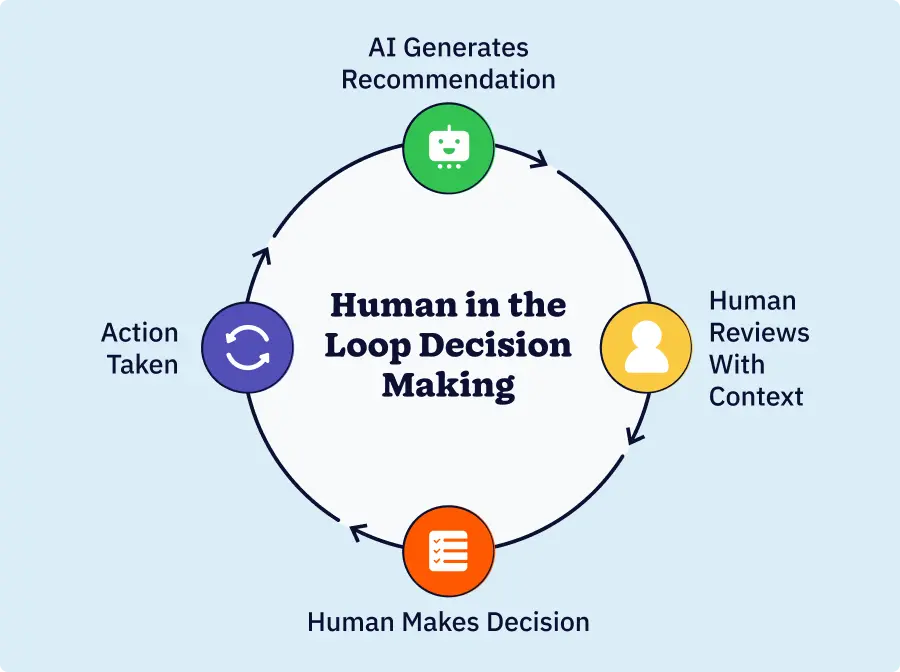
One of the most important principles of responsible AI in sales is maintaining human judgment as the final decision-making authority. AI should enhance human decision-making, not replace it.

Human-in-the-loop systems ensure that AI serves as a recommendation engine while sales professionals retain the ability to review, refine, and override AI outputs. This matters tremendously for trust. Customers can feel confident knowing that decisions affecting their relationship aren’t made purely by algorithms—humans are involved and accountable.

Practical implementation includes:

  • AI recommendations with human review: When lead scoring systems recommend which prospects to prioritize, sales reps should see the recommendations alongside key context about why the AI made that assessment. Reps then decide whether to follow the recommendation or adjust their approach based on their expertise.
  • Validated insights: AI might identify patterns in successful deals, but humans should validate whether those patterns are accurate and apply to future opportunities. This prevents the AI from reinforcing problematic assumptions.
  • Dispute and override capabilities: Sales professionals should be able to easily override AI recommendations when they have context that the AI lacks. This maintains accountability and ensures that individual customer relationships aren’t overshadowed by algorithmic patterns.

The Alan Turing Institute notes that ethical AI must be transparent, fair, and accountable, especially when used in areas that involve persuasion or influence, which is precisely what sales is. Human oversight ensures accountability remains clear.

Workflow diagram showing human-in-the-loop decision making: AI generates recommendations, humans review with context and business expertise, and humans make final decisions with the ability to override.

Addressing algorithmic bias in customer interactions

Algorithmic bias is one of the most subtle but consequential challenges in AI sales ethics. Bias can emerge when AI models are trained on historical data that reflects past discrimination or when algorithms are designed in ways that systematically disadvantage certain groups.

The scale of the problem is significant. According to McKinsey, 40% of companies using AI reported unintended bias within their models, and in sales, bias can manifest in several problematic ways:

  • Lead scoring bias: AI systems might consistently score leads from certain industries or geographies lower, simply because fewer past deals came from those segments. This creates self-fulfilling prophecies, where underrepresented segments receive less attention and thus never have the opportunity to become good customers.
  • Demographic discrimination: Without proper safeguards, AI might develop proxies for protected attributes. For example, a model might weight zip codes in ways that systematically disadvantage certain racial or ethnic groups, even though the model never explicitly considers race.
  • Interaction bias: AI-generated email templates or messaging might inadvertently use language that resonates better with certain demographics, subtly but consistently favoring some customer segments over others.

Addressing bias requires systematic approaches:

  • Diverse training data: Ensure that the data used to train AI models represents the full diversity of your customer base and potential customers. This is more challenging than it sounds—it requires intentional effort to ensure training datasets aren’t skewed by historical hiring, marketing, or sales patterns.
  • Regular audits and testing: Conduct regular audits by comparing AI recommendations across different customer segments. If high-scoring leads from one industry consistently convert at lower rates than high-scoring leads from another industry, that indicates the model is biased. Testing methods include comparing AI scores to actual outcomes across demographic groups and conducting “flip tests,” where one attribute (such as industry) is changed while holding all other variables constant, to determine if the score changes inappropriately.
  • Bias detection tools: Use dedicated bias detection tools and frameworks designed specifically for this purpose. Google’s What-If Tool enables teams to create interactive visualizations that explore how AI models behave across different groups and scenarios.
  • Ongoing monitoring: Bias detection isn’t a one-time project. Integrate ongoing monitoring into your AI operations to detect bias that emerges over time as new data is fed into the system.

Ensuring compliance with emerging AI regulations

The regulatory landscape surrounding AI is evolving rapidly, but existing privacy frameworks already impose significant requirements on how organizations utilize AI in sales. While comprehensive federal AI legislation in the U.S. is still being developed, privacy laws that directly impact AI-driven sales practices are already in effect.

Data protection compliance is the foundation

GDPR and CCPA already impose requirements on how organizations collect, process, and share customer data. When AI is involved in sales workflows, these requirements remain the same—but they require more careful attention and documentation. AI systems must be documented, their data sources must be identified, and individuals must be able to exercise their rights (like the right to know what data is being used about them or request data deletion).

For U.S. organizations, CCPA compliance is mandatory for companies doing business in California and handling the data of California residents. For organizations with EU customers, the GDPR applies regardless of the company’s location. And for many multinational organizations, both frameworks apply simultaneously.

Transparency and disclosure requirements under existing laws

Privacy frameworks like GDPR and CCPA require organizations to be transparent about automated decision-making. This directly impacts AI in sales—when AI scores prospects, recommends follow-ups, or personalizes outreach, customers have the right to understand that AI is involved and how it affects them.

Internationally, the EU AI Act, which entered into force in 2024, builds on these privacy foundations with additional requirements specifically for AI systems. Organizations with European customers should be aware of these requirements, as they represent the emerging global standard for how AI should be governed.

Documentation and governance as compliance frameworks

Whether operating under GDPR, CCPA, or the EU AI Act, organizations need to maintain detailed documentation of their AI systems—how they work, what data they use, and what safeguards are in place. 

This documentation serves multiple purposes: it demonstrates compliance to regulators, helps organizations identify and address problems, and signals accountability to customers.

Practical compliance approaches for US organizations

Organizations implementing responsible AI in sales typically:

  • Audit existing privacy policies to ensure they transparently disclose AI use in customer interactions
  • Document all AI systems used in sales, including their purpose, data inputs, and decision logic
  • Implement consent management processes that respect customer choices about data use with AI
  • Conduct privacy impact assessments before deploying new AI systems, particularly those involving customer data
  • Build audit trails that demonstrate compliance with privacy regulations and internal AI governance standards
  • Ensure data handling practices comply with applicable privacy laws (CCPA for California residents, GDPR for EU residents, etc.)

For US organizations, compliance with existing privacy laws like CCPA is mandatory. For those operating globally, GDPR compliance is essential. But even beyond legal requirements, these practices represent industry standards that forward-thinking organizations are adopting to maintain customer trust and competitive advantage.

Training sales teams on responsible AI adoption

Ethical AI sales practices only work if the people using them understand why they matter and how to implement them correctly. This requires dedicated training and culture change.

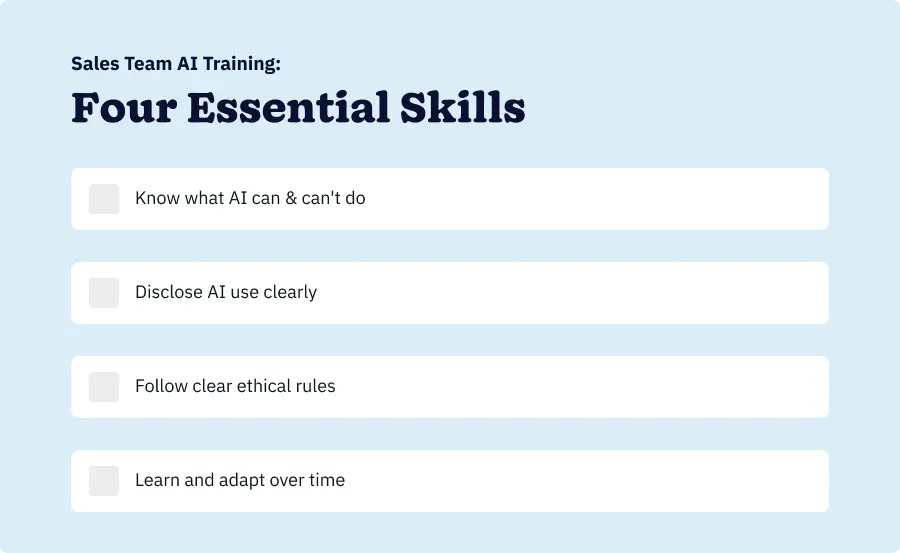
Checklist infographic showing four essential sales team training components: understanding AI limitations, transparency protocols, ethical guidelines, and continuous improvement

Sales teams need education on several fronts:

  • Understanding AI limitations: Reps should understand what their AI tools can and can’t do. An AI lead-scoring system might be 85% accurate overall, but that means 15% of scores are wrong. Understanding this variance helps representatives use the tool appropriately—as a guide to be evaluated with human judgment, rather than as a definitive answer.
  • Transparency protocols: Sales professionals need clear guidance on when and how to disclose that AI is involved in customer interactions. This might be as simple as language in email templates: “We use advanced analytics to identify which features are likely to provide the most value to your business.” The goal is honesty without creating unnecessary alarm.
  • Ethical guidelines: Organizations implementing responsible AI in sales typically establish clear guidelines for use, such as:
    • Don’t use AI-generated content that impersonates human judgment (e.g., “I reviewed your business and…” when an AI actually did the analysis)
    • Don’t continue contacting customers who have opted out, regardless of what the AI recommends
    • Escalate to a manager if the AI’s recommendation seems questionable or could disadvantage a particular type of customer
    • Maintain accurate records of AI-assisted interactions so customers can understand the process
  • Continuous improvement: As the organization learns more about how AI actually performs and where bias or problems emerge, training should be updated accordingly. This signals that responsible AI adoption is an ongoing commitment, not a one-time checkpoint.

Sales leaders play a critical role here. If leadership treats ethical AI adoption as important, teams take it seriously. If it’s seen as legal overhead, the culture won’t shift.

Measuring trust and validating ethical AI practices

Trust is difficult to measure, but the consequences of losing it are clear and measurable. Organizations need to track both direct indicators of trust and downstream business metrics that reveal whether ethical AI adoption is effective.

Tracking transparency and consent

Monitor how many customers are aware that AI is being used in their interactions and whether they’ve given informed consent to specific uses of their data. Consent management platforms can track this in real-time, providing visibility into whether transparency practices are actually reaching customers.

Measuring customer sentiment

Utilize surveys and feedback mechanisms to gain insight into how customers perceive the application of AI. Are customers who know about AI use more or less likely to trust your organization? Are there segments that have particular concerns?

Monitoring complaint and escalation rates

Track whether complaints about AI decisions are increasing or decreasing. If certain types of customers consistently escalate AI-made decisions, that’s evidence of bias or misalignment that needs investigation.

Validation of AI outputs

Establish processes to regularly validate that AI recommendations are actually accurate and unbiased. For lead scoring, this might mean comparing how leads with high AI scores actually perform versus how humans would have scored the same leads. For customer interaction AI, it might mean having humans audit a sample of AI-generated responses to ensure they’re helpful and appropriate.

Business outcomes

Ultimately, responsible AI adoption should improve business results. Organizations that implement these practices report improved customer satisfaction, a stronger brand reputation, and better long-term customer relationships. These aren’t just feel-good metrics—they translate into revenue retention and reduced churn.

The future of AI sales ethics: Transparency is your competitive advantage

The integration of AI into sales is inevitable. The question isn’t whether to use AI, but how to use it in ways that maintain the trust that customer relationships depend on.

Ethical AI sales practices—transparency, human oversight, bias mitigation, compliance, training, and continuous validation—aren’t obstacles to adoption. They’re the frameworks that make AI adoption sustainable and valuable. 

Organizations implementing these practices will find that customers aren’t skeptical of the AI—they’re skeptical of companies that use AI without transparency or accountability.

The data is clear: customers want AI to work for them, but they want to understand how and why it’s being used. The organizations that are succeeding with AI adoption appear to be those that prioritize responsible AI in sales alongside innovation. 

In a market where customer trust is increasingly the differentiator, the evidence suggests that AI sales ethics practices aren’t constraints on innovation—they’re foundational to sustainable adoption.

BACK TO TOP

Join 30,000+ other sales and marketing professionals. Subscribe to our Sell to Win newsletter!