AI CRM Use Cases That Deliver: Where AI in CRM Pays Off
-
Full pipelines with missed quotas are one of the greatest frustrations that many AI-invested companies face. But the lack of data isn’t the issue here. Most modern CRM platforms have baked in AI. The issue is that no one told the team where precisely to direct this data.
Research in 2025 by the IBM Institute for Business Value claims that 74% of CRM users are still struggling to improve customer experience and engagement despite the increase in AI. The tools exist, but the results are missing.
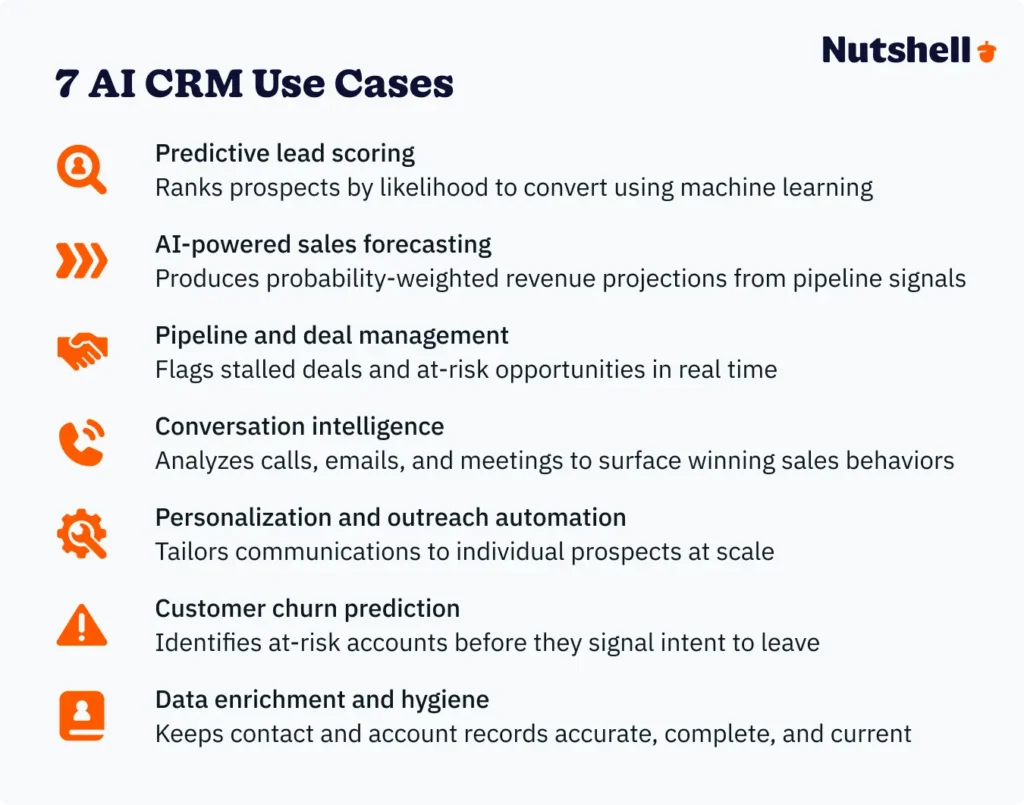
There are seven specific AI CRM use cases that are backed by research and have proven to help improve pipeline performance. Each use case is made to work on a specific part of the process where revenue is either won or lost.
This is Nutshell’s breakdown of how and why AI in CRM is worth the investment.
Key takeaways
- Research consistently shows that AI exhibits the clearest return on investment (ROI) in customer relationship management (CRM) when applied to activities such as lead scoring, forecasting, pipeline management, conversation intelligence, personalization, churn prediction, and dataset enrichment.
- Most implementations fail because of data quality issues and a lack of clear case ownership, not the AI.
- An analysis by Gong Labs in 2024 of over one million sales opportunities revealed that AI deal execution leads to a 35% increase in deal win rates.
What does AI actually do inside a CRM?
AI and CRM become one when machine learning, analysis of customer data, prediction of future behavior, and automation of time-consuming tasks come into play. Prediction of future behavior relies on algorithms that analyze historical data. AI and algorithms rely on fast and accurate systems that learn and modify data.
CRM systems are beginning to predict future trends, thanks to the integration of AI tools. The difference is that these systems no longer simply store past events and data. They determine and carry out the next best course of action.

What are the 7 proven AI CRM use cases?
1. Predictive lead scoring
Predictive lead scoring is the use of machine learning (ML) to analyze and rank prospects for their likelihood to convert based on a combination of behavioral, firmographic, and engagement-based heuristics.
Traditional lead scoring is based on static components and an arbitrary point system for attributes such as job title, company size, and form fills. Predictive lead scoring replaces static criteria with adaptive models based on the closed deals present in your CRM history.
A peer-reviewed study in Frontiers in Artificial Intelligence in 2025 determined that machine-learning-based lead prioritization and scoring outclassed traditional methods for B2B environments.
Gradient boosting models were able to identify the conversion-predictive signals that the manual model consistently failed to address. The end result is that reps will focus on leads that are most likely to convert, as opposed to leads that are most desirable on a static scoring system.
2. AI-powered sales forecasting
The reality concerning how most teams forecast revenue is a bit awkward. According to Gartner’s 2025 research on the role of AI in sales, only 7% of sales teams or organizations achieve 90% or greater forecast accuracy. The average falls within the range of 70% to 79%.
AI-powered sales forecasting is the use of ML to analyze the various components of a sales pipeline, such as deal age, engagement frequency, and stage velocity, and provide a forecast of revenue that has been weighted for probability.
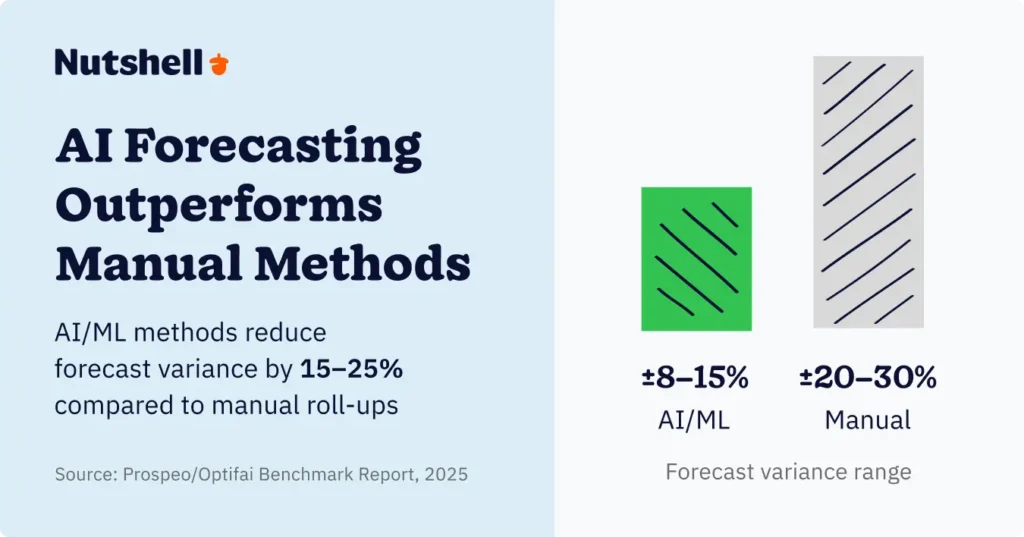
The use of AI and ML results in a forecast variance of approximately 8% to 15%, which is an improvement of 15% to 25% compared to a forecast created by the manual method. Improved forecasting results in better allocation of resources, fewer unexpected events at the end of each quarter, and finance meetings that don’t require a spreadsheet disclaimer.

3. Pipeline and deal management
Automated, AI-driven, closed opportunity pipeline management identifies stalls, risks, and momentum in deal activity. Deal health scores track real-time risks, alerting sales and management to cooling deals. This eliminates the need for scheduled deal reviews and the associated time-consuming and tedious spreadsheet audits.
This is crucial for growing teams where deal activity is outpacing management. A 2025 industry analysis by Optif.ai of 47,548 B2B deals across 938 companies highlighted that pipeline deals that stalled beyond 28 days resulted in 67% lower conversion rates. The study found that when teams acted on AI-generated warning signals within 72 hours, they reduced failure rates by more than half.
4. Conversation intelligence
Conversation intelligence is the integration of AI into sales meetings and sales communications to understand language, sales process, and sales psychology that correlate to successful and unsuccessful sales. This makes your sales team’s top performers visible, to then be developed and coached.
In 2024, Gong provided an analysis of over one million sales opportunities linked to 1,418 sales organizations. It found that using AI conversation intelligence data to help facilitate deals increased team win rates by 35%. And introducing generative AI functionality increased team win rates by 26%.
5. Personalization and outreach automation
At scale, AI has the capability to send personalized sales messaging across multiple touch points for every deal in your pipeline. And the adoption of AI technology is gaining speed.
LinkedIn’s 2025 ROI of AI report shows a staggering statistic: 56% of sales professionals who were surveyed globally by Ipsos reported that they use AI in sales on a daily basis. And Gong’s research found that the use of AI to write sales emails had increased by an astounding 464% in 2023.
Sales professionals now spend less time writing and more time selling due to the increased rate of email replies because of AI.
6. Customer churn prediction
Another use case for AI is predicting customer churn. AI analyzes the customer engagement of a company through logs, ticketing, usage data, etc., to predict which customers might churn. Those customers are assigned a churn risk score according to the customer engagement signals that suggest they will churn.
For SaaS and subscription-based businesses, this AI application is very valuable. A systematic literature review published in 2026 in the Sibatik Journal determined that companies that adopted AI in CRM reported a sales increase of 29% on average. The proactive management of customer churn was one of the five mechanisms identified as driving that increase.
7. Data enrichment and hygiene
CRM data enrichment is the automation of improving records and data management. Through data enrichment, firmographics, demographics, and data about customer engagement are added to CRM systems. Data hygiene for CRM systems is the identification and resolution of records that are incomplete, outdated, or duplicated.
It may sound unglamorous, but this functionality is indispensable. Each of these cases relies heavily on the availability of clean data. AI trained on stale records and incomplete datasets produces poor predictions.
In 2024, Salesforce and Forrester Consulting conducted a survey on more than 700 global business leaders. The survey results showed that 92% of respondents believe a sound data strategy is imperative for AI CRM success, but that only 34% have formalized this strategy. That gap directly corresponds to a big majority of the failed implementations.
Why do so many AI CRM implementations still fall short?
There are two main reasons AI CRM implementations fail, neither of which relies on technology.
The first issue is data. A majority of CRM databases are inconsistent, riddled with duplicates, gaps, or outdated data. These all but guarantee the failure of any AI integration at the onset. There are many AI tools that are operational within sales teams. But if there’s bad data going into the system, the output will be bad too.
The second issue plaguing teams is specificity. Companies employing broader AI functions without specifying the problem that each AI function solves are unlikely to see any return on their investments. Deploying AI solutions to combat specific problems will render far better results.
Frequently asked questions about AI CRM use cases
-
1. What is an AI CRM?
An AI CRM is a customer relationship management platform that incorporates ML, predictive analytics, and natural language processing to automate tasks, surface insights, and improve decision-making across the sales and customer life cycle.
-
2. Which AI CRM use case delivers the fastest ROI?
Predictive lead scoring and conversation intelligence tend to show the fastest measurable impact because they directly influence win rates on the active pipeline. Gong’s 2024 research on over one million opportunities showed win rate improvements of 26% to 35% when AI deal execution tools were applied consistently.
-
3. Do small businesses benefit from AI in CRM?
Yes. AI CRM capabilities are no longer exclusive to enterprise platforms. Smaller teams benefit most from use cases that reduce manual work. This includes data enrichment, automated follow-up personalization, and pipeline health alerts, which free up limited rep capacity for high-value conversations.
-
4. What is the biggest barrier to AI CRM success?
Data quality. A Salesforce-commissioned Forrester study found 92% of business leaders believe a strong data strategy is critical for AI success, yet only 34% have a formal strategy in place. AI models trained on incomplete or inaccurate CRM data produce unreliable outputs regardless of the underlying technology.
-
5. How is AI different from standard CRM automation?
Standard CRM automation is a rules-based system that executes predefined actions when set conditions are met, like sending a follow-up email three days after a demo. AI in CRM is an adaptive system that learns from data patterns to make predictions that no fixed rule could anticipate, like identifying which deal is most likely to slip before any explicit warning appears.
The use case gap is the real problem
The problem that most sales teams have boils down to targeting.
The data and results for the AI use case in the sales pipeline are irrefutable. What most companies need is a clear connection identifying which AI capabilities belong to which sales pipeline stages.
The AI use cases above offer the map sales teams need. It’s clear that the companies that have the edge have established the true problem: It’s not that they need more AI, but rather that the AI tools they employ align with specific use cases and solve specific issues. When taking this targeted approach, AI CRM integration becomes a real revenue-driving investment.
BACK TO TOPWritten by
Andy Fowler CEO & Co-Founder, NutshellEdited by
Will Gordon Sr. Director of MarketingReady to try
Nutshell for Free?Thank you! Your submission has been received!Oops! Something went wrong while submitting the form.
How to Use a CRM to Build Your Real Estate Empire: The Complete Agent’s Guide
Published on: May 11, 2023Sales Performance Reviews: 9 Tips to Make Them Valuable
Published on: November 10, 2022Unify Team Meeting Processes for Increased Productivity With Nutshell Scheduler Managed Meetings
Published on: May 16, 2025What Are the Top 3 Go-To-Market Strategies?
Published on: November 10, 2022Join 30,000+ other sales and marketing professionals. Subscribe to our Sell to Win newsletter!
- Product
- Nutshell Overview
CRM & Sales
Our powerful and easy-to-use flagship product.Marketing
Email marketing, forms, landing pages, and more.Engagement
Webchat, SMS, WhatsApp & more in your Omni-Channel Inbox.Prospecting
Prospect for new leads and new contacts in your CRM.Quotes & Invoices
Quickly create quotes & invoices in your CRM.
AI
See why Nutshell is the leading AI CRM.Integrations
Connect to Google/Microsoft and over 5,000 Apps.
ReportingCreate reports and forecasts in an instant.CRM Advisor
Get a dedicated point of contact to get the most out of Nutshell.Partner Marketplace
Find trusted partners to help optimize your Nutshell CRM.
- Pricing
Nutshell AI
- Resources
- Contact Us
Contact Sales
Send us your questions or book a 1-on-1 demo.Join a Demo
Join a group demo for a general overview of Nutshell.
Contact Support
Contact our support team via live chat in app or via email.Become a Partner
Refer businesses to Nutshell & earn commissions.
Contact Marketing
Questions about our website or our marketing opportunities?Careers
Join our growing team! See current openings.