You’ve just received a sales proposal from someone who you’re considering doing business with and this is the last remaining piece of information that will help inform your purchasing decision.
What is it that you’re going to notice about the proposal? What elements are you specifically looking for to help you make the decision to purchase?
Key takeaways
A truly killer proposal does more than just present your offer—it makes your buyer feel like a million bucks. It shows you understand their world, proves others trust you, and clearly demonstrates the value they’ll get.
These five elements are the non-negotiable foundation of every winning proposal:
Look and Feel: Professional design instills confidence and reflects the quality of your work
Personalization: Customized proposals addressing the buyer’s specific challenges outperform generic templates every time
Social Proof: Testimonials, case studies, and client success stories are cited by 97% of B2B buyers as the most reliable content
Competitive Comparison: Help buyers objectively evaluate you against alternatives instead of forcing them to research
The Solution: Clearly articulate both how you’ll solve the problem (the methodology) and what they’ll achieve (the outcome)
💡 Pro Tip: Speed is critical when it comes to B2B proposals. First impressions matter, and how quickly you respond can impact how your prospect sees your offerings. Even better: when multiple stakeholders view a proposal, close rates nearly double.
1. Look and Feel
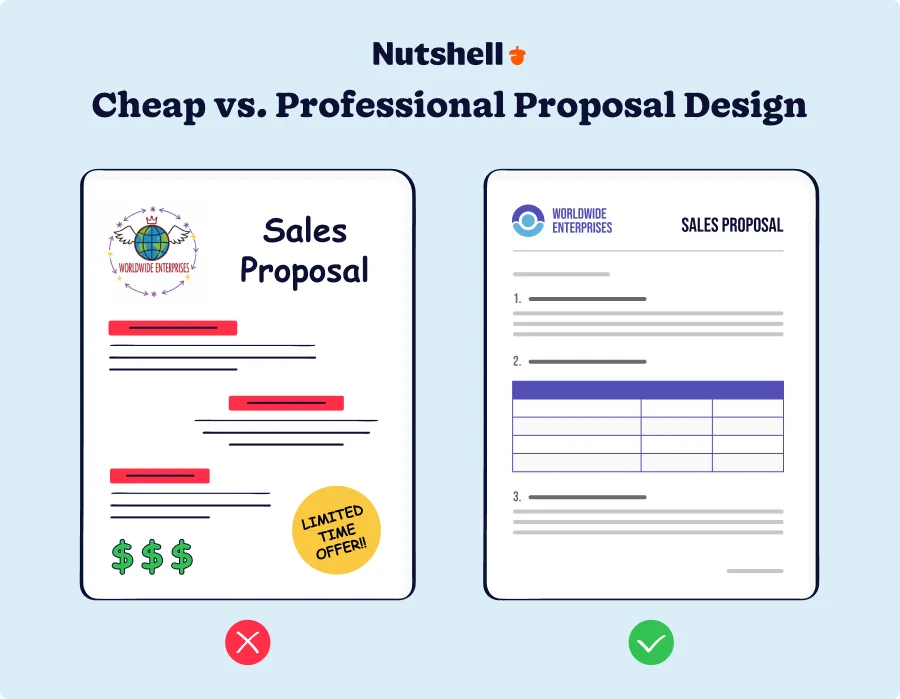
How does the proposal document actually look and feel when you first see it? Does the document appear to be polished and on-brand for the business? Are there dynamic elements like video, custom images, or an interactive pricing table?
Or, does the proposal seem kind of janky or cheap? Do you notice disproportionate logos? Questionable font choices? Cheesy stock images?
A proposal should make your buyer feel like a million bucks. They shouldn’t feel like they are reviewing a proposal from a bargain basement firm whose idea of branding is the 3D cyan/magenta word art in Microsoft Word.
Furthermore, the proposal in front of them should instill confidence that the company they are about to do business with is professional, smart, and will drive results. A cheap-looking proposal reflects poorly on the level of quality your company can provide.
Let’s say your company is in the market for highly specialized manufacturing equipment. You plan to meet with a salesperson so you can explain your unique needs, pain points, and goals.
Then, BAM!
You’re knocked upside the head with a cookie-cutter proposal that doesn’t speak at all to the challenges that you took the time to discuss. It’s essentially a template document with some pricing thrown into the mix. Talk about a disconnect.
What this should communicate to you as a buyer is that the salesperson wasn’t actually listening to your needs. Instead, they’re giving you the same proposed solution as everyone else that comes through the door.
3. Social Proof
Consciously or subconsciously, buyers are likely looking for something in the proposal that will provide legitimacy to “anchor” it. That credibility could take the form of social proof in success stories, testimonials, or performance data from other clients.
Even something as simple as bite-sized quotes from existing customers can provide the gut-check that other reputable companies have used the vendor and have had a desirable outcome.
4. Competitive Comparison
A buyer faces the daunting task of collecting as much information as possible to winnow down their purchase options and make a decision about which vendor will provide the best solution to their problem. The “best” solution may be determined by specific features, pricing, timelines, or other qualities of the proposed offerings.
Imagine how useful an objective “head-to-head” comparison between top competitors would be if it were included in the proposal. Not only would it help a buyer objectively evaluate the current proposed offering against competitive offerings, but it would also highlight where the competition falls short.
5. The Solution
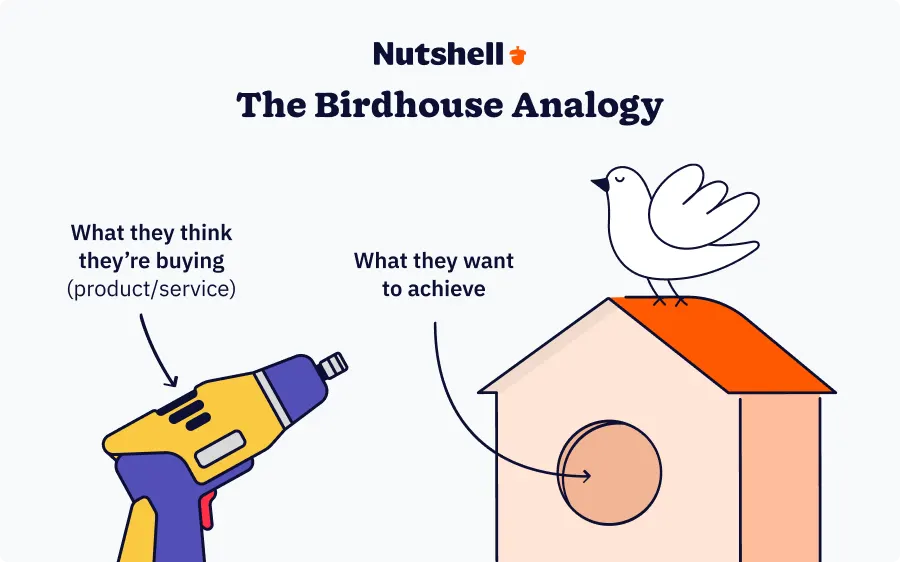
Imagine it is spring and you are looking to build the perfect birdhouse for your new backyard. So you head to your local hardware store to buy the perfect drill to do the job. But when you get there, you realize you have no idea what you need.
The same challenge applies for a sales proposal. The buyer often specifically looks for details and specs about what they think they’re buying—the drill. That’s the core product or service that you’re proposing.
But in reality, they’re really out to buy the hole to make the birdhouse—and the buyer doesn’t realize it. Here, the hole represents what they want to achieve by spending the money on the drill.
So, a proposal should speak to both the methodology (the product/service) and the outcome.
When the buyer arrives at the end of your proposal, they should feel confident that what you’re offering them will help solve a problem, address a pain point, or increase their revenue. Keep in mind that how you present this solution is just as important as the nature of what you’re presenting.
Knowing the 5 elements is one thing. Executing them consistently across dozens of proposals? That’s where most sales teams struggle.
Nutshell’s Quotes & Invoices feature makes it simple to create professional, branded proposals that incorporate all five elements—without starting from scratch every time.
Here’s what makes Nutshell different: ✅ Professional templates: Start with branded templates you can customize for each buyer ✅ One-click personalization: Pull buyer information directly from your CRM into proposals automatically ✅ Proposal tracking: See exactly when prospects open your proposal, which pages they view, and when they’re ready to sign ✅ Integrated workflow: Create, send, track, and accept proposals without leaving Nutshell ✅ Built for sales teams: No need for separate proposal software. Everything happens inside your CRM.
The result? Sales teams report spending 75% less time creating proposals and closing deals 45% faster when they use proposal software integrated with their CRM.
You’ve learned what makes proposals win. Nutshell helps you execute it consistently.
FAQs about creating sales proposals
1. How long should my sales proposal actually be?
The data is clear on this one. Research analyzing 1.6 million proposals found that 10 pages is the winning sweet spot. Long enough to be comprehensive, short enough to hold attention. The key? Include only information that directly impacts the buying decision. Remove anything—no matter how interesting—that doesn’t move the deal forward.
2. Should I include pricing in the proposal?
Yes, always. Buyers expect it. Make your pricing transparent and structured. Break it down by package or service tier, show what’s included at each level, and explain the value you’re providing. Hidden or vague pricing creates suspicion and kills deals.
3. Is it okay to send the same sales proposal to multiple people?
No. Generic proposals feel generic—and buyers can tell. Even if you’re using the same overall structure, customize heavily for each prospect. Reference their company name, the specific challenges they mentioned in your discovery call, and the unique solution you’re proposing. The structure can stay consistent, but the content must be personal.
4. What if I don’t have customer testimonials yet?
Build them as you grow. In the meantime, use case studies with detailed results, performance metrics from similar clients, industry certifications, or awards that demonstrate credibility. The moment you close your first deal, ask for a testimonial. You’ll need them for future proposals.
5. How soon should I follow up after sending a proposal?
Send an initial follow-up within 24 hours—something like, “Hi [Name], I wanted to make sure my proposal came through. Do you have any questions about what I outlined?” Then, if you don’t hear back, follow up again in 3-5 days. Many proposals sit unread simply because life gets busy. A gentle reminder can move things forward.
6. Can I use proposal software to make this easier?
Absolutely. Tools like Nutshell’s Quotes & Invoices feature let you create professional, branded proposals directly within your CRM. You can track when prospects view your proposal, get notified when they open it, and manage the entire quoting process without leaving your sales platform. Sales teams using proposal software report 45% higher win rates than those creating proposals manually.
7. What if a prospect asks me to modify the proposal?
Listen carefully and take it seriously. Modification requests often signal strong buyer interest. They’re negotiating—which is a good sign. Work with them to adjust scope, pricing, timeline, or deliverables based on their feedback. This back-and-forth is part of the sales process and often leads to closed deals.
Bethany Fagan is the Partner Marketing Manager at PandaDoc. When she’s not promoting one of our integrations or amazing partners, her time is spent exploring her new Brooklyn neighborhood with her husband and two French Bulldogs, Tater Tot and Pork Chop.
HOW DO YOU SELL?
Nutshell is flexible enough to fit every sales model.
Choose the model that best fits your business and see how we help teams like yours close more deals.