Why CRM is Important for Small Business Growth and Efficiency

-
Small businesses (those with less than 500 employees) make up 99% of businesses in the U.S. and employ almost half of the country’s workforce. Unfortunately, most rely on outdated systems like spreadsheets for managing customer relationships. As a result, there’s a measurable difference in the cost and efficacy of customer data management between small and larger businesses.
Customer relationship management (CRM) is the tracking and organizing of each customer and prospect across every touch point a business has with them. For small businesses, especially those with lean teams and tight margins, the use of CRM systems is a competitive advantage.
Studies have shown that small businesses utilizing CRM systems see greater sales performance and a higher rate of customer retention. These businesses also see better overall efficiency when compared to small businesses that do not use CRM systems.
To provide small businesses the opportunity to grow, this Nutshell guide shows the various data points that support small business CRM system use, and the most valuable tools and features small businesses should look for in a CRM solution.
Key takeaways
- Research published in Sustainability in 2025 shows that CRM adoption in SMBs increases customer retention, sales, and improves operational process efficiency.
- Compared to larger companies, SMBs have the greatest need for CRM solutions but are the least likely to adopt them, according to Metrigy’s CX MetriCast 2025 study.
- CRM solutions start paying off soon after implementation, as highlighted in a 2025 study by the IJPREMS. The effects get better over time as retention improves and teams work better together.
Table of contents
What is CRM, and why does it matter for small businesses?
CRM stands for Customer Relationship Management. At its core, CRM is a structured way to track and organize a business’s current and future customer touch points. Essentially, CRM software helps you manage business contact data, track business relationships, and organize future communication.
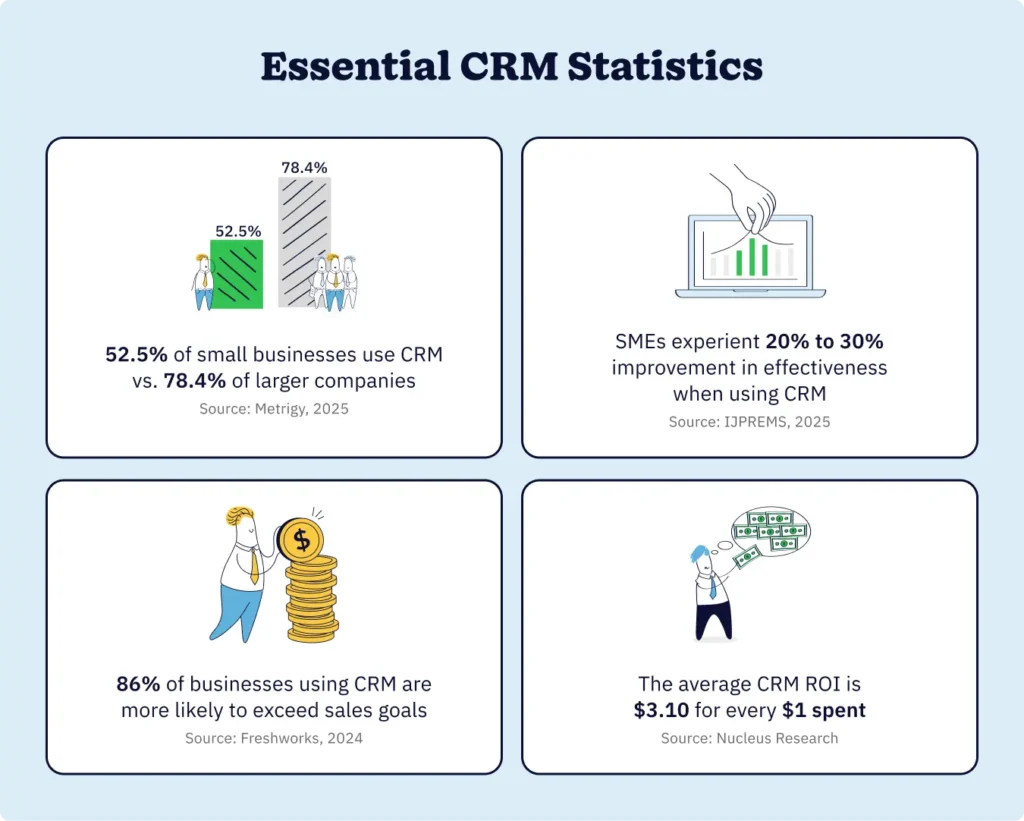
For large corporations, a powerfully structured CRM system is foundational. And, while small businesses are only starting to catch up, there’s still a significant gap to fill. Metrigy’s CX MetriCast 2025 study found that only 52.5% of companies with fewer than 250 employees have employed a CRM system. In comparison, 78.4% of companies with between 1,000 and 2,500 employees use a CRM. That gap shows which businesses have successfully built systems to cultivate customer relationships and which have not.
The reality is that small businesses find themselves on the losing end of that gap. When one employee holds vital customer information in their email, staff turnover can ultimately disrupt customer relationships that have been built over a long period of time. That’s not the way to build a business.
What does the research say about CRM and small business performance?
Research shows that across all sectors and scales, CRM adoption has a positive association with business performance. Importantly, research is no longer confined to large-scale enterprises.
In a 2025 peer-reviewed study published in the Sustainability journal, the author studied employees across 228 SMBs and covered the impact of CRM on small businesses. With 9 hypotheses in mind, the study found 8 of them to be true.
Out of all the 8 proven hypotheses, systematic CRM organization (the way customer data is organized in a CRM system) was found to have the highest impact on performance. The study also confirmed that CRM usage promotes customer loyalty, increases customer lifetime value, and improves competitive advantage in the dynamic marketplace.
In a different study published in the International Journal of Progressive Research in Engineering Management and Science (IJPREMS) in 2025, the author surveyed small business owners from retail, healthcare, education, and service sectors.
The study claimed that each major metric (time savings, automated follow-ups, improved coordination, and efficient complaint tracking) had an average score of greater than 4.7 out of 5. The research confirmed that the adoption of CRM systems by SMBs leads to a 20% to 30% improvement in effectiveness, particularly in customer retention and service quality.
CRM and small business performance example
One tangible example of how useful the tools in modern CRMs can be comes from Brother’s Leather Supply, a small leather goods manufacturer.
For a while, managing wholesale inquiries, email, and vendor communications was easy with the use of spreadsheets. But once web orders hit the company, the system became overloaded.
The company was losing out on revenue because there were so many unfulfilled orders. This was all due to broken and lost opportunities for sales calls and follow-ups.
Transitioning to a CRM system helped the company decrease operational friction and manage workflows to the point that they reported consistent growth of 40% every month and hit six figures in sales.

How does CRM improve day-to-day operations for small teams?
There are three major advantages many professionals point to: Data organization, time savings, and team coordination.
Data organization is the foundation. The localization of data and past interactions in a CRM helps sales teams pick up where past team members left off. It saves them the time of having to constantly recall past interactions with the customer or start from scratch when the data can’t be found.
Time savings become apparent fast. A survey performed by Freshworks in 2024 of 600 business professionals found that, across the board, the vast majority believed that CRMs helped save 5 to 10 standard work hours in a week. The results cited help with follow-ups, reminders, and alerts as being some of the primary CRM time-saving features.
Team coordination is where CRM delivers something that spreadsheets structurally can’t. CRM coordination tools are shared, real-time elements that allow multiple team members to access contact history, current conversations, and outstanding activities simultaneously. In small businesses where the division of responsibilities is less distinct, and everyone is involved with customer relationships, that transparency has a real impact on team dynamics.
Does CRM actually help small businesses scale?
Yes, and the data backing this up is compelling.
According to research by Freshworks in 2024, the majority of companies that adopted a CRM recorded a sales revenue increase of 21% to 30% and a sales cycle reduction of 8 to 14 days. Companies with a CRM reported that they were 86% more likely to meet sales targets compared to companies without a CRM.
A 2025 study by IJPREMS describes a moderate positive correlation between the retention of customers and the length of time a business has been using a CRM. The study argues that the longer a CRM is used effectively, the better the business’s customer retention.
Over time, CRM systems gain business intelligence. The more interactions, outcomes of decisions regarding deals, and preferences that are entered, the more beneficial the system is.
Businesses that adopt a CRM early differentiate themselves by having systems in place prior to rapid growth. Companies that wait to adopt a CRM typically do so during rapid growth, and the results are less predictable.
Is CRM worth the investment for a small business?
Yes. CRM is, without a doubt, worth the investment for small businesses.
Nucleus Research found in 2024 that a CRM system delivers an average return of $3.10. But what small business owners should be thinking about is the cost of missed opportunities when operating without a CRM.
Without a CRM, you risk having a slow onboarding process for new employees, losing context for deals, duplicating efforts when reaching out to clients, and more. These all affect your bottom line but are more difficult to quantify than the subscription fee.
That said, CRM systems are becoming more accessible to small businesses. Metrigy’s 2025 study recorded a significant jump in the adoption of CRM systems by small and medium-sized businesses in 2024.
Subscription fees and software complexity, which had kept small businesses from adopting CRM, are becoming a thing of the past. In fact, entry-level plans for major CRM systems now start at under $30 per user per month.
Frequently asked questions about the importance of CRM for small businesses
-
1. What does CRM stand for?
“CRM” stands for “customer relationship management.” CRM is both a business strategy for managing customer interactions and a category of software that centralizes contact data, tracks deals, and automates outreach across sales and marketing teams.
-
2. When should a small business start using a CRM?
Most experts recommend implementing CRM before it feels urgent, ideally before a team exceeds 5 people or a customer base grows beyond 50 to 100 active accounts. Earlier adoption typically leads to cleaner data and a smoother path to scaling.
-
3. Can a very small business with just a few employees benefit from CRM?
Yes. CRM is particularly valuable for solo operators and micro-teams because it compensates for the coordination challenges that come with wearing multiple hats. Automated follow-ups, centralized contact history, and task reminders replace the mental load of manually tracking every customer touch point.
-
4. How long does it take to see results from CRM?
Sales performance improvements tend to appear quickly, often within the first few months of adoption. Customer retention improvements are more gradual and strengthen over time as the CRM accumulates usage history and data. Research confirms a moderate positive correlation between CRM usage duration and retention outcomes.
-
5. What CRM features matter most for small businesses?
The features that deliver the most value are contact management, pipeline tracking, email integration, automated follow-up sequences, and reporting dashboards. Ease of adoption matters just as much as feature depth. The best CRM for a small business is one that the team will actually use consistently.
Growth doesn’t wait for better systems
A CRM is not an enterprise software program that small businesses have to adapt to. For any business that relies on relationships to earn revenue and grow, a CRM platform is an important business tool.
Sales revenue, customer retention, and time savings all improve with the level of organization, collaboration, and automation that a CRM provides. And that system builds in value over the years. Small businesses that treat CRM as optional are taking a gamble, either that they won’t lose customers or that losing customers will have zero cost impact on the business. The research on this is clear, and in no uncertain terms indicates that this is a bet small businesses will lose.
BACK TO TOPWritten by
Will Gordon Sr. Director of MarketingEdited by
Sam Poole Associate Content MarketerReady to try
Nutshell for Free?Thank you! Your submission has been received!Oops! Something went wrong while submitting the form.
What Are the Top 3 Go-To-Market Strategies?
Published on: November 10, 2022Sales Performance Reviews: 9 Tips to Make Them Valuable
Published on: November 10, 2022Join 30,000+ other sales and marketing professionals. Subscribe to our Sell to Win newsletter!
- Product
- Nutshell Overview
CRM & Sales
Our powerful and easy-to-use flagship product.Marketing
Email marketing, forms, landing pages, and more.Engagement
Webchat, SMS, WhatsApp & more in your Omni-Channel Inbox.Prospecting
Prospect for new leads and new contacts in your CRM.Proposals & Invoices
Create & send quotes, invoices and contracts in your CRM.
AI
See why Nutshell is the leading AI CRM.Integrations
Connect to Google/Microsoft and over 5,000 Apps.
ReportingCreate reports and forecasts in an instant.Mobile App
Take your CRM with you wherever you go.CRM Advisor
Get a dedicated point of contact to get the most out of Nutshell.
- Pricing
Nutshell AI
- Resources
- Contact Us
Contact Sales
Send us your questions or book a 1-on-1 demo.Join a Demo
Join a group demo for a general overview of Nutshell.
Contact Support
Contact our support team via live chat in app or via email.Become a Partner
Refer businesses to Nutshell & earn commissions.
Contact Marketing
Questions about our website or our marketing opportunities?Careers
Join our growing team! See current openings.