How to Build a Sales Pipeline From Scratch
-

Quick answer: How do you build a sales pipeline from scratch?
Start by defining your ideal customer profile and mapping out the stages your prospects move through, then document the specific actions your team takes at each stage. From there, use a CRM to track progress, automate repetitive tasks, and continuously refine your pipeline based on where deals are stalling.
Key takeaways
- A sales pipeline outlines each stage of the buyer’s journey and gives structure to your sales process—leading to higher win rates and more accurate forecasting.
- To build your own, define your ideal customer profile, map out each stage with clear actions, and use CRM tools to visualize progress and automate follow-ups.
- Regularly refine your pipeline by analyzing drop-offs and adjusting outreach tactics to improve conversion at every stage.
You’re spending hours managing deals in spreadsheets. Your team has no visibility into where prospects stand. Forecasts are guesswork, not data. And somewhere in the chaos, a deal worth thousands just slipped through the cracks.
Sound familiar?
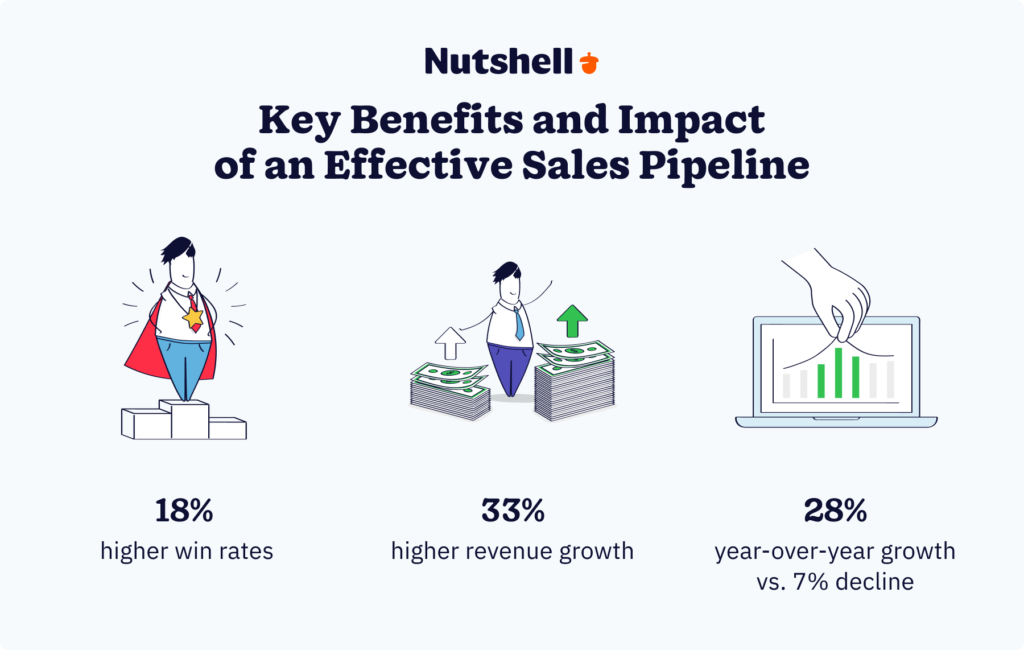
About 55% of sales leaders admit they’ve lost revenue from not having a clearly defined sales process. Meanwhile, companies with well-defined sales processes enjoy 18% higher win rates than those without structured approaches.
The difference between these outcomes? A properly built sales pipeline.
A sales pipeline isn’t just a fancy way to organize your contacts—it’s the strategic infrastructure that transforms chaotic sales activities into predictable revenue. It gives you visibility into every opportunity, helps you forecast with confidence, and ensures no prospect falls through the cracks. Best of all, it saves time by automating follow-ups and guiding your team through the exact steps needed to close deals.
Building a sales pipeline from scratch might sound complex, but it’s actually a straightforward process built on what already works in your business. This guide walks you through every step, from defining your ideal customer to tracking the metrics that matter.
Whether you’re a sales rep managing your first territory or a business owner building a sales operation from the ground up, you’ll learn how to create a pipeline that drives consistent results. Let’s dive in.
Understanding sales pipelines and their role
Sales pipelines are a critical tool for understanding your company’s sales process, what needs improvement in your sales operations, and what your deals need from you to move forward toward a sale.
Before we dive into how to build a sales pipeline, let’s cover the role your pipeline plays in your sales success.
What is a sales pipeline?
A sales pipeline is the series of ordered steps a prospect travels through on their journey to becoming a customer. Sales pipelines are defined by stages, which are loose categories detailing how the prospect should be interacted with.
Sales pipelines vary from business to business and even from product to product. They are meant to help determine which route a prospect can take to become a customer. Based on how easily prospects convert between specific stages, it’s also easy to analyze a sales pipeline and determine which stages need more fine-tuning.
For instance, if about 25% of prospects make it to each subsequent stage, except only 10% make it through the pitching stage, it might mean that your pitch requires some work, or maybe other details aren’t being adequately addressed leading up to this stage.
Sales pipeline vs. sales funnel: What’s the difference?
People conversationally misconstrue sales pipelines and sales funnels. From an operations perspective, a sales funnel is something else entirely.
We’ll leave the deep analysis of their key differences for another article, but in a nutshell, the difference between a sales funnel and a sales pipeline is this:
- A sales pipeline is a set of stages that a prospect moves through as they progress from a new lead to a customer.
- A sales funnel represents the quantity and conversion rates of prospects through the pipeline stages.
The relationship between a sales pipeline and a sales process
Whereas the sales pipeline is a series of stages, the sales process is a series of actions you and your salespeople need to complete that correspond to each pipeline stage.
Although often used interchangeably, the big difference is:
- A sales pipeline is the set of stages that a prospect travels through.
- A sales process is the set of actions you take for each stage.
- Therefore, each stage in the sales pipeline warrants its own sales process steps.
Remember, your prospect works their way through the pipeline, and you work your way through the sales process. The process serves as a tactical playbook of sales techniques that help get the prospect through the pipeline more effectively. Research by CSO Insights found organizations that have a well-defined sales process and effective pipeline management enjoy 18% higher win rates compared to those with informal processes.
Related: Why your sales team needs a standardized sales process
The importance of good pipeline management
In recent years, sales organizations have put greater emphasis on formalizing their sales pipelines – nearly half of executives admit their company is ineffective at pipeline management.
As a result, sales leaders are focusing on creating clear pipeline stages and standardized sales processes to improve win rates and predictability.
Companies with excellent sales pipeline management achieve 33% higher revenue growth than those with poor pipeline practices. In one study, firms with formal pipeline processes saw 28% year-over-year growth in pipeline vs. a 7% decline at companies with ineffective management. This illustrates how structured pipeline strategies translate into better results.
The bottom line is that pipeline management is key to effective sales process implementation and bottom-line results.
For more information on how to effectively manage your sales pipeline, check out our series of posts on pipeline management for different industries.Common sales pipeline stages
No two sales pipelines are identical, but many are similar. Here’s a straightforward sales pipeline example that most successful sales pipelines are built upon:
Lead generation
You have to generate leads before you have any deals in your sales pipeline. Lead generation is the process of getting people interested in your products or services. While many of the leads you generate may never buy, some will — and it’s vital that you find them.
Typically, increasing brand awareness through marketing efforts is a great way to generate leads. There are many ways to find leads for your pipeline, including:
- Posting on social media
- Paying for pay-per-click ads
- Running email campaigns
- Posting content on your website
Qualification
In the qualification stage, you, your company, your salespeople, etc., determine whether a prospect is a good fit for your product or service. There’s a lot to find out in the qualification stage, including:
- Whether they’re interested in your product
- Whether they have the budget
- If they can make the purchasing decision or if you need to contact someone else
This stage really serves to save you time because trying to pitch your product or service to someone who’s not interested will only hurt you in the long run.
Meeting
The meeting stage exists for the prospect to get a good, personalized look at what your product, service, or offer really does. Most of the time, this can be accomplished during a Zoom meeting or a phone call.
The meeting stage is also the point in your sales pipeline where video demos and webinars come into play. Especially for online businesses and B2B sales models, pre-recorded videos are an excellent way to consolidate all the questions that a prospect typically asks and answer them upfront in a constructive way.
It’s also a good idea to be available to prospects through other channels, like email, social media messaging, and live chat.
Pitch
If (and only if) a prospect is a good fit, you’ll demonstrate your solution in the pitching stage. The goal is to generate some interest, and your sales process should be thoughtfully crafted in order to do this as best as possible.
Remember that this stage is a two-way conversation with the prospect. Inviting them to share questions and objections is crucial so you can learn how to serve them better. And if you’re trying something new, their feedback will directly inform your sales process so that your pitch keeps getting better and better for future prospects.
Close
The closing pipeline stage is where the actual deal is negotiated. You or your sales team will need to answer any last-minute questions, and a contract or bill will be sent to the prospect for signing.
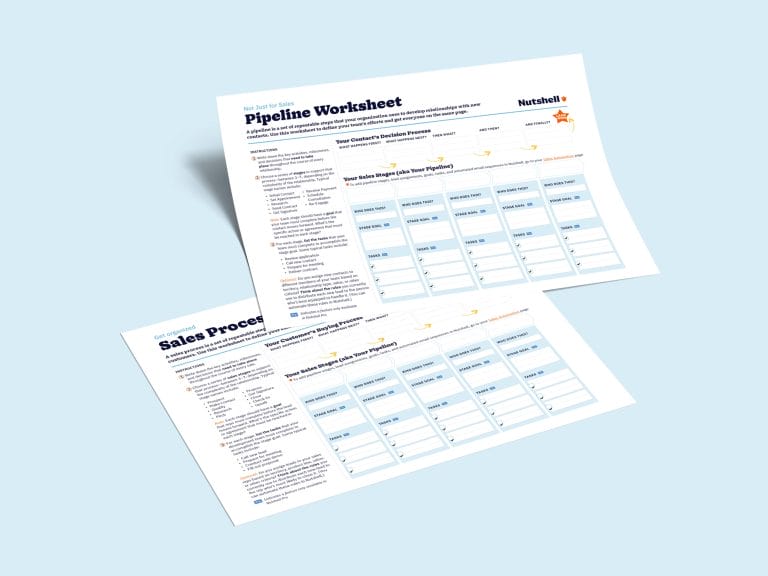
DOWNLOAD
Does your sales team have a roadmap for success?
Use our sales process worksheet to standardize your most effective sales efforts and close more deals.
The benefits of building a sales pipeline from scratch
Unfortunately, building a sales pipeline isn’t a set-it-and-forget-it kind of operation. When your salespeople interact with prospects, they’re gaining valuable information about optimizations that can make the experience better for prospects in the future. Sales pipelines are constantly being improved.
That’s why it’s a good idea to build your own sales pipeline rather than use a set formula. Here are a few more benefits of building your own sales pipeline:
- Personalization: When you create your own sales pipeline, you’re in control of what stages and processes your leads pass through, which is helpful because what’s worked for another business may not work for yours.
- Identifying bottlenecks: Creating your own pipeline is the best way to determine where leads are getting stuck and how much time they spend in each stage.
- Improvement: Building your own pipeline is also helpful for analyzing where your team is experiencing pitfalls, predicting future revenue, and figuring out how to improve your sales process.
How to build a sales pipeline
Creating your own sales pipeline takes some thought, but the benefits are worth the investment. Here’s how to build a sales pipeline in five easy steps:
1. Know your target audience
The first thing you should do when building a sales pipeline is to narrow down exactly who you want in that pipeline. Not every interested person is an ideal customer–defining an Ideal Customer Profile (ICP) helps your team focus on high-potential leads and avoid wasting time on poor fits.
Engaging in market segmentation is a good idea for determining who you should target for your pipeline. You’ll start by conducting research, then create customer segments you can target with marketing campaigns to generate leads.
It’s helpful to ask questions like:
- Who has been buying your product?
- What problem does your product solve?
- What puts you above your competitors?
- Where do you currently reach customers?
2. Identify the right stages
Every sales pipeline has its own unique processes behind it, which vary from company to company. The stages, however, are usually similar. Of course, they’ll look different based on your industry and company needs, but pipeline stages generally follow a pattern.
The pattern most pipelines follow reflects the customer’s journey to gaining awareness and interest, engaging with the company, and eventually making a purchasing decision.
In a typical sale, the buyer’s journey includes the following key decision phases:
- Unconcerned: The prospect is unaware of the issues your company solves.
- Investigating: The buyer is aware of the potential issue and is researching options.
- Defining: The prospect defines their decision criteria and process for addressing the issues your company solves.
- Selecting: The buyer is evaluating shortlisted options.
- Negotiating: The buyer is negotiating the best possible deal.
- Approving: The solution is formally approved by the decision-makers.
The sales pipeline that you build will include stages that acknowledge each of these steps in the buyer’s journey and maximize your team’s chances of engaging with them, anticipating their objections, and providing the answers they need to take the next step.
3. Work backward: What sales tasks do you do?
Building a sales pipeline starts with some knowledge of how the typical buyer’s journey plays out at your company. Do you have a formal qualification process? Does your meeting phase include pre-recorded videos? Does each sales pitch require some customization?
Since each step in your company’s sales process corresponds to a pipeline stage, you can easily create a pipeline built from the tasks and activities your sales team finds successful. For example:
Qualification activities include:
- Cold calling
- Cold emailing
- Fielding contact forms
Meeting activities include:
- Having a Zoom call
- Preparing a customized pitch
- Having a phone call with stakeholders
- Sending pre-recorded sales videos
Pitch activities include:
- Having a follow-up call
- Hosting a demo for the stakeholders tailored to their needs
- Holding a conversation about closing the deal
Closing activities include:
- Delivering a proposal
- Any final negotiations
- Acquiring a signed contract
4. Use the right tools
Once you’ve built your sales pipeline, it’s time to implement it in your sales process — but how? Manually keeping track of all the actions sales reps have taken with leads can be difficult and time-consuming. Instead, consider investing in a customer relationship management platform (CRM) that helps your team easily identify where leads are in the pipeline and maximize every opportunity.
CRMs are highly beneficial tools for organizing contact information and tracking leads as they move through your sales pipeline. They’re especially helpful if you have a long sales cycle or a complicated process that would be difficult to track with a spreadsheet.
Here are a few benefits of using a CRM in your sales process:
- Most CRMs will let you automate the cumbersome stuff like mass emails and advancing leads through your pipeline stages, so you can focus on what’s truly important—closing more deals.
- A CRM’s easy-to-understand user interface allows you to monitor the entire sales pipeline, see which stages need attention, how the corresponding processes can improve, and more.
- CRM reporting makes it easy to see which reps excel at which tasks, so you can maximize your team’s strengths.
The CRM you choose can also make or break your team’s success at managing your sales pipeline. For example, Nutshell’s sales automation features give you complete control over designing your pipeline, automating tasks, and providing guidance to your team to make sure no one ever misses a step.
Nutshell allows you to create custom pipelines to suit your business’s sales needs. Each pipeline stage represents a different step in your prospect’s journey. Upon creating a pipeline, a default template is shown, which can be changed to resemble your own company’s sales pipeline.
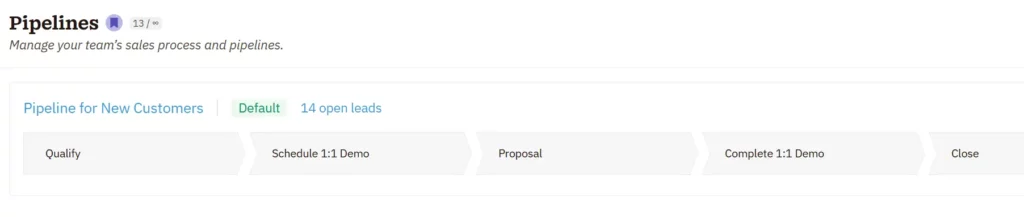
A default pipeline template From there, stages can be named and given custom parameters that determine things like:
- How long until the lead is considered overdue
- Lead confidence score
- How long until leads are closed
- Guidance for the rest of the sales team
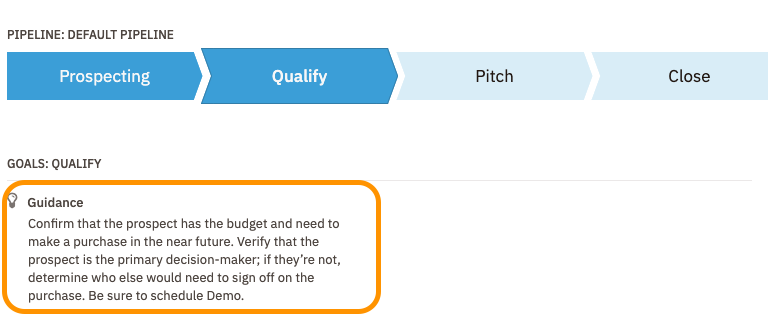
Guidance messages show up for everyone on your team. Most importantly, Nutshell CRM allows users to add automation to each stage in the sales pipeline so that certain repeatable actions are automatically performed for each stage in the pipeline.
For example, you can trigger a personalized email sequence or notify a specific salesperson when a lead is ready for a phone call. With automation, each pipeline stage can automatically get its own special treatment.
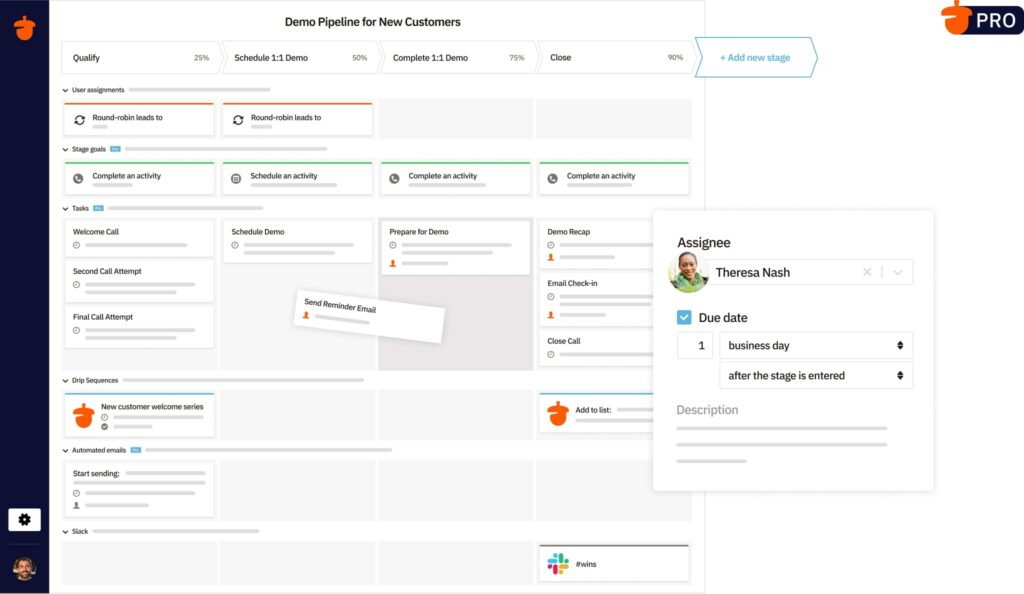
The customizable automation for each pipeline stage in Nutshell Nutshell’s pipeline management features also let your reps view and filter your pipeline in a way that works best for them. They can also mark leads as hot to prioritize the most valuable opportunities.
Want even more sales and marketing tips from our experts?
Join 30,000+ other sales and marketing professionals in signing up for our free Sell to Win newsletter!

5. Continue refining your sales pipeline
Even after you’ve created an effective sales pipeline and implemented it into your team’s process, the work isn’t done. It’s essential to continue reevaluating your pipeline and determining whether it’s working the way it should for your team.
For example, if you notice a large number of leads dropping off at a particular stage, you may want to test new approaches during that stage. If a particular communication channel worked especially well in another stage, you could integrate that channel into the stage you want to improve.
It’s up to you and your team to determine whether your pipeline works. Analyzing sales results is helpful, but consulting with your sales reps to determine which pipeline stages are necessary is also important.
Track the metrics that matter
Building a pipeline is just the first step. Optimizing it requires data. The most successful sales teams obsessively track pipeline metrics, using data to identify bottlenecks, improve conversion rates, and forecast revenue with accuracy.
Here are the pipeline metrics that separate high-performing teams from everyone else.
Conversion rates by stage: What percentage of prospects advance from each stage to the next? If 100 leads enter your pipeline and 25 make it to the qualification stage, you have a 25% lead-to-qualification conversion rate. Track this for every stage transition. When conversion drops dramatically at a specific stage, you’ve identified a bottleneck that needs fixing.
Average deal size: What’s the typical revenue value of closed deals? This helps you forecast total revenue by multiplying your pipeline value by your close rate. If your average deal is 15,000 and you have 20 qualified opportunities, you′re looking at 300,000 in potential revenue—but your actual revenue depends on your win rate.
Sales cycle length: How long does it take for a prospect to move from first contact to closed deal? Track both overall cycle length and time spent in each individual stage. The current reality: 34% of revenue teams report sales cycles lasting one to two full quarters. If your cycles are significantly longer, you might be pursuing deals that aren’t qualified or failing to create urgency.
Win rate: What percentage of qualified opportunities actually close? The average B2B win rate hovers around 21%, but top-performing organizations achieve 40% to 50%. If your win rate is below 20%, revisit your qualification criteria—you’re likely spending time on deals you shouldn’t be pursuing.
Pipeline velocity: How quickly do deals move through your pipeline? Velocity measures the speed at which opportunities convert to revenue. The formula: (Number of opportunities × Average deal value × Win rate) ÷ Sales cycle length. Higher velocity means more revenue in less time. Teams that close deals within 50 days achieve a 47% win rate compared to just 20% for deals exceeding that threshold.
Pipeline coverage ratio: How much pipeline do you need to hit your revenue target? Most teams maintain a three to one or four to one coverage ratio—meaning if your quarterly revenue goal is 100,000, you need 300,000 to $400,000 in qualified pipeline. This cushion accounts for deals that stall, prospects who go dark, and unexpected competitive losses.
Lead source performance: Which channels deliver the highest-quality leads? Track conversion rates and sales cycle length by source. You might discover that referrals convert at 40% with a 45-day cycle while cold outreach converts at 8% with a 120-day cycle. This data tells you where to focus your lead generation efforts.
Deal leakage: Where do prospects drop out of your pipeline? If 30% of qualified prospects disappear after the demo stage, your product demonstrations aren’t effectively communicating value. If deals consistently stall in contract negotiation, your pricing might be misaligned with perceived value.
The key is consistent tracking. Choose five to seven core metrics, measure them weekly, and review trends monthly. Share pipeline data across the team so everyone understands how their individual actions affect overall performance. When reps see that their qualification calls directly impact win rates, they pay closer attention to asking the right questions.
Set up automated reports in your CRM so you’re not manually calculating these numbers every week. Most modern platforms generate pipeline reports with a few clicks, showing you exactly where opportunities stand and which metrics need attention. The teams that win consistently are the ones that treat pipeline management as a discipline, not a guessing game.
Common challenges in building a sales pipeline
As highlighted earlier in this blog post, creating a sales pipeline from scratch offers many advantages. However, it can also pose challenges for businesses, especially those unfamiliar with structured sales processes.
A common challenge businesses face is a need for more clarity around their unique customer journey and sales cycle. With this understanding, guiding prospects effectively through each phase becomes easier.
Additionally, building a sales pipeline without a well-defined lead qualification stage can result in overinvesting in leads that aren’t likely to convert. On the other hand, it may also lead to valuable missed opportunities.
Once you’ve created your sales pipeline, you must follow through and maintain consistent communication throughout. If your sales pipeline is built and in place, your team needs to stay committed to their follow-ups to avoid stalled deals.
Your marketing and sales teams must be aligned for your sales pipeline to be successful. If the pipeline isn’t regularly maintained and refined, gaps can emerge between these teams, ultimately affecting overall performance. Clear communication and collaboration are vital to ensure everyone works toward common goals.
Common pipeline mistakes to avoid
Even with a well-designed pipeline, most teams make predictable mistakes that undermine performance. Recognizing these pitfalls helps you avoid them—or fix them quickly when they appear.
Mistake 1: Padding the pipeline with unqualified leads
The problem: Sales reps feel pressure to maintain a full pipeline, so they add every prospect who expresses mild interest—regardless of qualification. The result is a pipeline stuffed with deals that will never close, making forecasts wildly inaccurate and wasting time on dead-end conversations.
The fix: Implement strict qualification criteria and hold your team accountable for applying them. A smaller pipeline of genuinely qualified opportunities outperforms a bloated pipeline of maybes every single time. Focus on quality over quantity, and disqualify aggressively.
Mistake 2: Letting deals stagnate without action
The problem: Opportunities sit in pipeline stages for weeks or months with no activity. The sales rep claims the deal is “still interested” but can’t point to any recent conversation or next step. Meanwhile, the prospect has lost interest, evaluated competitors, or had their priorities shift.
The fix: Set maximum time limits for each pipeline stage. If a deal hasn’t progressed in 30 days, it either needs immediate action or should be disqualified. Nearly all sales leaders now update their sales processes quarterly specifically to address stagnation. Implement regular pipeline reviews where managers ask, “What’s the next action on this deal, and when will it happen?”
Mistake 3: Skipping pipeline stages to inflate progress
The problem: A rep jumps a deal from “Initial Contact” straight to “Negotiation” without completing qualification or discovery calls. They want to show progress, but they haven’t actually done the work to move the deal forward. When the proposal is presented, the prospect ghosts because fundamental questions were never answered.
The fix: Define clear exit criteria for each stage—specific milestones that must be achieved before a deal can advance. A prospect can’t move to “Demo Scheduled” until you’ve confirmed they have budget, authority, and a timeline. Enforce these gates consistently, and celebrate real progress rather than artificial advancement.
Mistake 4: Ignoring deal velocity and pipeline age
The problem: Teams focus on total pipeline value without considering how long deals have been sitting there. A $500,000 pipeline sounds impressive until you realize half of those deals have been “in negotiation” for six months with no movement.
The fix: Track deal age alongside pipeline value. Set alerts when deals exceed typical cycle length for their stage. When a deal is twice as old as your average sales cycle, it’s probably dead—disqualify it and focus energy elsewhere. Remember: opportunities closed within 50 days have a 47% win rate compared to 20% after that threshold.
Mistake 5: Failing to adapt the pipeline to market changes
The problem: The pipeline structure worked great two years ago, but buyer behavior has shifted, your product has evolved, or new competitors have entered the market. Yet the team keeps following the same outdated process, wondering why conversion rates are dropping.
The fix: Review your pipeline quarterly. Analyze where deals are getting stuck, which stages have declining conversion rates, and whether new qualification criteria are needed. Sales cycles have increased 32% since 2021—if your pipeline stages don’t account for longer decision-making processes, you’re operating on outdated assumptions.
Mistake 6: Neglecting follow-up cadences
The problem: A prospect shows interest, the rep sends one follow-up email, gets no response, and lets the deal die. Research shows that companies responding within one hour see a 53% conversion rate versus 17% after 24 hours—but only if they follow up consistently.
The fix: Build automated follow-up sequences into your CRM. After a demo, the system should trigger a series of touchpoints: thank you email same day, case study sent day three, value summary on day seven, check-in call on day 10. Persistence wins deals, but only when it’s systematic rather than random.
Mistake 7: Running the pipeline on intuition instead of data
The problem: Forecasts are based on gut feel rather than conversion rates. The team can’t explain why they think a deal will close other than “the prospect seemed really interested.” When pressed, they don’t know their win rate, average deal size, or typical sales cycle length.
The fix: Make data review a weekly habit. Every team meeting should include pipeline metrics: conversion rates by stage, current pipeline coverage, velocity trends, and forecast accuracy from previous periods. When decisions are grounded in data rather than optimism, forecasts become reliable and performance improves.
Avoiding these mistakes doesn’t require perfection—it requires awareness and consistent correction. Build regular pipeline hygiene into your routine, and you’ll catch problems before they compound into lost revenue.
Leverage AI and automation to accelerate your pipeline
The sales landscape has fundamentally changed in the last two years. AI-powered tools have moved from experimental novelty to essential infrastructure, and the teams posting the strongest results have stopped asking whether to adopt AI and started asking how to use it effectively.
The data tells the story: 70% of companies now use AI in their CRM, and 65% leverage generative AI for tasks like forecasting, lead scoring, and personalized outreach. More striking: 45% of high-performing sales teams have adopted hybrid human-AI SDR models, where AI agents handle initial research, prospect identification, and first-touch personalization while human reps focus on relationship development and complex qualification.
Here’s what AI and automation can do for your pipeline—and where human judgment still wins.
Automated lead scoring and qualification: AI analyzes thousands of data points to identify which leads match your ICP and exhibit buying signals. Instead of reps manually researching each prospect, AI scores leads based on engagement patterns, company fit, and behavioral signals—then surfaces only the highest-probability opportunities. Companies using AI-powered lead scoring see conversion rates 30% higher than those relying on manual methods.
Intelligent prospecting and research: AI tools can identify target accounts, research key decision-makers, and pull relevant company information in seconds rather than the 15 to 20 minutes manual research requires. Teams using AI prospecting report 90% reductions in research time. This means reps spend more time in actual conversations and less time preparing for them.
Personalized outreach at scale: Generative AI can craft customized emails and messages based on prospect data, recent company news, and engagement history. The technology has matured beyond generic templates—modern AI understands context and can generate genuinely personalized messaging that feels human. But there’s a critical caveat: AI-generated outreach still needs human review and refinement to maintain authenticity.
Automated follow-up sequences: Set up triggers so when a prospect takes an action (opens an email, visits your pricing page, downloads a resource), the CRM automatically sends the next appropriate message or creates a task for your rep. This ensures no lead goes cold because someone forgot to follow up. Companies that respond within one hour see 53% conversion rates versus 17% after 24 hours—automation helps you hit these windows consistently.
Predictive forecasting and pipeline health monitoring: AI analyzes historical win rates, deal velocity, and current pipeline composition to generate revenue forecasts that are 85% to 95% accurate. It can also flag deals at risk of stalling by identifying patterns that historically lead to losses—giving reps early warning to take corrective action.
Meeting preparation and recap automation: Before a call, AI can summarize all previous interactions, surface relevant content, and suggest discussion points based on the prospect’s industry and role. After the call, it generates meeting notes and next steps, saving 30 to 45 minutes of administrative work per meeting.
Where humans still matter more than AI: Despite the hype, AI doesn’t replace human judgment in pipeline management. Complex negotiations require nuanced understanding that AI can’t replicate. Building genuine trust with executive buyers happens through human connection, not automated touchpoints. Strategic deal decisions—knowing when to walk away from a bad-fit prospect or when to escalate to senior leadership—demand experience and emotional intelligence that AI lacks.
The teams winning in 2025 and beyond are those using AI as a force multiplier, not a replacement. AI handles repetitive research, data entry, and follow-up scheduling. Humans handle relationship building, complex problem-solving, and strategic decision-making. This partnership frees up four to seven hours per week for most reps—time that gets redirected into high-value activities that actually close deals.
The pipeline of the future isn’t human or AI—it’s both, working together to move opportunities forward faster than either could alone.
Sales pipeline FAQs
-
How long does building a sales pipeline take?
Building a sales pipeline from scratch requires some thought, but it may only take a few hours or days. However, thinking through which stages and activities you need to complete with leads throughout the buyer journey is an ongoing process.
-
When do you move a lead from one stage to the next?
Your team will move leads between pipeline stages whenever they’ve accomplished the tasks you outlined for the previous stage or when the lead meets your criteria for advancing. This process will look different depending on your company’s unique sales pipeline. For example, if you’ve determined that sales reps need to host a demo for stakeholders and hold a follow-up call during the pitch stage, you can move the lead to the closing stage once those actions have been taken.
-
How do you train your sales team on pipeline management?
Once your sales pipeline is built, the next step is ensuring your team understands how to navigate it effectively. Start by providing a thorough pipeline overview, emphasizing its various stages and key performance indicators.
To enhance training, incorporate role-playing scenarios that allow team members to practice qualifying leads and nurturing relationships at each stage. This will also help identify areas for improvement in the pipeline.
Offer hands-on training with your integrated CRM to familiarize the team with tracking tools and reporting features. Regularly review pipeline performance together, discussing successes and opportunities for enhancement.
Finally, foster an environment of open communication, encouraging team members to share best practices and support one another in managing their pipelines effectively.
Optimize your pipeline with Nutshell
Knowing how to build a sales pipeline — and continue refining it — can help your sales team work more effectively and capitalize on opportunities, ultimately leading to more sales.
If you’re looking for a tool to help you get the most out of your pipeline, look no further than Nutshell. Our award-winning CRM helps businesses gain visibility into their pipelines so they can generate more revenue. With an easy-to-use interface and tons of powerful sales and marketing features, Nutshell takes the frustration out of selling.
With Nutshell, you have the option to create a pipeline from scratch, tailoring it to your specifications. You can also choose from one of our robust, ready-made pipeline starter packs, equipped with stage goals, tasks, automations, and more to match your sales process, and use our draft pipelines to test and fine-tune your process before activating it.
If this is your first introduction to sales pipelines, be sure to reach out to Nutshell’s support team for help. We’ll even import your data into Nutshell for free!
Try Nutshell for yourself by starting a free 14-day trial!
BACK TO TOP Written by
Jack Virag and Audrey Braun Nutshell MarketersEdited by
Will Gordon Sr. Director of MarketingReviewed by
Andy Fowler Co-FounderReady to try
Nutshell for Free?Thank you! Your submission has been received!Oops! Something went wrong while submitting the form.






Sales Performance Reviews: 9 Tips to Make Them Valuable
Published on: November 10, 2022Best Simple CRMs: 9 Easy-to-Use Solutions Your Team Will Actually Use
Published on: October 10, 2025Join 30,000+ other sales and marketing professionals. Subscribe to our Sell to Win newsletter!