Being the New Guy: 8 Tips for Taking Over an Existing Sales Team

-

Key takeaways
- Lead with listening: Taking over as a new sales manager is less about making immediate changes and more about earning trust, observing team dynamics, and understanding existing workflows.
- Ask before you act: Success comes from asking the right questions, honoring what’s already working, and gradually aligning the team around clear expectations and goals.
- Build trust first: The foundation of everything else is trust. Lead with humility, listen more than you speak, and establish credibility before driving performance improvements.
If you’re reading this, congratulations! You’ve probably just landed a new sales leadership role, and you want to make the transition as successful as possible.
While this is an exciting time for you, it’s also a time of change for your sales reps. Adjusting to a new sales manager can be difficult, especially if the last person in charge was well-liked by the team. If you’ve been promoted to a manager position from within your organization, you might even encounter some jealousy or hostility from your former peers on the sales floor.
Whether you’ve been promoted to sales manager in your current company or you’re joining a new company in a leadership position, you’ll have to find a way to gain the team’s trust, get up to speed with what the role requires, and achieve the goals that have been set out for you by your company’s executive team.
Follow these eight guidelines for replacing a previous sales manager, and you’ll have a much easier time filling the last person’s shoes.
Quick reference: The 8 tips at a glance
Tip # Focus Key Action Timeline 1 Strategic Clarity Understand why you were hired and what success looks like Week 1 2 Team Understanding Learn how your team felt about previous leadership Week 1-2 3 Relationship Building Conduct 1-on-1 conversations with every team member Week 1-3 4 Clear Expectations Establish mutual goals and define what success means Week 2-3 5 Motivation & Support Learn what motivates each individual team member Ongoing 6 Contextual Adaptation Don’t force old playbooks on a new team Days 1-30 7 Team Unity Build cohesion through intentional connection Week 4+ 8 Resilience & Perspective Manage stress and celebrate wins along the way Ongoing Table of contents
- Your key responsibilities as a new sales manager
- 8 Tips for Taking Over an Existing Sales Team
- Your First 30-Day Checklist: Action by Action
- Your 30-60-90-Day Action Plan: The Three Phases of Transition
- Baseline Data Audit: What to Measure in Your First Month
- Team Culture & Motivation Audit: Reading Your Team’s Pulse
- Introductory Email & Meeting Scripts
- Frequently asked questions

Summarize this content with AI:
Your key responsibilities as a new sales manager
Stepping into the role of sales manager makes you the leader responsible for guiding a team of sales representatives toward their revenue goals. Beyond hitting numbers, your new role includes coaching individual reps on skills, managing pipelines, analyzing team performance, and setting the tone of culture.
Think of it this way: While sales reps are focused on closing individual deals, sales managers zoom out to see the big picture—ensuring the team has the right processes, tools, and motivation to win consistently. You’re part coach, part strategist, and part accountability partner.
8 tips for taking over an existing sales team
1. Understand what you were hired to accomplish
Before you start driving your team to create new business, make sure you have a full understanding of the expectations that come with your sales manager role, and why your company needed you to take over in the first place.
“The number one thing a sales manager should keep in mind is why they were hired,” says Sales Evolution CEO and veteran sales coach Scott Messer. “Were you hired to replace an underperforming sales manager or a high-performer who left the company for another opportunity? What does your manager expect from you? Is the goal to transition from less qualified sales reps and hire more experienced sales reps who can work bigger and longer deals?”
Having regular check-ins with your own manager early on will help you get a coherent sense of what you were hired to achieve in your new position. It will also help you stay on track with your own goals for your sales team. Never be afraid to ask for a meeting with your own manager if you are unsure whether the changes you plan on making make sense for the company.
2. Find out how your team felt about the previous leadership
One thing that will help make the transition process easier for your team is to be as candid about it as possible. Since you’re taking over for someone else, ask the team what they liked about their previous manager’s leadership style and what you could do differently as their new manager.
Ask each member of the sales team, “If you were the sales manager, what changes would you make?” Not only will this get your team thinking about your presence in terms of positive improvement, but it will also help them to consider what changes the entire team can make to become more successful.
Additionally, discuss what works and what doesn’t work in the team’s current sales process and let them know that you are there to help them in any way possible. Be there to listen, and hold off on trying to improve their process right away.
DOWNLOAD: Want to be a better leader?
Sales Manager’s Survival Guide includes 70+ expert tips on hiring, coaching, and motivating your sales team. Download it today!

3. Speak to everyone individually
It can be difficult to lead an entirely new team when you’re still trying to memorize everyone’s name and position. But no matter how big your sales team is, you should do your best to get to know each and every person on it. Find out what they believe their strengths and weaknesses are, their personal and professional goals, and how they work best.
One-on-ones are especially important if you’ve been promoted to sales manager within the same company. If you are now the manager of someone who used to be your peer, it’s important to clear the air early and have a conversation about it. Adjusting to a new work dynamic will be easier if you acknowledge the change.
Related: What should a weekly 1:1 sales meeting look like?
According to Ira Wolfe, President of Aim Smart Coaching, it’s imperative for new managers to build relationships with their team members in order to gain an understanding of how they think. “Just as salespeople ask questions to learn about their prospects’ needs and how they can serve them, the same should be done by the manager with their salespeople,” Wolfe says. “Build rapport, understand their values and challenges, and learn how you can support them.”
4. Establish concrete goals and expectations—for yourself and for the team
What do you want to achieve in your first quarter as the team’s new manager? What do you consider to be your priorities in order of importance? Make a list for yourself, then share your goals with the team, letting them know that they can hold you accountable, too.
You should also have ongoing conversations with the sales team about what you expect from them, including goals you have for the team as a whole and for each individual member. No member of your team should feel confused about what the measures of success will be under your leadership.
Of course, goal-setting shouldn’t just be a top-down exercise. Encourage your sales reps to come up with their own individual goals—even for what they’d like to see from the rest of the team and out of you as a leader—and share those goals with you as they feel comfortable.
5. Make sure everyone stays motivated during the transition
If you’re feeling nervous about taking on a new role and leading a new team, chances are your new team feels just as uneasy about answering to a new manager.
One way you can reduce their anxiety is by being there for them. Ask them what you can do to help them during the transition and beyond. Know that every individual has a different working style, and every person on the team may need different things from you. Some may work more independently while others may like to collaborate. Figure out what motivates each person individually and do your best to support it.
Sometimes, a lack of motivation can stem from a misunderstanding of why our roles in sales are meaningful, so make sure the team knows why their work is important. Have a conversation about why each person on the team matters to the success of the team and company as a whole, and reiterate why their work is meaningful.
6. Don’t assume that what worked for your last team will work with this one
If you have previous leadership and management experience, you likely have your own philosophy and techniques for managing a team. But not all tactics work in all organizations, and you can’t expect everything to improve the moment you start in your new position.
Of course, you should use your prior experiences to help you succeed in your new role and to help your team succeed under your leadership. That being said, changing everything right away can create unnecessary conflict. Every team is different and responds to different leadership styles and processes, so keep that in mind when you enter your new position.
7. Build team unity
Whether you’re getting to know a new team or moving up in your company, building team unity is a must. A unified team is a successful team, so it’s important that you and your sellers feel comfortable with each other.
Schedule activities outside the office so you and the team can get to know one another. Have team lunches once a week, participate in volunteer work together, or go out for a well-deserved happy hour after closing a major account. The better you know each other, the more effectively you’ll be able to work together.
8. Don’t sweat the small stuff
This may seem like a no-brainer, but trust us. Your new position might not be as easy to transition to as you hope. As with any new role, it will come with its fair share of hard times, but keep your head held high and do the best you can. Whatever the reason, you were hired to bring value to the sales team, so keep that in mind when settling in to your new role. Remember to breathe, give gratitude for your opportunity, and don’t let losses keep you from celebrating your wins, big or small.
Your first 30-day checklist: action by action
Your first month sets the tone for everything that follows. Here’s a week-by-week breakdown of what to prioritize. Print this out, bookmark it, or drop it in your project management tool—whatever keeps you accountable.
Week 1: Onboarding & strategic alignment
By end of Week 1, you should have:
- Met with your direct manager (1-2 hours total)
- Clarify why you were hired and what “success” looks like
- Understand the previous manager’s situation (were they underperforming, promoted, or did they leave?)
- Ask about company priorities and constraints
- Schedule regular check-ins (weekly is ideal for the first month)
- Met with your entire sales team as a group (1 hour)
- Introduce yourself and your background
- Acknowledge the transition explicitly: “I know change can feel unsettling. I’m here to listen and learn from you.”
- Share your philosophy in broad strokes—don’t make promises yet
- Ask an open question: “What’s one thing you want me to know about this team?”
- Scheduled individual 1-on-1 meetings (5-10 minutes each to schedule)
- Aim for 30-minute slots over the next 2 weeks
- Send a friendly message explaining you’re getting to know everyone individually
- If possible, suggest a casual setting (coffee, walk, video call from home)
- Reviewed critical documentation (2-3 hours)
- Sales process and pipeline stages
- Current quota and performance metrics
- Team members’ territories or account assignments
- Any recent organizational changes or goals you weren’t aware of
- Observed your CRM/sales tools (1-2 hours)
- Log in and spend time reviewing how data is structured
- Look at a few active deals to understand pipeline health
- Note any obvious gaps or outdated information (you’ll address this later)
Week 1 Mindset: Listen way more than you talk. Observe without judgment. Ask genuine questions.
Week 2: Deep dives & assessment
By end of Week 2, you should have:
- Completed 1-on-1 meetings with at least 50% of your team (15-20 hours total)
- For each person, ask:
- “What do you think your strengths are?”
- “What’s been challenging lately?”
- “What would you want from me as your manager?”
- “Where do you want to be in 2 years?”
- Listen way more than you pitch. Don’t make promises about changes yet.
- Take notes and look for patterns
- For each person, ask:
- Conducted a pipeline health audit (3-4 hours)
- Pull a snapshot of your team’s pipeline
- Categorize by stage and identify deals stuck in early stages
- Note: Which reps have strong pipelines? Which are thin?
- Look for patterns: Are deals stalling in a particular stage?
- This isn’t about judgment—it’s about understanding baseline health
- Reviewed individual rep performance metrics (2-3 hours)
- Close rates, average deal size, sales cycle length
- Activity metrics: calls, meetings, emails sent
- Quota attainment to date
- Compare to previous months/quarters to spot trends
- Observed at least 2 sales calls or demos (1-2 hours)
- Ask reps if you can listen in on calls (don’t interrupt)
- Pay attention to discovery questions, objection handling, and closing approach
- You’re building context, not evaluating yet
- Had informal conversations with your team (1-2 hours)
- Grab coffee or lunch with a few team members outside of formal 1-on-1s
- Talk about non-work stuff—get to know them as people
- These conversations often reveal more than formal meetings
Week 2 Mindset: You’re gathering intelligence, not making judgments. Everything you’re learning is just context.
Week 3: Feedback & gap identification
By end of Week 3, you should have:
- Completed all remaining 1-on-1 meetings (remaining hours)
- You should have met with everyone by now
- Start to synthesize what you’ve learned
- Mapped your team’s strengths and gaps (2-3 hours)
- Create a simple matrix:
- Column 1: Rep name
- Column 2: Key strength
- Column 3: Development area
- Column 4: Personal goal
- This becomes your coaching roadmap for the next 60 days
- Create a simple matrix:
- Identified your team’s biggest challenges (2 hours)
- From everything you’ve heard, what are the top 3 blockers?
- Is it a process problem, a people problem, a tool problem, or a market problem?
- Don’t fix it yet—just identify it
- Reviewed your company’s goals and how your team fits in (1-2 hours)
- Understand how your sales targets ladder up to company OKRs
- Know what success looks like for your function within the broader organization
- Scheduled a feedback conversation with your manager (1 hour)
- Share what you’ve learned about the team
- Ask for their perspective on your observations
- Confirm your priorities for the next 60 days
- Ask: “What would surprise you most if I improved it?”
- Documented your baseline assessment (1-2 hours)
- Write a brief summary (1-2 pages) of:
- Team composition and individual strengths
- Current pipeline health and trends
- Top 3 challenges you’ve identified
- Early themes from your 1-on-1s
- Keep this for your 90-day assessment
- Write a brief summary (1-2 pages) of:
Week 3 Mindset: You should now have a clear picture of your starting line. You haven’t changed anything—you’re just seeing clearly.
Week 4: Early wins & setting expectations
By end of Week 4, you should have:
- Identified 1-2 quick wins (2-3 hours)
- These are small improvements that don’t require big changes
- Examples: Updating CRM fields, scheduling regular 1-on-1s, starting a weekly pipeline meeting
- Quick wins build credibility and show you listen
- Set expectations for the next 60 days (2 hours)
- Schedule a team meeting or send a message outlining what you’re thinking
- Be honest: “I’ve spent the first month learning. Here’s what I’ve observed and where we’re headed.”
- Share 2-3 areas where you want to improve (but not how yet)
- Invite input: “I want to make changes that actually help—what’s on your mind?”
- Established a regular communication rhythm (ongoing)
- Weekly 1-on-1s with each rep (locked in on the calendar)
- Weekly team meeting (same time, same day)
- Monthly all-hands or check-in with leadership
- Clear communication cadence reduces anxiety
- Set your own goals for Days 31-60 (1-2 hours)
- What do you want to accomplish in your second month?
- What metrics will tell you you’re on the right track?
- What will you learn or implement?
- Share these with your manager for feedback
Week 4 Mindset: You’re now credible enough to have opinions. Use that credibility wisely, and only on things that actually matter.
First 30 days: Total time investment
- Week 1: ~10-12 hours
- Week 2: ~15-18 hours
- Week 3: ~10-12 hours
- Week 4: ~8-10 hours
- Total: 43-52 hours over 4 weeks
That sounds like a lot, but it’s spread across your week. The key is being intentional—every conversation and observation is building your foundation for the next 60 days.
Your 30-60-90-day action plan: The three phases of transition
The 30-60-90-day framework gives structure to your transition. Each phase has a different focus, different priorities, and different success metrics. Here’s how to think about it.
Days 1-30: Learning & building trust (observation phase)
Primary Goal: Understand your baseline and build credibility.
What you’re doing:
- Listening more than speaking
- Gathering information about processes, people, and performance
- Building relationships and trust
- Observing without judgment
- Asking lots of questions
Key activities:
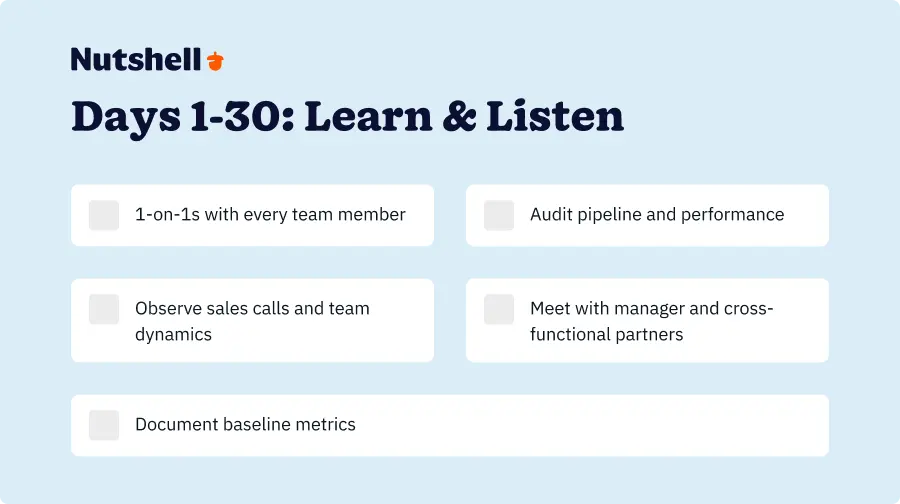
- 1-on-1 meetings with every team member
- Pipeline and performance audits
- Observation of sales calls and team dynamics
- Meetings with your manager and cross-functional partners
- Documentation of baseline metrics
What success looks like:
- You’ve met with everyone on your team at least once
- You understand the current pipeline health and performance trends
- You can articulate why each team member is strong and where they need support
- Your team trusts that you’re listening and not making snap decisions
- You’ve identified your top 3 priorities (but haven’t acted on them yet)
Metrics to track:
- Number of 1-on-1s completed
- Pipeline health snapshot (stage distribution, average deal age)
- Individual rep activity levels and close rates
- Baseline morale (from conversations, not formal surveys)
Common mistake to avoid: Making changes too fast. Resist the urge to “fix” things in Week 1. You don’t have enough context yet.
Days 31-60: Contributing & testing small changes (action phase)
Primary Goal: Demonstrate value and test improvements.
What you’re doing:
- Implementing your first 2-3 improvements
- Contributing to team revenue goals
- Refining your understanding of what works
- Building alignment on direction
- Starting to develop your team’s coaching plans
Key activities:
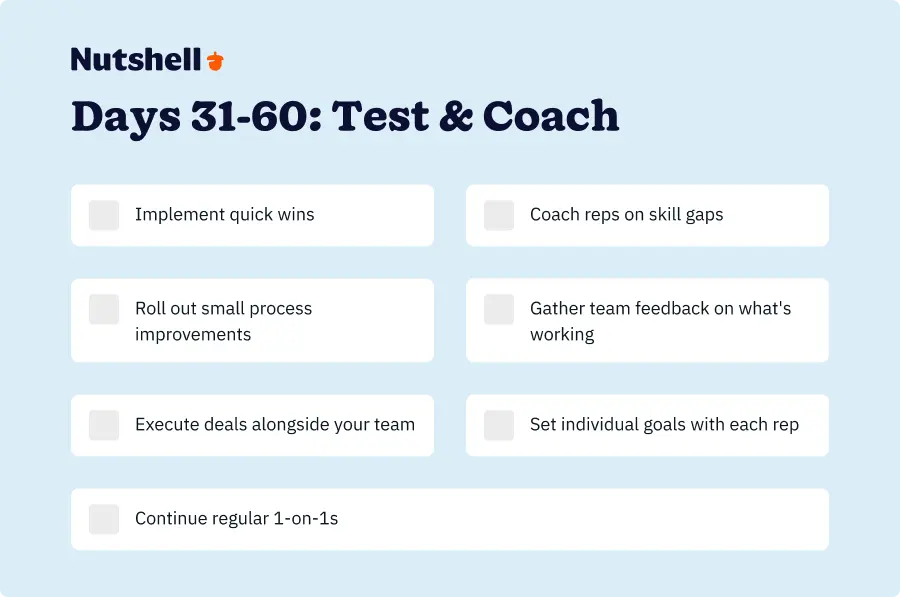
- Implement your identified quick wins
- Coach individual reps on skill gaps (start small: one rep, one skill)
- Introduce small process improvements (e.g., weekly pipeline meetings)
- Work on a deal alongside your reps (if you’re actively selling)
- Facilitate feedback sessions with your team on what’s working/not working
- Set clear individual goals with each rep
- Continue regular 1-on-1s and team meetings
What success looks like:
- Your quick wins have been implemented, and the team sees the benefit
- You’ve had coaching conversations with at least half your team
- Pipeline health is stabilizing or improving
- Your team is responding well to your leadership style
- You’ve built stronger relationships with key influencers on the team
- You have a clear coaching plan for each rep
- Your manager sees progress and is satisfied with your direction
Metrics to track:
- Number of coaching conversations completed
- Changes in pipeline health (stage movement, deal velocity)
- Individual rep performance on your targeted coaching areas
- Team feedback on recent changes (formal or informal)
- Your own activity level (calls made, deals worked, etc.)
Common mistake to avoid: Changing too many things at once. Stick to your top 2-3 priorities. Small, successful changes build credibility for bigger ones later.
Days 61-90: Leading & executing your strategy (execution phase)
Primary Goal: Lead confidently and establish sustainable systems.
What you’re doing:
- Running your team with confidence
- Implementing broader strategic changes
- Establishing your leadership brand and culture
- Developing next-generation leaders on your team
- Planning for beyond Day 90
Key activities:
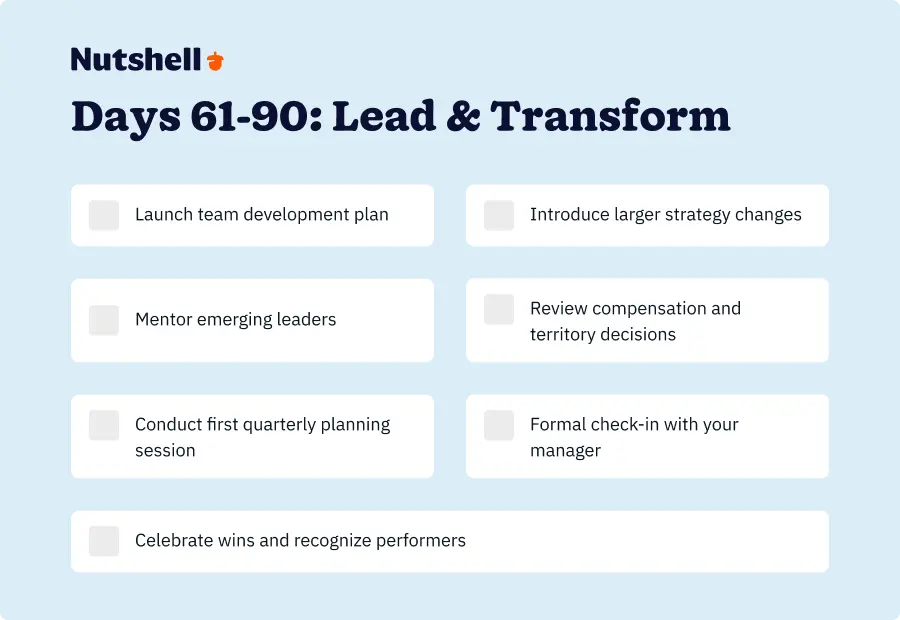
- Implement your comprehensive team development plan
- Introduce larger process or strategy changes
- Mentor emerging leaders on your team
- Review and adjust compensation/territory decisions if needed
- Run your first team planning session for the next quarter
- Have a formal check-in with your manager on your performance
- Celebrate wins and recognize strong performers
- Plan for your team’s future (growth, hiring, development)
What success looks like:
- Your team is executing your vision and responding well to it
- Pipeline health has improved meaningfully since Day 1
- Individual reps show measurable improvement in their coaching areas
- Your team morale is stable or improving (team members feel heard and supported)
- You’ve had an impact on at least one significant deal or strategic initiative
- Your manager has confidence in your leadership
- You’re thinking strategically about your team’s future
- You’ve identified 1-2 high-potential people to develop further
Metrics to track:
- Revenue progress against targets (quarter to date)
- Individual rep performance on goals
- Pipeline health trends over the quarter
- Team attrition (you want this to be zero or near-zero)
- Coaching effectiveness (are your coaching conversations translating to improved performance?)
- Your own leadership feedback (from manager and team)
Common mistake to avoid: Becoming complacent. Day 90 isn’t the finish line—it’s the beginning. Stay curious, keep learning, and keep adjusting.
Phases summary table
Metric Days 1-30 Days 31-60 Days 61-90 Primary Focus Listening & Learning Testing & Contributing Leading & Executing Change Velocity Low (gathering data) Medium (small wins) High (strategic execution) Key Relationships Building all Deepening key ones Leveraging aligned leaders Risk Level Low (listen only) Medium (small changes) Higher (bigger bets) Your Time on Revenue 20-30% 30-40% 40-50%+ Success Indicator Trust & credibility Early wins & alignment Confident leadership What success really looks like across 90 days
Week 1: You showed up, and people don’t think you’re crazy.
Week 4: You understand your baseline, and people trust you’re listening.
Day 60: You’ve made a couple of lasting small improvements, and people see you care about results.
Day 90: You’re leading with confidence, your team is moving in the right direction, and your manager feels good about their decision to hire you.
If you hit those milestones, you’re not just surviving your transition—you’re thriving.
Baseline data audit: What to measure in your first month
You can’t improve what you don’t measure. In your first 30 days, you need to pull baseline data across four dimensions: pipeline health, rep performance, activity levels, and quota coverage. This gives you the context to coach effectively and spot trends.
Pro Tip: Use your CRM to pull this data. If you’re not comfortable with your CRM yet, ask a trusted rep or your predecessor for help. Learning your systems is part of the onboarding process.
1. Pipeline health audit
What to pull:
- Total pipeline value (by rep and by stage)
- Number of deals in each pipeline stage
- Average age of deals by stage (how long they’ve been there)
- Average deal size
- Historical close rates by stage
What to look for:
- Red Flag #1: Huge concentration in early stages (too many new deals, not enough moving through)
- Red Flag #2: Deals stalling in specific stages (deal velocity slowing down)
- Red Flag #3: Inconsistent deal sizes (some reps working tiny deals, some working large deals)
- Red Flag #4: Very long sales cycles (6+ months normal? That might need investigating)
What you’re trying to understand:
- Is your team’s pipeline healthy or hanging by a thread?
- Which reps have strong pipelines? Which are thin?
- Where are deals getting stuck?
- How predictable is your forecast?
Template (simple Google sheet or CRM report):
Rep Name Total Pipeline Stage 1 Stage 2 Stage 3 Close Stage Avg Deal Size Typical Sales Cycle Rep A $450K $150K $200K $100K $0 $45K 60 days Rep B $200K $50K $100K $50K $0 $40K 45 days [Continue for all reps] 2. Individual rep performance audit
What to pull (YTD or last 12 months):
- Total revenue closed
- Quota attainment % (actual vs. target)
- Number of deals closed
- Average deal size
- Win rate / close rate
- Sales cycle length (from first contact to closed deal)
What to look for:
- Star performers: Who consistently closes? Who has the highest close rates?
- Struggling performers: Who’s below quota? Who closes deals but at a slower pace?
- Patterns: Is there a rep who closes lots of small deals vs. fewer big deals?
- Consistency: Who’s reliable month-to-month? Who’s erratic?
What you’re trying to understand:
- Who are your strong closers? They might be your future leaders.
- Who needs the most coaching? They might have high potential if supported.
- What’s the range of performance? (Some reps 150% of quota, others 60%)
- Are there skill gaps across the team?
Template:
Rep Name YTD Revenue Quota % to Quota Deals Closed Close Rate Avg Deal Size Sales Cycle Rep A $450K $400K 112% 12 35% $37.5K 55 days Rep B $200K $400K 50% 8 20% $25K 60 days 3. Activity audit
What to pull (Last 30 days):
- Number of calls made (inbound and outbound)
- Number of meetings held (demos, discovery, etc.)
- Number of emails sent
- Number of proposals sent
- Time spent in CRM vs. selling
What to look for:
- Activity consistency: Some reps very active, others ghost?
- Activity-to-close correlation: Do your closers also have high activity? (They usually do)
- Effort variability: Are people working the same amount, or is there a huge variance?
- CRM hygiene: Are people actually logging activities, or is the CRM a ghost town?
What you’re trying to understand:
- Who’s putting in the work? Who’s coasting?
- Do your high performers also have high activity? (Usually yes, but not always)
- Where might activity be low, but it shouldn’t be?
- Is your team overwhelmed or underutilized?
4. Quota coverage audit
What to calculate:
- Total team quota for quarter/year
- Total team pipeline value
- Pipeline-to-quota ratio (pipeline ÷ quota = how many times over is your pipeline?)
- Forecast (deals likely to close in the current period)
- Gap (what’s missing to hit quota?)
Industry benchmarks:
- Healthy: 3-4x quota in pipeline (you have 3-4 dollars of pipeline for every 1 dollar of quota)
- Concerning: 2x quota or less (you’re not set up to win)
What you’re trying to understand:
- Can your team hit quota? (Does your pipeline support it?)
- What’s the risk? (If the top 3 deals fall through, can you still hit quota?)
- How much new business needs to be generated?
Template:
Metric Value Team Quota (This Quarter) $1,200K Current Pipeline $3,400K Pipeline-to-Quota Ratio 2.8x (healthy) Forecast (likely to close) $950K Gap to Quota $250K What to do with this data
Week 2-3: Pull this data and document it. Don’t interpret it yet—just observe.
Week 3-4:
- In your 1-on-1s, reference this data. “I noticed your pipeline is lighter than the team average—what’s going on?”
- Look for context. “Is the market slow right now?” “Did we lose a big prospect?” “Are you working on a monster deal not in the CRM yet?”
- Don’t judge. You don’t have the full story yet.
Days 31+:
- Use this baseline to measure progress. Are things improving? Staying the same? Getting worse?
- It becomes your coaching roadmap. “Let’s get your activity up to match Rep A’s” or “Let’s work on your close rate.”
- It informs your priorities. If everyone’s pipeline is thin, prospecting is your #1 focus. If close rates are low, discovery and qualification are your focus.
Team culture & motivation audit: Reading your team’s pulse
Data tells you what happened (closed deals, pipeline health). Culture and motivation tell you why it happened and whether your team will sustain performance going forward. In your first 30 days, you need to assess the emotional and cultural foundation you’re working with.
This isn’t about running a formal survey. It’s about paying attention during 1-on-1s, team meetings, and casual conversations.
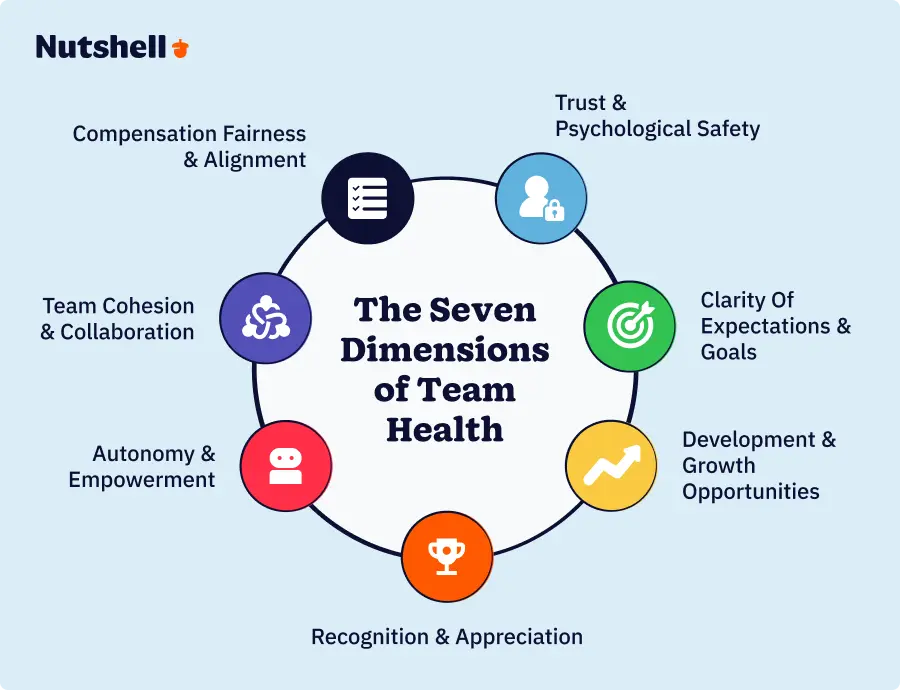
The 7 dimensions of team health
Assess your team across these dimensions. For each one, rate it as Strong, Neutral, or Concerning based on what you observe in conversations.
1. Trust & psychological safety
What it means:
Do people feel safe being themselves? Can they admit mistakes? Do they speak up with ideas?
Questions to listen for (in 1-on-1s):
- “What’s one thing you wish you could improve about yourself?”
- Strong: They’ll be honest. “I need to improve my closing technique.”
- Concerning: They’ll deflect. “I’m pretty good at everything,” or “The leads just aren’t good enough.”
- “What’s one thing I should know about the previous manager?”
- Strong: They’ll be candid, both positive and negative.
- Concerning: They’ll be guarded or only complain.
- “If you saw something broken in our sales process, would you tell me?”
- Strong: “Absolutely.” They’ll even start giving you examples.
- Concerning: “I don’t know… maybe?” Or they change the subject.
What to look for in meetings:
- Do people speak up? Or is it just you and one person talking?
- Do people challenge ideas respectfully? Or is it total silence/agreement?
- When someone makes a mistake, do they own it? Or do they blame externals?
Current state:
Strong / Neutral / Concerning
2. Clarity of expectations & goals
What it means:
Do people know what “good” looks like? Do they understand their goals and how they contribute to company success?
Questions to listen for:
- “What does success look like for you in your role this year?”
- Strong: They’ll articulate 2-3 clear goals tied to business outcomes.
- Concerning: “Hit my number?” or “I don’t know, what do you want me to do?”
- “How does your quota connect to the company’s bigger picture?”
- Strong: They understand the linkage.
- Concerning: They have no idea.
What to look for:
- Do people align on what matters? Or do different people have different ideas about priorities?
- Are goals realistic or pie-in-the-sky?
Current state:
Strong / Neutral / Concerning
3. Development & growth opportunities
What it means:
Do people feel like they’re learning and growing? Or are they stuck?
Questions to listen for:
- “What’s a skill you’d like to improve?”
- Strong: They have a specific answer. “I want to get better at discovery questions.”
- Concerning: “I don’t know. What do you think I need to work on?”
- “Where do you see yourself in 2 years?”
- Strong: They have some vision, even if fuzzy.
- Concerning: “Honestly, I haven’t thought about it” or “Probably still doing this job.”
- “What would make you excited about coming to work?”
- Strong: They mention learning, challenges, or specific growth.
- Concerning: “More money” or “Easier leads.”
What to look for:
- Are people taking on stretch assignments? Or playing it safe?
- Do people ask questions about how to improve? Or do they seem content?
- Has the previous manager invested in people? (Training, mentoring, etc.)
Current state:
Strong / Neutral / Concerning
4. Recognition & appreciation
What It Means: Do people feel valued? Or are wins overlooked and mistakes highlighted?
Questions to listen for:
- “When was the last time you felt recognized for something you did?”
- Strong: “Last month, when [manager] called out my big deal in the team meeting.”
- Concerning: “I can’t remember” or “That doesn’t really happen.”
- “What would make you feel more appreciated at work?”
- Strong: “Public recognition for wins” or “Feedback on what I’m doing well.”
- Concerning: “I don’t know” or “More money, I guess.”
What to look for:
- Do you see the previous manager (or team leads) celebrating wins? Or is it all pressure?
- When someone closes a deal, does the team acknowledge it? Or is it just business as usual?
Current state:
Strong / Neutral / Concerning
5. Autonomy & empowerment
What it means:
Can people make decisions? Or do they need permission for everything?
Questions to listen for:
- “Tell me about a time you made a decision without asking first.”
- Strong: They have examples. “I decided to offer a discount to close a deal faster.”
- Concerning: “I usually ask first” or “I don’t really make decisions.”
- “What would help you feel more empowered in your role?”
- Strong: “More autonomy on pricing decisions” or “Trust to run my territory my way.”
- Concerning: “I don’t know” or “Just more hand-holding.”
What to look for:
- Do people take initiative? Or do they wait for direction?
- Is there a culture of “ask first, do second”? Or “do it, then tell me”?
Current state:
Strong / Neutral / Concerning
6. Team cohesion & collaboration
What it means:
Do people help each other? Or is it every rep for themselves?
Questions to listen for:
- “Who do you collaborate with most on your team?”
- Strong: They’ll name specific people and describe actual collaboration.
- Concerning: “I don’t really work with anyone else” or “Mostly on my own.”
- “If someone on the team was struggling, would you help them?”
- Strong: “Of course. We’re all trying to hit our numbers.”
- Concerning: “I mean, maybe… but I have my own stuff to do.”
What to look for:
- Do you see people helping each other in team meetings? Or is it territorial?
- Do people celebrate each other’s wins? Or is it competitive tension?
Current state:
Strong / Neutral / Concerning
7. Compensation fairness & alignment
What it means:
Do people feel their pay is fair? Are the incentives aligned with what you want them to do?
Questions to listen for:
- “How do you feel about how you’re compensated?”
- Strong: “I think it’s fair based on what I close.”
- Concerning: “I feel like I’m underpaid” or “The commission structure is confusing.”
- “Do you understand how your compensation works?”
- Strong: They can explain it clearly.
- Concerning: “It’s… complicated” or “I’m not entirely sure.”
What to look for:
- Are people chasing the right behaviors? (Or are incentives creating perverse outcomes?)
- Is comp tied to individual performance, team performance, or both?
Current state:
Strong / Neutral / Concerning
Team culture & motivation audit template
Dimension Current State Notes Priority for Improvement Trust & Psychological Safety Strong/Neutral/Concerning High/Medium/Low Clarity of Expectations & Goals Strong/Neutral/Concerning High/Medium/Low Development & Growth Opportunities Strong/Neutral/Concerning High/Medium/Low Recognition & Appreciation Strong/Neutral/Concerning High/Medium/Low Autonomy & Empowerment Strong/Neutral/Concerning High/Medium/Low Team Cohesion & Collaboration Strong/Neutral/Concerning High/Medium/Low Compensation Fairness & Alignment Strong/Neutral/Concerning High/Medium/Low What to do with this assessment
Days 1-30: Just observe. Don’t try to fix anything yet. You’re building a baseline.
Days 31-60: Address the “High Priority” items. If trust is low, focus on psychological safety. If goals are unclear, spend time clarifying. Pick one dimension and improve it in this phase.
Days 61-90: Work on medium priorities. By now, you have the credibility to make changes that matter.
💡Pro Tip: Share your assessment with your team. Not the ratings—but the dimensions. “I’ve been listening in my first month. Here’s what I’m noticing. Here’s what I want to improve together.” Transparency builds trust faster than anything else.
Introductory email & meeting scripts: What to say (and what not to say)
Your first communication as a new manager sets the tone. Here are templates for your introductory email and your first team meeting. Adapt them to your style—authenticity matters more than perfect wording.
Template 1: Your first email to the team
Send this: Your first day, or the day before you start if you’re remote.
Subject: Let’s get to know each other 👋
Hi [Team Name],
I’m [Your Name], and I’m excited to be joining the team as your new sales manager starting [Date].
A bit about me: [2-3 sentences about your background, what you’ve done, and why you’re excited about this role]. I’ve spent [time in sales / relevant experience], and I’m here because I believe in [core value—e.g., “supporting reps to hit their goals” or “building high-performing teams”].
Here’s what I want you to know up front: I’m coming in to listen first. I’ll be scheduling 1-on-1s with each of you over the next couple weeks so I can learn about your strengths, your challenges, and what you need from me as your manager. I’m not here to make sweeping changes in Week 1. I’m here to understand what’s working and how I can support your success.
What I need from you: Be honest in our conversations. If something’s broken, tell me. If something’s working great, tell me that too. If you have ideas or concerns, bring them. I’m genuinely interested in your perspective.
I’ll send out a calendar invite soon to schedule our first 1-on-1. In the meantime, if you have any questions or want to grab coffee before my official start date, let me know.
Looking forward to meeting you.
[Your Name]
Why this works:
- Sets expectation of listening (not immediate change)
- Humanizes you with a bit of background
- Invites honest feedback
- Acknowledges the elephant in the room (“I know this is a transition”)
- Clear call to action
Template 2: Your first team meeting
Schedule this: Your first or second day. 30-45 minutes. Format: Live meeting (in-person or video). Not an email, not a Slack message.
What to prepare:
- Have names and faces matched up (look at headshots beforehand)
- Know the team size
- Have one personal anecdote ready (something relatable, not a bragging story)
- Bring a list of questions (see below)
Your opening (3-5 minutes):
“Hey, everyone. Thanks for being here. I know transitions can feel unsettling, so I want to just… be direct about what I’m thinking.
I’m [Name], and I’m your new sales manager starting today. I’ve got [relevant background], and I’m here because [why you took this role—genuine reason]. More importantly, I’m here to help you succeed.
Here’s what I want to be clear about from the jump: I’m not here to overhaul everything. I know [previous manager] built something here, and I’m not going to throw it out and start from scratch. What I am going to do is listen, learn, and figure out how I can actually make your jobs easier.
For the next 30 days, that means I’m going to be asking a lot of questions and not making a lot of changes. I’m going to schedule 1-on-1s with each of you. I’m going to observe some calls. I’m going to try to understand what you’re dealing with every day.
I’m going to mess some stuff up. That’s part of the deal. And when I do, I’d appreciate it if you’d tell me so I can course-correct.
Here’s what I need from you: Honesty. If something’s broken, tell me. If something’s working, tell me that too. If you have ideas, bring them. Don’t hold back because I’m new—that actually makes it more valuable that I hear your real thoughts.”
Then ask them (10-15 minutes):
“A few questions for you:
Question 1: ‘What’s one thing the previous manager did really well that I should keep doing?’
[Listen. Take notes. Don’t defend or interrupt.]
Question 2: ‘What’s one thing you wish were different?’
[Again, listen. People will be hesitant at first—your job is to create safety so they’re honest.]
Question 3: ‘What would make your job easier?’
[This is about removing friction. You’ll get gold here.]
Question 4: ‘What should I know about our sales process / our market / our customers?’
[You’re learning. These are the nuances you need to understand.]
Then close (2-3 minutes):
“Here’s what I heard: [Quick recap of themes, not every detail]. That’s super helpful. I’m going to digest all this over the next few days, and then I’ll be coming around for individual conversations with each of you.
I’m not going to pretend I have all the answers right now. I’m going to be figuring this out alongside you. But I can promise you this: I’m going to work hard, I’m going to be honest with you, and I’m going to do my best to set us up to win.
Questions for me right now?”
[Answer whatever comes up. If you don’t know the answer, say: “That’s a great question. I don’t know the answer yet, but I’ll find out.”]
“Alright. Let’s get after it. I’ll see you all soon.”
Why this works:
- You’re acknowledging the change without being defensive
- You’re setting expectations (listening first, changes later)
- You’re inviting honesty without demanding it
- You’re being humble and human
- You’re clear on what you need from them
- You’re not making promises you can’t keep
Template 3: Your first 1-on-1 meeting
Schedule this: Within the first 2 weeks. 30 minutes per person. Format: One-on-one, in-person if possible, casual setting if possible (coffee, walk, quiet corner).
Your opening (2-3 minutes):
“Thanks for making time. I’m trying to get to know everyone on the team individually, and I want to hear your perspective. I’m going to ask some questions, and I’m genuinely interested in hearing the real answers—not the ‘say what you think the manager wants to hear’ version. Deal?”
Your questions (20-25 minutes):
Ask these in this order, and listen way more than you talk.
- “Walk me through your background. How’d you get into sales? What’s your journey been?”
- Why: You’re learning who they are, not just their sales numbers.
- Listen for: Their motivations, what they care about, what brought them here.
- “What do you think your greatest strength is?”
- Why: People know their own strengths. You’re validating what you’ll be building on.
- Listen for: Confidence, clarity, specificity. “I’m really good at prospecting” is better than “I’m a good closer.”
- “What’s something you want to get better at?”
- Why: This is your coaching roadmap.
- Listen for: Honesty. If they have no answer, they might not be self-aware yet (that’s useful to know).
- “Tell me about your biggest win. What deal are you most proud of closing?”
- Why: You’re understanding what good looks like to them.
- Listen for: Details, process, what they learned. This tells you a lot about their sales approach.
- “What’s been challenging lately? What’s getting in your way?”
- Why: This is where you understand their pain points.
- Listen for: Are they blaming external factors? Or owning their challenges? Both are telling.
- “What would you want from me as your manager?”
- Why: They’re telling you how to lead them.
- Listen for: More autonomy? More coaching? More clarity? Different feedback style?
- “Where do you want to be in 2 years?”
- Why: You’re understanding their ambitions.
- Listen for: Are they thinking bigger? Happy where they are? Hedging? This tells you their trajectory.
- “Is there anything else I should know?”
- Why: Open-ended, lets them share what’s on their mind.
- Listen for: Often, the most important stuff comes out here.
Your closing (3-5 minutes):
“Here’s what I heard: [Quick recap]. That’s super helpful. I want you to know that I’m here to support you. If you need anything—coaching, resources, whatever—I want you to come to me.
I’m going to be thinking about how to best support you. We’ll stay in touch regularly, and we’ll figure out what your goals are together.
Any questions for me?”
[Answer. Be honest. If you don’t know, say it.]
“Great. Let’s do this.”
What NOT to do in these communications
Don’t:
- Make promises you can’t keep (“You’re definitely getting a raise”)
- Change existing policies or processes in your first communication
- Trash-talk the previous manager (even if they deserved it)
- Position yourself as the savior (“I’m here to fix things”)
- Ask about specific performance issues yet (that comes in 1-on-1s with context)
- Be fake or overly formal (people sense inauthenticity)
- Over-share about your personal life (they don’t need to know your whole story yet)
- Interrupt or finish their sentences when they’re talking
Do:
- Be humble
- Be honest
- Listen more than you talk
- Take notes
- Follow up on what people tell you
- Admit what you don’t know
- Show genuine interest
- Create psychological safety for honesty
Frequently asked questions about transitioning into your new sales management role
-
1. How long does it typically take to fully transition into a new sales manager role?
Most sales managers need 90 days to fully transition. The first 30 days focus on learning and building relationships, days 31-60 on contributing and implementing small changes, and days 61-90 on leading confidently and executing your strategy.
-
2. Should I make changes to the sales process immediately, or wait?
Wait. Spend your first 30-60 days observing and learning what’s working before making changes. Rushing to implement new processes without understanding current workflows can damage trust and overlook effective practices. Make changes gradually after you’ve earned credibility.
-
3. How do I handle managing former peers who may resent my promotion?
Address it directly in one-on-one conversations early. Acknowledge the relationship change, listen to their concerns, and set clear expectations. Be transparent about decisions, avoid favoritism, and focus on their professional development. If resentment persists despite your efforts, have a frank conversation.
-
4. What should I focus on in my first week as a new sales manager?
Schedule one-on-one meetings with each team member and your own manager. Learn why you were hired and what success looks like. Observe team dynamics without making judgments. Review current sales processes, metrics, and tools. Most importantly, listen more than you speak.
-
5. How do I assess my inherited sales team’s performance without being judgmental?
Start by reviewing objective metrics like pipeline health, close rates, and activity levels. Conduct individual meetings to understand each rep’s strengths, challenges, and goals. Observe sales calls and meetings. Focus on understanding context before evaluating performance—there’s often a reason behind the numbers.
What are some of the strategies that you’ve used to get off on the right foot in a new sales manager role? Tweet them to us @nutshell!
This article is part of our Playbook for Managing a Sales Team.
DOWNLOAD: Is your business ready for a CRM?
Discover the benefits of investing in customer relationship management software.
 BACK TO TOP
 Written by
Bailee Abell Contributor, Sell to WinReady to try
Nutshell for Free?Thank you! Your submission has been received!Oops! Something went wrong while submitting the form.

The Challenges of Transitioning From Spreadsheets to CRM for Sales and Marketing Teams
Published on: March 18, 2026

Sales Performance Reviews: 9 Tips to Make Them Valuable
Published on: November 10, 2022Best AI Chatbots for B2B Lead Generation: Capture & Qualify Leads 24/7
Published on: December 29, 2025Join 30,000+ other sales and marketing professionals. Subscribe to our Sell to Win newsletter!