How to Write a Sales Follow-Up Email Sequence That Actually Gets Replies

-
Quick answer: How do you write an effective follow-up email sequence?
A good follow-up sequence follows a proven structure—an opening cold email, a gentle reminder a few days later, and a break-up email— with each message delivering fresh value rather than repeating the last one.
Most responses don’t come until the second, third, or fourth email in your email follow up sequence, so hang in there!
Key takeaways
- Four to seven follow-up emails triple your reply rate: Campaigns with four to seven touches achieve a 27% reply rate — triple the 9% rate of campaigns with one to three emails.
- 80% of closed deals require five or more follow-ups: Yet 44% of sales reps quit after just one attempt — a gap that structured sequences close automatically.
- The break-up email outperforms the fourth and fifth attempts: Data from 156,000 sequences shows the final “break-up” email generates a 14% response rate — higher than any touch after the third.
- Personalized subject lines boost reply rates by 35%: Generic templates average a 3.43% reply rate; personalized sequences push that to 17% or higher.
- CRM automation is what makes consistency possible: Nutshell’s personal email sequences fire automatically when a lead enters a pipeline stage — and stop the moment a reply comes in.
A sales follow-up email sequence is a structured series of timed, personalized emails sent after an initial outreach — designed to move a lead from silence to conversation. For most B2B sales teams using CRMs like Nutshell, HubSpot, Salesforce, Pipedrive, or Close CRM, a well-built sequence is the single highest-leverage thing a sales rep can do between calls.
Here’s the uncomfortable truth: 80% of closed deals require five or more follow-up touches, yet 44% of sales reps give up after a single attempt. That gap — between what closes deals and what most reps actually do — is where pipeline goes to die. The good news? A structured follow-up email sequence closes that gap automatically, ensuring every lead hears from you at the right moment with the right message, without you having to remember to send it.
We’ve seen this firsthand at Nutshell. Our longer follow-up sequence — five emails spread across two weeks — helped us land our first 175 customers. It wasn’t about volume or aggression. It was about showing up consistently, adding value with every touch, and making it easy for leads to say yes when they were ready.
This guide walks you through exactly how to build that kind of sequence — from the anatomy of a great follow-up email to the timing, templates, and automation tools that make it scale.
Table of Contents
- What is a follow-up sales email?
- Why do sales follow-up email matter
- When should you use a follow-up email sequence?
- What should a follow-up sales email template include?
- What should a sales email sequence include?
- The longer sales email sequence
- How do you add value to follow-up sales emails?
- What are the best practices for follow-up email sequences?
- What does a good follow-up email response rate look like?
- FAQ
What is a follow-up sales email?
A follow-up sales email is an email sent after a sales representative interacts with a lead, with the purpose of strengthening the relationship and leading to a sale.
What separates a follow-up sequence from random check-ins is intent and structure. Every email in a well-built sequence has a specific purpose, a clear call to action, and a defined place in the cadence. The goal isn’t to nag — it’s to show up as a helpful, credible resource until the timing is right for your lead.
Why do sales follow-up email matter
Follow-up emails are the most underleveraged tool in B2B sales. Research from Belkins analyzing over 16.5 million cold emails found that the first email alone generates an 8.4% reply rate, but 42% of all replies across a sequence come from follow-up messages, not the initial send. In other words, if you’re only sending one email, you’re leaving nearly half your potential replies on the table.
The math gets more striking from there. Campaigns with four to seven follow-up emails achieve a 27% cumulative reply rate — triple the 9% rate of campaigns with just one to three touches. And one follow-up email alone increases reply rates by 49%, yet 48% of sales reps never send one. That’s not a copywriting problem. That’s a consistency problem — and it’s exactly what automated sequences in a CRM solve.
Beyond reply rates, follow-up sequences build brand familiarity. By appearing in your leads’ inboxes consistently and with genuine value, you make Nutshell — or whatever you’re selling — the name they think of first when they’re finally ready to move.
When should you use a follow-up email sequence?
A follow-up email sequence is appropriate any time you’ve made initial contact with a lead and want to keep the relationship warm without relying on memory or manual reminders. The most common trigger points are:
- After a cold outreach email: Your initial message went out — now the sequence kicks in to follow up automatically if no reply comes in.
- After a phone call or demo: A post-call sequence is one of the highest-converting use cases. Leads who’ve already heard your pitch just need a nudge and supporting evidence.
- After a webinar or event: Leads who attended a session have shown intent — a timely, relevant follow-up sequence can convert that intent into a booked call.
- After a proposal or quote: Silence after a proposal is common. A structured sequence keeps you top of mind without seeming desperate.
- When a prospect goes cold: Re-engagement sequences — including a well-timed break-up email — can recover leads that have gone quiet for weeks.
The right CRM makes these triggers automatic. In Nutshell, personal email sequences fire as soon as a lead enters a designated pipeline stage, and stop the moment a reply arrives, so no lead ever gets a follow-up they’ve already responded to.
What should a follow-up sales email include?
A successful follow-up sales email will typically include four parts, including a subject line, opening content, body content, and call to action. Learn more about each of these elements:
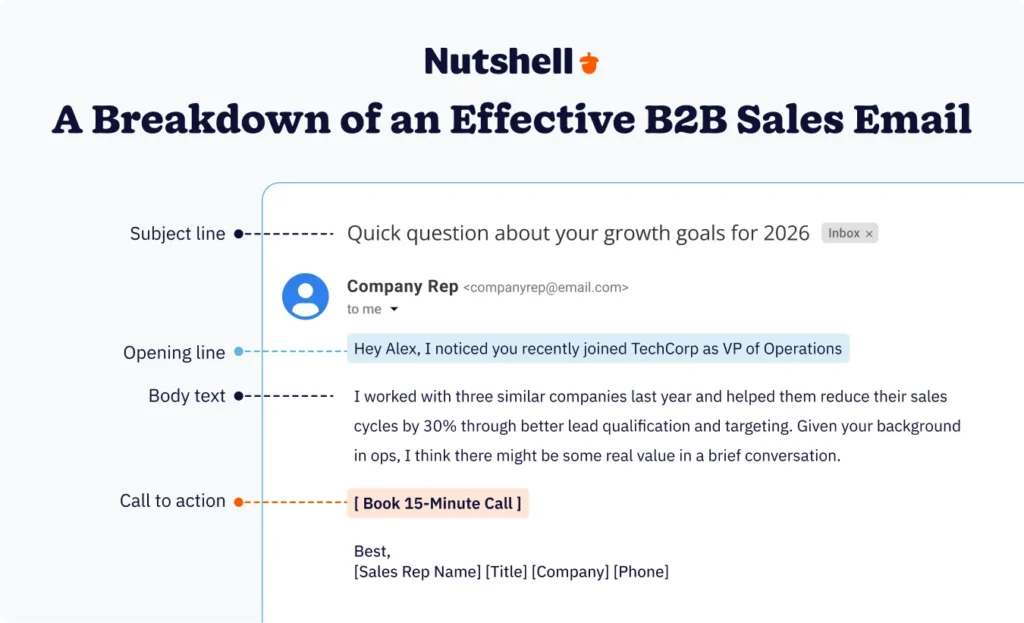
1. Subject line
Your email’s subject line will either encourage the prospect to open and read your message or move it straight to the trash. Subject lines should be relevant to the relationship and attention-grabbing. For example, a subject line for a follow-up sent after no response will be very different than one for general follow-up, which will be different than one used after a successful conversation.
2. Opening content
Captured your recipient’s attention with a great subject line? The first few lines you use in your follow-up email will also have a big impact on whether they keep reading. It’s best to write opening content that continues to hold the reader’s attention while setting the scene for the main content in your email.
3. Body content
The rest of your follow-up email will contain more information related to the goal of the email. Whether you’re trying to set up another sales call, offering free resources, or re-engaging a lead, the body content is where you’ll do most of the work.
4. Call to action (CTA)
Your email’s CTA should be clear and focused, prompting the prospect to take an action that will move them further down your sales funnel. A good CTA will usually promise to provide value even as it encourages the recipient to take a specific action.
What should a sales email sequence include?
While the first follow-up is highly important, experts agree that sending multiple messages in a follow-up email sequence is the best way to ensure a positive outcome. The emails may all have the same goal or have supporting goals with varying CTAs meant to encourage multiple actions.
Every sales email sequence should include at least these three steps:
1. An opening cold email
A cold email is a short, personalized outreach message sent to a lead with whom you haven’t yet established a relationship. It is not a pitch deck in email form. Keep it under 125 words, lead with a specific reason you’re reaching out to this person at this company, and end with a single, clear CTA. Warm the outreach with a LinkedIn connection request the day before if possible — familiarity increases open rates meaningfully.
A strong cold email includes:
- A specific hook: Reference a company milestone, a LinkedIn post, or a challenge relevant to their industry
- A clear “what’s in it for them”: State the value proposition in one sentence
- A trust signal: A relevant customer name, a data point, or a shared connection
- One CTA: Book a call, reply to a question, or click a link — never all three
Example cold email template:
Subject: Quick question about [Company]’s sales process
Hi [First Name],
I came across [Company] while researching [industry/trigger event] and noticed [specific observation]. We’ve helped teams like [similar company] cut their follow-up time in half using automated email sequences built directly into their CRM.
Would a 15-minute call this week make sense to explore whether it’d be a fit for your team?
[Your name]
2. A gentle but firm reminder (2-3 days after the initial email)
Emails tend to be overlooked; your prospect might be busy, not in a good mood to answer, or simply out of office for a few days. You’d be amazed at the power of a simple follow-up email reminder.
Don’t repeat yourself, though. For example, send a follow-up email in the same thread and simply ask if they saw your previous email, if they got a chance to think about your offer, etc.
Example gentle reminder template:
Subject: Re: Quick question about [Company]’s sales process
Hi [First Name],
Just wanted to make sure my last note didn’t get buried. Did you get a chance to take a look?
Happy to keep it brief — even a five-minute call would be helpful.
[Your name]
3. A break-up email (4-5 days after the previous email)
I’m about to let you in on a secret.
Seriously, this is the formula for a break-up email that gets a response.
You know how no one wants to miss out, and most people want to help. And also how some people simply need a second reminder?
There’s a single-sentence sales email subject line template that encapsulates all that. Here it is:
“What could have changed your mind?”
Try to use that as your subject line (or as part of your subject line) and ask in your body text if they can point you to a couple of things that might have swayed their decision.
Why is it so powerful? It makes the reader think about your offer and the reasons they wouldn’t give you an answer. And suddenly, when they type those reasons out, they don’t seem so compelling anymore.
Example break-up email template:
Subject: What could have changed your mind?
Hi [First Name],
I don’t want to keep filling up your inbox, so I’ll make this my last note for now.
If the timing isn’t right or this isn’t a priority, I completely understand — just let me know and I’ll get out of your hair. But if there’s something specific that’s held you back, I’d genuinely love to hear it.
Either way, I wish you and the [Company] team the best.
[Your name]

Struggling to manage follow-up sales emails while juggling the rest of your sales activities?
Register for our Intro to Nutshell live demo and see why sales teams love us!

The longer sales email sequence
Depending on the importance of the decision, the risk, and the reputation of the company, some follow-up sequences may require more than a few emails and demand more persuasion.
Whereas small transactions may lead to fast decisions, big or complex transactions may require you to establish extra credibility or be more persistent in order for your prospect to wrap their head around the idea of responding to your messages.
This follow-up sales email sequence involves more work but also drives much more value. It helped us recruit our first 175 customers.
Keep in mind that these longer sales email sequences must be integrated into multichannel engagement strategies that will allow you to build a more meaningful relationship.
It runs over a two-week period and looks something like this:
Email Timing Purpose Cold email Day 1 Initial outreach — hook, value prop, single CTA Gentle reminder Day 3–4 Re-surface the thread, short and direct Value bringer #1 Day 7–8 Add something new — case study, data point, relevant article Value bringer #2 Day 11–12 Different angle — testimonial, referral mention, or specific question Break-up email Day 15–17 Final close — low pressure, prompts a response through finality Keep in mind that longer sequences work best as part of a multichannel approach. Sequences that combine email, phone, and LinkedIn generate 287% higher response rates than email alone. Your CRM should be the hub that coordinates all three — logging every touchpoint, surfacing the next action, and ensuring nothing falls through the cracks.
Example value bringer #1 template:
Subject: How [Similar Company] handled [specific challenge]
Hi [First Name],
I wanted to share something that might be relevant — [Similar Company] was dealing with [specific challenge] before they started using Nutshell’s automated email sequences. Within [timeframe], they saw [specific outcome].
I thought it might resonate given what you’re working on at [Company].
Still happy to connect for 15 minutes if you’d like to dig into the details.
[Your name]
Example value bringer #2 template:
Subject: One question before I close the loop
Hi [First Name],
I’ll keep this short — I’ve been reaching out because teams like yours at [Company] typically run into [specific pain point], and I think there’s a real opportunity to [specific benefit].
Would it be useful to see how other [industry] companies have approached this? I can put together a quick comparison — no strings attached.
[Your name]
Powerful marketing software, minus the headaches!
Access email marketing and landing page software connected directly to your Nutshell CRM. Generate leads, organize contacts, segment audiences, track campaigns, and manage communications from a single tool!
How do you add value to follow-up sales emails?
There are five main things to include to make your follow-up emails incredibly valuable and help your prospect take an action that will move the sales process forward.
1. Case studies
Case studies are powerful because they show how one of your customers solved a specific problem successfully and with measurable results. Neil Patel, co-founder of KISSmetrics and Crazy Egg, managed to increase his sales by 70% by including case studies in his emails!
They allow you to grab the attention, demonstrate value, show differentiation, and mitigate the risks.
2. Success stories
Success stories are about summarizing the successful experience of a customer with your company, just enough to pique interest. (As opposed to case studies, which focus on the methods implemented to make that experience successful.)
Objections are stories; they’re a projection of what might go wrong or might not work. As Shawn Callahan puts it: “You can’t beat a story with fact, you can only beat it with a better story.”
If you can anticipate the reasons for your prospect’s reluctance, bring them stories that deal with those reasons. Keep in mind that facts alone aren’t generally enough when handling objections.
3. Testimonials
This time, you’re not the one telling the story—your satisfied customer is. And that can have a tremendous impact.
According to Business Dasher, testimonials placed on a sales landing page can increase conversions by 34%.
They allow you to build trust, sell without selling, and overcome skepticism.
4. Referrals
According to Harvard Business Review, referred customers bring in between 30-57% more new customers than other customers. That means more new business with fewer leads.
The best referrals start with an introduction by someone your prospect knows, trusts and respects.
Referrals allow you to bypass the gatekeeper, get you ahead of the competition, earn trust and credibility, and maybe win an introduction from them to another prospect.
5. Relevant content
If you don’t have any customer data to share—or none that would be relevant to your prospect—you can still offer value by including a piece of valuable content.
It’s easy and it provides you with an opportunity to prove you took the time to understand a prospect’s challenge and find something that could help them solve it without necessarily including your product in the process.
What are the best practices for follow-up email sequences?
So now you can craft a follow-up sales email and a sales email sequence. How do you boost follow-up email performance? Consider these strategies.
1. Plan your sequence before you write a single email
A follow-up email sequence is a system, not a collection of individual messages. Before writing anything, map out the full arc: how many touches, what value each email delivers, what trigger moves a lead from one email to the next, and what outcome you’re optimizing for. Reps who plan sequences at the start of a campaign — rather than improvising touch by touch — close significantly more deals because they’re thinking about the buyer’s journey, not just their own to-do list.
Download our Sales Pipeline Training Guide!
From getting leads into your pipeline to managing it effectively, our Sales Pipeline Training Guide can help you transform your sales process to strengthen customer relationships and drive business growth.
2. Deliver value—always
The moment a follow-up email fails to offer something new, it becomes noise. Every touch in your sequence should leave the lead better informed, more confident in your credibility, or closer to resolving a concern. This isn’t just good manners — it’s a strategic differentiator. Non-personalized campaigns average a 2% reply rate. Personalized sequences that deliver relevant value with each touch push that figure to 17% or higher.
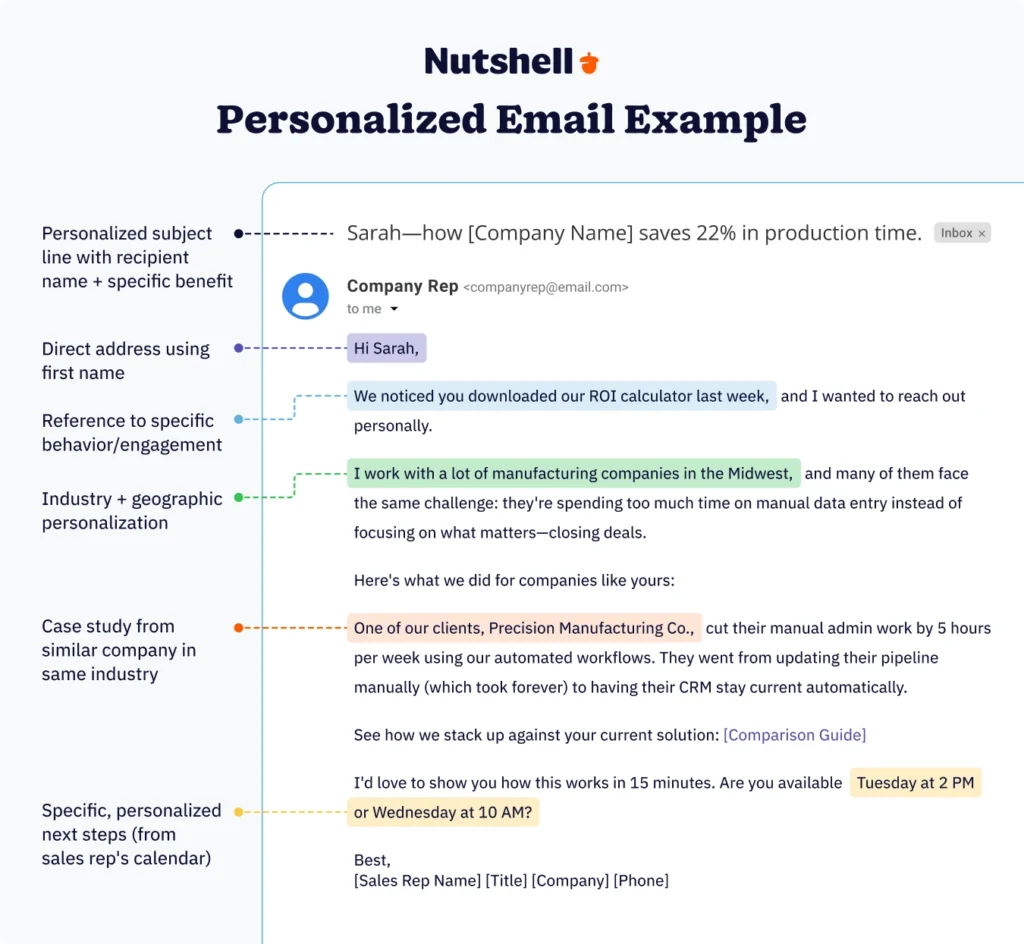
3. Personalize beyond the first name
Personalization is not inserting {{FirstName}} into a template. True personalization means referencing a specific company initiative, a recent LinkedIn post, a shared connection, or a pain point mentioned in a previous conversation. Advanced personalization — drawing on CRM data, intent signals, and behavioral context — achieves up to 18% reply rates, more than double the industry average. Nutshell’s personal email sequences support dynamic merge tags including contact name, company name, and custom fields, so every automated email feels hand-written.
4. Experiment with send times and the number of follow-ups
The optimal number of follow-up emails in a sequence and the best times to send them depends on many factors, like your industry, sales cycle, prospect’s needs, and more. Experimentation is the best way to find the sweet spot where persistence encourages action without being annoying. Develop a follow-up sales email sequence and use it for a quarter before reevaluating and tweaking the content, cadence, and send time.
5. Automate your email sales sequence
Email automation is a sales representative’s secret weapon. With the right email automation tool, you can create personal email sequences that send automatically and are responsive to your recipient’s actions, so you ensure the best possible experience for every lead. Find out as much as possible about your prospect, know what you’re expecting from them, and tailor a follow-up automated email sequence based on that!
6. Design visually appealing follow-up emails
Most recipients will skim your follow-up email in under eight seconds before deciding whether to reply. Make that eight seconds count — lead with your most important line, use short paragraphs (two to three sentences max), bold any critical information, and make the CTA unmissable. Avoid wall-of-text emails. Avoid multiple links. Keep it clean, keep it focused, and keep it under 125 words wherever possible.
What does a good follow-up email response rate look like?
Response rate benchmarks are one of the most commonly misunderstood metrics in B2B sales outreach. A good cold email response rate for most B2B teams is between 5% and 10% — top performers on focused, well-researched campaigns with verified contacts can reach 15% or higher. Here’s how the numbers break down across a typical sequence, based on Optifai’s benchmark data from 939 companies:
Sequence position Optimal timing Average response rate 1st follow-up Two to three days 21% 2nd follow-up Three to four days 17% 3rd follow-up Four to five days 13% 4th follow-up Five to seven days 9% Break-up email Final touch 14% Source: Optifai Sales Ops Benchmark, Q1–Q3 2025, N=939 companies
The counterintuitive finding here is the break-up email — it outperforms both the fourth and fifth attempts. The psychology is simple: scarcity and finality prompt action. When a prospect realizes the conversation is about to close, they’re far more likely to respond than when they believe you’ll keep following up indefinitely.
How does Nutshell make follow-up sequences easier?
Nutshell is an all-in-one CRM and sales automation platform that lets sales reps build, personalize, and automate follow-up email sequences directly inside their pipeline — without switching between tools. A personal email sequence in Nutshell is a series of scheduled, personalized emails that trigger automatically when a lead enters a pipeline stage, pause when a reply arrives, and resume or close based on the rules you set.
Here’s what makes Nutshell’s approach different from standalone email tools like Mailchimp, Constant Contact, or Outreach:
- Pipeline-stage triggers: Sequences fire based on where a lead is in your sales process — not on arbitrary calendar dates. This means every email is contextually relevant to the lead’s buying stage.
- Automatic pause on reply: The moment a lead responds, the sequence pauses. No more awkward automated emails landing after a conversation has already started.
- Shared templates across your team: Any sequence that works can be shared across the organization instantly. One rep’s winning sequence becomes every rep’s starting point.
Connected to your full CRM data: Every email sent, opened, and replied to is logged automatically in the lead’s record — giving sales managers full visibility into outreach activity without manual reporting.
Try Nutshell – and Nutshell IQ – free for 14 days, no credit card required!
Frequently asked questions
-
1. When should you send follow-up emails for best results?
For B2B sales, send follow-ups on Tuesday or Thursday between 10 AM–12 PM. Research shows this peak productivity window delivers highest engagement. Space follow-ups 2–3 days apart for initial sequences. Use your CRM’s smart send features to align timing with each prospect’s time zone for maximum open rates.
-
2. What’s a good response rate for sales follow-up emails?
A solid cold email response rate is 5–10% for most B2B teams. Top performers hit 15%+ on focused campaigns with verified contacts. First follow-ups boost replies by 49%, while initial emails typically generate 8.4% response rates. Your CRM’s analytics help you track performance against these benchmarks and optimize accordingly.
-
3. How many follow-up emails should you send before giving up?
Send 4–9 follow-ups over 2–3 weeks before pausing a prospect. Research shows 80% of sales require 5+ touchpoints, yet 44% of salespeople quit after one attempt. Never stop until the prospect explicitly declines or your CRM flags them as unresponsive—provide genuine value with each touch.
-
4. Should follow-up emails be only email, or use multiple channels?
Multichannel outreach combining email, phone, and SMS delivers 30–40% higher response rates than email alone. Email works best for detailed info sharing; calls for urgent matters; SMS for quick reminders. A CRM with integrated email, phone, and SMS capabilities helps you orchestrate these touchpoints seamlessly across your pipeline.
-
5. How do you personalize automated follow-up sequences?
Use dynamic merge tags like {{FirstName}}, {{CompanyName}}, and custom fields beyond basic names. Reference recent company news, job changes, or specific pain points mentioned in prior conversations. Your CRM’s automation tools let you build personalized sequences that feel one-to-one while scaling to your entire prospect database.
-
6. What is a break-up email in a sales sequence?
A break-up email is the final email in a sales sequence — a short, honest message that signals you’re closing the outreach loop. Break-up emails are counterintuitively effective, generating a 14% response rate in B2B sequences — higher than the fourth or fifth follow-up attempt. The psychology relies on scarcity: once a prospect realizes the conversation is ending, their urgency to respond increases. A subject line like “What could have changed your mind?” is a proven format that prompts leads to articulate — and often reconsider — their hesitation.
Find your ideal customer from your CRM
Connect with your future buyers and spend less time doing it!
Define your ideal customer and ProspectorIQ does the heavy lifting, so you can add new contacts to your CRM and start making more sales
About Forster Perelsztejn
Forster is currently the marketing manager at Rooftop, a powerful shared inbox and collaboration platform.
Connect with him on LinkedIn!
BACK TO TOP Written by
Forster Perelsztejn ContributorEdited by
Will Gordon Sr. Director of MarketingReviewed by
Andy Fowler Co-FounderReady to try
Nutshell for Free?Thank you! Your submission has been received!Oops! Something went wrong while submitting the form.




Vanity Metrics: Definition, Examples by Channel, and What to Track Instead
Published on: November 10, 2022What Is Revenue Intelligence? An All-Encompassing Guide
Published on: January 24, 2024Highly Effective Strategies for Elevating Sales Team Performance
Published on: November 10, 2022Join 30,000+ other sales and marketing professionals. Subscribe to our Sell to Win newsletter!