Sales Qualifying Questions: 15 Must-Ask Questions to Close More Deals

-

Quick answer: What are the best sales qualifying questions?
The best sales qualifying questions help your sales reps determine whether a lead has the budget, authority, need, and timeline to become a paying customer. Questions like “What business problem are you trying to solve?”, “Who makes the final purchasing decision?”, and “Do you have a budget allocated for this?” keep your pipeline full of deals that actually close.
Key takeaways
-
- Sales qualifying questions are essential for pipeline efficiency: Asking the right questions early helps sales reps identify good-fit leads fast, so they spend more time on deals that actually close.
- Budget, authority, need, and timeline are the four pillars: Every effective qualification framework – BANT, CHAMP, and MEDDIC included – is built around these four dimensions.
- Not every lead is sales-ready: Research suggests 50–56% of leads aren’t ready to buy at the time of first contact. Qualifying questions help you identify who needs nurturing and who needs a proposal.
- Sequencing matters as much as the questions themselves: Opening with rapport-building questions before moving into budget and authority inquiries produces more honest, more complete answers.
- A CRM like Nutshell turns qualification into a repeatable system: Recording answers to qualifying questions in Nutshell means your entire team works from the same intelligence – and your next action is always clear.
Sales qualifying questions are targeted questions that help sales reps determine whether a prospect has the budget, authority, need, and timeline to become a paying customer. The right questions – asked in the right order – are the difference between a pipeline full of real opportunities and one cluttered with leads that will never close.
Here’s the hard truth: industry research suggests that roughly 67% of lost sales stem from poor lead qualification – not bad pitches, not weak products, not pricing. Qualification. B2B buyers now complete 70% of their research before ever speaking to a sales rep, per Gartner – which means by the time someone reaches out to your team, they already know what they want. Your job isn’t to educate them from scratch. It’s to quickly determine whether you’re the right fit for each other.
We’ve put together 15 sales qualifying questions that work across B2B discovery calls, inbound follow-ups, and outbound sequences. For each question, we’ll explain what to ask, when to ask it, what a strong answer sounds like – and what a red flag looks like. We’ll also show you how to log what you learn in Nutshell so qualification data actually drives your next action instead of disappearing into your notes app.
Table of Contents
- 15 Questions at a glance
- What is a qualifying question in sales?
- Why are qualifying questions important in sales?
- What is the qualifying process?
- Which qualification framework is right for your team
- 15 sales qualifying questions for B2B sales team
- How to use qualification data in Nutshell
- Frequently asked questions about sales qualification
Need to design eye-catching forms for your website?
Use Nutshell Forms, an easy-to-use form builder that fits right into your CRM.

At-a-glance: All 15 questions
Here is a list of effective lead qualifying questions to ask your prospects.
Question Best For 1. How did you hear about us? Understanding lead source and buyer awareness level 2. What business problem are you trying to solve? Identifying core pain points and solution fit 3. Why is solving this problem a priority right now? Gauging urgency and motivation 4. Have you tried to solve this problem before? Uncovering past failures and budget history 5. Who else is involved in evaluating solutions? Mapping the buying committee 6. Who makes the final purchasing decision? Identifying the economic buyer 7. What does your purchasing process look like? Understanding deal complexity and timeline 8. Do you have a budget allocated for this? Qualifying financial readiness 9. What does success look like for you in six months? Aligning on outcomes and fit 10. What happens if you don’t solve this problem? Quantifying the cost of inaction 11. Are you evaluating other solutions right now? Assessing competitive landscape 12. What criteria matter most when choosing a solution? Understanding decision-making priorities 13. What’s your ideal timeline for implementation? Confirming purchase urgency 14. What would make you walk away from a solution? Surfacing deal blockers early 15. What would a successful partnership look like? Testing long-term fit and relationship expectations What is a qualifying question in sales?
A qualifying question in sales is a targeted question designed to help a sales rep determine whether a prospect is a realistic, high-probability fit for their product or service. Sales qualifying questions assess four core dimensions – budget, authority, need, and timeline – and help reps decide where to invest their time. The best qualifying questions are open-ended, conversational, and specific enough to produce actionable answers rather than vague commitments.
Qualifying questions are distinct from discovery questions, though the two often overlap. Discovery questions are broad – they help you understand a prospect’s world. Qualifying questions are evaluative – they help you decide whether to keep investing in a prospect or redirect your energy elsewhere.
Why are qualifying questions important in sales?
Qualifying questions are important because they tell you where to spend your time. Every sales rep has a finite number of hours – and not every lead deserves the same level of attention. Leads that aren’t a good fit for your product waste your time, inflate your pipeline, and skew your forecasting. Worse, they produce unsatisfied customers when they do close.
Leads contacted within five minutes of inquiry are 21 times more likely to qualify for the sales pipeline than leads contacted after 30 minutes, per the MIT Sloan/InsideSales.com study by Dr. James Oldroyd. That window of high intent is exactly where qualifying questions deliver maximum value – when a prospect is engaged, present, and ready to share real information about their situation.
Sales qualified leads (SQLs) convert to opportunities at 20–30%, compared to just 5–15% for marketing qualified leads (MQLs). The gap between those two numbers is largely the result of rigorous qualification – asking the right questions early, recording the answers consistently, and only advancing leads that genuinely meet your criteria.
What is the sales qualification process?
The sales qualification process is a structured method for evaluating whether a prospect meets the criteria your team has defined for a viable customer. It is not a single conversation – it’s an ongoing assessment that begins with the first contact and continues through every touchpoint until a deal closes or gets disqualified.
Most B2B sales teams use a qualification framework to organize this process. The most common frameworks are BANT (Budget, Authority, Need, Timeline), CHAMP (Challenges, Authority, Money, Prioritization), and MEDDIC (Metrics, Economic Buyer, Decision Criteria, Decision Process, Identify Pain, Champion). Each framework structures the same underlying goal – understanding whether a prospect can, will, and should buy from you – through a different lens.
Which qualification framework is right for your team?
Sales qualification frameworks are structured models that help sales reps consistently evaluate leads against the same criteria. Here’s how the three most widely used frameworks compare:
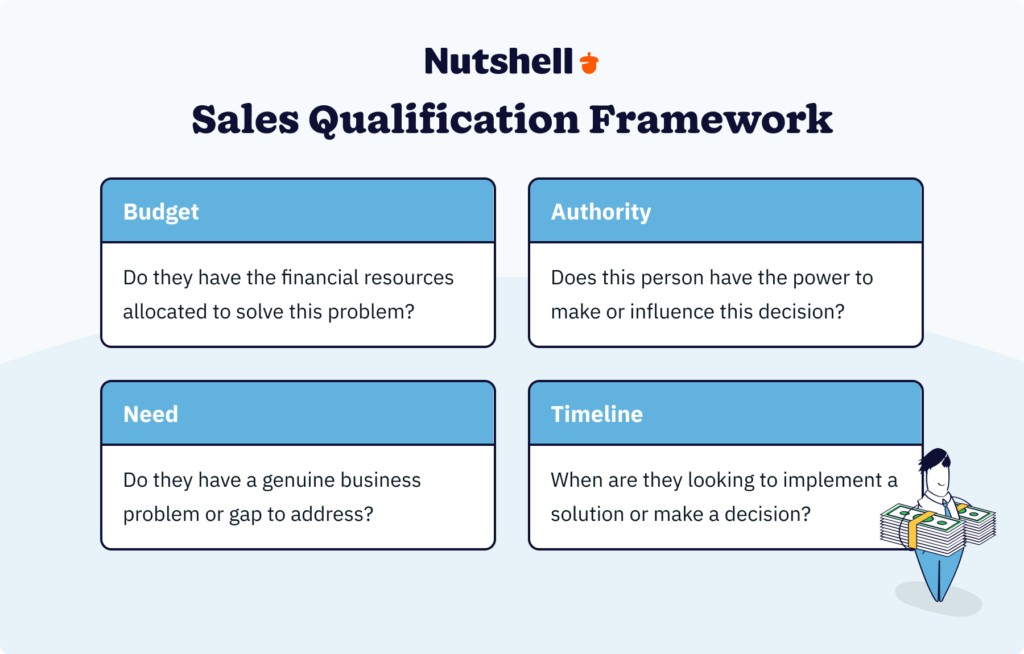
Framework Best for Key focus Typical sales cycle BANT SMBs, shorter sales cycles Budget and timeline up front Two to eight weeks CHAMP SMBs, consultative sales Challenges before budget Four to twelve weeks MEDDIC Enterprise, complex deals Decision process and champion Three to twelve months BANT is a framework developed by IBM in the 1950s built around four criteria: Budget, Authority, Need, and Timeline. BANT is the most widely taught qualification model and works well for SMBs and transactional sales. Its limitation is that it leads with budget – which can feel abrupt and close off conversations before they’ve started. Many sales teams find that using BANT-style sales qualification questions helps them quickly identify viable leads.
CHAMP is a framework that flips BANT’s order, leading with Challenges rather than budget. CHAMP – which stands for Challenges, Authority, Money, and Prioritization – is better suited to consultative sales environments where understanding the prospect’s pain before discussing price produces more honest, productive conversations. Using questions to identify a sales lead based on the CHAMP framework can lead to more meaningful conversations.
MEDDIC is a framework built for enterprise sales with long cycles and multiple stakeholders. MEDDIC – Metrics, Economic Buyer, Decision Criteria, Decision Process, Identify Pain, Champion – is the most rigorous of the three and is especially valuable when deals involve procurement teams, legal review, or executive sign-off. For complex enterprise sales, a set of qualifying sales lead questions based on MEDDIC is often necessary.
For most SMB sales teams using Nutshell, CHAMP or a simplified version of BANT is the right starting point. The 15 questions below are organized to work with either framework – and every answer you gather can be logged directly in Nutshell’s lead records to build a qualification picture your whole team can act on.
How we selected these questions
These 15 questions were selected based on three criteria: coverage of the four core qualification dimensions (budget, authority, need, timeline), applicability across inbound and outbound B2B sales contexts, and ability to surface actionable information rather than surface-level agreement. Questions that produce “yes/no” answers without follow-up context were excluded in favor of open-ended prompts that reveal motivation, urgency, and fit. Each question has been mapped to a stage in a typical discovery call so you know not just what to ask – but when.
15 sales qualifying questions for B2B sales team
One of the best ways to qualify leads is to talk with them – but talk with structure. The following 15 questions are organized into three phases of a discovery call: Opening (Questions 1–4), Core Qualification (Questions 5–10), and Deep Discovery (Questions 11–15). Use them in sequence to build rapport before diving into budget and authority – which is where most reps lose prospects by moving too fast.
Qualification call phase overview
Phase Questions Goal Opening 1–4 Build context, establish pain, assess urgency Core qualification 5–10 Identify decision-makers, budget, and timeline Deep discovery 11–15 Surface blockers, competitors, and long-term fit Question 1: How did you hear about us?
Qualification impact: Medium
This is the right question to open with because it doesn’t feel like an interrogation – it feels like genuine curiosity. The answer tells you more than just lead source. It tells you how much your prospect already knows about what you do, and how warm or cold they came in.
What to listen for: A prospect who found you through a referral, a webinar, or organic search typically arrives with more context and higher intent than someone who clicked a paid ad. Neither is disqualifying – but they require different approaches. A referral prospect already has some trust built in. A cold ad click may need more education before you can qualify effectively.
When to ask: At the very start of the call, before any other questions. It sets a collaborative tone without signaling that you’re evaluating them.
Why it works: Lead source is a meaningful qualifier in its own right. If your data shows that LinkedIn leads convert at twice the rate of paid search leads, knowing where a prospect came from shapes how you invest the next 30 minutes. A prospect who attended your webinar on sales automation already understands your positioning – you can move faster into need and fit.
Nutshell tip: Log the lead source in Nutshell’s lead record at the start of every call. Over time, you’ll build a data picture of which sources produce your highest-converting customers – and your marketing team will thank you for it.
Question 2: What business problem are you trying to solve?
Qualification impact: High
This is the most important question on the list. Every purchase decision – from a ten-dollar software subscription to a million-dollar enterprise contract – starts with a problem that needs solving. Your job as a sales rep is to understand that problem deeply enough to know whether you can solve it.
What to listen for: Listen for specificity. A prospect who says “we’re struggling to track our sales pipeline and deals keep falling through the cracks” is describing a real, solvable problem. A prospect who says “we’re just exploring options” may not have a defined pain yet – which means they’re earlier in their buying journey than you need them to be. That’s not a disqualification – it’s a signal to nurture rather than close.
When to ask: After the opening question and initial pleasantries. Don’t rush here. Let the prospect answer fully before you respond.
Why it works: Pain is the foundation of every sale. When you understand your prospect’s specific challenge – whether it’s lost deals, wasted rep time, or disconnected tools – you can evaluate whether your product directly addresses it. If it does, you have a foundation for every conversation that follows. If it doesn’t, you’ve just saved both parties a lot of time.
Nutshell tip: Add the prospect’s stated pain point to the Notes field in their Nutshell lead record. When you follow up – or when a colleague picks up the conversation – that context is there immediately.
Question 3: Why is solving this problem a priority right now?
Qualification impact: High
This question is where urgency lives. A prospect who has a real problem but no urgency to solve it is a nurture candidate, not a sales-ready lead. Understanding what’s driving their timing gives you insight into their motivation – and motivation is what converts interest into action.
What to listen for: Strong urgency signals include a recent leadership change, a contract renewal coming up with a current vendor, a regulatory deadline, or a growth target they’re behind on. Weak urgency signals – “we’ve been thinking about this for a while” or “no particular reason, just exploring” – suggest the deal is unlikely to close in the near term. That’s useful information. Don’t ignore it.
When to ask: Immediately after Question 2. The two questions flow naturally together – “What’s the problem?” followed by “Why now?” is a conversational sequence that doesn’t feel clinical.
Why it works: Timing is one of the four pillars of qualification. Prospects who want to solve a problem now are exponentially more likely to close than prospects who are simply researching. Industry research suggests 50–56% of leads aren’t ready to buy at the time of first contact – this question helps you identify which camp your prospect is in so you can respond accordingly.
Question 4: Have you tried to solve this problem before?
Qualification impact: High
This question is one of the most underused in sales. A prospect’s history with the problem tells you whether you’re dealing with an informed buyer, a frustrated one, or someone who doesn’t yet appreciate the complexity of what they’re trying to solve.
What to listen for: If they’ve tried a solution before – a competing tool, a manual process, a previous vendor – ask why it didn’t work. That answer reveals their real requirements, their tolerance for change management, and whether their expectations are realistic. If they’ve never tried to solve the problem, that can be a red flag – it may mean budget hasn’t been prioritized, or the problem isn’t as urgent as they’re suggesting.
When to ask: Toward the end of the Opening phase, after you’ve established what the problem is and why it matters now.
Why it works: Past behavior is one of the most reliable predictors of future purchasing. A prospect who has already invested in a solution – even a failed one – has demonstrated willingness to allocate budget and organizational energy to solving the problem. That’s a stronger buying signal than someone who’s never acted on it before.
Nutshell tip: If a prospect mentions a specific competitor they’ve tried, log it in Nutshell’s Competitors field. This helps your team tailor the rest of the conversation to your actual differentiators.
Question 5: Who else is involved in evaluating solutions
Qualification impact: High
The average B2B buying decision now involves roughly seven stakeholders, per SPOTIO – and sales cycles have stretched to an average of 6.5 months as a result. If you’re only speaking to one person, you’re only seeing part of the picture. This question helps you map the buying committee before you invest hours in a deal that gets blocked at the last minute by someone you never knew existed.
What to listen for: A prospect who says “just me” in an organization where that seems unlikely – a manager at a 500-person company buying enterprise software, for example – may not be the real decision-maker. A prospect who immediately names two or three other stakeholders is being transparent and helping you plan. Ask about each person’s role in the process, not just their title.
When to ask: Early in the Core Qualification phase – as soon as you’ve established that there’s a real problem worth solving.
Why it works: Knowing the full buying committee lets you plan your deal strategy. Who needs to be on the next call? Whose objections haven’t you heard yet? Who is the champion inside the organization that will advocate for your solution when you’re not in the room?
Question 6: Who makes the final purchasing decision?
Qualification impact: High
This is a natural follow-up to Question 5 – and it’s one of the most important questions on this list. Understanding who holds the actual authority to approve a purchase keeps you from investing weeks in a deal only to discover that the person you’ve been selling to can’t pull the trigger.
What to listen for: The economic buyer – the person with budget authority – is not always the person you’re talking to. In many B2B organizations, a manager or analyst will evaluate solutions while a director or VP makes the final call. That’s not a problem – but you need to know it early so you can plan how and when to engage the decision-maker directly.
When to ask: Alongside Question 5, as part of a natural conversation about the evaluation process. Framing it as “so that I can make sure we’re including the right people” removes any awkwardness.
Why it works: Selling to the wrong person is one of the most common – and most avoidable – causes of stalled deals. This question makes sure you’re building relationships with everyone who matters, not just the person who happened to book the call.
Question 7: What does your purchasing process look like?
Qualification impact: Medium
Even when you’re talking to the right person, the deal may still need to travel through procurement, legal, IT security review, or executive approval. Understanding the full purchasing process early keeps you from being blindsided by steps you didn’t know existed.
What to listen for: Listen for the number of steps, the people involved at each stage, and any dependencies – like a budget cycle, a board approval, or an IT security audit – that could affect timing. A prospect who describes a streamlined, two-step approval process is a very different deal from one who describes a six-month procurement committee review.
When to ask: After establishing who the decision-maker is. This question flows naturally as a follow-up: “And what does the typical purchasing process look like once you’ve identified the right solution?”
Why it works: Knowing the purchasing process lets you set realistic expectations with your own manager, build a deal timeline that accounts for internal delays, and avoid promising a close date that the prospect’s organization simply can’t meet.
Nutshell tip: Log the number of decision-making steps and any known dependencies in Nutshell’s lead notes. Set a reminder to follow up at each stage so no deal stalls silently in your pipeline.
Question 8: Do you have a budget allocated for this?
Qualification impact: High
Budget is one of the four core pillars of qualification – and it’s the one most sales reps avoid asking directly. That avoidance costs deals. A prospect who loves your product but has no budget to buy it is not a sales-ready lead. The sooner you know, the sooner you can decide whether to nurture, escalate to a budget conversation, or move on.
What to listen for: The most honest answer you’ll get is a budget range, not a number. “We have roughly $X set aside for this” is a strong buying signal. “We’re still figuring that out” or “we’ll find the money if the solution is right” are softer signals that warrant a follow-up conversation about how budgeting decisions get made at their organization. “We have no budget” is a clear disqualifier – unless you have reason to believe budget can be secured.
When to ask: Mid-way through the Core Qualification phase, after you’ve established real pain and organizational context. Asking about budget too early – before you’ve established value – can shut down the conversation. Asking too late wastes everyone’s time.
Why it works: Budget alignment is fundamental to closing deals. Enterprises pay an average of $349 per lead – seven times more than small businesses – reflecting their longer sales cycles and more complex budget processes, per Agentive AIQ. Understanding where your prospect sits on that spectrum helps you calibrate how long and how deep to invest in the deal.
Question 9: What does success look like for you in six months?
Qualification impact: High
This question shifts the conversation from features and pricing to outcomes – and that’s where deals are really won or lost. When a prospect describes what success looks like, they’re telling you exactly what they need your product to do. If their definition of success aligns with what Nutshell – or whatever you’re selling – actually delivers, you have a real fit. If it doesn’t, better to know now.
What to listen for: Specific, measurable outcomes are a strong signal. “We want to cut our sales cycle from 90 days to 60 days” or “we need every rep logging their activity so our manager can coach based on data” tells you exactly what this prospect needs and gives you a concrete way to demonstrate fit. Vague answers like “we just want things to run smoother” need a follow-up: “Can you tell me more about what that would look like day-to-day?”
When to ask: After the budget conversation – this question resets the energy of the call from evaluative to collaborative, which is exactly the tone you want heading into the back half of the qualification process.
Why it works: Outcome-focused questions are one of the most powerful tools in a sales rep’s toolkit because they get the prospect selling themselves. When they articulate what success looks like, they’re building a mental picture of the future state your product creates. That picture is what closes deals.
Question 10: What happens if you don’t solve this problem?
Qualification impact: High
This is the cost-of-inaction question – and it’s one of the most underused in B2B sales. Most sales reps spend their energy explaining what a solution can do. The cost-of-inaction question flips that dynamic: it gets the prospect to articulate what staying with the status quo is already costing them.
What to listen for: Strong answers quantify the pain – “we estimate we’re losing about two deals a month because reps aren’t following up fast enough” or “our churn rate is climbing because we don’t have visibility into at-risk accounts.” Weak answers – “things will just keep going as they are, I guess” – suggest the problem isn’t urgent enough to drive a purchase decision in the near term.
When to ask: As the final question of the Core Qualification phase – after you’ve established pain, urgency, budget, and decision-making. This question summarizes the stakes and sets up a natural transition to your solution.
Why it works: The cost of inaction is often more motivating than the promise of a better future. When a prospect can clearly articulate what they’re losing by not solving the problem – time, revenue, customers, competitive position – the value of a solution becomes self-evident. As Jessica Hall, Director of Sales and Customer Experience at Nutshell, would frame it: the goal isn’t to convince a prospect they have a problem. It’s to help them articulate the cost of that problem clearly enough that solving it becomes the obvious next step.
Question 11: Are you evaluating other solutions right now?
Qualification impact: Medium
This question is less about competition and more about context. A prospect who is actively evaluating three other vendors is further along in their buying journey – which means they’re closer to a decision but also more likely to be comparing on price. A prospect who hasn’t started a formal evaluation yet is earlier in the process – which means you have more room to shape their criteria.
What to listen for: Specific competitor names are valuable intelligence. If a prospect mentions Salesforce, HubSpot, or Pipedrive, you know exactly what you’re being compared to – and you can tailor the rest of the conversation to your specific advantages over those tools. If they say they’re “just looking around,” probe gently: “Is there a particular type of solution you’ve been drawn to, or are you still defining what you need?”
When to ask: At the start of the Deep Discovery phase – after the core qualification criteria have been established.
Why it works: Understanding the competitive landscape helps you position your solution correctly and set a realistic expectation for how long the decision is likely to take. It also helps your manager forecast more accurately.
Nutshell tip: Log any competitors mentioned in Nutshell’s Competitors field. If your team regularly sees the same competitors come up, that intelligence should feed directly into your sales playbook and battle cards.
Question 12: What criteria matter most when choosing a solution?
Qualification impact: High
This question reveals the prospect’s decision-making framework – which is arguably more valuable than any single piece of information you could gather. When you know what criteria matter most, you can structure every subsequent conversation, demo, and proposal around exactly what they care about.
What to listen for: Prioritized criteria are the most useful. “Ease of use is number one – we’ve tried tools that required too much training and our team abandoned them” tells you to lead with Nutshell’s usability and onboarding story. “Price-to-feature ratio is the most important thing” tells you to prepare a clear comparison. “We need a vendor who can grow with us” tells you to emphasize scalability and the product roadmap.
When to ask: Mid-way through the Deep Discovery phase, after you’ve established competitive context.
Why it works: Decision criteria are the scorecard your prospect is using to evaluate every vendor – including you. Knowing the scorecard before the evaluation is complete gives you the opportunity to address your strengths and proactively handle objections before they become deal blockers.
Question 13: What’s your ideal timeline for implementation?
Qualification impact: High
Timeline is the fourth pillar of qualification – and it’s where many deals stall silently. A prospect who says they want to be live in 30 days is a very different opportunity from one who says “sometime this year.” Both may be real buyers – but they require completely different engagement strategies.
What to listen for: Specific dates or milestones are strong signals. “We need to be live before our Q3 kickoff” or “we’re migrating off our current system in 60 days” indicate genuine urgency. Vague timelines – “no rush, whenever we’re ready” – warrant a follow-up question: “Is there a business event or deadline that’s driving when you’d like to have this in place?”
When to ask: After the decision criteria question – at this point in the call, the conversation naturally moves toward “so what would moving forward look like?”
Why it works: Implementation timeline is both a qualification criterion and a planning tool. It helps you set realistic expectations, coordinate with your onboarding team, and build a mutual action plan that gives the prospect a clear path from “yes” to “live.”
Nutshell tip: Set the expected close date in Nutshell based on the prospect’s stated implementation timeline. This keeps your pipeline forecast honest and gives your manager real visibility into deal velocity.
Question 14: What would make you walk away from a solution?
Qualification impact: High
This is one of the most revealing questions you can ask – and one of the least frequently used. It surfaces deal blockers before they become deal killers. A prospect who tells you “we’d walk away if we couldn’t get a month-to-month contract” or “if the implementation takes more than two weeks, we’re out” is giving you a gift. They’re telling you exactly what you need to address – or be honest about – before you invest more time in the deal.
What to listen for: Hard blockers are non-negotiable requirements that your solution either meets or doesn’t. Soft blockers are concerns that can be addressed with the right information or flexibility. The distinction matters. A hard blocker you can’t meet is a polite disqualification waiting to happen. A soft blocker is a sales conversation.
When to ask: Late in the Deep Discovery phase – once you’ve built enough trust that the prospect feels comfortable being candid.
Why it works: Surfacing objections early is always better than encountering them at the proposal stage. This question treats the prospect as a partner in the evaluation process rather than a target – and that shift in framing tends to produce more honest, more useful answers.
Question 15: What would a successful partnership look like?
Qualification impact: Medium
This is the closing question of your qualification conversation – and it’s intentionally forward-looking. It asks the prospect to imagine a future where they’ve chosen your solution and things are going well. That mental shift – from evaluation to partnership – is powerful because it moves the conversation from “should we do this?” to “what would doing this look like?”
What to listen for: A prospect who can paint a vivid picture of a successful partnership – specific outcomes, regular check-ins, expansion plans – is signaling that they’re ready to think seriously about moving forward. A prospect who gives a vague or hesitant answer may still have unresolved concerns that need to be addressed before they’re ready to commit.
When to ask: As the final question of the qualification call – before moving into next steps and follow-up commitments.
Why it works: This question naturally transitions a qualification conversation into a closing conversation. It also gives you one final piece of intelligence: what this prospect values in a vendor relationship. If their answer aligns with how your team operates – proactive support, shared success metrics, a named account manager – you have a strong foundation for a long-term customer relationship. Genoskin, a biotech company that adopted Nutshell to manage their sales pipeline, found exactly that kind of alignment – and saw their revenue roughly double year-over-year while achieving 100% team adoption, including at the CEO level.
How to use qualification data in Nutshell
Asking great qualifying questions is only half the job. The answers only drive results if they’re captured, shared, and acted on – and that requires a CRM your team will actually use. Nutshell is designed to make qualification data easy to log and easy to find, so every rep on your team works from the same picture of every deal.
Here’s how to put your qualification answers to work in Nutshell:
- Log pain points and urgency signals in the Notes field on each lead record – accessible to every team member in real time
- Tag leads by qualification stage using Nutshell’s custom fields so your pipeline reflects actual deal quality, not just volume
- Use Nutshell’s pipeline view to see at a glance which leads have been fully qualified and which are missing key information
- Set automated reminders for follow-up actions based on the timeline your prospect shared – so no deal stalls in your pipeline without you knowing
- Track competitor mentions using Nutshell’s Competitors field to build intelligence across your entire team over time
Nutshell’s next-action sales approach means every lead always has a clear next step – and your qualification answers are what determine what that step should be.
Frequently asked questions about sales qualification
-
1. What are sales qualifying questions?
Sales qualifying questions are open-ended questions that sales reps use during discovery calls and early sales conversations to determine whether a prospect has the budget, authority, need, and timeline to become a customer. They help reps focus their time on leads most likely to close.
-
2. What is the BANT framework in sales?
BANT is a sales qualification framework developed by IBM that stands for Budget, Authority, Need, and Timeline. BANT is a method for evaluating whether a prospect is ready to buy by assessing these four criteria during early sales conversations. It remains one of the most widely used qualification models, particularly in SMB and transactional sales environments.
-
3. How many qualifying questions should you ask on a discovery call?
Most effective discovery calls include five to ten qualifying questions, depending on the complexity of the sale and the prospect’s engagement level. The goal is not to run through a checklist but to have a natural conversation that covers budget, authority, need, and timeline by the end of the call.
-
4. What’s the difference between a qualifying question and a discovery question?
A discovery question is broad – it helps you understand a prospect’s world, goals, and challenges. A qualifying question is evaluative – it helps you decide whether to invest more time in a prospect. In practice, the two overlap: the best qualifying questions are also great discovery questions because they generate insight while simultaneously assessing fit.
-
5. How do you qualify a B2B sales lead?
To qualify a B2B sales lead, assess four core dimensions: budget (do they have funds allocated?), authority (are you speaking to a decision-maker or influencer?), need (do they have a specific problem your solution solves?), and timeline (are they looking to act within a relevant timeframe?). A structured qualification framework like BANT, CHAMP, or MEDDIC provides a consistent way to evaluate every lead against the same criteria.
-
6. What should you listen for in a qualifying call?
On a qualifying call, listen for specificity, urgency, and decision-making clarity. Strong buying signals include a clearly defined problem, a recent triggering event (like a leadership change or contract renewal), named decision-makers, an allocated budget, and a defined timeline. Red flags include vague pain (“we just want to improve things”), no urgency (“we’re just exploring”), and an inability to identify who makes the final call.
-
7. How do you qualify a customer in sales?
You can qualify a customer during the sales process by creating an ideal customer profile (ICP) and comparing leads to that persona. To craft an ICP, perform market research and come up with a list of characteristics your ideal audience would have. Then ask sales qualifying questions to see whether leads match those profiles.
-
8. What is an example of a qualified prospect?
A qualified prospect is someone who is in a good position to buy your product or service. Generally, qualified prospects are struggling with an issue your product can solve, are dissatisfied with their previous solutions, and have the budget to purchase your product.
-
9. What are some of the best sales qualification questions?
Powerful sales questions are the questions you can ask a prospect to gain a lot of information about their needs, priorities, and expectations. Besides the sales qualifying questions listed above, a few powerful sales questions include:
- What are your organization’s short-term and long-term goals?
- What challenges do you foresee arising when implementing this solution?
- How does your team evaluate a new product or service and make purchasing decisions?
- What do you consider to be your team’s greatest strength? And weakness?
-
10. When should you ask sales qualifying questions?
You should ask different sales qualifying questions at different stages of the sales qualification process. For example, finding out the problem a lead is trying to solve should be a priority in the beginning of the process. Broaching the topic of budget is best reserved for the middle of an initial call.
Uncover the best use of your team’s time with Nutshell
Sales qualifying questions are the foundation of a healthy pipeline – but the system that captures and acts on those answers is what separates a good sales call from a closed deal.
Nutshell gives your team a single place to log qualification data, track deal progress, and trigger the right next action at every stage. With fast setup, automated workflows, and a pipeline view designed around how reps actually work, Nutshell helps you save time and close more deals.
Ready to put your qualifying questions to work? Start your free trial of Nutshell today – no credit card required.Thanks to Volodymyr Hryshchenko on Unsplash for the cover photo. ✊
NO CREDIT CARD REQUIREDWant to kick the tires a bit?
No problem. Start Your Free 14-Day Trial—See Nutshell in Action, No Credit Card Needed!
 BACK TO TOP
 Written by
Kevin Randolph Partnerships and Outreach SpecialistEdited by
Will Gordon Sr. Director of MarketingReviewed by
Andy Fowler Co-FounderReady to try
Nutshell for Free?Thank you! Your submission has been received!Oops! Something went wrong while submitting the form.




Email Marketing Costs: Complete 2026 Pricing Guide for Small Businesses
Published on: January 20, 2026
WhatsApp Business for B2B: How SMBs Are Cutting Sales Cycles in Half
Published on: February 19, 2026Highly Effective Strategies for Elevating Sales Team Performance
Published on: November 10, 2022Establishing a System for CRM Data Entry and Management
Published on: April 11, 2023Introducing Nutshell Forms Spam Prevention
Published on: April 22, 2024Join 30,000+ other sales and marketing professionals. Subscribe to our Sell to Win newsletter!