SMS Sales: How B2B Sellers Can Close More Deals With Text Messages

-

Key takeaways
- SMS offers a powerful way to engage B2B prospects with high visibility and a personal tone, complementing email and calls.
- Always get explicit opt-in permission and use a dedicated SMS tool for compliance and effective campaign management.
- Craft concise, valuable messages with clear CTAs, optimize sending times, and iterate based on performance.
Cold calling is great—if your prospects actually pick up the phone.
Many buyers are more comfortable with texting than phone calls, which means you have to get comfortable with it, too. Learn to leverage this underrated communication channel, and SMS sales just might become the secret weapon in your selling arsenal.
Here’s what’s changed in 2025. SMS adoption in B2B sales is finally hitting the mainstream. While only 44% of B2B companies currently use SMS in their sales strategy, that means you have a competitive advantage if you act now.
Modern SMS platforms built for compliance make it easier than ever to stay legal and respectful. And with AI transforming how sales teams work, SMS fits perfectly into automated sales sequences that actually save reps time instead of creating busywork.
The buyers you’re trying to reach? They live on their phones. They’re constantly checking text messages. Email is crowded.
Cold calls often go unanswered. But a well-timed SMS? That lands. That gets read. That moves deals forward.
Here are a few quick facts to prove it to you:
- The average American checks their phone 205 times a day.
- 90% of SMS messages are read within three minutes of delivery.
- SMS delivers a click-through rate of 19% on average, roughly 15% higher than email.
- B2B SMS response rates average 40 to 50% compared to email’s 6%.
What do these stats tell us? That the best way to reach potential customers is via the supercomputer they carry around in their pockets. Keep reading to learn more about what SMS sales is, the benefits and disadvantages of this selling strategy, and seven SMS best practices you can use to sell more products or services via text.
Table of Contents
- What is SMS sales?
- What are the benefits of selling via text?
- How different B2B industries use SMS to close deals faster
- Are there any disadvantages of SMS selling?
- 7 SMS sales best practices
- When to text prospects: SMS use cases across the B2B sales cycle
- SMS sales metrics you should be tracking
- 5 common SMS sales mistakes (and how to fix them)
- TCPA compliance in 2026: Why staying legal protects your bottom line
- FAQs about sales text messages
What is SMS sales?
SMS sales, which is short for short message service sales, is an increasingly popular sales tactic that enables businesses to contact and sell to prospects and customers via text.
Have you ever received a text from a salesperson you hardly knew? Maybe you were out car shopping on a Saturday afternoon. Then, first thing Monday morning, you receive a text message from the sales rep asking if you wanted to take another test drive.
Or maybe you get texts on a regular basis from your favorite local restaurant, telling you what the special of the day is or offering you the chance to download a free drinks coupon.
Both of these scenarios are examples of SMS sales that can easily be used in a B2B context as well.
What are the benefits of selling via text?
Why should you text your prospects and customers? Isn’t it better to just call or reach out via email? What’s better depends on the demographics and preferences of your buyers. (We know that millennials generally hate talking on the phone, for example.) But SMS sales definitely has a few distinct advantages, such as:
1. Deliverability speed
When you send a text to your prospects and customers, it gets delivered immediately. This fact makes it possible to send perfectly timed messages about flash sales, event-related promotions, and other time-sensitive circumstances.
Since 81% of Americans own a smartphone and 90% of SMS messages are read within three minutes, texting is a viable way to reach an audience in a hurry. And unlike emails, texts don’t run the risk of getting caught in a spam filter.
2. A more personal approach to selling
SMS messaging is less formal, and therefore more personal, than many other forms of communication. Think about the way you text with your friends. You probably use a wide range of abbreviations and emojis, right? Because of this, texting is viewed differently than other text-based communication channels like email.
You can use this to your advantage and build trust with your prospects via conversational SMS messages. Then you can continue to use the strategy to boost customer loyalty once a prospect becomes a buyer.
To be clear, we aren’t suggesting that you quit calling your prospects or give up on email marketing. Both of these sales channels still have their place! But it’s clear that SMS messaging, when used correctly, can be a viable sales channel for most organizations.
B2B SMS: No longer just for retail
If you think SMS is only for restaurants sending happy hour specials or clothing stores announcing sales, think again. The perception that SMS is too informal for B2B is officially outdated.
In 2025, executives are texting salespeople back. B2B buyers prefer a quick text confirmation over a formal email. And the tools have caught up—modern SMS platforms now include built-in compliance features, consent management, and CRM integration that makes B2B outreach both professional and legal.
Here’s what’s shifted: compliance has improved dramatically. Platforms like Nutshell SMS are specifically designed to handle TCPA rules, quiet hours, opt-in tracking, and audit trails. The old days of “hoping you don’t get sued” are gone. You can now text B2B prospects confidently because the infrastructure exists to do it right.
Consider this: if only 39% of B2B companies are using SMS in their sales process, the ones who adopt it now will close deals faster than their competitors. Your prospect’s inbox is flooded. Their voicemail is ignored. But their text thread? It’s personal. It’s immediate. And it works.
The question isn’t whether you should use SMS in B2B anymore. It’s whether you’ll move fast enough to get ahead of the companies finally catching on.
Real results: How one B2B company increased conversions by 217% with SMS
The numbers speak for themselves. A B2B text messaging company struggling with low email engagement integrated SMS directly into their Salesforce CRM and saw transformational results.
The challenge: Their sales team faced a 12% email open rate, disconnected communication tools that required constant platform switching, manual tracking that created gaps in contact history, and slow deal closures that stretched their sales cycle.
The solution: They implemented native Salesforce SMS with two-way messaging capabilities, allowing reps to have real conversations without leaving the CRM. They set up bulk SMS campaigns for targeted outreach and automated follow-up sequences triggered by specific CRM actions—like a prospect viewing a proposal or a deal moving to a new pipeline stage.
The results in six months:
- 217% increase in lead conversions: More prospects moved from initial contact to qualified opportunity
- 60% faster deal closures: Average sales cycle shortened from weeks to days in many cases
- 3X more responses compared to email: Prospects replied to SMS three times more often than email outreach
- 40% improvement in team productivity: Reps spent less time switching tools and more time selling
The key to their success wasn’t just adopting SMS—it was integration. Every text message logged automatically under the contact record. Reps could see the full conversation history alongside emails and calls. No information fell through the cracks.
This is what proper SMS implementation looks like in 2026. It’s not about sending more messages—it’s about sending the right message at the right moment, and making it easy for prospects to respond when they’re ready.
How different B2B industries use SMS to close deals faster
SMS isn’t one-size-fits-all. The way a manufacturing sales rep texts a procurement manager looks different from how a SaaS account executive reaches a VP of Marketing. Here’s how SMS fits into real B2B workflows across industries.
Manufacturing and wholesale
Challenge: Long sales cycles with multiple decision-makers, complex quotes, and time-sensitive inventory availability.
SMS applications:
- Quote follow-ups: “Your custom quote for 5,000 units is ready. Valid through Friday—reply YES to review.”
- Inventory alerts: “The steel grade you requested just came in stock. Want me to hold 10 tons?”
- Shipping updates: “Your order shipped this morning. Tracking: [link]. ETA Thursday by 2pm.”
- Reorder reminders: “You ordered fasteners every quarter last year. Need another shipment?”
Manufacturing buyers appreciate the directness. They don’t have time to dig through email threads when they need a simple yes or no answer.
Professional services (legal, accounting, consulting)
Challenge: Relationship-based selling with long consideration periods and high trust requirements.
SMS applications:
- Meeting confirmations: “Confirmed for Tuesday, 10 am. I’ll bring the compliance audit summary we discussed.”
- Document requests: “I need your Q4 financials to finalize the proposal. Can you send by end of day?”
- Case updates: “Judge approved the motion. I’ll call you at 3 pm to discuss next steps.”
- Referral follow-ups: “Sarah mentioned you might need estate planning help. Happy to send you some info—no pressure.”
Professional services thrive on responsiveness. A well-timed text shows you respect the client’s time and keeps projects moving.
SaaS and tech sales
Challenge: Crowded inboxes, ignored cold calls, and prospects researching solutions independently before engaging sales.
SMS applications:
- Trial engagement: “Saw you signed up for the free trial yesterday. Need help setting up your first campaign?”
- Feature announcements: “We just launched the integration you asked about in our demo. Want a quick walkthrough?”
- Renewal reminders: “Your annual plan renews in two weeks. Let me know if you want to discuss the new enterprise features.”
- Event invites: “We’re hosting a webinar on API automation next Thursday. Save your spot: [link].”
SaaS buyers expect modern communication. If you’re selling digital products but still relying solely on email, you’re not matching their expectations.
Construction and home services
Challenge: Field-based teams, time-sensitive project windows, and clients who need quick answers during business hours.
SMS applications:
- Bid delivery: “Your estimate for the kitchen remodel is ready: [link]. Questions? Reply here or call.”
- Scheduling coordination: “Can we move your site visit from Thursday to Wednesday morning? Permit cleared early.”
- Change order approvals: “Upgraded fixtures will add $1,200. Reply YES to approve and keep us on schedule.”
- Payment reminders: “Final invoice sent yesterday. Let me know if you didn’t receive it.”
Construction clients are busy managing projects. SMS gives them a way to make decisions quickly without playing phone tag.
The common thread across all these industries? SMS works when it’s integrated into your existing sales process, not treated as a standalone tactic. The manufacturers using SMS successfully aren’t just blasting promotions—they’re answering real questions and moving real deals forward.
Are there any disadvantages of SMS selling?
Unfortunately, it’s not all sunshine and rainbows when it comes to SMS sales. There are a few drawbacks to using this selling strategy that you should be aware of:
1. Potential negative reactions
Because SMS messaging is a more intimate form of communication, some people feel violated when they’re contacted by a corporation via text. That’s why it’s SO important to get permission to text your leads before actually sending them messages!
We’ll talk more about this in the next section. But for now, know that while acceptance of SMS sales strategies is growing, there are still folks who are vehemently opposed to the practice.
2. Content limitations
You don’t have a lot of time to wax poetic about your products and/or services when you contact your audience via text message. You need to state your business in 160 characters or less, which isn’t always easy to do. Also, you can’t always use rich media like you might in an email, making the words you send doubly important.
The texting format forces you to get to the point, so it helps to be a skilled copywriter to begin with. If you can’t craft quick, compelling messages to send to your audience, you might be better off using a different strategy than SMS sales.
Download our 16 sales process templates for B2B pipelines
Whether you’re building your first sales process or overhauling an existing one, these Nutshell-approved templates will give you a great head-start.
7 SMS sales best practices
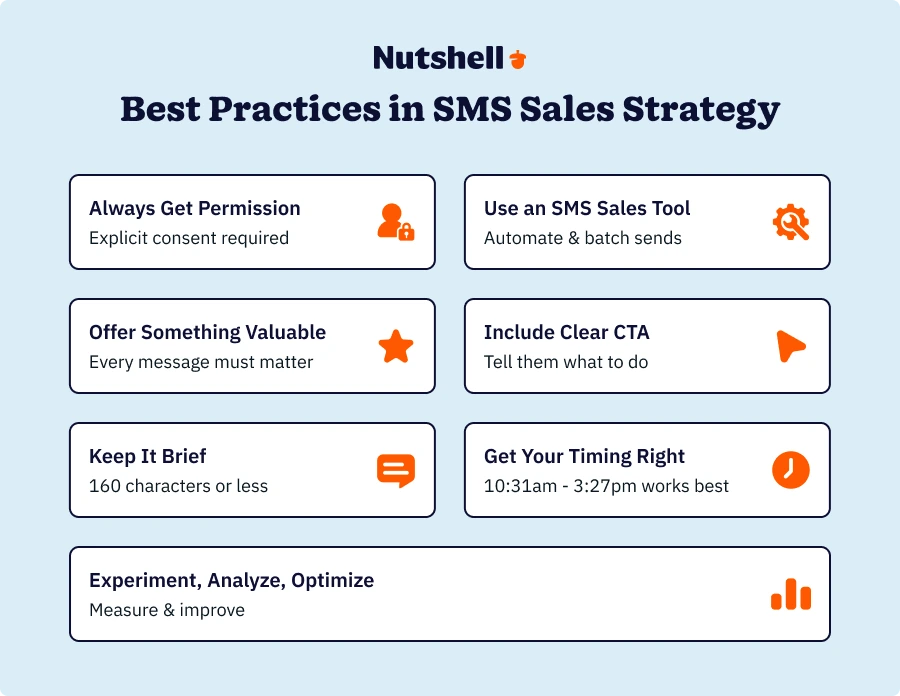
If you’ve decided that text messaging is a viable strategy for your business, you’ll want to know how to do it properly. The following seven SMS sales best practices will help you get started on the right foot. Let’s dive in…
1. Always get permission
It goes without saying, but we’ll say it anyway: You need to get permission from your audience before you start texting them. If you don’t, you’ll be breaking the law. Plus, you’ll make many of your prospects and customers angry, which is never good for business.
Fortunately, getting permission isn’t too difficult:
- Create an SMS campaign: An SMS campaign is any marketing initiative that encourages people to text a specific code or keyword to a business in order to receive a reward or benefit of some kind in return.
- Provide an opt-in box: When a customer makes a purchase on your website, give them the chance to opt in to text messages from your company. Just be transparent about the kind of things you’ll text them about once they join your list.
Both of these strategies will work and allow you to begin texting your audience legally, without putting a strain on the relationship you’ve built.
2. Use an SMS sales tool
Just like with email marketing, there are software tools available to make your SMS sales efforts more effective and efficient. Can you imagine using your personal cell phone to text each of your customers one by one with offers? Terrible idea!
Instead, use a tool that will batch your communications, automate them to a sending schedule of your own choosing, and ensure total privacy (for you and your audience) is upheld.
Here are a few SMS sales tools to check out:
- Nutshell SMS: When you add Chat and SMS to your Nutshell CRM plan, you can send text messages—personalized, automated, or off-the-cuff—to any of your contacts, directly from your CRM platform. This lets you pin text threads to contact timelines, assign specific threads to the right sales rep, and automate your text messaging to send at the right stage of your sales pipeline.
- TextMagic: TextMagic has been in the bulk SMS service game since 2001, making them an experienced partner for all your SMS sales needs. The tool features email to SMS capabilities, two-way SMS chat so that you can speak directly with customers, an advanced analytics dashboard, and the option to send texts with up to 918 characters. (Nutshell users will also appreciate seamless integration possibilities with your CRM.)
- Podium Webchat: Capture and convert leads while they’re on your website with an easy-to-use button that connects you to your leads through text. Podium Webchat is just one of several messaging tools from Podium, which helps businesses acquire leads, reviews, payments, and more, all through text.
- EZTexting: EZTexting is a leader in the SMS marketing and sales industry. Its platform is easy to use and allows its customers to quickly engage their audiences via text message. That’s why more than 160,000 businesses have used the tool to send well over 5.5 billion messages. Some of EZTexting’s top features include keywords, drip campaigns, and picture messages.
- Tatango: Tatango offers top-notch features for major corporations like TBS, Ace Hardware, and Sony Music. Use the platform to create powerful messaging workflows that get clicked, segment subscribers based on specific criteria, view detailed analytics, and much more. Tatango also integrates with MailChimp, Nutshell, and ActiveCampaign for your convenience.
- SimpleTexting: SimpleTexting is exactly what you’d expect—an SMS marketing and sales platform that’s incredibly easy to use. If you choose this tool, you’ll enjoy features like two-way messaging, text scheduling, autoresponders, data collection, and more. Join big-name brands like Starbucks, Samsung, and Marriott Hotels and use SimpleTexting to better reach and engage your audience.
Keep in mind that some email marketing software includes SMS capabilities as well. If you’re an ActiveCampaign or Brevo user, for example, you might not need to invest in a secondary app to send texts to your audience.
Feature Nutshell SMS TextMagic Podium EZTexting Tatango SimpleTexting Best for B2B sales teams using CRM International SMS and 2-way chat Web-based lead capture Volume senders and campaigns Enterprise automation Small business ease of use CRM integration ✅ Native (Nutshell CRM) ✅ Integrates ✅ Limited ✅ Integrates ✅ Yes ✅ Yes Ease of setup ⭐⭐⭐⭐⭐Very easy ⭐⭐⭐⭐Moderate ⭐⭐⭐⭐⭐Very easy ⭐⭐⭐⭐Moderate ⭐⭐⭐Steeper ⭐⭐⭐⭐⭐Very easy Two-way messaging ✅ Yes ✅ Yes (strong) ✅ Yes ✅ Yes ✅ Yes ✅ Yes Automation/workflows ✅ Pipeline-based ✅ Basic ⚠️ Limited ✅ Yes ✅ Advanced ✅ Yes TCPA compliance tools ✅ Built-in ⚠️ Basic ⚠️ Basic ✅ Yes ✅ Yes ✅ Yes Consent management ✅ Automated tracking ⚠️ Manual ⚠️ Manual ✅ Yes ✅ Yes ✅ Yes Price/message $0.01–$0.05 $0.01–$0.05 Varies $0.01–$0.05 $0.01–$0.05 $0.01–$0.05 Free trial? ✅ 14 days ✅ 30 days ⚠️ Free demo ✅ 14 days ⚠️ Free demo ✅ 14 days Final rating ⭐⭐⭐⭐⭐ Top choice ⭐⭐⭐⭐ ⭐⭐⭐ ⭐⭐⭐⭐ ⭐⭐⭐⭐ ⭐⭐⭐ Why Nutshell SMS stands out for B2B sales teams: It’s the only option purpose-built to integrate directly with your CRM sales pipeline. You can trigger SMS automatically when a prospect reaches a specific stage, keep all communication history in one place, and maintain compliance without extra work. For sales teams already using Nutshell, adding SMS is seamless. For teams switching to Nutshell, SMS integration is a huge efficiency gain.
The other tools are solid options depending on your needs—TextMagic excels at international texting, Podium is great for web-based lead capture, EZTexting handles high volume well, Tatango offers enterprise-level automation, and SimpleTexting is perfect for simplicity. But if you’re building a B2B sales strategy and want SMS integrated with your CRM from day one, Nutshell SMS is the clear winner.
Get started with Nutshell SMS
Want to start leveraging text messaging in your sales strategy? Head to your SMS page in Nutshell to register!

3. Offer something valuable
Gintaras Steponkus, a Sales & Marketing Manager at Solidguides, reminds us, “Make sure that every text message you send has some value.”
Your audience didn’t sign up to receive text messages from you for no reason. They expect something in return for their phone numbers. In B2B, that “value” might look different than in B2C:
B2B value doesn’t have to mean discounts. It might be:
- A relevant resource or guide
- A meeting reminder (saves them from embarrassment)
- A project update or timeline
- Access to industry research
- A link to a case study relevant to their situation
- A one-time code for a special offer
The key is relevance. Your prospect should read your SMS and think, “This is actually helpful” or “I needed this reminder” or “This is exactly what I was looking for.”
Just remember: always have a specific reason for sending each SMS. Sending texts “just because” or to fill a quota is a quick way to get your company blocked and damage your reputation. Every message should move the relationship forward.
4. Include a clear call-to-action
You need to do more than just offer something valuable to your audience in your text messages. You also need to give them a clear and compelling way to get it. In other words, you need a great call-to-action (CTA).
According to Jill Gibbons, a Digital Marketer at ClickSend, the best CTAs are interactive. She says, “Via SMS, encourage consumers to participate by voting, answering surveys, completing questionnaires, and replying with a keyword.”
Another tactic is to include a simple, straightforward CTA such as:
- Sign up now for free!
- Use this code and get 15% off at checkout!
- Complete this 2 minute survey and win!
The key to this kind of call-to-action is clarity and brevity. Explain to your audience what they need to know as quickly as possible. Then sign off.
5. Keep it brief
As mentioned earlier, SMS sales strategies don’t give you a lot of space to get your points across. You have to be brief when texting your audience. The question is, how? Here are a few tips to help you write short, enticing messages that get opened, read, and clicked:
- Begin with an enticing phrase: If you start your SMS message with a phrase like “FREE OFFER” you’ll quickly grab attention without wasting characters.
- Focus on the benefit: Why should people click through and see/accept your offer? Keep the focus of your texts on benefits, not a list of features.
- Experiment with MMS: MMS stands for multimedia message service and will allow you to send images with your texts. You know what they say, a picture is worth a thousand words. To get your points across quicker, use visuals.
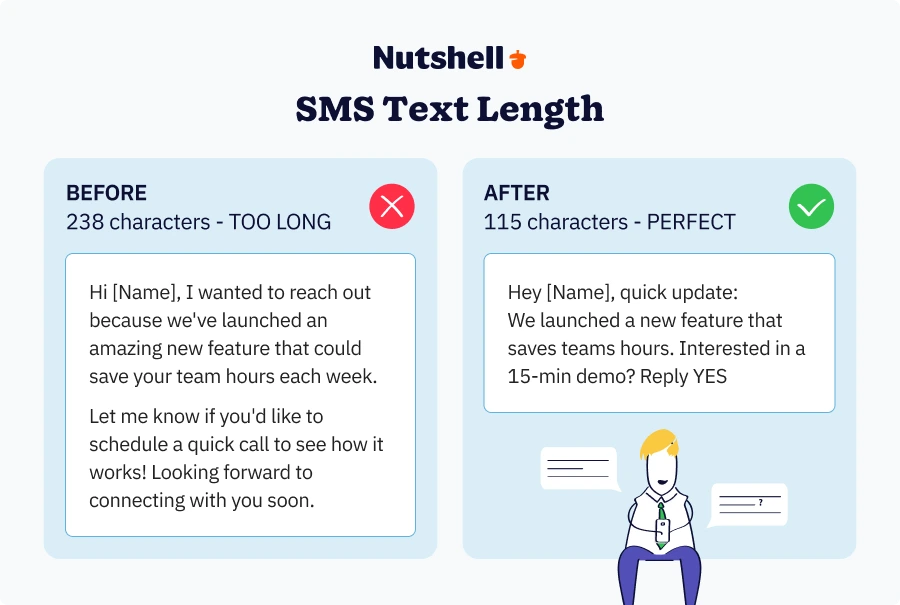
While it can be difficult to write an enticing message in 160 characters or less, it’s definitely possible—especially if you follow the above tips.
6. Get your timing right
When you send your texts is almost as important as what you say in them. For example, if you text a customer at 2am, you’ll probably look creepy and your text won’t be effective. Instead, aim for one of these recognized times to send your messages:
- Between 10:31am and 11:29am
- Between 2:34pm and 3:27pm
While these general time frames should work in most cases, keep your personal goals in mind. You wouldn’t, for instance, want to send a lunchtime offer for your restaurant at 3:05pm—even though it falls within the window of effective sending times.
We should also mention that the number of texts you send to your audience matters a lot. Christopher Prassad, the Marketing Manager at JookSMS, an SMS marketing company says, “The last thing you want to do is spam consumers, so it is important to be considerate in your approach, and know the best time to contact people through this medium.”
7. Experiment, analyze, optimize
Like any other marketing and sales strategy, you have to experiment, analyze, and optimize your approach to SMS sales in order to find success. Take a look at the data. What can you do to entice more customers to sign up for text messages? Can your engagement metrics be improved? If so, how?
By asking yourself these and similar questions, you’ll put yourself on track to improve your SMS strategy. All that’s left to do is try a few different ideas to see what sticks.
When to text prospects: SMS use cases across the B2B sales cycle
Knowing when to send an SMS is just as important as knowing what to say. Here’s how SMS fits into each stage of the B2B buying journey.
Lead awareness and qualification
Goal: Start a conversation without being pushy.
SMS examples:
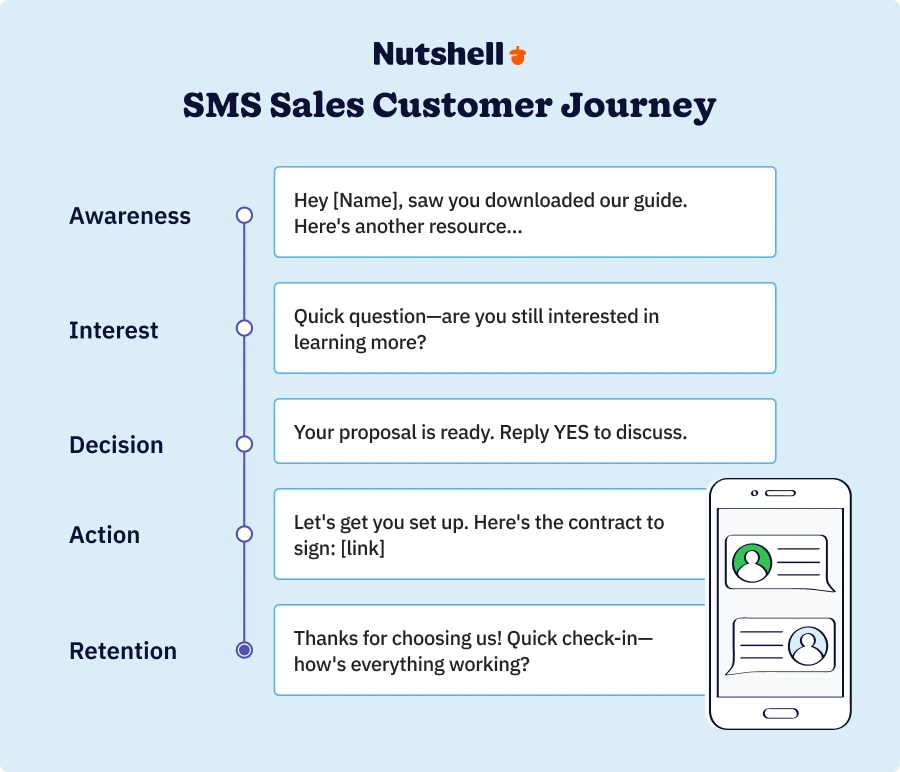
- After content download: “Saw you grabbed our guide on [topic]. Did it answer your questions, or should I send you something more specific?”
- Event follow-up: “Great meeting you at [conference name]. Here’s that case study I mentioned: [link].”
- Webinar registration confirmation: “You’re registered for Thursday’s webinar. I’ll text you the Zoom link 10 minutes before we start.”
Why it works: You’re providing value and making it easy to respond with a quick yes, no, or question.
Discovery and needs analysis
Goal: Schedule conversations and gather information.
SMS examples:
- Meeting scheduling: “Still good for our call Tuesday at 2pm? I’ll send the calendar invite.”
- Pre-call prep: “Before our demo tomorrow, what’s your biggest challenge with [pain point]? Helps me customize the walkthrough.”
- Discovery follow-up: “You mentioned needing better reporting. I found two examples from companies in your industry: [link].”
Why it works: SMS reduces scheduling friction and shows you’re prepared and attentive.
Proposal and evaluation
Goal: Keep deals moving when decision-makers are reviewing options.
SMS examples:
- Proposal delivery: “Your proposal is ready: [link]. I’m available Thursday or Friday if you want to walk through it together.”
- Competitive displacement: “Heard you’re evaluating a few options. Happy to answer any comparison questions—no sales pitch, just facts.”
- Objection handling: “You mentioned concerns about implementation time. Want me to intro you to a client who went live in two weeks?”
Why it works: Buyers appreciate the low-pressure check-in. It keeps you top of mind without feeling like you’re hovering.
Negotiation and closing
Goal: Remove friction and close the deal quickly.
SMS examples:
- Contract reminders: “Contract sent Monday. Let me know if you need any changes before Friday’s board meeting.”
- Approval nudges: “How’s the contract review going? I can extend the pricing deadline if you need a few more days.”
- Signature requests: “We’re all set on our end. Reply when you’ve signed and I’ll get your onboarding scheduled.”
Why it works: SMS makes it easy for prospects to confirm progress without formal emails or calls.
Onboarding and expansion
Goal: Ensure successful implementation and identify upsell opportunities.
SMS examples:
- Implementation check-ins: “How’s the setup going? Our support team is ready if you hit any snags.”
- Feature adoption: “Noticed you haven’t tried [feature] yet. It’s perfect for [use case]. Want a quick demo?”
- Renewal conversations: “Your contract renews in 60 days. Let’s schedule time to review your results and discuss next year.”
Why it works: Retention starts with responsiveness. SMS keeps the relationship active after the sale.
The pattern across all stages? SMS is most effective for time-sensitive updates, low-friction requests, and keeping momentum when email would feel too formal or get ignored.
SMS sales metrics you should be tracking
You can’t improve what you don’t measure. Here are the key metrics to monitor as you build your SMS sales strategy:
Delivery rate (Target: 95%+)
Not all SMS messages make it to your prospect’s phone. Phone numbers change. Carriers flag suspicious activity. A delivery rate below 95% signals a problem—either with your contact list quality or your sending practices. Use a dedicated SMS tool (like Nutshell SMS) that tracks and reports this automatically.
Response rate (B2B target: 40-50%)
This is where SMS shines. Email averages 6% response rate. SMS in B2B settings typically reaches 40-50%. If your response rate is below 30%, your messaging might be off—test different CTAs, timing, or content angles.
Opt-in rate
How many of your prospects actually agree to receive SMS from you? A healthy opt-in rate is 15-25% when you’re offering genuine value. If it’s lower, your value proposition isn’t compelling enough.
Cost per message ($0.01−$0.05)
SMS is cheap. Small businesses typically pay $0.04−$0.05 per message. Enterprise senders pay closer to $0.015. But it’s not just about per-message cost—calculate cost per conversion (how much you spend in SMS to close one deal). You’ll likely find SMS outperforms email and calls by this metric.
Message unsubscribe rate
Monitor who’s opting out. A high unsubscribe rate means you’re either messaging too frequently, sending low-value content, or reaching the wrong audience. Aim to keep this below 5%.
Cycle time impact
Here’s the real win: does SMS shorten your sales cycle? Track whether deals involving SMS communication close faster than those without. Even a 2-3 day reduction in cycle time adds up to significant revenue gains.
5 common SMS sales mistakes (and how to fix them)
Even experienced sales teams make these errors. Here’s how to avoid them.
Mistake 1: Using your personal cell phone number
The problem: Prospects have your personal number forever. You can’t track conversations in your CRM. You can’t hand off leads to other reps. And when you leave the company, those relationships walk out the door with you.
The fix: Use a dedicated SMS platform that provides business phone numbers. Nutshell SMS, for example, gives you a dedicated number that integrates with your CRM, so every conversation is logged, assigned to the right rep, and tracked alongside emails and calls.
Mistake 2: Sending the same message to everyone
The problem: Bulk SMS campaigns with generic messages get ignored. “Hi [First Name], just checking in!” doesn’t provide value and screams automation.
The fix: Segment your audience and personalize messages based on where they are in the buying journey. A prospect who downloaded a pricing guide needs a different message than someone who attended your webinar. Use your CRM data to trigger relevant, timely texts.
Example:
- Generic (bad): “Hi John, just checking in to see if you’re still interested!”
- Personalized (good): “John, saw you downloaded our ROI calculator for manufacturing CRMs. Did the numbers make sense for your team size?”
Mistake 3: Forgetting to include an opt-out option
The problem: TCPA requires an easy opt-out method. If prospects can’t unsubscribe, you’re violating federal law.
The fix: Every SMS platform should automatically include opt-out language. Standard format: “Reply STOP to unsubscribe.” Honor opt-outs immediately—no delays, no confirmation emails, no “Are you sure?” messages.
Mistake 4: Sending texts without CRM integration
The problem: If your SMS tool doesn’t connect to your CRM, you’re creating information silos. Reps don’t know what messages were sent. Managers can’t see SMS activity in reports. Handoffs between team members fail because conversation history isn’t documented.
The fix: Choose an SMS platform with native CRM integration. When a prospect replies to your text, that response should appear in their contact record alongside every other interaction. Nutshell SMS does this automatically—every text thread is pinned to the contact timeline.
Mistake 5: Measuring the wrong metrics
The problem: Tracking delivery rates and open rates misses the point. SMS isn’t about volume—it’s about outcomes.
The fix: Focus on business metrics:
- Response rate: Are prospects replying?
- Meeting conversion rate: Are SMS reminders reducing no-shows?
- Deal velocity: Are deals with SMS touchpoints closing faster?
- Cost per closed deal: How much are you spending in SMS to close one deal?
If your SMS strategy increases response rates but doesn’t shorten sales cycles or improve close rates, something’s wrong with your messaging or timing.
TCPA compliance in 2026: Why staying legal protects your bottom line
SMS is incredibly effective. It’s also heavily regulated. The Telephone Consumer Protection Act (TCPA) has been around since 1991, but enforcement is getting stricter—and more expensive.
What changed since 2025:
New state regulations, including Texas SB 140 (effective September 2025), are explicitly bringing SMS under “telephone solicitation” rules. This means the rules are tightening, not loosening.
Here’s what non-compliance costs:
- TCPA violations: $500 to $1,500 per message
- No intent required: Even honest mistakes trigger penalties
- Class action risk: One slip-up can turn into thousands of claims
For example, if you send 1,000 non-compliant texts, that’s $500,000 to $1.5M in potential fines. For most SMBs, that’s business-ending money.
How to stay safe:
- Get explicit written consent before texting anyone—forms, checkboxes, verbal confirmations with documentation
- Honor opt-outs immediately (within 10 days maximum per TCPA)
- Respect quiet hours (8:00 AM – 9:00 PM recipient’s local time in most states)
- Use a compliant platform with built-in opt-in/opt-out management, consent tracking, and audit trails
Understanding 10DLC registration for business texting
If you’re sending business SMS in the United States, you need to understand 10DLC (10-Digit Long Code). This is the registration system carriers use to identify legitimate business senders and filter out spam.
What is 10DLC? A 10-digit phone number (looks like a regular cell number) registered with mobile carriers for business messaging. Before 10DLC, businesses used short codes (five to six digits) or unregistered long codes—both had deliverability and compliance issues.
Why it matters:
- Unregistered numbers get blocked: Carriers like AT&T, T-Mobile, and Verizon now filter unregistered business SMS
- Higher delivery rates: Registered 10DLC numbers have 95%+ delivery vs. 60 to 70% for unregistered
- Compliance proof: Registration creates an audit trail showing you’re a legitimate business
How to register: Your SMS platform (like Nutshell SMS) handles this for you, but here’s what they’re doing behind the scenes:
- Brand registration: Your company registers with The Campaign Registry (TCR)
- Campaign registration: You describe your SMS use case (appointment reminders, sales follow-ups, etc.)
- Carrier approval: AT&T, T-Mobile, and Verizon review and approve your campaign
- Throughput assignment: Carriers assign a message-per-minute limit based on your trust score
Processing time: Two to four weeks for approval. Plan ahead before launching SMS campaigns.
Cost: Typically $4 to $15 per month for brand registration plus $10 to $15 per campaign. Most SMS platforms include this in their pricing.
State-by-state compliance variations
While the TCPA is federal law, some states have additional SMS regulations.
States with stricter rules:
- California (CCPA): Requires clear disclosure of data usage and easy opt-out
- Florida (FTSA): Prohibits SMS to numbers on the state Do Not Call list
- Texas (SB 140, effective September 2025): Explicitly includes SMS under “telephone solicitation” rules
- Illinois (BIPA): Biometric data restrictions (rarely applies to SMS, but know the rules if you’re in healthcare)
What this means for you:
- Always get explicit consent before texting anyone in these states
- Include clear opt-out instructions in every message
- Honor opt-outs immediately (within 10 days maximum, ideally instant)
- Don’t rely on “established business relationship” exceptions—get fresh consent for SMS
Best practice: Follow the strictest state rules (California and Texas) for all your SMS campaigns. That way you’re compliant everywhere.
What happens if you violate TCPA?
Penalties are severe and enforceable:
- $500 per violation: Each unauthorized text is one violation
- $1,500 for willful violations: If you knew the rules and ignored them, penalties triple
- Class action exposure: One violation can become thousands if multiple recipients file together
- No intent requirement: “I didn’t know” isn’t a defense
Real-world example: A company sending 1,000 non-compliant texts faces $500,000 to $1.5 million in potential fines.
The risk isn’t worth it. Use a compliant platform, get explicit consent, and honor opt-outs immediately.
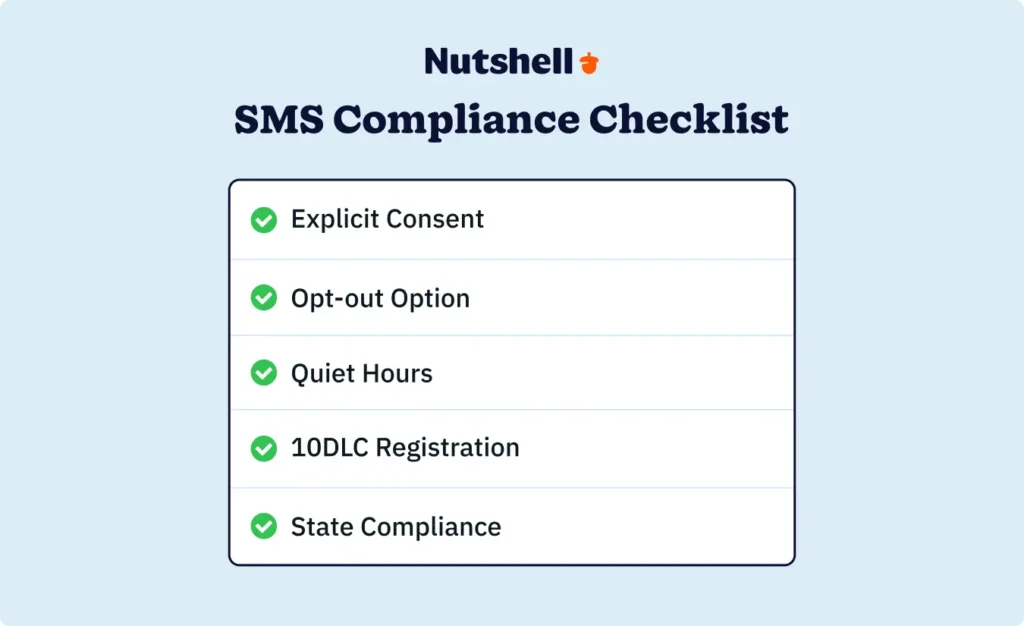
This is where Nutshell SMS shines. It’s built with compliance baked in—automated consent tracking, quiet hour enforcement, easy opt-out management, and documentation that protects you if questions arise.
SMS is too effective a sales tool to lose to compliance mistakes. Get it right from the start.
SMS + email + calls: Building your multi-channel sales strategy
SMS is powerful. But it works best when integrated with your other sales channels, not as a replacement for them.
The most effective sales teams in 2025 use omnichannel coordination: SMS, email, and calls work together in a deliberate sequence based on where the prospect is in their buying journey.
Here’s how it works:
- Email: Sends detailed information (product specs, case studies, pricing docs)
- SMS: Delivers time-sensitive nudges (“Your proposal is ready for review—reply YES to discuss”)
- Call: Happens when the relationship is warm, timing is right, and objections need to be addressed in conversation
The danger of siloed channels:
If your sales rep doesn’t know that another team member just emailed the prospect, they might text a redundant offer. Now the prospect is seeing your company three times in an hour and feeling spammed.
The solution:
Use your CRM to coordinate. Nutshell SMS integrates directly with your pipeline, so you can:
- Trigger SMS automatically when a prospect reaches a certain stage
- See SMS conversation history alongside emails and calls
- Coordinate multi-channel sequences that feel intentional, not chaotic
- Avoid over-messaging by tracking all touches in one place
SMS shines brightest when it’s part of a coordinated strategy, not a standalone tactic. Your prospects will respond better, and your team will be more efficient.
FAQs
-
1. Is cold texting legal for B2B sales?
No, cold texting is illegal in the United States under the TCPA, even for B2B. You must get explicit written consent before texting anyone. Violations can cost $500−$1,500 per message. Always collect opt-ins through forms, checkboxes, or verbal consent before sending sales texts.
-
2. How much does SMS marketing cost per message?
SMS messages typically cost $0.01−$0.05 per message, depending on volume and provider. Small businesses (1,000-10,000 messages/month) pay around $0.04−$0.05 each, while enterprise senders (100,000+ messages) pay closer to $0.015. Platform fees and features add to the total cost.
-
3. What’s the difference between SMS sales and SMS marketing?
SMS sales focuses on one-to-one conversations to close deals and nurture existing relationships. SMS marketing sends promotional campaigns to larger audiences to drive awareness and generate leads. Sales is conversational and relationship-driven; marketing is broadcast-focused and promotional.
-
4. Can I integrate SMS with my existing CRM and email campaigns?
Yes, most modern SMS platforms integrate with popular CRMs like Nutshell, Salesforce, and HubSpot. This lets you sync contact data, trigger texts based on pipeline stages, and coordinate multi-channel campaigns. Look for platforms with native integrations or API access for seamless workflows.
-
5. What’s a good response rate for B2B SMS campaigns?
B2B SMS campaigns typically achieve 40-50% response rates, significantly higher than email’s 6% average. However, response rates vary by message type, timing, and audience engagement. Focus on quality over quantity—personalized messages sent at strategic buying cycle moments perform best.
-
6. What does a good SMS sales message actually look like?
Keep messages conversational, benefit-focused, and action-oriented for each phase. Here are a few examples to get you started:
- Lead awareness: “Saw you downloaded our guide on [topic]. This might help too: [link].”
- Appointment reminders: “Still good for our call at 2pm? Reply YES or let me know.”
- Proposals/contracts: “Your proposal is ready: [link]. Questions?”
- Post-sale: “How’s everything working? Reply with issues.”
Always include a clear next step and make it easy to reply.
Meet your audience where they are: Sell via text
Text messages are a viable way to reach your target audience—if you follow the law and engage with your prospects and customers respectfully. To do so, just remember to follow the seven best practices we listed above:
- Always Get Permission
- Use an SMS Sales Tool
- Offer Something Valuable
- Include a Clear Call-To-Action
- Keep It Brief
- Get Your Timing Right
- Experiment, Analyze, Optimize
If you keep these seven best practices in mind, you’ll market and sell with speed, add a more personal approach to your selling efforts, and achieve better sales metrics. Good luck!
Write less email, get more replies.
Are you falling off your prospects’ radars? With Nutshell’s personal email sequences, we’ll remember the follow-up for you.
BACK TO TOP Written by
Jacob Thomas Contributor, Sell to WinReady to try
Nutshell for Free?Thank you! Your submission has been received!Oops! Something went wrong while submitting the form.



What Is Revenue Intelligence? An All-Encompassing Guide
Published on: January 24, 2024Highly Effective Strategies for Elevating Sales Team Performance
Published on: November 10, 2022Join 30,000+ other sales and marketing professionals. Subscribe to our Sell to Win newsletter!