AI in Customer Service: The Complete SMB Guide to Boost CSAT Scores

-

Picture this. It’s 10pm, and a potential customer has an urgent question about your product. In the traditional customer service model, they’d have to wait until business hours for an answer—potentially losing their interest and your sale in the process. But with AI-powered customer service, that same customer gets an instant, accurate response that not only answers their question but guides them toward a purchase.
This scenario isn’t science fiction—it’s happening right now for thousands of small and mid-sized businesses (SMBs) that have embraced artificial intelligence in their customer service operations. Companies that use AI in customer service have reported increases of up to 25% in customer satisfaction scores and reductions of as much as 30% in service costs.
For SMBs, this technology represents more than just efficiency gains. It’s a competitive equalizer that enables smaller companies to deliver enterprise-level customer experiences without incurring enterprise-level budgets. Whether you’re a growing SaaS company, a local service provider, or an e-commerce business, AI can transform how you interact with customers and, more importantly, how satisfied they are with those interactions.
For SMBs, AI isn’t just about being more efficient. It helps them compete by offering great customer service without the high costs. No matter your business, AI can change how you interact with customers and help you improve customer satisfaction.
In this comprehensive guide, we’ll explore everything you need to know about implementing AI in your customer service operations, from understanding the core technologies to creating a step-by-step plan to use AI to improve customer service and CSAT scores.
Key takeaways
Businesses implementing AI customer service solutions see measurable improvements across key metrics. Here’s what you need to know:
- Efficiency gains: AI can resolve up to 80% of routine customer queries without human intervention, freeing your team to handle complex issues
- Cost reduction: Companies report 25% reductions in call volumes and significant decreases in operational costs
- Customer satisfaction: 64% of business owners believe AI improves customer relationships through faster response times and 24/7 availability
- Revenue impact: AI-powered personalization helps businesses deliver the tailored experiences that 73% of consumers now expect
- Implementation timeline: Most businesses can deploy basic AI customer service tools within weeks, not months
Table of contents
- What is AI in customer service?
- Understanding machine learning’s role in customer service
- Benefits of AI in customer service for SMBs
- Examples of AI in customer service
- AI customer experience tools and platforms
- How to use AI to improve customer satisfaction scores
- Implementing AI in customer service
- How AI chatbots work: The technology behind automated customer service
- The future of AI in customer service: What’s coming next?
- FAQs about AI in customer service
- Key takeaways for SMB success
What is AI in customer service?
Artificial intelligence in customer service refers to the use of machine learning algorithms, natural language processing, and automated systems to enhance, streamline, and sometimes replace traditional customer support interactions.
At its core, AI in customer service is about creating smarter, more responsive support systems that can understand customer needs, provide relevant solutions, and learn from every interaction to improve future experiences.
Key applications include:
- AI-powered chatbots for 24/7 customer support: Automated conversational agents that handle inquiries around the clock
- Sentiment analysis for understanding customer emotions: Technology that detects frustration, satisfaction, or urgency in communications
- Predictive analytics for proactive customer service: Systems that forecast issues before they impact customers
- Automated ticket routing and response generation: Intelligent distribution of inquiries to appropriate team members
- Personalized customer experience delivery: Tailored interactions based on individual customer history and preferences
Using AI for customer support helps SMBs reduce response times while improving customer satisfaction scores.
Key AI technologies powering customer service
Natural language processing (NLP)
NLP is the technology that allows computers to understand and interpret human language in a meaningful way. In customer service, this means AI can read customer emails, chat messages, and even voice calls to understand not just what customers are saying, but what they actually need.
With this understanding, an AI chatbot, for example, can then provide the relevant resources or route a customer to the appropriate support person.
Machine learning (ML)
Machine learning enables AI systems to improve their performance over time without being explicitly programmed for every scenario. In customer service, ML algorithms analyze patterns in customer interactions, support tickets, and resolution outcomes to predict what customers need and suggest the best solutions.
Sentiment analysis
This technology goes beyond understanding what customers are saying to understand how they’re feeling. Sentiment analysis can detect frustration, satisfaction, confusion, or urgency in customer communications, allowing businesses to prioritize responses and tailor their approach accordingly.
Predictive analytics
By analyzing historical data and current patterns, predictive analytics can forecast customer behavior, identify potential issues before they become problems, and suggest proactive solutions. This may involve identifying customers who are likely to churn based on their support interaction patterns and triggering targeted retention campaigns.
Understanding machine learning’s role in customer service
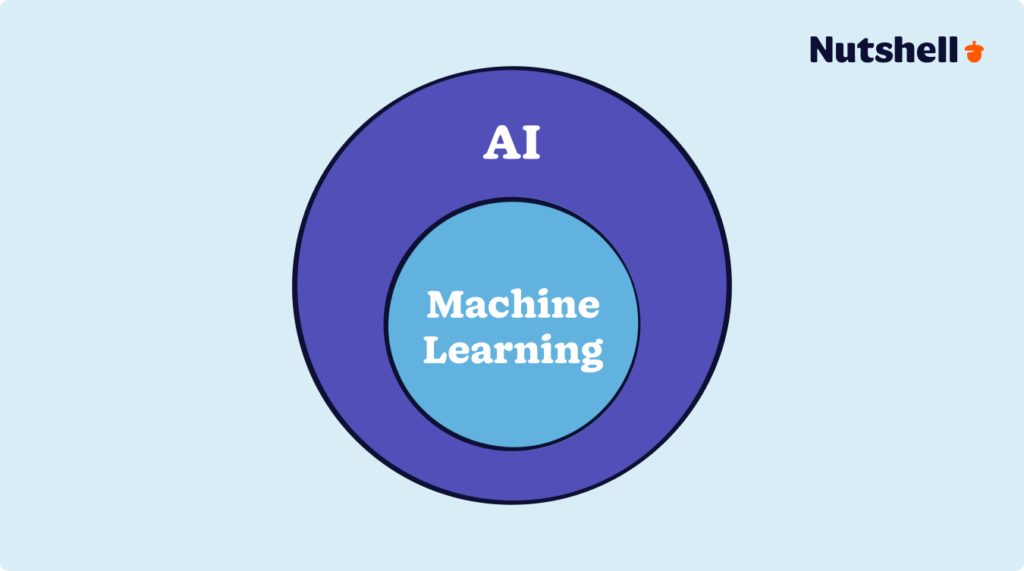
While artificial intelligence serves as the umbrella term for computer systems that can perform tasks requiring human intelligence, machine learning represents a specific subset that’s particularly powerful for customer service applications. Understanding this distinction helps SMBs make informed decisions about which technologies will deliver the most value.
Machine learning differs from traditional AI by focusing on systems that improve through experience rather than following pre-programmed rules. Instead of requiring developers to code every possible customer scenario, ML algorithms analyze patterns in your customer interactions and automatically adapt their responses based on what works best.
Think of it this way: a traditional chatbot follows a decision tree you create—if a customer says X, respond with Y. A machine learning system observes thousands of customer conversations, identifies which responses lead to satisfaction, and continuously refines its approach based on actual outcomes.
How machine learning algorithms learn from customer interactions
Machine learning in customer service operates through a continuous improvement cycle that makes your support smarter over time. Here’s how it works in practice.
The system starts by analyzing historical customer service data—support tickets, chat transcripts, email exchanges, and resolution outcomes. From this data, ML algorithms identify patterns such as:
- Common question types
- Effective resolution paths
- Sentiment indicators that predict escalation
- Optimal response timing
As the system handles live customer interactions, it applies these learned patterns while simultaneously gathering new data. Each interaction becomes a learning opportunity. When a customer expresses satisfaction, the system reinforces the approach it used. When escalation occurs, it adjusts its strategy for similar future situations.
The global machine learning industry’s rapid growth shows how accessible this technology will become for businesses of all sizes. Valued at almost $48 billion in 2025 with a projected CAGR of 26.7%, the ML market could reach $432.63 billion by 2032.
More importantly, 80% of businesses using machine learning report that the technology has helped increase revenue, demonstrating tangible business impact beyond just operational efficiency.
Supervised vs. unsupervised learning in customer support
Machine learning in customer service typically employs two main approaches, each suited for different applications.
Supervised learning
Supervised learning works with labeled training data where outcomes are already known. For customer service, this means training the system on past interactions where you know the results.
For example, you might feed the system thousands of support tickets labeled as “billing issue,” “technical problem,” or “product question.” The algorithm learns to recognize the characteristics of each category and can then automatically classify new incoming tickets.
This approach excels at tasks like ticket routing, categorizing customer inquiries, predicting resolution time, and identifying high-priority issues based on language patterns.
Unsupervised learning
During unsupervised learning, the algorithm discovers patterns without pre-labeled data. The system analyzes customer interactions and identifies natural groupings or anomalies on its own.
This process proves valuable for discovering emerging issues before they become widespread, identifying new customer segments based on behavior patterns, detecting unusual activity that might indicate fraud or system problems, and finding unexpected correlations in customer satisfaction data.
Small business AI adoption has jumped from 6.3% to 8.8% in just six months (February to August 2024), according to the SBA Office of Advocacy—and that includes the rising usage of ML systems. This rapid acceleration reflects both increasing accessibility and SMBs recognizing the competitive advantages these technologies provide.
Real-world example: How ML transforms customer service outcomes
Consider the case of VOXI mobile, Vodafone’s UK sub-brand targeting customers aged 16 to 29. In 2024, they faced a challenge familiar to many SMBs—their existing chatbot struggled to understand varied customer questions and couldn’t handle multiple queries within a single conversation.
Working with Accenture, VOXI implemented a large language model chatbot using Microsoft’s Azure AI Studio, making it the first customer-facing generative AI chatbot in the UK telecommunications industry. The machine learning system was trained on diverse customer scenarios, including different emotional states and communication styles, allowing it to understand context and intent rather than just matching keywords.
Within the first six months, the ML-powered system achieved increased containment rates, meaning more customers got their issues resolved without needing transfer to human agents. It also reduced average handling time for customers who did require agent assistance and boosted overall customer experience through simpler, faster interactions.
The transformation addressed a critical limitation of rule-based systems: traditional chatbots require questions to include predefined phrases they’ve been programmed to recognize. The ML-powered solution understands what customers mean, not just what they say, learning from every interaction to improve future responses.
This example demonstrates how machine learning makes AI customer service genuinely intelligent rather than just automated. For SMBs, this means you can offer sophisticated support that rivals larger competitors without requiring massive customer service teams.
Benefits of AI in customer service for SMBs
While enterprise companies have been using AI for years, the technology is becoming more accessible and affordable for small and midsized businesses as well. The benefits aren’t just theoretical – they’re measurable improvements that directly impact your bottom line and customer relationships.
Improved efficiency and productivity
One of the most immediate benefits SMBs experience with AI is the dramatic increase in team efficiency. Your customer service representatives can handle more inquiries in less time, but more importantly, they can focus on the complex, high-value interactions that truly require human expertise.
Customer service representatives typically spend much of their time addressing routine inquiries such as password resets, order status checks, and basic product questions. AI can handle these instantly, freeing your team to focus on complex problem-solving, relationship building, and sales opportunities.
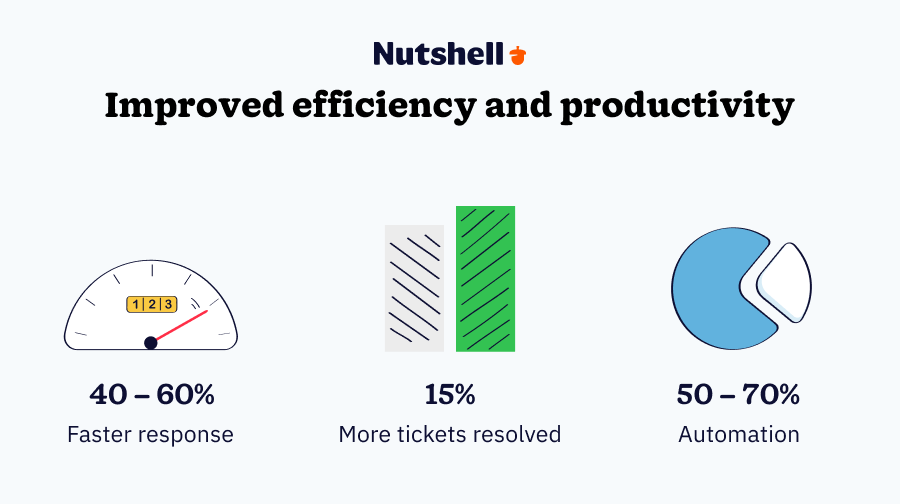
Companies implementing AI customer service tools typically see:
- 40-60% reduction in resolution time: Faster answers mean happier customers.
- 15% increase in tickets resolved per agent per hour with AI assistance: Human agents become more productive.
- 50-70% of routine inquiries handled without human intervention: Free up staff for more complex issues.
Personalized customer experiences at scale
For SMBs, personalization has always been both an advantage and a challenge. You know your customers better than large corporations, but you lack the resources to provide personalized experiences to hundreds or thousands of customers simultaneously. AI changes this equation entirely.
AI systems can analyze every customer interaction, purchase history, support ticket, and engagement pattern to create detailed customer profiles. When a customer contacts support, the AI can instantly provide context about their history, preferences, and potential needs.
Practical example
When Sarah from ABC Company calls about an integration issue, your AI system immediately knows:
- She’s been a customer for 18 months
- She typically contacts support via email, so a phone call suggests urgency
- She last had a similar issue 6 months ago that was resolved by updating her API settings
- Her company is in its busy season based on usage patterns
- She’s mentioned in previous interactions that she values quick, technical solutions
Armed with this information, your support agent can provide a personalized, efficient experience that makes Sarah feel valued and understood.
24/7 availability and faster response times
Your customers don’t work 9-to-5 schedules, and increasingly, they don’t expect to wait for business hours to get help. AI-powered customer service offers round-the-clock support, handling inquiries, providing information, and resolving issues even when your team is asleep.
This isn’t just about having a basic chatbot that frustrates customers with canned responses. Modern AI customer service can:
- Provide relevant answers to complex questions: NLP enables true comprehension.
- Access knowledge base and product information in real-time: Instantly retrieve accurate information.
- Escalate to human agents when necessary: Seamless handoffs with full context preserve the customer experience.
- Handle multiple languages and communication styles: Effectively serve more diverse customer bases.
- Learn from each interaction to improve future responses: The system reiterates its approach for continuous performance enhancement.
While your competitors’ customers wait until Monday morning for a response to their Friday afternoon question, your AI system provides immediate assistance. This responsiveness often becomes a key differentiator in customer retention and satisfaction.
Cost savings and scalability
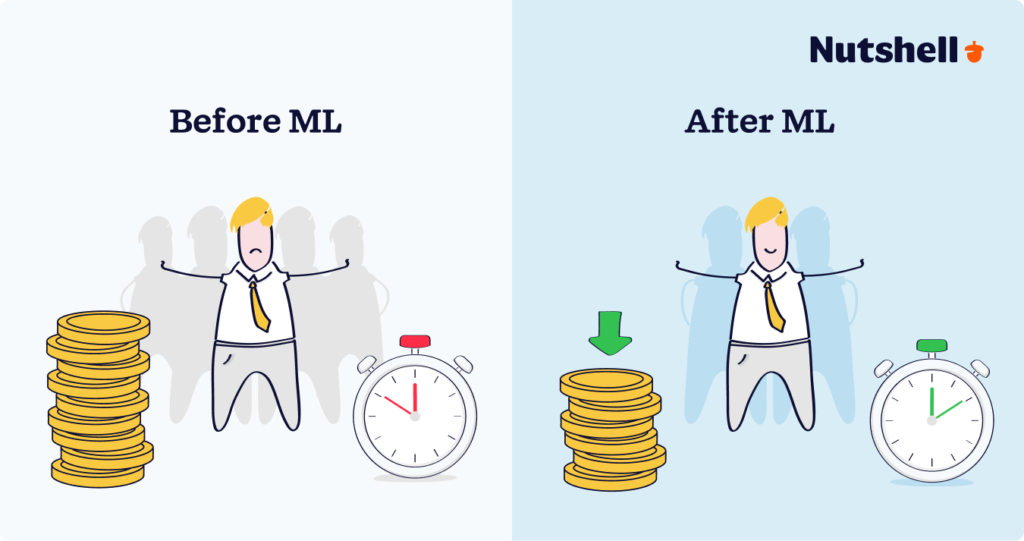
For SMBs operating on tight budgets, the cost savings from AI implementation can be transformative. While there’s an initial investment in AI tools and setup, the long-term savings typically far exceed the costs.
Direct cost savings include:
- Reduced need for additional customer service hires as you grow: Scale support without proportional staff increases.
- Lower training costs: AI doesn’t need onboarding or hours of training.
- Decreased overtime and after-hours support costs: Automated 24/7 coverage keeps operations moving even after business hours.
- Reduced errors and associated resolution costs: Thanks to continuous learning, the system produces consistent, accurate responses.
According to one Gartner report, adopting agentic AI will lead to a 30% reduction in operational costs by taking over 80% of common customer service issues from human reps.
There’s also the reported 80% boost in revenue we mentioned earlier, which means businesses implementing AI see broader financial impact.
Scalability benefits
Perhaps more importantly, AI allows SMBs to scale their customer service operations without proportionally scaling their costs. Whether you’re serving 100 customers or 10,000, your AI systems can handle the increased volume without requiring additional staff.
A growing SaaS company, for example, might see their customer base double in six months. Without AI, they’d need to hire and train additional support staff, increase their office space, and manage a larger team. With AI handling routine inquiries, they might only need to add one additional human agent to handle the complex cases.
Data-driven insights for better decision-making
Every customer interaction generates valuable data, but most SMBs struggle to analyze and act on this information effectively. AI not only handles customer service but also converts every interaction into actionable business intelligence. Here are a few of the way AI can enable data-driven decision-making:
- Customer behavior insights: AI can identify patterns in customer inquiries that reveal product issues, feature requests, or market opportunities. If you’re suddenly getting more questions about integrating with a specific software platform, that’s valuable product development intelligence.
- Performance optimization: AI analytics can show you which support channels are most effective, what types of inquiries take the longest to resolve, and where your team might need additional training or resources.
- Predictive insights: By analyzing customer interaction patterns, AI can help predict which customers might be at risk of churning, which prospects are most likely to convert, and what products or services customers might need next.
Continuous learning and performance improvement
Unlike traditional software that remains static until you manually update it, machine learning systems in customer service become more effective over time without additional programming. This continuous improvement capability represents a fundamental shift in how customer service technology delivers value.
Each customer interaction generates data that ML algorithms use to refine their performance. When a customer rates an interaction positively, the system reinforces the approaches that led to satisfaction. And when issues arise, it adjusts its strategy for similar future situations. All of this learning happens automatically, without requiring your team to manually update rules or workflows.
Machine learning’s ability to evolve by itself creates a compounding advantage for SMBs. In the first month, your ML-powered chatbot might successfully resolve 40% of routine inquiries. By month six, that same system could handle 65% as it learns from accumulated interactions. By month 12, it might reach 75% to 85%, matching the performance benchmarks that businesses report when chatbots deflect customer queries.
The learning extends beyond just chatbots. Machine learning in customer service also:
- Continuously optimizes ticket routing: The algorithm learns which agents excel at specific issue types.
- Improves response suggestions: The algorithm identifies language patterns that increase satisfaction.
- Defines escalation triggers: ML recognizes subtle indicators that issues need human attention.
- Enhances personalization: The algorithm can understand individual customer communication preferences.
This stands in contrast to rule-based systems that require manual updates every time customer needs evolve or new products launch. With ML, the system adapts automatically to changes in your business, product offerings, and customer base.
Small business leaders are recognizing this advantage, with 70% of mid-sized businesses reporting a 40%+ jump in customer satisfaction within three months of adopting AI. The continuous improvement nature of machine learning means these gains aren’t one-time improvements but the beginning of ongoing enhancement.
Download our guide to modern-age customer relationships
By embracing AI and innovative CRM strategies, you can create lasting loyalty and drive your business forward. Download the full guide now to unlock the secrets to exceptional customer relationships.
Examples of AI in customer service
Understanding the benefits of AI is one thing, but seeing how it works in practice helps SMBs envision how these technologies could fit into their own operations. Let’s explore the most common and effective applications of AI in customer service today.
AI-powered chatbots and virtual assistants
Modern chatbots have evolved far beyond the frustrating “press 1 for sales, press 2 for support” systems of the past. Today’s AI-powered virtual assistants can engage in natural conversations, understand context, and provide genuinely helpful responses.
What they can do:
- Answer frequently asked questions instantly: Immediate responses to common inquiries
- Guide customers through troubleshooting processes: Step-by-step problem resolution
- Help customers find specific products or information: Intelligent search and recommendations
- Collect initial information before escalating to human agents: Efficient triage and context gathering
- Process simple transactions like password resets or account updates: Automated routine tasks
Real-world example: A customer visits your website at 11 PM with a question about your pricing plans. Instead of finding a contact form with a promise of “we’ll get back to you within 24 hours,” they’re greeted by an AI assistant that can:
- Explain the differences between your pricing tiers
- Calculate costs based on their specific needs
- Answer questions about features and limitations
- Schedule a demo with your sales team for the next business day
- Provide case studies of similar companies using your service
The customer gets immediate value, and you wake up to a qualified lead instead of just another inquiry.
Get a free AI chatbot for your website
Every Nutshell Sales subscription comes with access to an AI chatbot for your website that can answer questions, book meetings, and capture leads.

Machine learning use cases transforming SMB customer service
While general AI handles many customer service tasks, machine learning specifically excels at applications requiring pattern recognition, continuous improvement, and predictive capabilities. Understanding these use cases helps SMBs identify where ML will deliver the greatest impact.
Automated ticket classification and intelligent routing
Machine learning algorithms analyze incoming support requests and automatically categorize them by issue type, urgency, and complexity. Unlike rule-based systems that require you to anticipate every possible scenario, ML learns from your historical ticket data to recognize new variations and edge cases.
The system routes each ticket to the agent with the right expertise and availability, reducing resolution time and improving first-contact resolution rates.
Customer churn prediction and proactive retention
ML models analyze customer behavior patterns—support interaction frequency, tone and sentiment in communications, product usage trends, and payment history—to identify accounts at risk of churning before they cancel. This allows SMBs to proactively reach out with targeted retention offers, personalized support, or product recommendations that address specific concerns.
Response quality optimization
Machine learning continuously analyzes which support responses lead to high customer satisfaction and which generate follow-up questions or escalations. The system identifies effective language patterns, optimal response length, and successful problem-solving approaches. For human agents, ML provides real-time suggestions based on what’s worked in similar situations. For automated responses, the system refines its output to match proven successful patterns.
Sentiment-based priority escalation
Traditional support systems rely on keywords like “urgent” or “frustrated” to prioritize tickets. ML-powered sentiment analysis understands context and nuance, detecting customer frustration even when they remain polite, identifying accounts that repeatedly experience issues, recognizing when a situation is escalating despite agent efforts, and flagging high-value customers requiring special attention. According to Salesforce’s seventh State of Service Report, 79% of service leaders say investment in AI agents is essential to meet business demands, with sentiment analysis capabilities being a primary driver of this adoption.
Predictive issue resolution
Machine learning identifies patterns that predict problems before customers experience them. For example, if certain product configurations consistently generate support tickets within 48 hours, the system can trigger proactive outreach with setup guidance to those customers. If usage patterns suggest a customer will encounter a limitation, ML can prompt timely communication about upgrades or alternatives.
Natural language understanding for global support
ML-powered natural language processing allows SMBs to offer support across multiple languages without hiring multilingual staff. The system doesn’t just translate words but understands intent, cultural communication nuances, and context. It can detect when automated translation might miss important meaning and route those conversations to human review.
These machine learning applications share a common advantage: They improve automatically as your business grows.
Every customer interaction makes the system smarter, creating compound returns on your AI investment. For SMBs with limited resources, this means your customer service capabilities scale without proportional increases in staff or costs.
AI-driven knowledge bases and self-service portals
AI can transform static FAQ pages into dynamic, intelligent self-service experiences. Instead of customers scrolling through long lists of questions hoping to find their answer, AI-powered knowledge bases understand what customers are looking for and surface the most relevant information.
This may take the form of smart, AI-driven search. When a customer types “I can’t sync my data,” the AI doesn’t just look for articles containing those exact words. It understands the intent and might surface articles about:
- Data synchronization troubleshooting
- Common connectivity issues
- API configuration guides
- Recent updates that might affect syncing
Based on the customer’s account type, usage patterns, and previous interactions, AI can even prioritize the most relevant solutions for their specific situation.
Sentiment analysis for understanding customer emotions
One of the most powerful applications of AI in customer service is its ability to understand not just what customers are saying, but how they’re feeling. This emotional intelligence allows businesses to respond appropriately and prioritize urgent situations.
How it works in practice:
- An email with phrases like “extremely disappointed” and “considering other options” gets flagged as high priority and routed to your most experienced agent: Immediate escalation for at-risk accounts
- A chat conversation where sentiment starts positive but becomes increasingly negative triggers an automatic escalation: Real-time intervention before issues worsen
- Social media mentions are analyzed for sentiment, allowing you to proactively reach out to frustrated customers: Reputation management and recovery opportunities for sentiment, allowing you to proactively reach out to frustrated customers
Predictive analytics for proactive support
Instead of waiting for customers to encounter problems, predictive analytics allows businesses to identify and address issues before they impact customer satisfaction. This proactive approach transforms customer service from reactive problem-solving to preventive relationship management.
Predictive scenarios in action:
- Usage pattern analysis: If a customer’s software usage drops significantly, AI can trigger an automated check-in email or flag the account for proactive outreach
- Product lifecycle predictions: AI can identify when customers typically need upgrades, renewals, or additional training based on their usage patterns and company profile
- Issue forecasting: By analyzing support ticket patterns, AI can predict when certain problems are likely to occur and proactively send preventive guidance
AI-powered agent assistance tools
AI doesn’t just interact directly with customers – it also makes human agents more effective by providing real-time assistance, suggestions, and information during customer interactions.
Live conversation assistance might include:
- Real-time suggestions: As agents type responses, AI suggests relevant knowledge base articles, previous successful solutions, or appropriate next steps
- Sentiment monitoring: AI monitors ongoing conversations and alerts agents when customer sentiment shifts, allowing them to adjust their approach
- Auto-completion: AI can suggest complete responses for common scenarios, which agents can customize and send
Knowledge augmentation offers:
- Instant expertise: When an agent encounters an unfamiliar issue, AI can instantly surface relevant documentation, similar past cases, and expert recommendations
- Cross-selling opportunities: AI identifies opportunities to mention relevant products or services based on the customer’s current situation and history
For example, during a support call about integration issues, AI might suggest to the agent: “This customer mentioned expanding their team last month. Consider mentioning our team collaboration features after resolving their current issue.”
AI customer experience tools and platforms
The AI customer service landscape offers solutions for businesses of every size and budget. Understanding your options helps you choose tools that align with your specific needs and growth plans.
Enterprise-level AI platforms
Zendesk Answer Bot
Zendesk’s AI-powered Answer Bot can resolve common customer inquiries automatically by searching your knowledge base and suggesting relevant articles. For SMBs, this means customers get instant answers to routine questions, while complex issues are seamlessly escalated to human agents with full context.
Salesforce Einstein
Einstein brings AI capabilities across the entire Salesforce ecosystem, including Service Cloud. It can predict case escalation, recommend solutions, and even draft responses for agents. The platform’s strength lies in its integration capabilities, making it ideal for businesses already using Salesforce CRM.
IBM Watson Assistant
Watson Assistant excels at understanding natural language and can be deployed across multiple channels like websites, mobile apps, messaging platforms, and voice assistants. Its advanced NLP capabilities make it particularly effective for businesses with complex products or services.
Specialized AI customer service solutions
Intercom Resolution Bot
Designed specifically for modern businesses, Intercom’s Resolution Bot can typically handle a third of customer questions automatically. It’s particularly effective for SaaS companies and online businesses that need to provide instant support across multiple time zones.
Freshworks Freddy AI
Freddy AI offers predictive contact scoring, intelligent ticket assignment, and automated responses. Its strength lies in its ability to learn from your specific business context and improve over time.
Nutshell’s AI-powered features and integrations
At Nutshell, we’ve integrated AI throughout our CRM platform to help SMBs provide exceptional customer experiences without requiring dedicated IT resources or extensive training. Nutshell’s AI features include:
- AI chatbot: All subscriptions include an AI chatbot that can be trained on your URLs and PDFs to answer common questions, collect contact details, schedule meetings, and hand off to human agents with the full transcript when needed.
- Meeting summarization: Nutshell also automatically transcribes and summarizes conversations across Zoom, Google Meet, and click-to-call and posts summaries to the related contact timeline, helping anyone on your team quickly understand the context of past conversations.
- Timeline summarization: AI-powered timeline summarization condenses each contact or account’s history—emails, calls, meetings—into key highlights and suggested next steps, which can support consistent handoffs and follow-up.
Additional AI tools in Nutshell include context-aware email reply starters for faster drafts, a voice-to-text Notetaker for capturing notes, and an MCP server integration to let external assistants like ChatGPT or Claude access CRM data with configurable permissions and logging.
Do less and win more with AI in Nutshell
Save time and focus more on building relationships with AI tools like timeline summarization, chatbots, AI email replies, and more.
How to use AI to improve customer satisfaction scores
Implementing AI isn’t just about adopting new technology – it’s about strategically enhancing every aspect of your customer experience. Here are proven strategies that SMBs can implement to see measurable improvements in their customer satisfaction (CSAT) scores.
Strategy 1: Reduce response times with intelligent routing
The approach: Use AI to analyze incoming customer inquiries and automatically route them to the most appropriate agent or department based on content, urgency, and customer history.
Implementation steps:
- Set up AI-powered ticket classification that categorizes inquiries by type, complexity, and priority
- Create routing rules that consider agent expertise, current workload, and customer relationship history
- Implement escalation triggers for high-priority or negative sentiment communications
Strategy 2: Personalize every interaction
The approach: Leverage AI to provide agents with comprehensive customer context before and during every interaction.
What this looks like:
- Pre-interaction briefing: Before answering a call or responding to an email, agents see a summary of the customer’s recent activity, previous issues, preferences, and current account status
- Real-time suggestions: During conversations, AI suggests relevant solutions, upsell opportunities, or escalation triggers based on the conversation flow
- Post-interaction follow-up: AI automatically schedules appropriate follow-up actions and updates customer records
Practical example: When John from TechStart Inc. calls about a billing question, your agent immediately sees that John recently expanded his team, had a positive experience with your onboarding specialist last month, and typically prefers email communication for follow-ups. This context allows for a more personalized, effective interaction. You can automatically provide this context with tools like Nutshell’s AI timeline summarization.
Strategy 3: Implement proactive support
The approach: Use predictive analytics to identify and address potential issues before customers experience problems.
Proactive support tactics:
- Usage monitoring: Identify customers whose engagement patterns suggest they might be struggling with your product
- Lifecycle triggers: Automatically reach out at key moments in the customer journey with helpful resources or check-ins
- Issue prevention: Analyze support ticket patterns to identify common problems and proactively address them through improved documentation, product updates, or targeted communications
Strategy 4: Optimize self-service options
The approach: Create AI-powered self-service tools that actually solve customer problems instead of frustrating them.
Key components:
- Intelligent search: Help customers find answers quickly with AI that understands intent, not just keywords
- Interactive troubleshooting: Guide customers through step-by-step problem resolution with AI that adapts based on their responses
- Personalized recommendations: Surface the most relevant help articles based on the customer’s specific situation and history
Implementing AI in customer service: A step-by-step guide
For SMBs, the key to successful AI implementation isn’t trying to do everything at once – it’s taking a strategic, phased approach that builds on early wins and learns from real customer interactions.
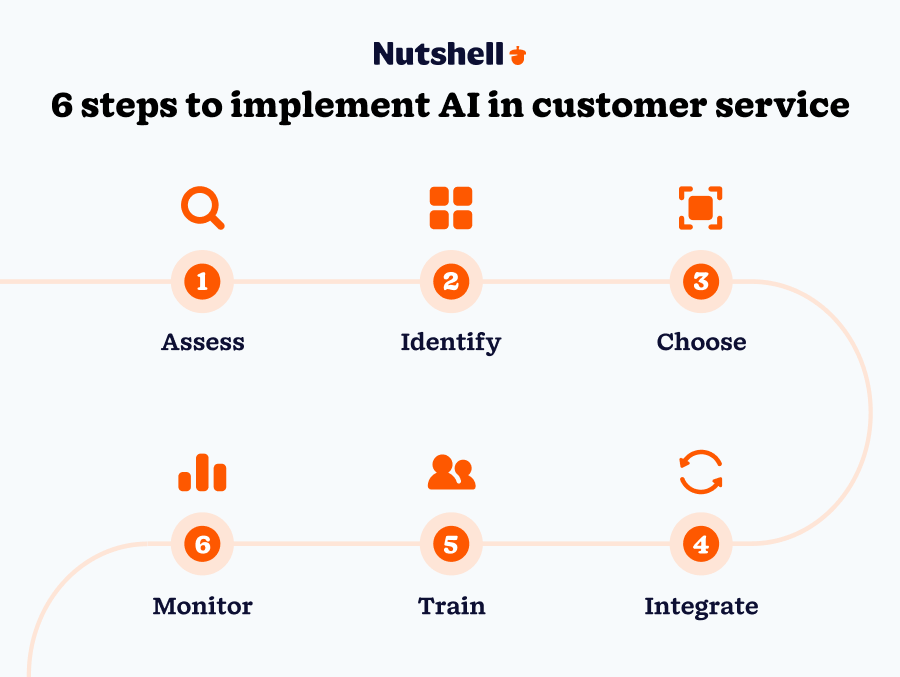
Step 1: Assess your current customer service processes
Before implementing any AI solution, you need a clear picture of your current customer service landscape. This assessment will help you identify the biggest opportunities for improvement and ensure your AI investment delivers maximum ROI.
Conduct a customer service audit:
- Volume analysis: Track the number and types of inquiries you receive across all channels, including email, phone, chat, and social media
- Response time measurement: Calculate your average response times for different types of inquiries and channels
- Resolution tracking: Identify how many issues are resolved on first contact vs. requiring multiple interactions
- Agent workload assessment: Understand what percentage of your team’s time is spent on routine vs. complex inquiries
Identify pain points:
- Customer feedback analysis: Review recent customer satisfaction surveys, support tickets, and reviews to identify recurring complaints
- Agent feedback: Ask your customer service team what tasks they find most repetitive or time-consuming
- Peak time challenges: Identify when your team is overwhelmed and customers experience longer wait times
Benchmark your current performance:
- Average response time by channel
- First-contact resolution rate
- Customer satisfaction scores (CSAT)
- Net Promoter Score (NPS)
- Agent productivity metrics
Example assessment findings: For example, a growing e-commerce company might discover that 65% of their support tickets were routine order status inquiries, their average email response time was 8 hours, and customer satisfaction dropped significantly during peak shopping seasons when response times increased.
Step 2: Identify areas where AI can provide the most value
Based on your assessment, prioritize AI implementation opportunities that will deliver the biggest impact with the least complexity.
High-impact, low-complexity opportunities:
- Routine inquiry automation: Password resets, order status checks, basic product information
- Initial ticket routing: Automatically categorizing and routing inquiries to appropriate agents
- Knowledge base enhancement: Making existing help content more searchable and accessible
Medium-impact, medium-complexity opportunities:
- Chatbot implementation: Handling common questions and collecting initial information
- Sentiment analysis: Identifying urgent or frustrated customers for priority handling
- Agent assistance tools: Providing real-time suggestions and information during customer interactions
High-impact, high-complexity opportunities:
- Predictive analytics: Forecasting customer behavior and proactive outreach
- Advanced personalization: Tailoring every interaction based on comprehensive customer data
- Omnichannel integration: Providing seamless AI support across all customer touchpoints
Start with solutions that can handle your highest-volume, lowest-complexity inquiries. These typically offer the fastest ROI and help your team see immediate benefits from AI implementation.
Step 3: Choose the right AI tools and platforms for your needs
Selecting the right AI customer service tools requires balancing functionality, ease of implementation, cost, and scalability. Here’s how to make the best choice for your business.
Evaluate criteria such as:
- Integration capabilities: How well does the tool work with your existing CRM, help desk, and communication platforms?
- Ease of setup: Can your team implement and manage the tool without extensive technical expertise?
- Scalability: Will the solution grow with your business, or will you need to switch platforms as you expand?
- Customization options: Can you tailor the AI to your specific business needs and customer base?
- Support and training: What level of ongoing support does the vendor provide?
- Costs: Consider initial startup costs, ongoing costs, any hidden expenses, and the potential ROI.
Begin with a pilot program using one AI tool for a specific use case, such as a chatbot for your website. This allows you to learn how AI works in your environment before making larger investments.
Step 4: Integrate AI with your existing CRM and marketing automation systems
Successful AI implementation requires seamless integration with your existing tools, especially platforms that are important for customer relationships, like your CRM and help desk software. These integrations ensure that AI-generated insights and interactions become part of your comprehensive customer relationship management strategy.
Some integration elements to prioritize include:
- Customer data synchronization: Ensure AI tools can access and update customer information in real-time
- Interaction history: All AI interactions should be logged in customer records for complete visibility
- Lead scoring integration: AI insights should feed into your existing lead management processes
- Automated task creation: AI should be able to create follow-up tasks and reminders in your CRM
Step 5: Train your team on how to use AI effectively
Successful AI implementation relies on effective team training, ensuring AI enhances human expertise.
Training should cover technical skills (tool use, understanding AI insights, troubleshooting), strategic application (AI in overall strategy, improving customer relationships, balancing AI with empathy), and ongoing education (updates, best practices, feedback analysis, industry trends). Change management is crucial to address job concerns, highlight AI’s empowering role, celebrate successes, and offer continuous support.
Step 6: Monitor and optimize AI performance
AI implementation is not a “set it and forget it” process. Continuous monitoring and optimization ensure that your AI tools continue to improve and deliver value over time.
Key performance indicators to track include:
- Efficiency metrics: Response times, resolution rates, agent productivity
- Quality metrics: Customer satisfaction scores, escalation rates, accuracy of AI responses
- Business impact: Cost savings, revenue impact, customer retention rates
- AI-specific metrics: Automation rates, confidence scores, learning progression
Optimization strategies include:
- Regular data review: Analyze AI performance data monthly to identify improvement opportunities
- Customer feedback integration: Use customer feedback to refine AI responses and capabilities
- A/B testing: Test different AI approaches to find the most effective solutions
- Continuous training: Update AI models with new data and customer interaction patterns
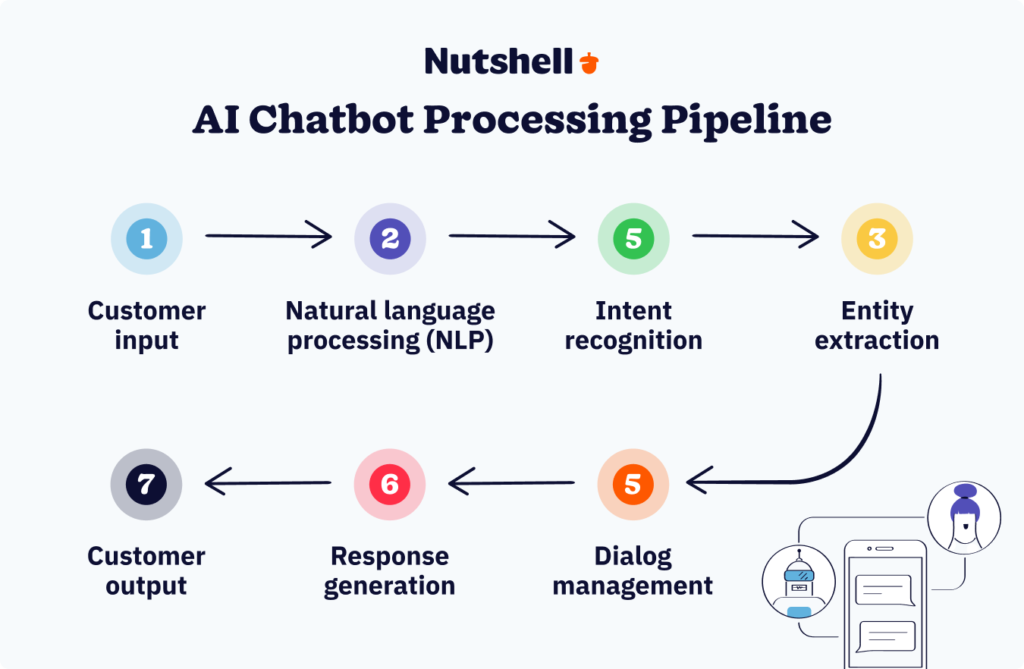
How AI chatbots work: The technology behind automated customer service
Understanding the technology powering AI chatbots helps businesses make informed decisions about implementation and set realistic expectations for what these tools can accomplish.
Natural Language Processing (NLP) forms the foundation of AI chatbot capabilities. NLP enables machines to understand human language in all its complexity, including slang, misspellings, and context-dependent meanings. Modern NLP models are trained on billions of text examples, allowing them to recognize patterns in how people express questions and requests.
Intent recognition
Intent recognition is the chatbot’s ability to determine what a customer actually wants, even when they phrase it in unexpected ways. A customer might say “I can’t log in,” “login broken,” or “it won’t let me access my account,” but the chatbot recognizes all these variations as the same underlying intent: authentication assistance.
Entity extraction
Entity extraction identifies specific details within customer messages that are relevant to resolving their issue. When a customer writes “I ordered product #12345 three weeks ago and it still hasn’t arrived,” the chatbot extracts two critical entities: the order number (12345) and the timeframe (three weeks ago). These extracted entities allow the chatbot to query databases and provide specific information rather than generic responses.
Dialog management
Dialog management orchestrates the conversation flow, determining what the chatbot should say next based on previous exchanges. Advanced dialog management systems maintain context across multiple messages, remembering earlier parts of the conversation to provide coherent, relevant responses. This is why modern chatbots can handle multi-turn conversations that feel more natural than the rigid, scripted interactions of earlier bot generations.
Machine learning models
Machine learning models continuously improve chatbot performance based on interaction history. When a chatbot provides a response that leads to successful issue resolution, that outcome reinforces the model’s approach. Conversely, when interactions fail or require human handoff, the system learns to handle similar situations differently in the future.
Integration architecture
Integration architecture connects chatbots to the business systems they need to be truly helpful. A customer service chatbot typically integrates with CRM platforms, order management systems, knowledge bases, and ticketing tools.
These integrations transform the chatbot from a simple question-answering system into an action-oriented assistant that can look up account details, process returns, update addresses, and perform other concrete tasks.
Knowledge base connectivity
Knowledge base connectivity allows chatbots to access and reference your company’s support documentation, product guides, and FAQs. Rather than requiring manual programming of every possible answer, the chatbot can search your knowledge base in real time and formulate responses based on authoritative company content.
The most sophisticated AI chatbots combine all these technologies into seamless experiences where customers often can’t tell they’re interacting with automation rather than a human agent.
The future of AI in customer service: What’s coming next?
The AI customer service landscape continues to evolve at a remarkable pace, with several emerging trends poised to reshape how businesses support their customers over the next few years.
Emotion AI
Emotion AI and empathetic responses represent the next frontier in customer interaction quality. While current AI systems can detect sentiment (positive, negative, neutral), emerging emotion AI technologies can identify specific emotions like frustration, confusion, anxiety, or excitement.
This granular emotional understanding allows AI systems to adjust their communication style accordingly, offering reassurance to anxious customers or additional explanation to confused ones.
Multimodal AI assistants
Future AI assistants will move beyond text to seamlessly integrate voice, images, and video. Customers will be able to show a product defect via photo, describe an issue verbally, and receive step-by-step video instructions for resolution—all within a single AI-powered interaction.
Salesforce’s 2024 State of Service report found that 68% of customers prefer visual communication for technical support issues, making multimodal capabilities increasingly important.
Hyper-personalization engines
Evolving ML engines will leverage comprehensive customer data to deliver even more individualized experiences.
Rather than generic responses, AI will reference a customer’s purchase history, communication preferences, product usage patterns, and even browsing behavior to provide contextually perfect support. This might mean:
- Automatically suggesting products in a customer’s preferred color
- Referencing their previous successful resolutions
- Adjusting language complexity based on their technical expertise level
Autonomous issue resolution
Autonomous issue resolution will expand beyond simple queries to complex problem-solving scenarios. Future AI systems will coordinate across multiple business systems—automatically processing refunds, scheduling technician visits, updating subscriptions, and orchestrating multi-step resolutions without human intervention.
Recent research suggests that by 2029, agentic AI will handle 80% of customer service interactions without human involvement.
Proactive outreach
Proactive outreach based on behavioral signals will shift customer service from reactive to preventive. AI systems will monitor product usage patterns, detect anomalies that suggest emerging problems, and initiate contact before customers experience failure or frustration. For example, an AI might notice a customer’s software showing signs of instability and proactively reach out with a solution before the application crashes.
Conversational commerce integration
Conversational commerce integration will blur the lines between customer service and sales. AI assistants will seamlessly transition from answering product questions to processing purchases, upselling complementary items, and managing post-purchase support—all within natural conversation flow.
Privacy-preserving AI
AI-powered privacy systems will become essential as data regulations tighten globally. New federated learning approaches allow AI models to improve without centralizing sensitive customer data, while differential privacy techniques enable personalization without compromising individual privacy.
Augmented human agents
AI copilots will provide real-time coaching, suggest optimal responses, and automate administrative tasks. These AI assistants won’t replace human agents but will make them significantly more effective, potentially doubling productivity while improving quality.
The businesses that thrive in this AI-powered future will be those that adopt these technologies thoughtfully—maintaining the human connection that exceptional customer service requires while leveraging AI to deliver faster, more personalized, and more proactive support than ever before.
Frequently asked questions (FAQs) about AI in customer service
-
How accurate are AI customer service systems compared to human agents?
AI accuracy varies significantly based on implementation quality and use case complexity. For straightforward, frequently asked questions, well-trained AI systems achieve 90% to 95% accuracy rates that match or exceed human performance.
However, for complex, nuanced situations requiring empathy, creativity, or deep domain expertise, human agents still outperform AI. The most effective approach combines both: AI handles routine inquiries with high accuracy while escalating complex cases to human specialists.
-
What’s the typical ROI timeline for implementing AI customer service?
Most businesses see initial ROI within six to 12 months of implementation. According to IBM’s 2024 AI Adoption Index, companies report an average 25% reduction in support costs and 18% improvement in customer satisfaction within the first year.
However, the timeline depends heavily on implementation scale, existing infrastructure, and how aggressively you deploy AI capabilities. Start with focused pilot programs to demonstrate value quickly before expanding to full-scale deployment.
-
Will AI replace human customer service agents entirely?
No. While AI will continue handling an increasing percentage of routine inquiries, human agents remain essential for complex problem-solving, emotionally charged situations, and cases requiring judgment beyond predefined parameters.
The future of customer service is hybrid: AI handles high-volume, repetitive tasks while human agents focus on situations where empathy, creativity, and advanced reasoning create the most value. Forward-thinking companies are retraining customer service staff to work alongside AI rather than replacing them entirely.
-
How do I ensure my AI customer service experience maintains my brand voice?
Maintaining brand voice requires careful training data curation and ongoing monitoring. Start by providing your AI system with examples of on-brand customer interactions, style guides, and approved language. Implement regular quality audits where human reviewers assess AI responses for tone, terminology, and brand consistency.
Most enterprise AI platforms allow customization of response templates, prohibited phrases, and personality parameters. Many companies also maintain a human-in-the-loop review process for the first 30 to 60 days after deployment to fine-tune brand alignment.
-
What data do I need to train an AI customer service system effectively?
Effective AI training requires historical customer interactions (emails, chat transcripts, support tickets), product documentation, FAQs, and resolution outcomes. Most experts recommend at least 10,000 to 50,000 historical interactions for initial training, though some modern transfer learning approaches can work with smaller datasets. Quality matters more than quantity—clean, accurately labeled data produces better results than massive volumes of poorly organized information. Also include edge cases and difficult scenarios to help the AI learn appropriate escalation triggers.
-
How do customers feel about interacting with AI instead of humans?
Customer attitudes toward AI support have improved dramatically as technology quality has increased. Salesforce’s 2024 State of the Connected Customer report found that 73% of customers are comfortable using AI for customer service, up from 58% just two years earlier. However, customer acceptance depends heavily on transparency and effectiveness. Customers appreciate AI when it resolves issues quickly and offers easy escalation to humans when needed. They become frustrated when forced through ineffective AI systems that can’t solve their problems or make human assistance difficult to access.
Key takeaways for SMB success
The integration of AI into customer service represents one of the most significant opportunities for SMBs to compete effectively in today’s market while building stronger, more satisfying customer relationships. Throughout this guide, we’ve explored how artificial intelligence can transform every aspect of your customer service operations – from providing instant 24/7 support to delivering personalized experiences that make every customer feel valued and understood.
The journey to AI-enhanced customer service doesn’t require a complete overhaul of your current operations. Instead, it’s about strategically integrating intelligent tools that amplify your team’s capabilities and improve your customers’ experiences.
Immediate actions you can take include:
- Assessing your current customer service performance using the framework outlined in this guide
- Identifying your highest-impact opportunities for AI implementation
- Researching AI tools that align with your specific needs and budget
- Starting with a pilot program to test AI effectiveness in your environment
How Nutshell can support your AI customer service journey
At Nutshell, we understand that SMBs need AI solutions that work immediately without requiring extensive technical expertise or large implementation teams. Our AI-powered CRM features are designed to enhance your customer relationships from the first interaction through long-term retention.
Ready to see how AI can boost your customer satisfaction scores? Start a free trial of Nutshell and experience how our AI-powered features can save your team time and help you build stronger customer relationships.
See Nutshell in action!
Try Nutshell free for 14 days or let us show you around before you dive in.
 BACK TO TOP
 Written by
Kevin Randolph Partnerships and Outreach SpecialistReady to try
Nutshell for Free?Thank you! Your submission has been received!Oops! Something went wrong while submitting the form.





How to Create an Effective Sales Report Template [With Downloadable Examples]
Published on: November 20, 2024
Highly Effective Strategies for Elevating Sales Team Performance
Published on: November 10, 2022Establishing a System for CRM Data Entry and Management
Published on: April 11, 2023Introducing Nutshell Forms Spam Prevention
Published on: April 22, 2024Join 30,000+ other sales and marketing professionals. Subscribe to our Sell to Win newsletter!