What is a Sales Pipeline, and How Does it Differ From a Sales Funnel?

-

Quick answer: What is the difference between a sales pipeline and a sales funnel?
The main difference is perspective: a sales pipeline focuses on the specific actions and stages a salesperson takes to move a deal forward (what the seller does), while a sales funnel represents the journey from the customer’s point of view, measuring conversion rates at each stage (what the buyer does). While you can directly change your pipeline by adding or modifying sales tasks, you can only influence your funnel by improving your team’s effectiveness and lead quality.
Many sales professionals use ‘pipeline’ and ‘funnel’ interchangeably, but understanding the pipeline vs funnel distinction can transform how you manage deals and forecast revenue.
Sales funnel and pipeline both describe how prospects move through the sales journey, but they serve fundamentally different purposes. A sales pipeline tracks the specific actions your sales team takes to move deals forward, while a sales funnel measures how many prospects actually convert at each stage of their buying journey.
Think of it this way: your pipeline shows what sellers do, while your funnel reveals what buyers do.
For small to medium-sized businesses, this distinction matters more than ever. With 68% of companies lacking formal funnel measurement and 79% of leads never converting due to insufficient nurturing, understanding both concepts helps you identify exactly where deals stall and what actions drive results.
Whether you’re tracking 10 deals or 1,000, knowing the difference between pipeline management and funnel analysis means the difference between reactive firefighting and proactive revenue growth.
Key Takeaways
- A sales pipeline outlines the specific stages and actions a salesperson takes to move a prospect from a new lead to a customer.
- In contrast, a sales funnel represents the customer’s journey and measures the conversion rates of prospects as they move through these stages.
- While a pipeline focuses on the seller’s activities and what they can directly control, a funnel provides a broader view of the customer’s path to purchase and helps identify where leads are dropping off.
Table of contents
- Why understanding pipelines and funnels matters for your business
- What is a sales pipeline?
- What is a sales funnel?
- The difference between sales pipelines and sales funnels
- The marketing handoff: Where funnels and pipelines meet
- How to use pipelines and funnels in your sales strategy
- Essential metrics to track for your pipeline and funnel
- How AI and digital transformation are reshaping sales in 2026
- Common misconceptions about pipelines and funnels
- Tips for building a sales pipeline
- Tips for managing a sales pipeline
- FAQs
Why understanding pipelines and funnels matters for your business
If you’re running a small to medium-sized business, you’re likely wearing multiple hats and working with limited resources. You don’t have time to waste on deals that won’t close or strategies that don’t work. That’s exactly why understanding the distinction of a sales pipeline vs. sales funnel is critical.
- Resource optimization: Small teams can’t afford to chase every lead. When you track both your pipeline (what your team is doing) and your funnel (what’s actually working), you can focus energy on the highest-impact activities. Recent data shows that contacting leads within 24 hours increases conversion by 5x, but only if you’re tracking the right metrics to know which leads deserve immediate attention.
- Predictable revenue: Small businesses need reliable cash flow to survive and grow. Your pipeline helps you forecast what’s coming based on current deals, while your funnel uses historical patterns to predict future performance. Companies with documented sales funnels generate 2.3x more ROI than those winging it.
- Identifying problems early: When conversion rates drop between stages, your funnel data tells you there’s a problem. Your pipeline data tells you what your team was doing differently. Together, they help you spot issues before they become revenue disasters. The biggest drop-off typically happens at the MQL to SQL stage, where only 12 to 18% of marketing-qualified leads become sales-qualified.
- Scaling efficiently: As your business grows, manual tracking becomes impossible. Understanding both concepts now sets you up to implement the right CRM systems and automation tools later. With AI adoption in sales surging from 39% to 81% in just two years, businesses that grasp these fundamentals are better positioned to leverage new technology effectively.
You can’t improve what you don’t understand. Mastering the sales pipeline vs funnel difference gives you the clarity to make smarter decisions, coach your team more effectively, and grow your business without burning out.
What is a sales pipeline?
A sales pipeline is a set of stages that a prospect moves through as they progress from a new lead to a customer. Once each pipeline stage is completed, the prospect is advanced to the next stage. The sales funnel vs sales pipeline distinction is important here: unlike a sales funnel, which focuses on conversion rates and buyer behavior, a sales pipeline centers on your sales team’s actions and activities.
When you ask what is a sales pipeline, think of your pipeline as your sales team’s playbook. It defines the specific steps reps take to qualify prospects, present solutions, handle objections, and close deals Every action your team controls—from the initial discovery call to sending the final contract—happens within your pipeline stages.
The sales pipeline is a linear, seller-centric view of the sales process. You directly control and modify it by changing how your team operates, adjusting stage definitions, or implementing new tactics. When your pipeline is working well, deals move smoothly from stage to stage. When it’s not, you’ll see deals stalling, inconsistent processes, and missed revenue targets.
Essential stages of a sales opportunity pipeline
Though the structure can differ from company to company when building a sales pipeline, here are some of the more common stages:
- Qualification: The rep asks questions to determine if the prospect has the need, budget, and authority to buy in the near future.
- Meeting: The sales rep and prospect discuss the solution that would best fit the prospect’s needs.
- Proposal: The rep sends the prospect a detailed quote laying out what will be provided, at what cost, and for how long.
- Closing: Final negotiations are made, and contracts are signed. The prospect is officially a customer.
Pipeline vs. sales process: A sales pipeline is similar—but not identical—to a sales process, which refers to the recurring actions that a team takes on every lead to move them across those stages (i.e., distributing leads to the proper team member, calling new leads to qualify them, or doing research in advance of a presentation). The actions in a sales process are divided into pipeline stages.
Pipeline vs. pipeline value: Many sales professionals use “pipeline” or “sales pipeline” to mean the quantity or dollar value of the deals currently in their pipeline, not the series of sales stages themselves. It’s very common to hear a sales rep lament that their “pipeline is looking rough” because they let their prospecting efforts fall by the wayside or to hear a manager call a “pipeline meeting” to discuss the specific deals that the team has in progress.
What they’re really talking about is deal pipeline value, which is measured by a pipeline report. A pipeline report shows the value and quantity of all deals in each stage of the opportunity pipeline at the moment when the report is run. Pipeline reports are important for effective pipeline management, helping sellers keep track of the status of every deal and understand whether they have an appropriate distribution of deals in order to meet their sales targets.
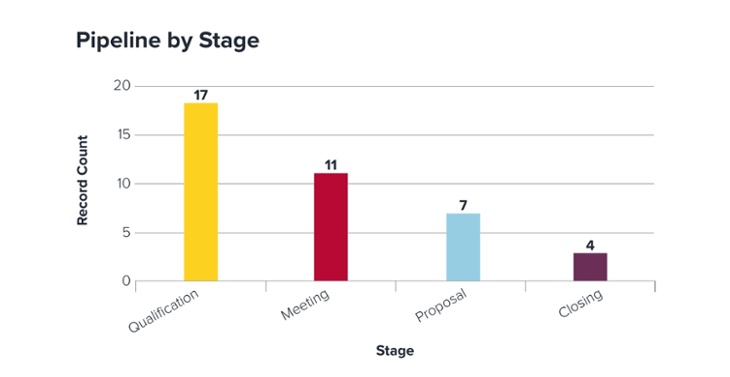
Pipeline reports are important for effective pipeline management, helping sellers keep track of the status of every deal and understand whether they have an appropriate distribution of deals in order to meet their sales targets.
Related: The sales pipeline prescription: how to cure the 10 most common ailments plaguing your pipeline
What does a sales pipeline look like?

Perhaps you’re wondering what a sales pipeline looks like. A sales pipeline is typically depicted as a horizontal bar broken up into the different sales process stages. For example, the sales pipeline pictured above shows a horizontal series of pipeline stages from Qualify to Close.
Pipeline performance: what the data tells us
Understanding whether your pipeline is healthy requires benchmarking against industry standards. Recent research analyzing thousands of B2B sales pipelines reveals typical conversion rates at each stage:
- Lead to MQL: 20 to 25% (average 22%) successfully qualify as marketing-ready leads
- MQL to SQL: 12 to 18% (average 15%) advance to sales-qualified status – this is where the biggest drop-off typically happens
- SQL to Opportunity: 10 to 12% (average 11%) become genuine opportunities with confirmed buying interest
- Opportunity to Closed-Won: 6 to 9% (average 7%) ultimately convert to customers
These benchmarks reveal a harsh reality: for every 100 leads entering your pipeline, only about two become paying customers. The steepest drop-off occurs at the MQL to SQL stage, where many marketing teams hand over leads that aren’t truly sales-ready.
Several factors influence whether deals progress or stall at each pipeline stage. Follow-up speed matters enormously. Sales and marketing alignment also plays a critical role, as misaligned ideal customer profile definitions consistently reduce conversions. Industry variations also create different benchmarks, with SaaS and cybersecurity often seeing lower conversion rates due to competitive markets, while healthcare and manufacturing demonstrate steadier progression.
Companies implementing AI-driven lead scoring have reported conversion rate improvements of 25% by helping sales teams focus on high-value prospects with genuine buying signals. The key is not just tracking your pipeline stages, but understanding what drives progression at each transition point.
Ready to perfect your sales pipeline?
Transform your sales process with our comprehensive sales pipeline training guide. From filling your pipeline to pipeline management, learn it all.
What is a sales funnel?
Unlike a sales pipeline, which focuses on the set of actions taken by sellers, a sales funnel represents the quantity and conversion rates of prospects through your pipeline stages. It’s called a “funnel” because of its shape: wide at the top as prospects enter, then increasingly narrow as they are disqualified or decide not to buy.
Unlike a sales lead pipeline report, which shows the value and quantity of deals at the moment when the report is run, a funnel report is based on a cohort. This means that a funnel report can tell you, for example, of the 100 leads you received last quarter, what percentage of them advanced through each stage of your pipeline.
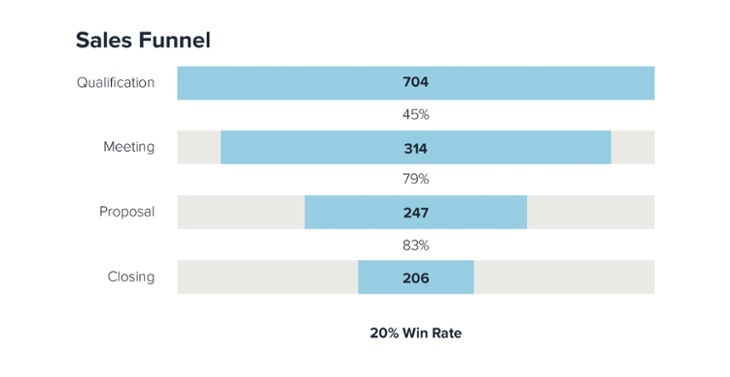
A sales cycle funnel report is important for sales leaders because it can help them forecast sales and identify where deals are getting stuck. A sales funnel forecast report is generated based on the current lead volume. And pinpointing bottlenecks in the funnel cycle helps them improve their process and better coach their team.
What does a sales funnel look like?
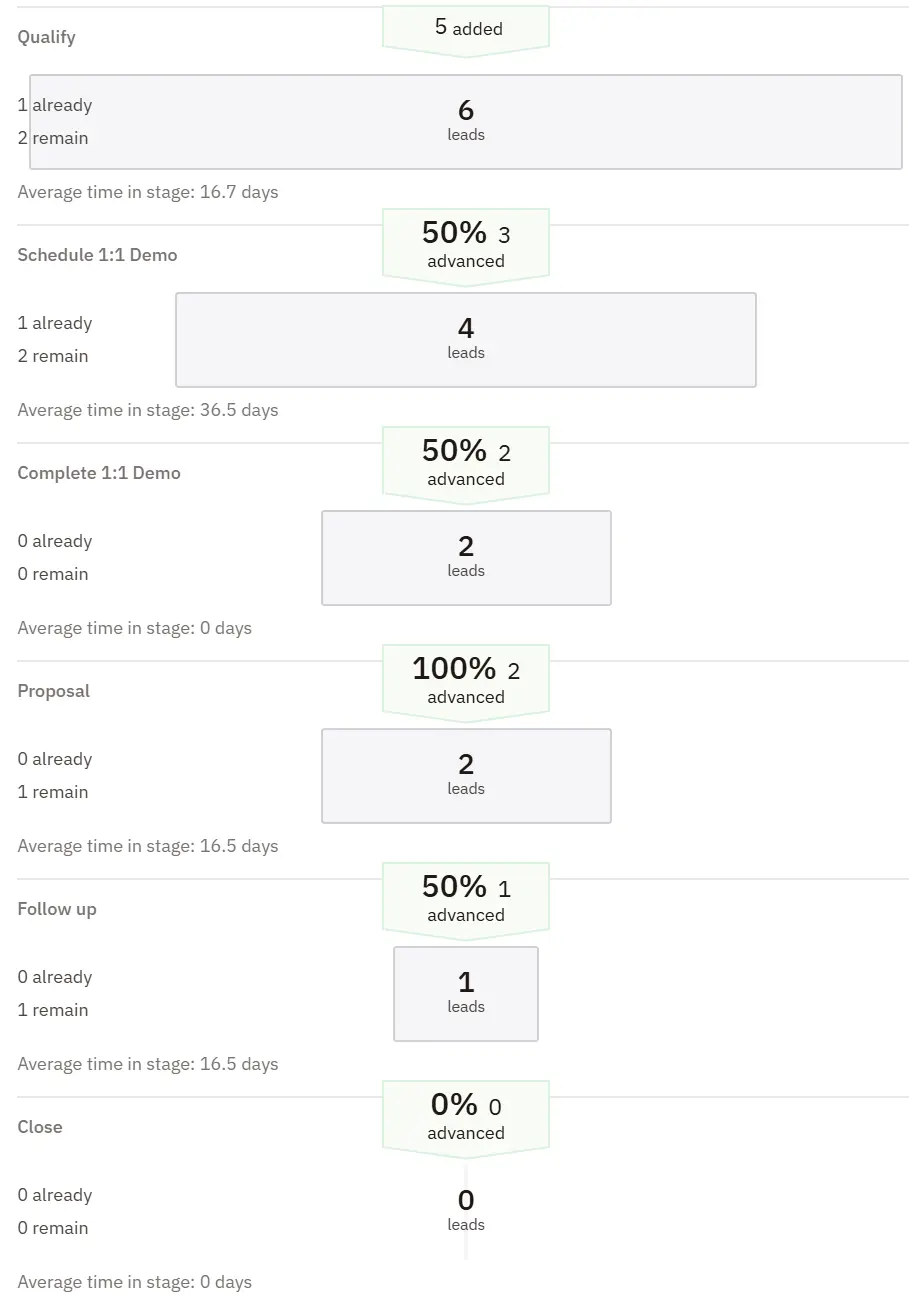
We know what a sales pipeline looks like—how does the look of a sales funnel differ? A sales funnel depicts the buyer journey in a vertical format, from when the lead enters the top of the funnel to the point at which the lead becomes a customer at the bottom.
Because the number of leads usually decreases from stage to stage, the sales funnel automatically takes on the shape of a funnel, as shown in the above picture of a sales funnel. For this reason, regardless of whether the funnel highlights the number of leads per stage or simply focuses on the types of stages in the sales process, the sales funnel is usually visualized in funnel form.
The difference between sales pipelines and sales funnels
So, when you’re thinking about the difference between a pipeline and a funnel, remember this: A pipeline reflects what a seller does during the sales process and a funnel measures conversion rates through the sales process.
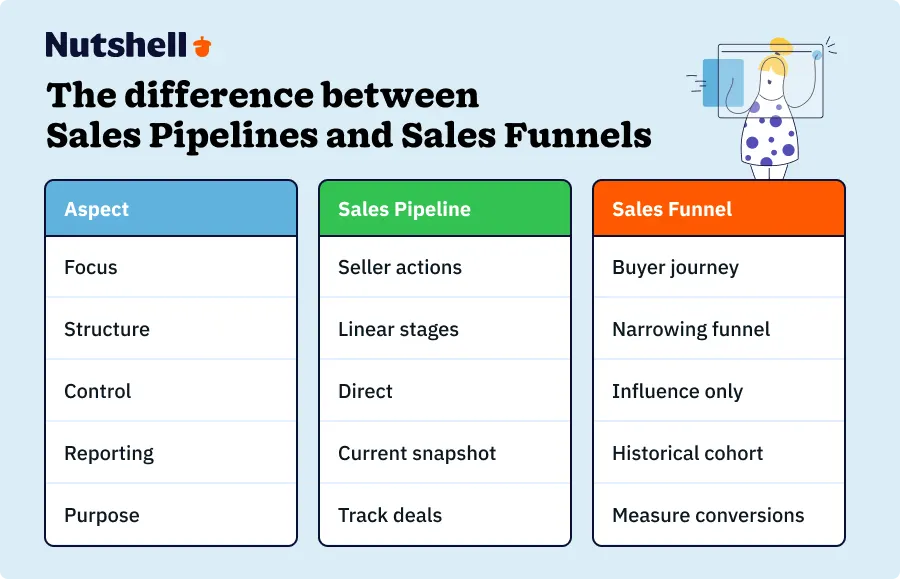
To sum up:
- The sales lead pipeline is a series of stages that focuses on the seller’s actions to move the lead to the next stage. The sales funnel is a series of stages that show the volume of leads that have gone through each stage in the buyer’s journey.
- The sales pipeline can be changed directly, as managers and sellers can move, change, and add pipeline stages and actions. The sales funnel, on the other hand, is merely a numerical representation of the actions taken by leads – it cannot be directly changed but only influenced.
- The sales pipeline report enhances pipeline management, enabling sales teams to keep track of the status of every deal and understand what next actions to take. The sales funnel report helps you to forecast sales and understand where leads may be getting stuck in the buyer’s journey.
Want to be a better leader?
The Sales Manager’s Survival Guide includes 70+ expert tips on hiring, coaching, and motivating your sales team. Download it today!
The marketing handoff: Where funnels and pipelines meet
If you want your sales process to run smoothly, you have to understand where marketing ends and sales begins. This transition is where the concepts of funnels and pipelines naturally overlap—and where most growing companies accidentally lose their best leads.
Typically, your marketing team is responsible for the top of the funnel. They use blog posts, webinars, and targeted ads to build awareness and generate leads. Their goal is to capture interest and get people to raise their hands by filling out a form or downloading a guide.
But a raw lead is rarely ready for a direct sales pitch. Marketing needs to nurture those people until they meet your specific criteria for a qualified prospect. Once a person has the right budget, authority, and need, the handoff happens.
At this exact moment, the prospect exits the marketing funnel and enters the first stage of your sales pipeline. Your sales reps take over, using phone calls, demos, and personalized outreach to move them toward a purchase.
When your marketing and sales teams operate in silos, leads get lost in the shuffle. By aligning your marketing funnel and your sales pipeline inside a shared CRM, you ensure that no one slips through the cracks during that critical transition—effectively building a unified sales pipeline funnel for your business.
Using sales pipelines and sales funnels in your sales strategy
As you’ve probably realized, the sales pipeline and sales funnel are moving in the same direction along the buyer’s journey from discovery to close. That’s why you can – and should – use both to determine your business’s sales strategy.
The conversion rates found in the sales funnel report are a response to things that your sales team can control – sales rep actions, how they communicate, and how often they’re reaching out and working to move leads through the sales deal pipeline.
When analyzing conversion rates in your sales funnel, keeping your sales pipeline on hand can help you map seller actions directly to buyer conversions and find opportunities to improve your process.

Want to learn more about sales pipeline automation?
Learn how to set up your sales pipeline with custom automations to streamline your workflow and keep deals moving forward!

Essential metrics to track for your pipeline and funnel
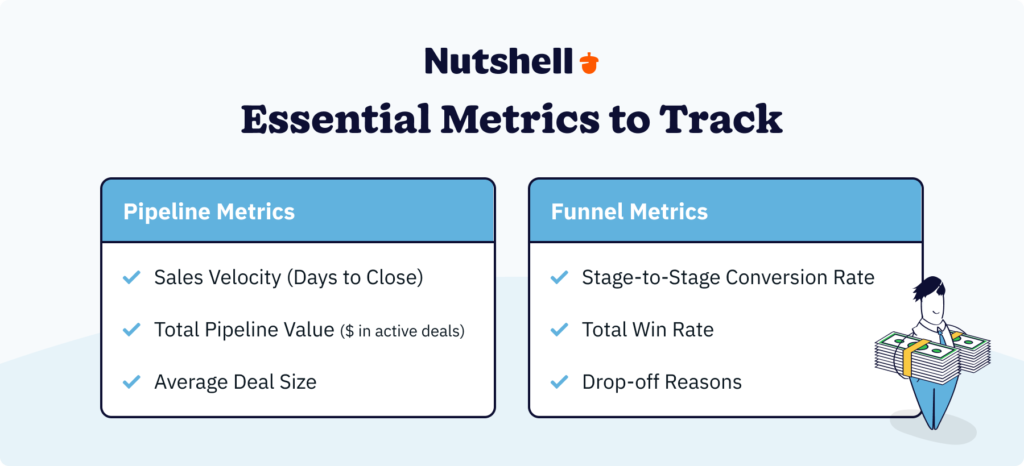
Because pipelines and funnels serve entirely different purposes, you need to track different numbers to understand how healthy they are. Looking at the right data helps you stop guessing and start growing your revenue predictably.
What to measure in your sales pipeline:
Since your pipeline tracks your team’s day-to-day actions, you want to measure speed, value, and effort.
- Sales velocity: How many days does it take for a new lead to become a paying customer? If your team can shorten the time between a first meeting and a final proposal, you will naturally close more deals in a quarter.
- Total pipeline value: How much potential revenue is your team currently working on? If your revenue goal is high but your active deal value is low, your team needs to pause their closing efforts and spend more time prospecting immediately.
- Activity metrics: How many calls, emails, and meetings does it take to move a deal forward? Tracking these activities helps you figure out if your team is spending its time on the right tasks.
What to measure in your sales funnel:
Since your funnel tracks buyer behavior over time, you want to measure success rates and drop-offs.
- Stage-to-stage conversion rate: What percentage of people move from one specific stage to the next? If 80% of your leads say yes to a meeting, but only five percent actually show up, you know exactly where you need to fix your communication.
- Total win rate: Out of all the people who enter the top of your funnel, how many eventually buy? This number is critical for accurately forecasting your revenue and setting realistic marketing goals.
- Funnel leakage: Where are you losing the most prospects? Identifying the exact stage where people abandon the purchasing journey tells you where your sales pitch needs the most work.
How AI and digital transformation are reshaping sales in 2026
The landscape of pipeline and funnel management is experiencing dramatic change. Technology, buyer behavior, and selling methodologies are converging to create fundamentally different approaches to moving deals through your sales process.
The AI revolution in pipeline management
Artificial intelligence has moved from experimental to essential. The global AI in CRM market reached $14.9 billion in 2025, growing at 35.2% annually, as businesses discover measurable performance improvements from intelligent automation.
AI adoption in sales has surged from 39% to 81% in just two years, with 83% of sales teams using AI reporting increased revenue in 2024. Companies implementing AI in their sales processes have seen a 30% increase in sales revenue on average. These aren’t marginal improvements—they’re transformative results that separate growing businesses from stagnant ones.
AI-driven lead scoring now improves conversion rates by 25% compared to traditional demographic-based methods. Modern systems analyze real-time behavioral data, engagement levels, and buying signals through machine learning algorithms that continuously learn and improve.
The practical applications extend throughout the pipeline. AI systems now handle qualification, predict which deals are at risk, recommend next-best actions for sales reps, and automatically log activities to keep CRM data current. This isn’t about replacing salespeople—it’s about eliminating busywork so reps can focus on building relationships and closing deals.
Digital-first buyer behavior is now the default
By 2025, 80% of B2B sales interactions between suppliers and buyers happen in digital channels. This represents a complete transformation in how business decisions are made, and it fundamentally changes how both pipelines and funnels function.
Today’s buyers are more informed, skeptical, and self-reliant than ever before. The seller’s role has evolved from information gatekeeper to strategic advisor who provides context and guidance buyers can’t find on their own.
Buyers now use an average of 10 different interaction channels on their journey, up from just 5 channels in 2016. This channel proliferation means sales teams must maintain consistent presence and messaging across multiple touchpoints—email, phone, LinkedIn, website chat, video calls, and more.
The implications for pipeline management are significant. Traditional linear pipelines assumed sellers controlled the flow of information and timing. Today’s reality requires flexibility. Buyers might engage late in their process already knowing exactly what they want, or they might disappear for weeks conducting internal discussions before re-engaging. Your pipeline must accommodate this non-linear behavior while still providing structure for your team’s activities.
The death of the linear funnel
The traditional sales funnel depicted a smooth, predictable progression where buyers moved step-by-step from awareness to purchase. That model is dead. Modern buyers zig-zag through the process, jumping ahead, circling back, and conducting extensive independent research.
Buyers spend only 17% of their total buying time meeting with potential suppliers. The rest involves independent digital research, peer consultations, and internal discussions. They’re qualifying you long before you qualify them.
This creates measurement challenges for funnel reporting. Historical cohort-based analysis still provides valuable insights, but it must account for longer, less predictable journeys. Understanding where leads enter your funnel, how they move through it, and where they drop off requires more sophisticated tracking than ever before.
The solution isn’t abandoning funnel metrics—it’s evolving how you measure and respond to them. Advanced analytics now track engagement signals across channels, predict likelihood to convert based on behavioral patterns, and identify when prospects are ready for human intervention.
What this means for your business
These trends aren’t future predictions—they’re current reality. Businesses that adapt their pipeline and funnel strategies to embrace AI, accommodate digital-first buyers, and track non-linear journeys are outperforming competitors who stick with traditional methods.
The technology exists today to transform how you manage both pipelines and funnels. The question is whether you’ll leverage it before your competitors do.
Common misconceptions about pipelines and funnels
Despite how fundamental these concepts are to sales success, several persistent misconceptions create confusion and lead to poor decision-making.
Misconception #1: “Pipeline and funnel are just different names for the same thing.”
This is the most common and most damaging misconception. While both track the progression of prospects toward becoming customers, they serve entirely different purposes. Your pipeline is a management tool showing your team’s activities and deal status right now. Your funnel is an analytical tool showing historical conversion patterns over time. Treating them as interchangeable means you’ll either over-focus on activities without measuring results, or obsess over conversion rates without understanding what drives them.
Misconception #2: “I only need to track one or the other.”
Some sales leaders believe that pipeline management alone is sufficient—if you track all your deals and keep reps active, results will follow. Others focus exclusively on funnel metrics, analyzing conversion rates without connecting them to specific seller behaviors. Both approaches fail. You need pipeline data to manage day-to-day operations and coach your team. You need funnel data to identify systemic problems and forecast accurately. They work together, not in isolation.
Misconception #3: “Funnel optimization is just a marketing responsibility.”
While marketing teams often own top-of-funnel metrics, the entire funnel spans both marketing and sales activities. The biggest drop-offs typically occur at the MQL to SQL transition—exactly where marketing hands off to sales. Treating the funnel as marketing’s problem means sales teams miss crucial insights about why qualified leads don’t convert. Effective funnel optimization requires collaboration between marketing and sales to align on definitions, processes, and shared accountability.
Misconception #4: “A healthy pipeline means deals spread evenly across all stages.”
Actually, healthy pipelines typically show concentration in early stages with progressively fewer deals in later stages—forming that funnel shape. If you have equal numbers of deals in prospecting, qualification, proposal, and closing stages, it likely indicates problems with lead generation or slow progression. Natural attrition means you should have more early-stage activity than late-stage deals.
Misconception #5: “Complex pipelines with many stages are better.”
More stages don’t equal better management. Overly complex pipelines create confusion about deal status, slow progression, and make it harder to identify bottlenecks. The best pipelines have clear, distinct stages where something meaningful changes—not arbitrary divisions that add administrative burden without improving outcomes. Most effective pipelines have between four to seven stages.
Misconception #6: “Once you build your pipeline, it’s set.”
Your pipeline should evolve as your business, products, and markets change. A startup’s pipeline looks different from an established company’s. Enterprise sales require different stages than SMB sales. As you gather data on what works, refine your stages and qualification criteria. Static pipelines become obsolete.
Understanding what pipelines and funnels actually are—and aren’t—helps you use both tools effectively to drive predictable revenue growth.
Need a user-friendly CRM to boost sales and team efficiency?
Take our guided tour to explore Nutshell’s incredible features!
Tips for building a sales pipeline
Building an effective sales opportunity pipeline may seem complicated at first—there are several factors to consider to ensure you get it right. With a straightforward process in hand, building a sales lead pipeline geared toward moving prospects through the stages and encouraging more deals is simplified.
Let’s take a look at the core steps to create the best sales pipeline for your team and business success:
- Zero in on your ideal customer: Define the characteristics of customers you want in your pipeline and group them accordingly for more effective audience targeting and lead generation.
- Identify key pipeline stages: Determine the essential stages needed in your pipeline, mapping the customer’s journey from awareness to purchase.
- Reverse engineer pipeline tasks: Develop your pipeline based on mission-critical sales tasks and activities at each buyer journey stage, working from purchase back to awareness.
- Select the right tools: Equip your sales team with the right tools for the job—build your pipeline using a leading CRM platform to effectively track leads, automate tasks, and maximize opportunities.
- Evaluate and optimize: Keep assessing sales results, gathering team feedback, and testing new approaches to ensure your deal pipeline is as efficient and effective as possible.
Tips for managing a sales pipeline
You’ve followed the steps outlined above and built a great sales pipeline to empower your sales team. What next? The next step is to implement a solid pipeline management process so you, your team, and your company get the most from your sales efforts.
We’ve already touched on continuous pipeline evaluation and optimization, but there’s more to pipeline management than just that. Here are some of the top tips for successfully managing a sales pipeline:
- Determine your milestones: Examine the key steps in your sales process tailored to your business needs to clearly define your pipeline stages so you can track deal progress and spot potential roadblocks.
- Prioritize hot leads: Set up a system allowing you and your team to score and rank leads to ensure you focus your efforts on those most likely to convert.
- Centralize your customer data: Invest in a robust CRM solution to help you generate, collect, organize, and analyze customer data, giving you the tools to gain essential insights into behavior and preferences.
- Automate repetitive tasks: Use CRM pipeline automation tools to streamline tasks and activities so you and your team can focus on strengthening prospect relationships and closing deals.
- Simplify the sales cycle: Pinpoint and remove sales process obstacles, allowing you to speed up revenue generation and improve lead retention.
- Standardize your processes: Work toward developing consistency within your workflows, ensuring they remain tailored to your needs while making them easy to replicate and learn for seamless sales rep onboarding.
Master your sales lead pipeline with Nutshell
Want to turn your sales pipeline into a conversion machine? Take a tour of Nutshell and learn how our CRM’s sales process tools and insights help sales reps add more qualified leads to their pipeline and win more deals.
And with our Multiple Pipelines feature, Nutshell Pro users can even configure multiple sets of stages for distinctly different sales efforts, while draft pipelines (available to all users) make it easy to experiment with new processes before putting them into practice.
After exploring our robust suite of CRM features, why not try it out for yourself? Explore any Nutshell plan free for 14 days – no credit card required. Contact our team to learn more about how Nutshell can help your business create the ideal sales pipeline, whatever your sales model.
FAQs
-
1. Which is more important for sales forecasting—pipeline or funnel?
Both are essential, but they serve different forecasting purposes. Your pipeline helps forecast based on current deal stages and values, while your funnel uses historical conversion rates to predict future revenue. For the most accurate forecasts, use pipeline data for short-term projections and funnel metrics to identify long-term trends and bottlenecks.
-
2. Can a small business benefit from using both a pipeline and funnel?
Absolutely. Small businesses actually benefit more from using both tools together. Your pipeline keeps deals organized and moving forward, while your funnel reveals which stages need improvement. You don’t need complex systems—a simple CRM like Nutshell tracks both automatically, helping you close more deals without adding overhead or complexity to your process.
-
3. How do I know if my pipeline or funnel needs fixing?
Watch for these red flags: deals stalling in one stage for weeks, conversion rates dropping between stages, inconsistent deal values, or reps spending too much time on low-quality leads. If your pipeline report shows uneven distribution or your funnel reveals high drop-off rates at specific stages, it’s time to optimize your process and retrain your team.
-
4. What’s the difference between a sales funnel and a marketing funnel?
A marketing funnel focuses on building brand awareness and attracting potential customers through content, ads, and social media. Once someone shows buying intent, they enter your sales funnel, where your sales team guides them through evaluation, proposal, and closing stages. Marketing generates interest; sales converts that interest into revenue. Both work together in your customer journey.
-
5. Does Nutshell CRM track both pipeline and funnel metrics?
Yes. Nutshell automatically tracks both your pipeline stages and funnel conversion rates in real time. You’ll get pipeline reports showing current deal status and values, plus funnel reports revealing conversion rates at each stage. Our reporting tools help you forecast revenue, identify bottlenecks, and coach your team—all without manual data entry or complex spreadsheets.
Register for a product tour!
Have a question? Need to see more? Register for a free 30-minute Nutshell demo and product tour with one of our team members to determine if Nutshell is a match for your business.
BACK TO TOP
Ready to try
Nutshell for Free?Thank you! Your submission has been received!Oops! Something went wrong while submitting the form.






Budget Objection Handling: 9 Sales Experts Share Proven Strategies to Overcome ‘No Budget’
Published on: November 10, 2022Sales Performance Reviews: 9 Tips to Make Them Valuable
Published on: November 10, 2022Join 30,000+ other sales and marketing professionals. Subscribe to our Sell to Win newsletter!