10 Sales Pitch Examples to Boost Your Close Rate

-

Key takeaways
-
Structure matters: A compelling sales pitch should follow a clear structure—identify the prospect’s pain point, present a tailored solution, explain your process, and build trust with proof (e.g., testimonials or case studies).
-
Storytelling and personalization boost engagement: Pitches that tell relatable stories, ask thought-provoking questions, or center the customer as the hero are more memorable and persuasive than generic product descriptions.
-
Adapt the format to the medium and moment: Whether it’s a quick elevator pitch, a cold email, a phone call, or a video, tailor your pitch style and message to fit the context and capture attention quickly.
The right sales pitch examples can be the difference between a hard no and a high-value closed deal. We’ve compiled 10 proven examples with real-world case studies, ratings, and frameworks to help your reps pitch more effectively and close more often.
Sales pitch examples at a glance
- Leading with a question: Best for capturing immediate attention and sparking curiosity
- Creating a dichotomy: Best for helping prospects see their problem from a new angle
- Telling a good story: Best for building emotional connection and trust
- Using (genuine) flattery: Best for building strong rapport with prospects
- Following the rule of three: Best for keeping your pitch simple and memorable
- Creating a sense of urgency: Best for motivating quick decision-making
- Letting the product speak: Best for demonstrating tangible value in action
- Acknowledging the prospect’s emotions: Best for showing empathy and understanding
- Show supporting data: Best for establishing credibility and reducing risk perception
- Remembering the customer: Best for personalizing your approach and proving you’ve done your homework
Table of Contents
- What is a sales pitch?
- The power of storytelling in sales pitches
- The different types of sales pitches
- The difference between product and service sales pitches
- The sales pitch framework
- How to structure your sales pitch
- 10 best sales pitch examples to increase sales
- Additional tips to dazzle your prospect
- FAQs
What is a sales pitch?
A sales pitch is a concise, persuasive speech that explains what your product is, communicates its value, and encourages the customer to make a purchase.
It’s your chance to turn a prospect’s interest into action. But it can also make or break a deal. If your buyer isn’t hooked by what you say, they likely won’t purchase your product.
The power of storytelling in sales pitches
Incorporating storytelling into your sales pitches can significantly enhance audience engagement. Storytelling is one of the most effective creative pitch ideas to engage your audience and build trust. You create an emotional connection that resonates with potential buyers by sharing a compelling narrative about your company’s journey or a customer’s success. For example, start by outlining a customer’s challenges, explain how your product or service provided a solution, and conclude with impressive results. This approach transforms your sales pitch into a relatable story highlighting your offerings’ value.
Crafting a narrative doesn’t have to be daunting. Consider the storytelling techniques used in your favorite movies and apply similar methods in your presentations. Use visuals and interactive elements to enrich the experience, ensuring your message aligns with your audience’s preferences. You can also start with a relevant industry statistic to set the stage. You create a compelling sales pitch idea by positioning your potential client as the hero facing challenges your product can solve. Engaging stories foster trust and encourage potential customers to connect with your brand, making storytelling an essential tool for effective selling.
The different types of sales pitches
You may develop a winning sales pitch structure based on your most common sales scenario. However, different ways to engage with your prospects exist, so adapting your pitch to the situation is crucial.
The primary sales pitch categories you will likely encounter include the following:
- Elevator pitch: This is a fast-paced pitch, typically used in situations where you have a limited time to grab your prospect’s attention and get your point across as quickly as possible. A no-frills pitch that gets right to the point in the simplest terms is the best approach here.
- Email pitch: Executing your sales pitch over email can be challenging, especially when you consider that getting your prospect to open the email is half the battle. A punchy subject line stipulating your value proposition and a concise email with a clear CTA can go a long way.
- Phone pitch: Pitching over the phone is one of the most common sales pitch types and comes with its own challenges. Consider the best time of the day to call your prospect, earn their trust by being honest, and talk and connect with them for the best results.
- Social media pitch: A modern sales pitch approach, the social media pitch can lead to lucrative deals, but there are a few obstacles to navigate. To ensure you don’t look like a spammer, engage with your prospect on something specific and relevant you found in their profile and build on that while keeping things professional.
- Video pitch: The video pitch method combines the advantages of in-person, call-based, and text-based pitches, which you can place strategically in messaging.
The difference between product and service sales pitches
Recognizing the differences between product and service sales pitches is crucial for effective communication. While both aim to persuade potential customers, their approaches vary significantly.
A product pitch highlights the features and benefits of a tangible item, demonstrating how it addresses customer pain points. For example, showcasing a high-quality product emphasizes its durability and unique advantages over cheaper alternatives, making it easier for customers to see its value.
In contrast, a service sales pitch presents the overall value of the service rather than a specific product. When selling services like consulting or marketing, the focus is on building trust and demonstrating expertise. For instance, when pitching a CRM marketing software solution, you would emphasize how your services improve efficiency and drive results rather than just listing features.
By understanding these distinctions, you can tailor your sales strategies to meet your prospects’ specific needs, enhancing your overall effectiveness in closing deals.
Want even more tips for driving sales success?
Our Sell to Win Playbook provides tons of expert advice on what it takes to turn prospects into sales. Get an insider look by downloading the playbook for free!
The sales pitch framework
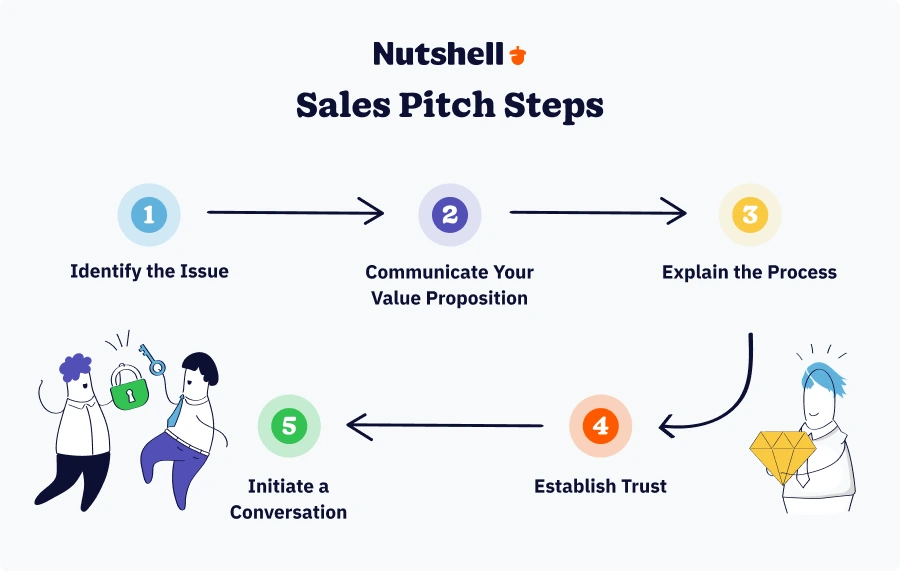
Building a solid sales pitch requires thoughtful consideration and a clear roadmap to guide your conversation. With careful consideration, you can create a pitch roadmap to guide you through the conversation. When planning your pitch, try to stick to the following proven framework.
Identify the issue
Knowing how to effectively start your pitch is critical to keeping your prospect engaged and interested. Start by highlighting the problem your product or service addresses. Open with a real-life example or a striking statistic that illustrates the gravity of the issue and emphasizes the need for a solution. This sets the stage for the rest of your pitch and draws your audience in.
Communicate your value proposition
Clearly articulate what your company offers and how it stands out. Focus on the identified problem and explain how your product or service provides a solution. Highlight the benefits your prospect can expect when working with you, making it relevant to their needs.
Explain the process
Provide details on how you and your team will assist the prospect’s business. Outline the steps you will take, your unique approach, and what differentiates your method from others. Ensure your explanation is concise and engaging, keeping the prospect interested.
Establish trust
Building a relationship with your prospect begins with trust. And you can establish trust in several ways, including:
- Case studies: Include an example of a company with a similar problem you’ve successfully helped with your product or service. Break down the nature of the problem and the steps your business took to resolve it.
- Client testimonials: Incorporate statements from happy clients who have benefited from your product or service. Ask the client for permission to include their full name and company name as part of the pitch, as this will help you establish credibility.
- Industry accolades: Has your company achieved any awards or reached a significant milestone? If so, mentioning these achievements will go a long way to developing trust.
Initiate a conversation
Conclude your pitch by asking an open-ended question that encourages dialogue. These questions should invite the prospect to share more about their situation and cannot be answered with a simple “yes” or “no.” Consider asking:
- What risks could your business face if this problem isn’t resolved?
- What are your company’s top priorities for the coming fiscal year?
- What are some of the challenges you’ve experienced in delivering your product or service?
Following this structured approach, you’ll create a compelling sales pitch that resonates with your audience.
How we chose these sales pitch examples
We didn’t just pull these ten techniques from thin air. Each one was evaluated based on proven effectiveness in real-world B2B sales environments. Here’s how we filtered the noise and landed on the techniques that actually move deals forward.
Selection criteria
- Effectiveness: Does this technique actually help reps close deals? We prioritized approaches backed by case studies, expert endorsements, and measurable sales outcomes. Hype alone didn’t make the cut.
- Versatility: Can a rep use this across different industries, deal sizes, and prospect personalities? We focused on techniques flexible enough to work in construction, tech, consulting, manufacturing, and beyond.
- Ease of implementation: Can an average sales rep learn this in a week and apply it tomorrow? If a technique requires a PhD in psychology or weeks of training, it didn’t make our list. We wanted actionable methods, not theoretical frameworks.
- Real-world validation: Have we seen this work in the field? Many of these examples come from sales leaders we’ve worked with, case studies from companies that have scaled their pitch, and feedback from thousands of sales professionals using CRMs like Nutshell to track what actually converts.
- Relevance to modern sales: Does this technique work for 2025? We included timeless approaches (storytelling has worked for centuries) alongside modern tactics (video pitches and signal-based outreach) that reflect how buyers actually want to be engaged today.
Why these specific ten?
These ten techniques represent the sweet spot between foundational sales wisdom and practical innovation. They range from opening moves (leading with a question) to closing strategies (creating urgency) that can work for cold outreach and warm introductions. They’re effective in emails, on calls, in person, and on video.
Most importantly, each one addresses a core challenge that sales reps face:
- How do I get attention?
- How do I create connection?
- How do I build trust?
- How do I close the deal?
If you master even three of these techniques and know when to use them, you’ll notice a measurable difference in your close rates and deal velocity.
10 best sales pitch examples to increase sales
Now that we’ve pinned down the basic structure, let’s dig into some of the best sales pitch examples to create your proposal template and boost your close rate. These creative pitch ideas are designed to help you connect with prospects and boost your success rate.

1. Lead with a question
Our rating: 4.9/5⭐️
Best for: Capturing and holding your prospect’s attention by appealing to their curiosity
How it works:
When you start your pitch with a thought-provoking question, it immediately grabs your prospect’s attention. Preferably start with a question that compels them to see their problem from a different perspective. If the question promises valuable information, they’ll want to know the answer and will stay engaged through the next part of the pitch.
Why it works:
Questions shift the dynamic. Instead of you talking AT the prospect, you’re inviting them into a conversation. Their brain activates—they want to know the answer. That’s the moment you’ve won their attention, and it’s the moment you can begin building your case.
Good example
A digital marketing sales rep might open with a question like, “Did you know Instagram’s rapidly changing algorithm is working against you?” This question:
- Hints at important information the prospect is missing.
- Makes them reconsider their current social media strategy.
- Creates an opening for the sales rep to provide an answer that promotes their social media services.
Bad example
“Are you looking for a way to ________?”
While this question format is popular, here’s why it doesn’t work:
- It’s generic and overused.
- Prospects can easily say “no” and disengage.
- It doesn’t touch on a need you can fill.
If your question isn’t compelling enough, your customer might not stick around for more of your pitch. Your opening question should have your target dying to know more.
When to use this pitch:
- Cold calls where you have 10 seconds to make an impression
- Email subject lines and opening sentences
- First calls after a prospect has shown interest
- Any situation where attention is your first obstacle
When it might fall flat:
- If your question is too obvious or commonly asked
- If you don’t have a compelling answer to back it up
- If the prospect is too rushed to engage (always be ready to pivot)
💡 Pro Tip: Test your opening question with colleagues first. If they immediately see where you’re going, try something more unexpected. The best opening questions challenge assumptions without feeling manipulative.
⚠️ Watch Out: Don’t ask questions you don’t already know the answer to. Prospects can sense when you’re fishing for information versus when you’re leading them somewhere intentional.
🎥 For Video Pitches: Ask your question directly to the camera in the first 5 seconds, then pause briefly (as if waiting for their response) before answering. This approach creates a conversational feel even in recorded format.
2. Create a dichotomy
Rating: ⭐⭐⭐⭐ (4.5/5)
Best For: Helping prospects recognize problems they haven’t identified yet, or clarifying why the status quo isn’t working.
How it works:
This pitch follows a three-step process. You start by stating a truth about your prospect’s business or situation. Then, you introduce another truth that contradicts the first one—this contrast creates tension by highlighting the gap between where your prospect is and where they want to be. Finally, you bring in your product and show how it can bridge the gap you’ve created.

Source: TechCrunch Why it works:
This technique works because it uses cognitive dissonance—the discomfort people feel when holding two contradictory beliefs simultaneously. That discomfort creates space for a new perspective, and that’s where your solution fits in.
Good example
In an episode of Shark Tank, the creators of DARTdrones creatively used the dichotomy technique in their pitch:
They started by explaining that drones are a beneficial piece of technology. Then, they contradicted this truth by stating that drones are prone to crashing, an issue that can cost tens of thousands of dollars over time.
The solution they offered? Their training course for drone pilots. Presenting the dichotomy first made the issue crystal clear and the solution even more obvious.
Bad example
If your product doesn’t create real tension, or if you don’t offer a clear solution, the dichotomy won’t be effective. Make sure you draw a clear line between your product and the problem introduced in your pitch.
When to use this pitch:
- When prospects haven’t articulated their own problem yet
- Early in conversations when you want to establish credibility
- When your solution directly resolves a contradiction they’re living with
- In sales pitch presentations where you need to make a compelling case for change
When it might fall flat:
- If the dichotomy feels forced or doesn’t reflect their reality
- If your solution doesn’t clearly resolve the contradiction
- If the prospect is already aware of the contradiction and has accepted it
💡 Pro Tip: The best dichotomies surface things prospects already sense but haven’t articulated. Listen in early conversations for where they’re struggling with contradictions—that’s your dichotomy material.
⚠️ Watch Out: Avoid creating false dichotomies or exaggerating the contradiction. Prospects can tell when you’re oversimplifying, and it damages credibility.
🎥 For Video Pitches: Use visual elements to show the contradiction. Show a before-and-after split screen or use on-screen text to highlight Truth 1 vs. Truth 2. The visual contrast makes the dichotomy even more powerful.
3. Tell a good story
Rating: ⭐⭐⭐⭐⭐ (4.8/5)
Best for: Building emotional connection, making your pitch memorable, and helping prospects see themselves in your solution.
How it works:
Stories are often more compelling than cold facts and figures—especially when you incorporate them into creative sales pitches. According to Ryan Dohrn, people remember stories 75% of the time. They also remember facts and stats less than 1% of the time.
That’s because stories activate a different part of your brain. When you tell a story, listeners don’t just process information—they experience it. They imagine the scenario. They feel the tension, the resolution, and the relief.

Once a buyer emotionally invests in your story, they will be more likely to care about your product. But avoid introducing your product at the beginning of the story. It’s best to weave in your product during the middle or end once the listener fully engages in what you have to say.
Why this technique works:
Stories are generally more persuasive than statistics, even when the stats are more compelling from a logical standpoint. Stories create emotional engagement, which leads to decisions.
Using a story in a pitch does more than tell a prospect about your solution. You show them what adopting it could look like for their business.
Good example
During his pitches, Backroads CEO Tom Hale likes to tell the origin story of founding his travel company. Hale has always disliked mass tourism, and one night while working in Las Vegas he woke up in a cold sweat with a brilliant sales pitch idea. He got to work and by 8 AM had a completed plan for Backroads, a slow-tourism outdoor-focused travel company.
Here’s why it worked:
- It’s authentic (he’s the founder telling his own story)
- It shows his passion and conviction
- It explains the ‘why’ behind the company
- It positions the company as solving a real problem (unsatisfying mass tourism)
- Prospects who’ve felt the same frustration immediately connect
Bad example
“So once there was this company with a sales problem. They didn’t know how to pitch. It was hard. Then they bought our software. Now it’s better.”
Why this doesn’t work:
- It’s generic and could apply to any company
- There’s no real tension or emotional investment
- It feels made up or generic
- There’s no specific transformation or result
- The listener doesn’t emotionally invest in the outcome
When to use this pitch:
- When building relationships with qualified leads
- In longer sales conversations where you have time for story
- When the emotional stakes are high (big deal, big change)
- When you want to differentiate from competitors who are leading with features
When it might fall flat:
- If the story doesn’t connect to the prospect’s situation
- If the story is too long or loses focus
- If the story is confusing or boring
- If you tell it without authenticity or belief in its importance
💡 Pro Tip: Remember, your company’s story doesn’t need to be a verbatim account of everything that happened—keep the good parts and skip over the filler.
⚠️ Watch Out: Never force a customer story if it doesn’t fit. Inauthentic storytelling destroys credibility faster than just delivering your pitch directly.
🎥 For Video Pitches: Record a real customer telling a brief version of their story, then share it in your pitch. Authentic customer testimonials on video are incredibly powerful and feel less “salesy” than you telling someone else’s story.
16 sales process templates for B2B pipelines
Whether you’re building your first sales process or overhauling an existing one, these Nutshell-approved templates will give you a great head-start.

4. Use flattery (if it’s genuine)
Rating: ⭐⭐⭐⭐ (4.0/5)
Best For: Building rapport and making prospects feel valued early in conversations.
How it works:
Like they say, flattery will get you everywhere. When done genuinely, subtle flattery creates a positive impression and builds rapport. But the key word is “genuine.” Flattery that feels forced or over-the-top backfires. Instead, the most effective flattery is specific and references something the prospect should be proud of.
Rather than complimenting personal attributes (“That’s a great tie!”), subtle flattery acknowledges something about their company, their achievement, or their thoughtfulness. It shows you’ve done your homework and noticed something specific about them.
Why it works:
When someone compliments something you’ve accomplished or something you’re proud of, you naturally feel more favorably toward them. It creates a small moment of connection. In a sales conversation, that moment of connection can be the difference between a prospect who’s guarded and one who’s open to your message.
Good example
This suggestion from Investopedia is a perfect example of a sales pitch with the right amount of flattery. As you can see, it doesn’t explicitly complement the prospective client. Instead, the sales rep subtly compliments the client. By mentioning this was a “limited run” product, the sales rep shows that the client is important or special enough for this exclusive product.
This approach:
- Shows genuine research
- Compliments something legitimate
- Connects the flattery to why you’re reaching out
- Feels earned rather than slick
Bad example
“Wow, that’s the sharpest tie I’ve ever seen! You must have great taste. So anyway, I wanted to tell you about our product…”
Why this doesn’t work:
- It feels superficial and potentially creepy
- It has nothing to do with business
- It comes across as manipulative
- The prospect knows you’d say it to anyone
When to use this pitch
- Early in first conversations to build initial rapport
- After you’ve done research on the prospect or company
- When you can reference something specific and legitimate
- When other techniques feel too aggressive or cold
When it might fall flat
- If it’s not genuine or research-backed
- If it feels like you’re setting them up for a “gotcha”
- If you complement the person instead of their achievements
- If it takes up too much of the conversation
💡 Pro Tip: The most effective flattery is often asking a genuine question about something you noticed they’ve accomplished. “I saw you were recently promoted to VP of Sales—congratulations. How have you been settling into that role?” feels more authentic than direct flattery.
⚠️ Watch Out: Never fake flattery or compliment someone on something they should be embarrassed about. People have excellent BS detectors, and inauthentic flattery destroys trust immediately.
🎥 For Video Pitches: Reference something from their LinkedIn profile or recent company news. “I noticed your company just won an industry award—that’s fantastic, and it tells me you’re the kind of organization that’s serious about continuous improvement.
5. Follow the rule of three
Rating: ⭐⭐⭐⭐⭐ (4.9/5)
Best For: Making your pitch memorable, keeping it simple, and ensuring prospects can recall and share your message.
How it works:
Instead of overwhelming your prospects with endless facts, choose three key elements that you want them to retain in their minds. This will help your buyer remember your product while helping you keep the pitch concise.
Why this technique works
Our brains are designed to recognize patterns. Three items create a pattern. Three items are also the threshold of “this is a real pattern” in human cognition. When you give someone three key points about your solution, they can remember them. When you give them ten, they remember none.
Additionally, if the prospect retells your pitch to someone else (a decision-maker they need to buy in), they can actually remember and articulate your three main points. That’s powerful.
Good example:
Of course, your product has more than three exciting aspects, but you need to narrow down the key points to make this pitch effective. If you pitch a food delivery app, the three points could be:
- Ease of using the app
- Delivery speed
- Customer satisfaction reviews
If you’re pitching a complex SaaS product with tons of bells and whistles, do as much research as you can upfront to present the prospect with the three benefits most relevant to their specific business.
Bad example:
While simplicity is usually the best policy, it can also get you in trouble here. Speaking from experience, we know that almost every CRM tool on the market claims to be easy to use, powerful, and affordable. In a crowded market, you need to get specific. So, what are three selling points you can make that your competitors can’t?
When to use this pitch:
- When you have limited time
- When speaking to busy executives
- When you want the prospect to remember and share your message
- When you need to differentiate in a crowded market
When it might fall flat:
- If the three points don’t feel comprehensive enough
- If you leave out something the prospect specifically asked about
- If the three points feel disconnected from each other
- If prospects push back asking “but what about X?”—you might have missed an important point
💡 Pro Tip: Before your pitch, ask yourself: “If the prospect could only remember three things about my solution, what would I want those three things to be?” That discipline forces you to clarify your core value proposition.
⚠️ Watch Out: Don’t force three points if two or four naturally fits better. The rule of three is powerful, but it shouldn’t be so rigid that your pitch feels artificial.
🎥 For Video Pitches: Display your three points on screen as you mention them. Use visual separation (cards, icons, or simple graphics) to make each point distinct and memorable. The visual reinforcement of “three” strengthens the memorability.
6. Create a sense of urgency
Rating: ⭐⭐⭐⭐ (4.0/5)
Best For: Motivating prospects to make decisions quickly and preventing indefinite delays in the sales cycle.
How it works:
Have you ever thought you were about to close a deal only to have the customer drag their feet? It’s frustrating to put in the work only for a customer to delay the deal. During your pitch, it helps to create a sense of urgency so the customer will feel compelled to close the deal before they float away.
Why this technique works:
FOMO (fear of missing out) is a real psychological phenomenon. When people believe they might miss an opportunity, they’re more likely to act. But it only works if the urgency is real and the stakes feel authentic to the prospect’s situation.
Good example:
An advertising agency rep might say: “We’re fully booked for new client work through Q2, but we just had a client project get postponed. That means we have one open slot for the next quarter if you want to get started before the holidays. After Q1, we’re booked through mid-year.”
This creates urgency because:
- It’s based on real constraints (they’re actually booked)
- It’s tied to a specific timeline
- There’s a real cost to waiting (missing the open slot)
- It feels earned (they’re in demand)
Bad example:
“You really should implement this solution right away! Seriously, the sooner the better!”
This doesn’t work because:
- There’s no real reason given
- It feels pushy rather than urgent
- The prospect doesn’t understand what they’d miss by waiting
- It feels manipulative
Telling the client to “take their time” or to “reach out when they are ready” is also ineffective for creating a sense of urgency. Instead, this lets the client off the hook and encourages them to drag their feet.
When to use this pitch
- Late in sales conversations when prospects are close to deciding
- When you have real constraints or deadlines
- When the prospect is showing strong interest but hesitating
- When procrastination is a real risk factor
When it might fall flat
- If the urgency isn’t real (prospects sense manipulation)
- If you create artificial deadlines too early in the conversation
- If the timeline doesn’t match when the prospect actually needs a solution
- If you use urgency as a substitute for explaining genuine value
💡 Pro Tip: The most effective urgency is tied to the prospect’s timeline, not yours. “When do you want to have this implemented by? Let’s work backward from that deadline to see if we need to move quickly.”
⚠️ Watch Out: Never create false urgency or artificial scarcity. Prospects who feel manipulated become former prospects—and they tell others about it.
🎥 For Video Pitches: Show a calendar with specific dates or a deadline counter. Make the urgency visual and concrete rather than just stated. “We’re finalizing our Q1 implementation schedule—spots are filling up. Here’s when we have availability.”
7. Let the product speak
Rating: ⭐⭐⭐⭐ (4.3/5)
Best For: Selling products that have clear, tangible value that’s obvious when prospects see them in action.
How it works:
Words can only go so far. Instead of overexplaining the product, let the customers try it out for themselves. When customers see the product in action, they’ll understand how it works and why they need it.
Why this technique works:
Seeing is believing. When a prospect experiences your product directly, they form their own opinions based on real experience, not your claims. And if the product is genuinely good, their own conclusions are more powerful than any pitch you could make.
Additionally, prospects are looking for reasons to say “no.” A demo removes ambiguity. They can’t argue with what they see. If the product solves their problem, it becomes obvious.
Good example:
In this video, you’ll see the salesman Joe Ades demonstrating his product in New York City’s Union Square. Yes, he’s still talking about the product. But as he speaks, he peels the carrots. With a product like a vegetable peeler, showing how it works is more effective than just talking about it.
United Building Maintenance uses an effective tactic to differentiate its commercial cleaning company. When their sales reps arrive at a prospective client’s building, they walk the halls and speak with the cleaning staff. They point out their inefficient cleaning tools and explain how UBM’s commercial products will make cleaning easier. This pitch works because UBM describes how its products are more efficient than the competition.Even if you’re selling a complicated product, a simple demonstration of the tool can be very persuasive in showing a prospect that what you’re selling is easy to use and genuinely helpful.
Bad example:
The biggest mistake when using a demo in your sales pitch is not making sure your product works smoothly beforehand. Run the demo a few times before doing it for customers. Nothing ends a sale faster than a demonstration showing your product doesn’t work.
When to use this pitch
- When you have a visually clear product
- When prospects are skeptical or hesitant
- When the feature set is complex (show beats explain)
- Late in sales conversations when prospects are seriously considering
- When competitors are also pitching (stand out by actually showing, not just telling)
When it might fall flat
- If the demo isn’t smooth or fails (prepare thoroughly)
- If the demo takes too long (respect their time)
- If you spend more time talking than showing
- If the prospect isn’t ready to see a demo (they need to understand the problem first)
💡 Pro Tip: Always test your demo beforehand. Nothing ends a sale faster than a demo that doesn’t work smoothly. Have backup plans (screenshots, video recording) in case of technical issues.
⚠️ Watch Out: Don’t let the demo distract from the value prop. Pause the demo periodically to point out why what they’re seeing matters to their specific situation.
🎥 For Video Pitches: Record a screen recording with your voice-over narration. Show exactly what the prospect would experience. Highlight the moments where the value becomes obvious. “Notice how the report generates in three clicks—most systems require seven or eight steps.”
8. Acknowledge the prospect’s emotions
Rating: ⭐⭐⭐⭐ (4.2/5)
Best For: Building deep trust, differentiating from competitors, and helping prospects feel genuinely understood.
How it works:
While emotions are a powerful tool, most sales pitches tend to ignore them entirely. Play on these during your pitch. Of course, you should avoid coming across as manipulative, as this will turn off your customer.
This technique is about naming the emotional reality of their situation and validating those feelings. It shows you’re not just trying to sell them; you understand what they’re going through.
Why this technique works:
People buy from people who understand them. When a sales rep acknowledges the emotional stakes of a decision, it builds trust. It says, “I get it. This isn’t just a business decision for you. This is an investment, a change, a risk. I understand that matters.”
Additionally, when you name the emotion first, prospects feel less defensive. They’re less likely to argue or shut down because you’ve already validated their concerns.
Good example:
Your prospective customer might feel stressed about “breaking up” with their current supplier. Play off this emotion during your pitch by coaching the client through the “break-up” process. Your potential customer will feel relieved that they have a strategy for ending their business relationship.
This approach:
- Acknowledges the fear (“switching is risky”)
- Validates the concern (“disruption is real”)
- Shows understanding of the emotional reality (“frustration”)
- Reframes the decision in a more empowering way
Bad example:
“Your current system is inefficient. Upgrade to ours and you’ll be way more productive.”
Why this doesn’t work:
- It’s dismissive of their investment in the current system
- It doesn’t acknowledge the cost or effort of switching
- It feels arrogant (“way more productive” isn’t supported)
- It ignores the emotional complexity of the decision
When to use this pitch
- When building trust with prospects who are skeptical or hesitant
- During objection handling (“I understand why you’d be concerned…”)
- Early in conversations to establish empathy
- When competitors are using logic-only pitches (differentiate with emotion)
- When addressing the emotional barriers to change
When it might fall flat
- If you name an emotion the prospect doesn’t feel (inaccurate)
- If you seem condescending or patronizing
- If you acknowledge emotion but then ignore it (“I get it, but here’s why you’re wrong to feel that way”)
- If emotional acknowledgment dominates over problem-solving
💡 Pro Tip: Listen for emotional signals in the prospect’s language. When they say “We’ve always done it this way,” there’s often attachment or comfort anxiety there. When they say “We’ve tried this before and it didn’t work,” there’s skepticism or fear of failure. Name those emotions, and you’ll build trust.
⚠️ Watch Out: Don’t fake emotional understanding. If you haven’t actually dealt with the situation, don’t pretend you have. Instead, acknowledge that you’ve worked with other clients in similar situations and learned what their emotional concerns usually are.
🎥 For Video Pitches: Slow down and make direct eye contact (speak directly to camera). Let your tone convey genuine understanding and empathy rather than typical “sales voice” energy. “I know this is a big decision. Let me walk you through it step by step.
9. Show supporting data
Rating: ⭐⭐⭐⭐⭐ (4.6/5)
Best For: Building credibility, reducing perceived risk, and convincing data-driven prospects that your solution delivers results.
How it works:
While you don’t want your pitch to seem dry, feel free to toss in a few hard facts to back up your pitch. You need your customers to trust you—and for some people, objective data sets their minds at ease and removes ambiguity. As long as you can provide legitimate sources for any numbers you throw out, a few well-placed stats will make you seem more credible.
The key is presenting data in ways that are easy to understand and directly relevant to what the prospect cares about. A chart beats a list of statistics. A comparison beats a single data point.

Why this technique works:
Different prospects are motivated by different things. Some are emotional buyers (stories work). Some are analytical buyers (data works). By including supporting data, you’re speaking to the analytical side of the prospect’s brain while also covering your bases with other decision-makers who might be more numbers-focused.
Additionally, data builds confidence. When a prospect sees that other companies have implemented your solution and seen measurable results, the perceived risk of choosing you decreases.
Good example:
Use easy-to-interpret charts and graphs to explain your supporting data. Introduce the statistics in digestible chunks instead of throwing them all out at once.
Bad example:
The phrase, “What if I said …” does not instill confidence in your sales pitch. Avoid this or similar sentiments when you are discussing facts. This phrase makes it seem like you can’t prove your claim.
When to use this pitch
- When your prospect is numbers-focused or analytical
- When objections relate to risk or uncertainty
- Late in conversations when trust is established and they want proof
- When you have multiple stakeholders and some are more data-driven
- When competitors are also pitching (your data might be better)
When it might fall flat
- If the data is outdated or from non-credible sources
- If you have too much data (overwhelming the prospect)
- If the data doesn’t connect to the prospect’s specific needs
- If you present data without explaining why it matters
💡 Pro Tip: Before your pitch, research what metrics your prospect actually cares about. Don’t assume. If they’re a CFO, they care about ROI. If they’re a sales leader, they care about win rates and deal velocity. Tailor your data to their priorities.
⚠️ Watch Out: Avoid using data in misleading ways. “We’re used by companies in 50 countries” might sound impressive, but if you have only 100 customers total, that’s not as compelling as it seems. Be honest about what the data actually shows.
🎥 For Video Pitches: Use animated charts or graphics to make data come alive. Show trends over time. A static chart is fine; an animated one that shows data coming in or growing over time is more engaging and memorable.
10. Remember the customer
Rating: ⭐⭐⭐⭐⭐ (5.0/5)
Best For: Every single pitch. This is the foundation of effective selling in 2025.
How it works:
Your pitch is ultimately about convincing the customer to buy your product. Instead of using a one-size-fits-all pitch every time, tailor your pitch to each customer.
“Remembering the customer” means doing the homework upfront. It means your pitch isn’t generic—it’s customized to their specific situation, their role, their priorities, their pain points.
Why this technique works
Personalization is more powerful than any pitch technique because it addresses the fundamental feeling every prospect has: “Does this person actually understand my situation, or are they just running their standard pitch?”
When you personalize, you signal that you’ve invested time in understanding them. You’ve done research. You respect their time. You’re not just cycling them through a script—you’re actually solving for their specific needs.
Good example:
Imagine you are tasked with selling Chromebooks. When you pitch the product to a school, you would highlight how the Chromebook can boost test scores and help students learn 21st century skills. But if you pitch the Chromebooks to a hospital, you would explain how this product can help streamline the patient check-in process and make it easier to store valuable patient information. The same pitch won’t be effective for both groups. Remember to adjust your pitch so it relates to each customer.
Bad example:
Using the exact same pitch every time makes it evident that you didn’t consider the customer. All you have to do is tweak a few phrases or swap out some data points to keep your pitch relevant for each prospect.
When to use this pitch
Always. This isn’t one technique among many—it’s the foundation that makes all other techniques more effective.
When it might fall flat
- If your research is inaccurate or generic (“I saw you work at a company” isn’t personalization)
- If you personalize but then ignore what you learned (doing research but then pitching generically)
- If you personalize so heavily that it feels creepy or invasive (“I noticed you changed your profile picture on Thursday…”)
💡 Pro Tip: Set up a pre-call research process. Before every conversation, spend 15 minutes researching the prospect and their company. This single habit will improve your close rate more than learning any other pitch technique.
⚠️ Watch Out: Personalization without genuine empathy feels manipulative. Make sure your research is in service of understanding their situation, not just gathering ammunition for your pitch.
🎥 For Video Pitches: Reference specific things you learned about their company or role. “I noticed your company just launched a new product line—congratulations. I imagine that’s brought new sales challenges with a different buyer profile.
Additional tips to dazzle your prospect
While the above basic pitch framework and examples offer comprehensive guidance for your sales pitch template, you could include a few extras to take your delivery up a notch.
Address common objections
Knowing your prospect’s opposition to your offering will help you tackle potential objections. But you’ll need to have done a fair amount of research or have some experience with client engagement to pull this off.
Therefore, anticipate common objections in your sales pitch template that might arise based on experience, and ensure you cover those with sound solutions before the prospect has the chance to object.
Offer a personalized solution
Is your product or service customizable? Offering a tailored solution is a great way to set your service apart from the competition. It lets your prospect know that you are sensitive to their particular needs and that you’re willing to adapt things to ensure those needs are met.
Demonstrate ROI
Including an ROI section in your sales pitch template is a great selling tool for prospects who care most about financial gain. If you have the data, run the numbers to show your prospects what they can expect in terms of ROI.
Perhaps your product or service helps businesses save on expenses, in which case you should provide a basic breakdown to show the average savings percentage.
If your product or service positively influences productivity, offer a quantitative example of how much your solution could impact the business’s revenue and growth.
Craft a compelling sales pitch template and close more deals
As you work on your own sales pitch template, remember to keep it concise. Regardless of which techniques you use, it should be a short speech that immediately hooks your customer. An effective sales pitch is short, convincing, and leaves the customer wanting more.
FAQs
-
1. How long should a sales pitch be?
The ideal length depends on the format. For elevator pitches, aim for 30-60 seconds—just enough to spark interest. Phone pitches work best at 2-3 minutes before asking questions. For presentations, follow the “9-minute rule”: our brains naturally lose focus after 9-10 minutes, so introduce a change of pace (like a demo, story, or new speaker) to re-engage your audience. The key isn’t just time—it’s keeping your prospect actively involved throughout.

-
2. What makes a sales pitch effective?
An effective pitch is personalized, addresses specific pain points, and clearly communicates value. The best pitches include concrete data or social proof (like case studies), focus on outcomes rather than features, and end with a clear call to action. You’ll know your pitch works when prospects ask questions, engage in dialogue, and show interest in next steps. Remember: if your prospect can’t retell your pitch to their team in one or two sentences, simplify it.
-
3. What’s the difference between an elevator pitch and a sales pitch?
An elevator pitch is a brief introduction (30-60 seconds) designed to build trust and spark curiosity about who you are and what you do. A sales pitch is a longer, more detailed presentation aimed at closing a deal by demonstrating your solution’s value. Think of it this way: your elevator pitch opens the door to a conversation, while your sales pitch walks through that door to show how you solve specific problems. Use elevator pitches for networking; save sales pitches for qualified prospects.
-
4. What are the most common sales pitch mistakes to avoid?
The biggest mistakes include talking too long without engaging your prospect, focusing on features instead of benefits, and using a generic one-size-fits-all approach. Other pitfalls: reading from a script (sounds robotic), failing to research your prospect beforehand, overloading your pitch with jargon, and ending without a clear call to action. We also see reps who don’t practice enough or, conversely, over-rehearse and lose authenticity. The fix? Know your key points, personalize for each prospect, and make it conversational.
-
5. How do you adapt a sales pitch for different industries?
Start by researching industry-specific pain points and priorities. Healthcare buyers care about compliance and patient outcomes; manufacturing focuses on efficiency and cost savings; tech companies prioritize scalability and integration. Use language and metrics that resonate with each industry—don’t pitch “increased productivity” to a CFO when you should be talking about “reduced operational costs.” Reference relevant case studies from similar companies, and adjust your ROI focus based on what matters most to that sector. The framework stays the same; the details change.
Nutshell is flexible enough to fit every sales model.
Choose the model that best fits your business and see how we help teams like yours close more deals.
BACK TO TOP
Ready to try
Nutshell for Free?Thank you! Your submission has been received!Oops! Something went wrong while submitting the form.







Highly Effective Strategies for Elevating Sales Team Performance
Published on: November 10, 2022Join 30,000+ other sales and marketing professionals. Subscribe to our Sell to Win newsletter!