8 Ways to Integrate Email Branding in Your Marketing Strategy

-
Quick answer: How do you use branding in email marketing?
You brand your email marketing by making every message instantly recognizable—consistently applying your logo, color scheme, and typography, along with a steady tone of voice and sender name—across all your emails. Creating that cohesive, predictable inbox experience builds trust and familiarity, strengthens your brand identity, and helps your emails stand out in a crowded inbox.
Creating brand awareness can be tricky, for small to medium-sized businesses. Between limited resources and packed schedules, maintaining a consistent brand presence often falls to the bottom of the priority list. Email branding is one of the most cost-effective ways to establish strong brand awareness with your customers when executing email marketing campaigns.
This strategy helps your emails stand out in a perpetually crowded inbox and ensures your customers recognize your organization, your brand, and your products instantly. When you do email marketing the right way, you’ll be able to:
- Boost customer loyalty: Consistent branding builds trust that keeps customers coming back
- Increase ROI within marketing campaigns: Email marketing generates an ROI of $42 for every $1 invested
- Decrease the rate at which customers unsubscribe: Brand consistency reduces email fatigue
- Further establish your brand in the eyes of your customers: Recognition leads to preference
Sending the right email to your customers can hold a lot of weight and power, so why not leverage it to your company’s advantage? Not only is it a cost-effective strategy, but it’s also a great way to stay relevant in the eyes of your customers. And with the right tools—like Nutshell’s email marketing platform that connects directly to your CRM—you can implement these strategies without adding hours to your workday.
Pull up a chair, and let’s get started.
Key Takeaways
To effectively brand your email marketing, it’s crucial to ensure every message is instantly recognizable by consistently using your company’s logo, color scheme, and typography. This strategy goes beyond visuals to include a consistent tone of voice and sender name, which helps build trust and familiarity with your audience. By creating a cohesive and predictable experience in the inbox, you strengthen your brand identity and make your communications stand out.
Table of contents
- Before you begin
- What is email branding?
- Why is branding important in email marketing?
- Why email branding matters more than ever in 2026
- 8 ways to incorporate branding in email marketing
- Measuring the success of your email branding efforts
- Next steps: Your 90-day email branding roadmap
- Marketing email branding FAQs
Before you begin
To successfully implement the email branding strategies in this guide, make sure you have:
- An active email list: Even a small, engaged list of 100 to 500 subscribers gives you enough data to test and refine your branding approach
- Basic brand guidelines: At minimum, know your logo files, primary brand colors (with hex codes), and preferred fonts
- Email marketing platform: Choose a platform that connects to your CRM for better personalization (like Nutshell’s integrated email marketing)
- Mobile testing capability: Access to multiple devices or email testing tools to preview how branded emails appear across email clients
- Clear business goals: Define what success looks like (more website visits, increased sales, higher engagement) before launching branded campaigns
Don’t have all of these yet? That’s okay. Start with consistent sender names and subject line approaches while you build out the other elements. Progress beats perfection when it comes to email branding.
What is email branding?
Email branding is the use of various elements within your emails that reflect your brand image and voice. These can include anything related to the visual or written elements that relate to your brand, such as logo, colors, graphics, images, fonts, messaging, and tone of voice.
The purpose of email branding is to elevate your audience’s experience, enhance brand awareness, and encourage audience engagement.
Why is branding important in email marketing?
Consistent branding in email marketing is vital for many reasons, including the following:
- Builds brand trust: Being consistent in your brand image and voice makes your emails and brand more recognizable over time, leading to a more profound sense of trust in your brand.
- Improves customer loyalty: When your audience recognizes and trusts your brand, they will likely buy your products and remain loyal.
- Enhances the brand-customer connection: Letting your brand persona shine through in your marketing emails creates an emotional connection with the audience and lays the foundation for building lasting customer relationships.
- Increases email engagement: The more recognizable and trustworthy your branded emails are to your audience, the more open and click-through rates you’ll receive, increasing your engagement figures.
- Boosts email deliverability: With increased trust and engagement comes an improved sender reputation, boosting your email deliverability rates.
- Drives more conversions: As trust, loyalty, and engagement with your branded emails increase, you’ll experience more sales from your audience and upsells from existing customers.
Why email branding matters more than ever in 2026
The email marketing landscape has evolved dramatically. With 99% of users checking their email inbox at least once daily, your branded messages have tremendous reach potential. But that same accessibility means your emails are competing with hundreds of others for attention.
Here’s what the latest research tells us about email branding’s impact:
- Personalization is no longer optional: 62% of consumers say brands lose their loyalty if they provide unpersonalized experiences. Your email branding must extend beyond visuals to include personalized, relevant content.
- Segmentation drives revenue: Companies that segment their email campaigns see revenue increases of up to 760%. Consistent branding across well-targeted segments reinforces recognition and trust.
- Mobile matters more than ever: Approximately 60% of emails are read on mobile devices in 2025. Your branded emails must look professional and remain functional on screens of all sizes.
- AI is changing the game: By the end of 2026, 40% of enterprise apps will include task-specific AI agents for email tasks. Forward-thinking businesses are already using AI to maintain brand consistency while personalizing at scale.
The businesses winning at email marketing in 2025 aren’t just sending prettier emails—they’re using platforms like Nutshell that combine CRM data, marketing automation, and email in one connected system. This integration ensures every email reflects accurate customer information while maintaining your brand standards, all without manual data entry or switching between tools.
ONE TEAM. ONE TOOL.
Powerful email marketing, minus the headaches
Nutshell’s email marketing plugs directly into your CRM data, so you can create highly targeted audience segments, track the impact of your emails in real-time, and manage all your communications out of a single tool. Get started for free!
8 ways to incorporate branding in email marketing
When you’re ready to roll up your sleeves and start creating an email marketing strategy, utilize these six methods for incorporating your brand, its imagery, and your products into your customers’ inboxes.
The foundation: Sender name and email address consistency
Before diving into visual branding elements, start with the most fundamental aspect of email branding: who the email appears to come from. Your sender name and email address create the first impression—often determining whether recipients even open your message.
Why sender identity matters
Your sender name appears in bold at the top of every inbox. It’s the first thing recipients see, even before your subject line on many mobile devices. Inconsistent sender names confuse subscribers and erode trust.
Best practices for sender consistency
- Choose one sender name and stick with it: Use your company name or a recognizable person from your organization (like “Sarah from Nutshell”). Test to see what resonates with your audience, then maintain consistency.
- Use a recognizable email address: Avoid generic addresses like “info@” or “noreply@.” Instead, use addresses like “[email protected]” or “[email protected]” that invite replies and feel more personal.
- Implement proper authentication: Set up SPF, DKIM, and DMARC records to verify your sender identity. These technical safeguards are now mandatory for maintaining sender reputation and ensuring your branded emails reach the inbox rather than the spam folder.
- Consider BIMI (Brand Indicators for Message Identification): This newer standard displays your logo next to your sender name in supported email clients, providing instant visual brand recognition before recipients even open the email.
Nutshell’s email platform automatically maintains consistent sender information across all your campaigns, sequences, and one-to-one emails. Your team can send messages confidently, knowing they’re reinforcing—not confusing—your brand identity.
CRM-powered email marketing that drives revenue
Build and automate campaigns in Nutshell, track every open and click in your CRM, and move more deals.

1. Don’t be afraid to get personal
People can smell an inauthentic message a mile away. And yes, even in their inbox. If you treat all your readers the same way, chances are good that they’ll start to notice.
To make sure the correct elements of your brand reach the right people, you’ll need to employ a personal automation and segmentation strategy. The process of email segmentation is when you send out specific and relevant content to each individual subscriber.
This is key for brand awareness because not all your content will be relevant for everyone, and you want it in front of the right people. You can segment your readers based on the following:
- Age
- Gender
- Location
- Industry
Once you have this data, you can personalize your emails as you see fit. Doing so ensures readers feel like you really know them and don’t treat them all the same. This will boost your brand with your customers so they feel valued.
For example, let’s say you’re an athletic equipment company about to release a new line of skis. You may consider sending the first round of branded emails announcing the new product to customers who have either bought skiing equipment from your company in the past or live in a region where skiing is a popular activity.
At the end of the day, you want to keep your audience in mind before clicking send.
Real results from personalization and branding
A home services company recently transformed their email performance by combining personalization with consistent branding. Despite working with a legacy data system, they implemented strategic personalization across their email program:
- They customized winback emails to address each customer’s specific cancellation reasons while maintaining consistent brand visuals
- They used AI to identify loyal subscribers and celebrate their 5th anniversary with personalized messages
- They created location-specific content that adapted to seasonal needs while keeping their brand voice consistent
The results? A 14% improvement in click-through rates, a 50% reduction in unsubscribe rates, and a 300% increase in sales from personalized landing pages compared to generic versions.
Here’s the key insight: personalization and branding aren’t opposing forces. The most effective emails maintain consistent visual branding (logo, colors, templates) while personalizing the message, content, and offers based on subscriber data. When you send an email through Nutshell, you can automatically pull in contact details, deal information, and custom fields to personalize every message without sacrificing your brand consistency.
According to recent research, personalized emails generate 29% higher open rates and 41% higher click rates than non-personalized emails. Even simple personalization—like addressing recipients by name—can increase open rates and click-through rates by up to 35%.

gQuick action checklist: Getting personal
- Audit your current email list and identify three to five key audience segments
- Review your CRM data to determine available personalization fields (location, industry, purchase history)
- Create one personalized email variation for your largest segment and test against your generic version
- Set up tracking to measure engagement differences between personalized and generic emails
- Document which personalization tactics work best for future campaigns
2. Find a template that works and stick to it
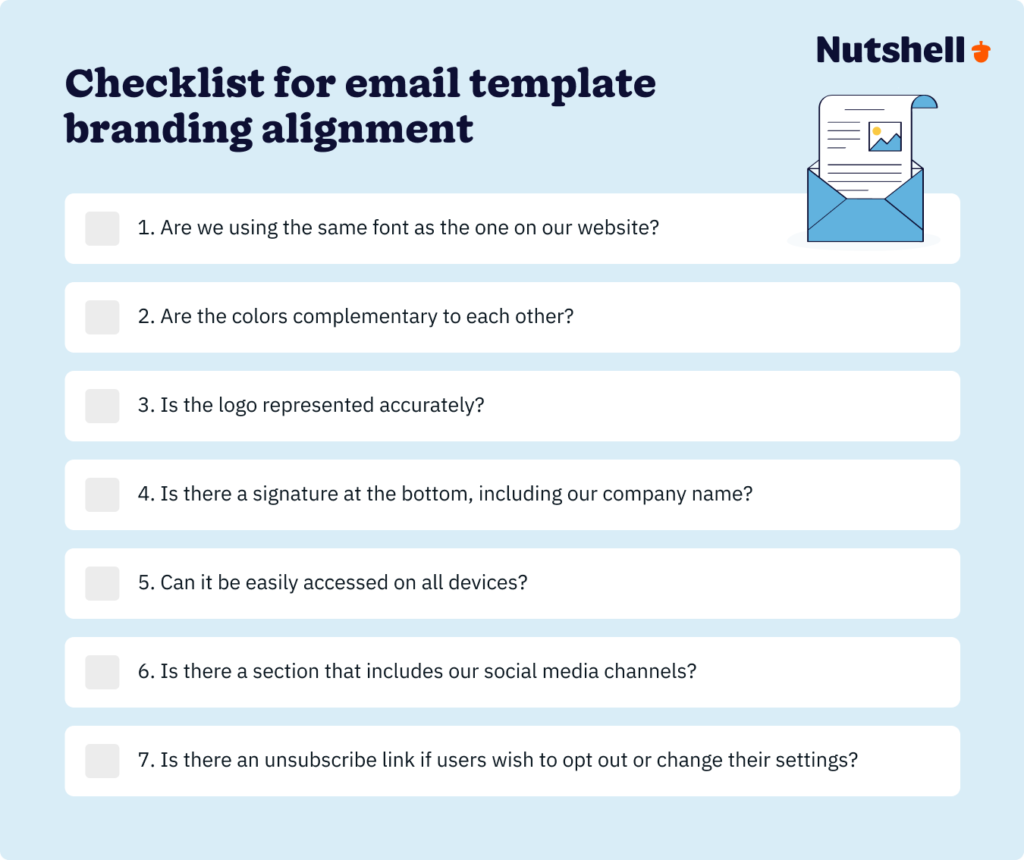
When creating an email template that aligns with your brand, here are some questions you can consider:
- Are we using the same font as the one on our website?
- Are the colors complementary to each other?
- Is the logo represented accurately?
- Is there a signature at the bottom, including our company name?
- Can it be easily accessed on all devices?
- Is there a section that includes our social media channels?
- Is there an unsubscribe link if users wish to opt out or change their settings?
Thanks to A/B testing, you can push out more than one version of your team’s templates and see which performs better. Some templates may work better for different segments of people.
The more data you can collect here, the more you will be able to reinforce brand recognition in a way that converts while also being easily recognized as coming from your brand.
Regardless of the templates you use, keep your brand guidelines in mind. Don’t create a neon green template if your brand is known for its soft yellow hues. Think of the branded emails within your marketing strategy as an extension of your website or app. The brand identity should be the same.
The same can be said for the tone of voice being used. If your brand is corporate consulting, you’ll need to keep it professional. If your brand is a beauty cosmetics brand, you can mix it up and have more fun.
No matter the direction you decide to go with, the tone and personality of your brand need to be consistent with all points of contact with your customers. This includes everything from the welcome email to the customer’s email inbox itself.
The tone should start with the welcome email and follow suit for every other message your brand sends.
Quick action checklist: Email templates
- Answer all seven template alignment questions from this section
- Review your last five email campaigns for visual consistency
- Create or update one branded email template that passes all seven checks
- Test the template on desktop, mobile, and tablet devices
- Save the approved template in your email platform for team use
- Schedule quarterly template audits to ensure ongoing brand alignment
Send and receive emails directly from Nutshell.


3. Get creative in the subject line
An inbox can be a crowded place, and the subject line of your emails within your marketing campaign is your first chance to stand out.
After you know which template works for which customers, you can also start to play around with the subject line. You’ll want to keep it concise but also enticing enough to the customer.
A simple glance at your subject line should give your customer a clear idea of what the email is about. For instance, if your brand offers a deal on a specific product, and the deal ends tonight, the subject line should tell customers that.
While the subject line gives you wiggle room to get creative and potentially have some fun, don’t stray from your tone. Doing so catches your customers off guard and reduces the likelihood that they’ll be reading what you remain have to say.
Quick action checklist: Mobile email strategy
- Send test emails to yourself and open them on smartphone and tablet
- Check that your logo displays clearly on small screens
- Verify that CTA buttons are large enough to tap easily (at least 44×44 pixels)
- Confirm email loads in under three seconds on mobile data
- Review font sizes (minimum 14px for body text on mobile)
- Test emails in both light mode and dark mode
4. Keep mobile in mind
85% of users use smartphones to access email. If you want your audience to read your email, you must write and format it so your customers can access it on their smartphones.
Doing so means you need to consider elements like:
- Font size
- Location of your call-to-actions, links, and logo
- Length
- Load time
Before you send out your email marketing campaign, it’s always a good idea to test how it’ll appear on smaller screens, from mobile devices to tablets, so it can reach and be readable to as many customers as possible.
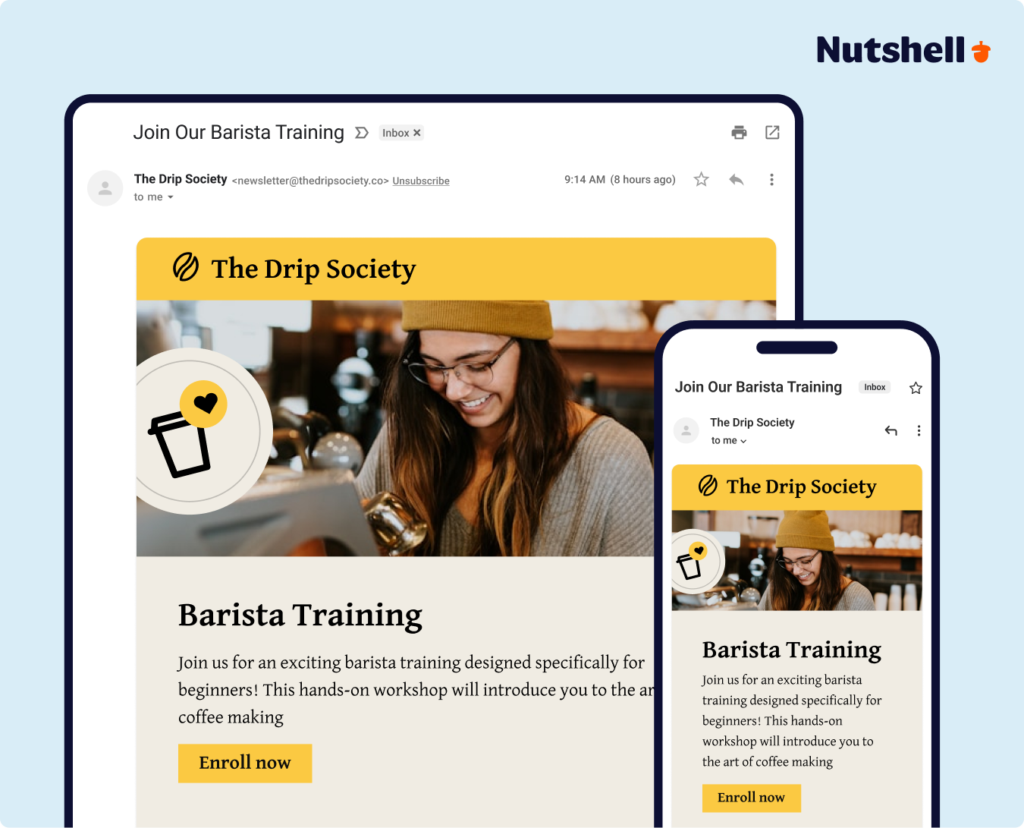
If you’ve only formatted your email for desktop readability, you’re losing out on a chance to reach the majority of your customers. They’ll also likely scroll right to the bottom and click unsubscribe instead of reading your email.
Quick action checklist: Mobile email strategy
- Send test emails to yourself and open them on smartphone and tablet
- Check that your logo displays clearly on small screens
- Verify that CTA buttons are large enough to tap easily (at least 44×44 pixels)
- Confirm email loads in under three seconds on mobile data
- Review font sizes (minimum 14px for body text on mobile)
- Test emails in both light mode and dark mode
5. Be entertaining

Utilizing your brand guidelines as part of your email marketing strategy allows you to stand out, entertain the readers, and showcase how you’re unique. How you decide to do this will depend on other factors, like your tone and what your email is actually saying.
As a good jumping-off point, consider that emails that contain graphics and GIFs have a better chance of performing than emails that are a single block of text.
It’s possible that you’re trying to keep it professional and a GIF won’t work, but a graphic will almost always work, no matter the message or tone.
Be more creative than just a stock photo — consider including photos of real employees, images from a workplace event, or even a video.
This is your chance for your audience to learn more about your company, its brand, and your products and services. It also allows you to humanize your brand and be authentic, so your customers can know real people are sitting behind the computer.
Quick action checklist: Be entertaining
- Identify three to five stories from your business that showcase your brand personality
- Gather authentic photos of your team, workplace, or customers (with permission)
- Create one email featuring a story or team member instead of just product information
- Add at least one relevant graphic or GIF to your next three email campaigns
- Track engagement on story-driven emails versus product-focused emails
6. Be consistent in sending emails
In addition to being consistent with your templates, branding, and tone — the same can be said for how often you click send.
For example, don’t bombard your subscribers with five emails in one week only to go completely silent the next. You should create an instance where the customer expects an email from your brand and is excited to open it and see what you have to say.
Similarly, unless you’re testing a new campaign strategy where you email your customers five days in one week, you don’t want to smother your customers, either.
The last thing you want is for one of your emails to appear in their inbox, only for their response to be, “again?!”. Give them some space while being consistent with how often they expect to hear from you.
Quick action checklist: Email consistency
- Analyze your email sending patterns over the past three months
- Choose a realistic sending frequency you can maintain (weekly, biweekly, monthly)
- Create a content calendar for the next 30 to 60 days
- Set up reminder systems or automation to maintain your schedule
- Communicate your email schedule to subscribers (“You’ll hear from us every Tuesday”)
DOWNLOAD
Want to generate more leads? Of course you do.
The B2B Marketer’s Toolkit collects 120+ of the best lead generation tips ever published on the Nutshell blog. Download it today!
7. Align your branded emails with your brand persona
Everything we’ve discussed thus far speaks to your brand’s image and voice as a whole. Together, they represent your brand persona—the “personality” behind your unique brand.
The core elements that inform your brand voice and image through email marketing include:
- Sticking with your brand’s core color palette
- Including your logo at strategic points
- Using the same fonts you use on your website and other branded assets
- Including photos of your team, products, etc.
- Ensuring your messaging stays true to your company vision
- Communicating in a tone that makes sense for your brand and audience
Combining these elements for cohesive email branding for your next campaign reinforces brand salience.
Quick action checklist: Aligning with your brand persona
- Document your brand’s core personality traits (professional, playful, authoritative, friendly, etc.)
- Review five recent emails and rate how well they reflect your brand persona
- Create a simple tone-of-voice guide for your email team (one page maximum)
- Update all email templates to include consistent brand elements (colors, fonts, logo)
- Test one email written in your defined brand voice and track engagement
8. Maintain brand consistency in automated emails
Your automated email sequences—welcome series, abandoned cart reminders, birthday emails, and follow-up sequences—often generate the highest engagement rates. But here’s the challenge: many businesses create these automations once and forget about them, leading to outdated branding or inconsistent messaging as the company evolves.
Why automation consistency matters
Welcome emails can achieve open rates of up to 69%, making them your highest-visibility touchpoint with new subscribers. If your welcome series uses last year’s logo or a different color scheme than your recent campaigns, you’ve immediately created brand confusion at the most critical moment in the customer relationship.
Best practices for automated email branding
- Audit your automations quarterly: Set a recurring calendar reminder to review all automated sequences. Check that logos, colors, fonts, and messaging align with your current brand guidelines.
- Use dynamic content for timely relevance: Incorporate elements that update automatically (like current product inventory, seasonal messaging, or location-specific information) while maintaining static brand elements.
- Test the entire sequence from start to finish: Don’t just review individual emails in isolation. Experience the full sequence as a subscriber would to ensure consistent branding throughout the journey.
- Maintain consistent tone across automation types: Your welcome series, transactional emails, and re-engagement campaigns should all sound like they come from the same company. Define your brand voice clearly and apply it to every automated touchpoint.
With Nutshell’s personal email sequences, you can set up automated follow-ups that maintain your brand consistency while saving hours of manual work. The platform remembers the follow-up for you, ensuring no lead falls through the cracks and every message reinforces your brand identity.
Quick action checklist: Maintain brand consistency
- List all automated email sequences currently running (welcome, abandoned cart, re-engagement, etc.)
- Walk through each automated sequence as a subscriber would experience it
- Check that logos, colors, and messaging match your current brand guidelines
- Update any outdated content, offers, or branding in automated emails
- Set quarterly calendar reminders to audit automations
- Document any dynamic content rules to ensure consistency
Skip the blank template—generate email campaigns with AI
Go from prompt to polished first draft in minutes with the 1-click AI email campaign builder!

Measuring the success of your email branding efforts
You’ve invested time in creating consistent, branded emails. Now you need to know if it’s working. While traditional metrics like open rates and click-through rates matter, email branding success requires a broader view of customer behavior and lifetime value.
Key metrics to track
Brand recognition metrics:
- Sender name recognition: Track how quickly new subscribers begin engaging with your emails. Faster initial engagement suggests strong sender name recognition.
- Direct traffic increases: Monitor direct traffic to your website after email sends. Strong email branding often leads to subscribers typing your URL directly into their browser.
- Survey feedback: Periodically ask subscribers, “How did you hear about us?” or “What channels do you engage with our brand through?” to measure brand awareness.
Engagement metrics:
- Open rates: While imperfect due to privacy changes, open rates still indicate subject line and sender name effectiveness.
- Click-through rates: Track CTR by email type (welcome, promotional, nurture) to identify which branded templates perform best.
- Unsubscribe rates: Higher rates might indicate inconsistent branding or messaging that doesn’t align with subscriber expectations.
Revenue attribution metrics:
- Email-attributed revenue: Track purchases, demo requests, or conversions that occur after email clicks. Email marketing’s average ROI of 4,200% makes this metric crucial.
- Customer lifetime value by acquisition source: Compare the lifetime value of customers acquired through email versus other channels. Strong email branding often correlates with higher customer retention and LTV.
- Conversion rates: Track how many email recipients complete desired actions (download resources, request demos, make purchases). Consistent branding builds trust, which typically improves conversion rates over time.
Advanced tracking with connected systems
When your email marketing connects directly to your CRM (like it does with Nutshell), you can track metrics that isolated email platforms miss:
- Deal progression: See which email campaigns move deals through your pipeline most effectively
- Multi-touch attribution: Understand how email branding works alongside other marketing touchpoints to close deals
- Engagement scoring: Automatically score leads based on email engagement combined with CRM activities
- Revenue per email type: Calculate actual revenue generated by different branded email templates to optimize future campaigns
The most successful businesses in 2026 don’t just track vanity metrics—they connect email performance directly to revenue impact and use that data to continuously refine their email branding strategy.
Next steps: Your 90-day email branding roadmap
Implementing all these email branding strategies at once feels overwhelming. Instead, use this phased approach to build consistency gradually while generating results along the way.
Days one to 30: Foundation phase
Week 1:
- Audit your current email branding across all campaigns and automations
- Document your brand elements (logo, colors, fonts, tone)
- Choose consistent sender name and email address
- Implement email authentication (SPF, DKIM, DMARC)
Week 2:
- Create or update one core email template that passes the seven-question test
- Test the template on multiple devices and email clients
- Update your welcome email series with consistent branding
Week 3:
- Review existing email list segmentation
- Identify three to five key audience segments for personalization
- Begin personalizing highest-volume emails (welcome series, weekly newsletter)
Week 4:
- Establish consistent sending schedule
- Create 30-day content calendar
- Measure baseline metrics (open rates, click rates, conversions)
Expected outcomes: Improved sender recognition, fewer unsubscribe complaints about “who is this?”, and establishment of consistent brand presence.
Days 31 to 60: Expansion phase
Week 5:
- Audit all automated email sequences for brand consistency
- Update outdated logos, colors, or messaging in automations
- Implement mobile optimization improvements
Week 6:
- Develop subject line formula bank based on past performance
- Test three subject line variations in next campaign
- Add visual elements (graphics, photos) aligned with brand personality
Week 7:
- Create location-based or behavior-based personalization for at least one campaign
- Test personalized version against generic version
- Document results and learnings
Week 8:
- Review 30-day metrics against baseline
- Identify top-performing branded emails
- Create template variations for different email types (promotional, educational, nurture)
Expected outcomes: 10 to 20% improvement in open rates from sender name recognition, measurable increase in click-through rates from improved templates, and higher engagement from personalization.
Days 61 to 90: Optimization phase
Week 9:
- Implement winning personalization tactics across more campaigns
- Create or update FAQ emails with brand-consistent formatting
- Add social proof and customer stories that showcase brand personality
Week 10:
- Test omnichannel consistency (ensure email branding matches website, social media)
- Expand segmentation to reach more specific audience groups
- Create branded templates for team members sending one-to-one emails
Week 11:
- Analyze revenue attribution from email campaigns
- Calculate actual ROI from branded email improvements
- Document successful tactics for ongoing use
Week 12:
- Set up quarterly email branding audit process
- Train team members on brand consistency guidelines
- Plan next quarter’s email content with brand alignment in mind
Expected outcomes: Measurable revenue impact from improved email branding, team-wide adoption of consistent templates, and established processes for maintaining brand consistency long-term.
Tools that accelerate the timeline
This 90-day roadmap assumes you’re building email branding manually. Platforms like Nutshell that integrate CRM and email marketing can compress this timeline significantly:
- Pre-built templates reduce design time from weeks to hours
- Automatic CRM data sync eliminates manual personalization work
- Built-in testing tools speed up optimization
- Connected analytics show revenue impact without complex tracking setup
Start your roadmap today, and within 90 days, you’ll have a consistent, recognizable email brand that drives measurable business results.
Ready, set, send
After you’ve created the templates using design guidelines, written the copy, and previewed the email on varying screen sizes, it’s finally time to click send. Remember that Rome wasn’t built in a day and that it’s okay if the first email within your marketing campaign isn’t a viral success.
Stick to your strategy and your customers will soon know what makes your business different from all the rest.
Plan and design world-class email marketing campaigns with our Nutshell’s email marketing feature. Try it for free today when you sign up for a 14-day trial with Nutshell!
Marketing email branding FAQs
-
1. What is the 80/20 rule in email marketing?
The 80/20 rule means 80% of your emails should provide value without asking for anything—like educational content, tips, or resources—while only 20% should be promotional or sales-focused. This balance builds trust and prevents subscriber fatigue while maintaining engagement.
-
2. What is the 60/40 rule for email design?
The 60/40 rule recommends using at least 60% text and maximum 40% images in your emails to avoid spam filters. Include at least 400 characters of readable text, use HTML buttons instead of image CTAs, and always add alt text to images for better deliverability.
-
3. How do I measure the success of my email branding efforts?
Track key metrics including open rates (20-30% is good), click-through rates (2-5% average), conversion rates, and overall ROI. Monitor brand-specific indicators like consistent template usage, engagement with branded content, and how email campaigns impact deal progression in your CRM.
-
4. What are common email branding mistakes to avoid?
Avoid using image-only emails, inconsistent sender names, mismatched design elements from your website, generic templates without personalization, and forgetting mobile optimization. Also, don’t neglect testing emails across different clients or skip including proper unsubscribe links and company information.
-
5. How long does it take to see results from email branding?
Most businesses see initial improvements in recognition and engagement within 30 to 60 days of implementing consistent email branding. However, the full impact on customer loyalty and lifetime value typically takes three to six months to materialize. Email branding is a cumulative effort—each consistent touchpoint builds on the previous one. Start with your highest-volume emails (like welcome series and weekly newsletters) to accelerate results.
-
6. What’s the difference between email branding and email marketing?
Email marketing refers to the overall strategy of using email to communicate with customers and drive business results. Email branding is a subset focused specifically on how you present your brand identity through visual elements (logo, colors, typography), voice and tone, sender information, and template consistency. Strong email branding makes your email marketing more effective by building recognition and trust with every message.
-
7. Do I need a designer to implement email branding?
Not necessarily. While professional design helps, many email platforms (including Nutshell) provide branded templates that non-designers can customize with your logo, colors, and content. Start with your existing brand guidelines—even basic consistency in fonts, colors, and logo placement significantly improves brand recognition. As your email program matures and generates revenue, investing in custom template design becomes worthwhile.
-
8. How often should I update my email branding?
Your core email branding elements (logo, primary colors, typography) should remain consistent for at least one to two years to build recognition. However, you can refresh secondary elements (imagery style, layout variations, seasonal accents) more frequently to keep emails feeling current. Major rebrands require updating all email templates immediately to maintain consistency across all customer touchpoints. Set quarterly reviews to ensure your automated email sequences reflect any minor brand evolution.
-
9. How do I maintain brand consistency across different email types?
Create a simple brand guide specifically for email that covers sender name, logo placement, color palette, typography, image style, and tone of voice. Then create template variations for different email types (promotional, educational, transactional) that all follow these guidelines while adapting layouts to their specific purposes. When using platforms like Nutshell that integrate CRM and email, you can save branded templates for different scenarios and trust that your team will maintain consistency even when sending one-to-one emails.
NO CREDIT CARD REQUIRED
Want to kick the tires a bit?
No problem. To see if Nutshell is the right choice for your sales team, start a 14-day free trial today!
 BACK TO TOP
 Written by
Will Gordon Sr. Director of MarketingEdited by
Andy Fowler Co-FounderReady to try
Nutshell for Free?Thank you! Your submission has been received!Oops! Something went wrong while submitting the form.




Nutshell Is the Best CRM for Zoom: AI Transcriptions, Summaries, and More
Published on: April 7, 2025
Highly Effective Strategies for Elevating Sales Team Performance
Published on: November 10, 2022Establishing a System for CRM Data Entry and Management
Published on: April 11, 2023Introducing Nutshell Forms Spam Prevention
Published on: April 22, 2024Join 30,000+ other sales and marketing professionals. Subscribe to our Sell to Win newsletter!