14 Welcome Email Templates for Every Stage of Your Customer Journey

-
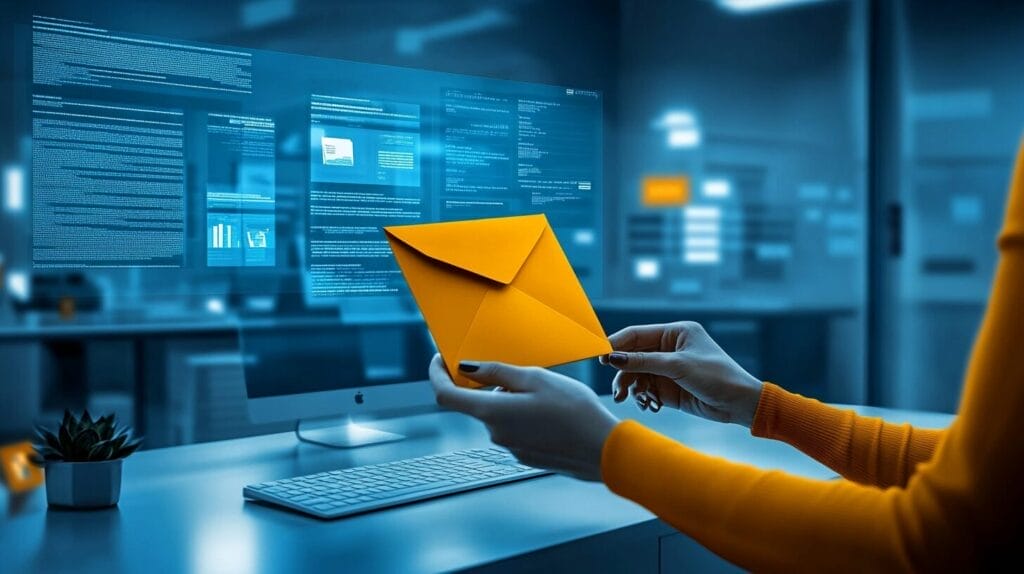
Quick answer: What makes a good welcome email?
A good welcome email greets new subscribers or customers immediately, delivers clear value, and includes a strong, single call to action—all wrapped in personalized, on-brand messaging. Welcome emails are some of the highest-performing messages you can send, with open rates far above standard emails, yet many brands skip them entirely.
For the best results, send a short sequence of two to three emails rather than a single message, and automate it through your CRM to stay consistent.
Key takeaways
-
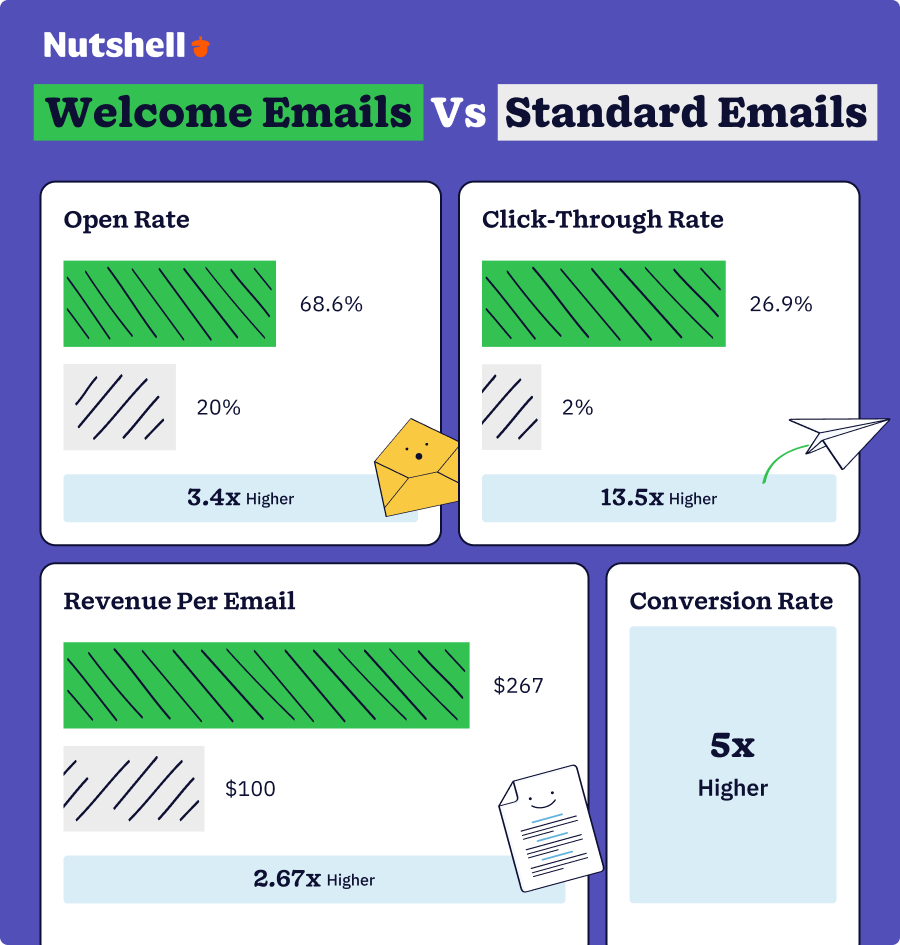
Welcome emails are high-performing yet underused—they achieve 68.6% open rates and 26.9% click-through rates, significantly higher than standard emails. They generate up to 320% more revenue than other promotional emails, making them critical for onboarding and early engagement.
- A 3-email welcome sequence generates 90% more orders than a single email—timing matters. The optimal sequence includes emails sent on Day 0 (immediate welcome), Day 1 (value delivery), and Day 2-3 (social proof or engagement).
-
Personalization and clarity are essential—elements like recipient names, videos, and strong CTAs help establish trust and guide new contacts toward action. Automated welcome emails have 80% open rates and 26% CTR.
-
CRM integration maximizes impact—using tools like Nutshell to automate, track, and personalize welcome emails ensures consistency and increases conversion potential across the customer journey.
- Only 57.7% of brands send welcome emails—this represents a massive opportunity. 74% of subscribers expect to receive a welcome email immediately after signing up, yet most brands are missing this critical touchpoint.
Automate your welcome emails with Nutshell!
Set it and forget it! Nutshell’s email automation lets you send personalized welcome messages to your contacts, keeping prospects engaged from the start!

When a prospect makes the decision to become your customer, you want to roll out the red carpet for them.
That’s just as true for a website visitor who subscribes to your newsletter or other marketing content. In both cases, a person has made a commitment to your company based on what you’ve shown them so far, and you have a wonderful opportunity to capitalize on that positive sentiment.
Considering that welcome emails boast four times the open rate and five times the click-through rate of a standard email, it’s important to ensure that your content is on its A-game. After all, your welcome email sets the foundation of your branding and helps to establish the connection you have with your customers or potential customers.
14 welcome email templates at a glance
Looking for a specific template type? Here’s a quick overview of all 12 templates covered in this guide:
- Discount Code Welcome Emails—Best for: E-commerce and retail businesses offering immediate incentives to drive first purchases
- Personalized Video Welcome Emails—Best for: SaaS and service-based businesses wanting to create personal connection and stand out
- Free Trial Welcome Email Campaigns—Best for: Software companies converting trial users to paid customers and guiding product adoption
- Brand Promise Welcome Emails—Best for: Mission-driven brands establishing emotional connection and shared values with customers
- Storytelling Welcome Emails—Best for: Businesses with compelling origin stories wanting to build emotional bonds through narrative
- Community-Focused Incentive Welcome Emails—Best for: Loyalty programs and membership-based businesses encouraging ongoing engagement
- Hybrid Confirmation and Welcome Emails—Best for: Newsletter signups and double opt-in processes requiring email verification
- Welcome Emails from an Actual Human Being—Best for: Founder/CEO personal touch and B2B relationship building with credibility
- “Welcome to Your Trial” Emails—Best for: SaaS free trials and product onboarding sequences clarifying trial terms and next steps
- Product-Focused Welcome Emails—Best for: Product introductions and feature highlights showcasing key capabilities and benefits
- Free Gift Welcome Emails—Best for: Immediate value delivery and conversions generating goodwill and first customer action
- “Thanks for Subscribing” Welcome Emails—Best for: Newsletter and content download confirmations setting expectations for future emails
- Reminder Emails—Best for: Re-engagement and reactivating inactive users who haven’t taken action
- Onboarding Welcome Emails—Best for: Customer success and value realization guiding customers to success milestones
Each template includes customizable text, real-world examples, key elements to include, and performance expectations based on industry data.
How we selected these welcome email templates
We didn’t just pick random templates. Our selection process was rigorous and data-driven, ensuring every template in this guide has been proven to work in real-world scenarios.
Our research methodology
We analyzed insights from:
- 950+ onboarding and implementation professionals surveyed in the 2025 State of Customer Onboarding Report
- 100+ SaaS companies’ welcome sequences reviewed and benchmarked
- Email marketing data from 2024-2025 including open rates, click-through rates, and conversion metrics
- Real-world case studies showing welcome email sequence performance
- Industry best practices from leading email marketing platforms and CRMs
Selection criteria
Each template was evaluated against these criteria:
- Performance Data: Templates with documented open rates (target: 68.6%), click-through rates (target: 26.9%), and conversion metrics (target: 5x higher than standard emails)
- Real-World Effectiveness: Proven results from case studies, industry reports, and customer implementations
- Versatility: Templates applicable across multiple industries—B2B, B2C, SaaS, e-commerce, services, and more
- Ease of Implementation: Templates that can be quickly customized and deployed without technical expertise
- Personalization Potential: Templates that support dynamic content, segmentation, and customization based on customer data
- Automation-Ready: Templates designed to work with email automation platforms and CRM systems like Nutshell
What each template includes
For every template in this guide, you’ll find:
- Clear use case and “best for” statement — Understand exactly when and why to use this template
- Customizable template text — Copy-paste ready text with [placeholders] for your specific information
- Real-world example — See how actual companies use this template type
- Key elements to include — Understand the critical components that make this template work
This ensures you have access to templates that have been proven to work across different business types, customer segments, and industries.
What is a welcome email?
So, what exactly is a welcome email? It’s not necessarily your “first impression” with a buyer since the recipient has already engaged with your sales team or marketing content. More accurately, a welcome email is the first communication that you send when a buyer reaches a new stage in your relationship.
Typically, you’ll send a welcome email soon after someone gives you their email address for the first time, such as when they sign up for your newsletter, download a guide from your website, or start a free trial.
Why send welcome emails?
So, why is it important to send welcome emails? Here are some of the main benefits:
- They help establish the relationship: When someone signs up for your email list, they expect to receive a welcome email to confirm their signup and kick off their relationship with your brand. Not sending a welcome email is a little like ignoring a customer when they walk into your store.
- They create trust and credibility: A well-crafted welcome email can significantly impact your brand’s credibility. By delivering on what you promised during sign-up, you start establishing trust, a cornerstone of any successful relationship.
- They open the door to further engagement: Welcome emails have higher open rates than most promotional emails. It’s the moment when your audience is most attentive—take advantage of this prime opportunity to share valuable information, special offers, or exclusive content that moves the reader further down the funnel.
- Lastly, welcome emails lead to revenue: Only 58% of brands send a welcome email to new customers, yet on average, welcome emails generate up to 320% more revenue than other promotional emails.
Welcome email templates
Welcome emails are an effective means of connecting with consumers transitioning from prospect to interested customer. Whether they sign up for your newsletter or enroll in your loyalty program, they’re committing to your business in a small way. You have an opportunity to capitalize on this relationship.
As of 2023, there were 4.37 billion daily email users, a number that could jump to 4.89 billion by 2027. Inboxes are busy and competitive, and knowing how to craft an inviting, eye-catching email is crucial. The right welcome email can guide those on your list further down the sales funnel and one step closer to becoming paying shoppers.
Explore the following welcome email templates and helpful tips for engaging new customers.
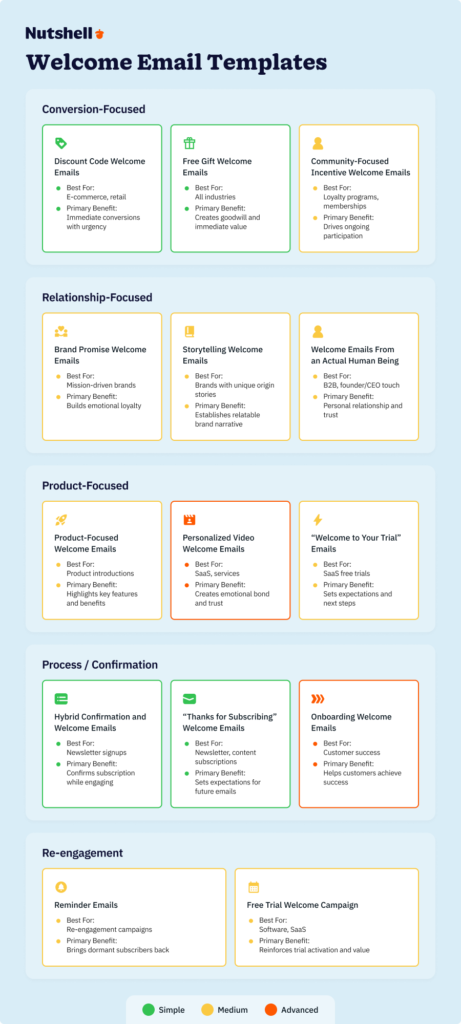
Welcome email templates comparison table
Template Type Best For Key Benefit Discount Code Welcome Emails E-commerce, retail Immediate conversions with urgency Personalized Video Welcome Emails SaaS, services Creates emotional bond and trust Free Trial Welcome Emails Software, SaaS Guides users to product value Brand Promise Welcome Emails Mission-driven brands Builds emotional loyalty Storytelling Welcome Emails Businesses with unique origin stories Establishes relatable brand narrative Community-Focused Incentive Welcome Emails Loyalty programs, memberships Drives ongoing participation Hybrid Confirmation and Welcome Emails Newsletter signups Confirms subscription while engaging Welcome Emails From an Actual Human Being B2B, founder/CEO touch Personal relationship and trust “Welcome to Your Trial”
EmailsSaaS free trials Sets expectations and next steps Product-Focused Welcome Emails Product introductions Highlights key features and benefits Free Gift Welcome Emails All industries Creates goodwill and immediate value “Thanks for Subscribing” Welcome Emails Newsletter, content subscriptions Sets expectations for future emails Reminder Emails Re-engagement Brings dormant subscribers back Onboarding Welcome Emails Customer success Helps customers achieve success 💡 Pro Tip: Choose your template based on your primary goal. If you want immediate conversions, use discount code or free gift templates. If you want to build long-term relationships, use storytelling or brand promise templates. Most successful welcome sequences use 2-3 different template types in combination.
1. Discount code welcome emails
Best for: E-commerce businesses, retail companies, and any business offering immediate incentives to new customers
Quick summary: Discount code welcome emails provide immediate value to new subscribers by offering a special offer or discount code. This template is highly effective for driving first purchases and generating quick conversions while the subscriber’s interest is at its peak. Use this template when your primary goal is to convert new subscribers into paying customers immediately.
Key features:
- Personalized greeting with subscriber’s first name
- Clear confirmation of signup action
- Specific discount amount and expiration date
- Prominent discount code display for easy copying
- Clear call-to-action (CTA) to use the code at checkout
- Information about what to expect from future emails
- Mobile-optimized design for easy reading on smartphones
Pros:
- Drives immediate first purchase while interest is highest
- Creates sense of urgency with expiration date
- Provides measurable ROI through discount code tracking
- Increases customer lifetime value through early engagement
- Works across all industries and business models
- Simple to implement and customize
- Generates quick feedback on offer effectiveness
Cons:
- May attract price-sensitive customers only
- Can reduce profit margins if discount is too generous
- May train customers to expect discounts on future purchases
- Requires careful tracking of discount code usage
- May not build long-term brand loyalty
- Could lead to higher return rates if discount attracts wrong audience
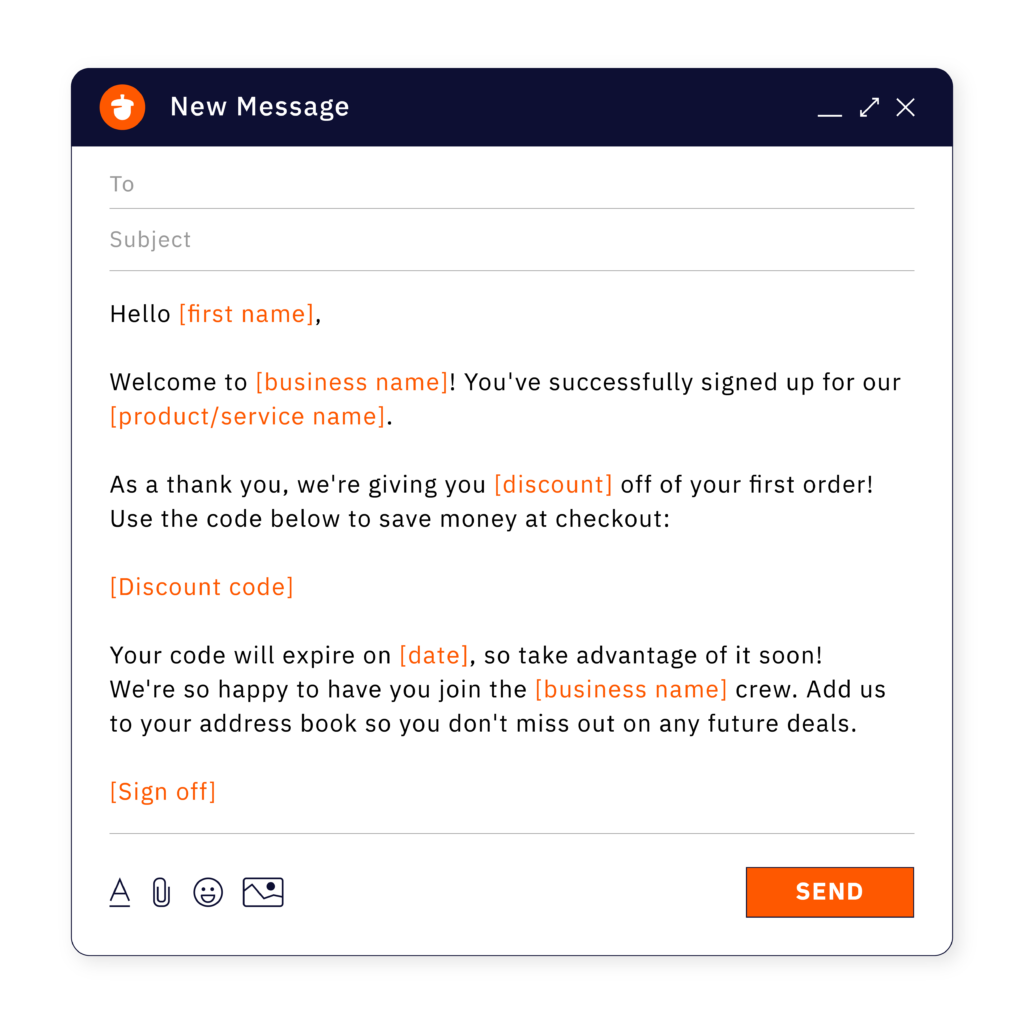
Discount code welcome email template:
Subject line: [First name], here’s your exclusive welcome offer
Hello [first name],
Welcome to [business name]! You’ve successfully signed up for our [product/service name].
We’re thrilled to have you join our community, and we want to show our appreciation with an exclusive offer just for you.
As a thank you, we’re giving you [DISCOUNT AMOUNT]% off your first order!
Use the code below at checkout to claim your discount:
[DISCOUNT CODE]
Your code will expire on [DATE], so take advantage of this offer soon!
What to expect from us: We’ll send you helpful tips, exclusive deals, and updates about new products—but we promise to keep it relevant and not overwhelming. You can manage your preferences anytime.
Add us to your address book so our emails don’t end up in your spam folder.
Ready to get started? [SHOP NOW]
Questions? Reply to this email or contact us at [support email/phone].
Best regards,
[Your name]
[Your title]
[Business name]
Real-world discount code welcome email example:
[Existing image of Nutshell email template]
This example from a leading e-commerce retailer demonstrates how to present a discount code prominently while maintaining brand consistency and setting clear expectations about future communications. Notice how the discount code is highlighted in a contrasting color and the expiration date creates urgency.
When to use this template:
- You have a new product launch and want to drive initial sales
- You’re running a seasonal promotion and want to capture new customers
- Your primary goal is immediate revenue generation
- You’re in a competitive market and need to incentivize first purchase
- You want to test product-market fit quickly
How to customize this template:
- Test the email on mobile devices before sending
- Replace [first name] with dynamic personalization from your email platform
- Insert your specific discount amount (e.g., 15%, $20 off, free shipping)
- Set an expiration date that creates urgency (typically 7-14 days)
- Use a unique discount code that’s easy to remember and track
- Link the CTA button to your product page or checkout
2. Personalized video welcome emails
Best for: SaaS companies, service-based businesses, and any company wanting to create personal connection and stand out from competitors
Quick summary: Personalized video welcome emails incorporate video content to make your message stand out and impress customers. Videos create a personal, one-on-one experience that builds trust and emotional connection. This template is especially effective for SaaS companies introducing product features or service providers explaining their approach.
Key features:
- Personalized greeting acknowledging the subscriber by name
- Clear explanation of why they’re receiving the email
- Introduction to the video content and what they’ll learn
- Video thumbnail with play button (or embedded video if supported)
- Brief text summary of video content
- Clear call-to-action to watch the video
- Alternative link for email clients that don’t support video
- Information about next steps after watching
- Mobile-optimized design for video viewing
Pros:
- Creates personal, one-on-one connection that builds trust
- Video content has higher engagement rates than text alone
- Demonstrates product features or services visually
- Founder/team videos add credibility and personality
- Videos are memorable and increase brand recall
- Can be personalized with subscriber’s name in intro
- Increases time spent engaging with your brand
- Higher click-through rates compared to text-only emails
Cons:
- Requires video production resources and skills
- Not all email clients support embedded video
- Video file sizes can slow email load times
- Requires fallback image and link for non-video clients
- May not work well for all industries or messages
- Requires testing across different email platforms
- Video hosting and bandwidth costs
Personalized video welcome email template:
Subject line: [First name], I created this just for you
Hi there, [first name]!
You are officially part of the [business name] family!
We want to personally thank you for joining our email list and share some helpful advice on getting started with [product/service name].
I recorded a quick video just for you that covers:
- How to get the most out of [product/service]
- Our top tips for [specific benefit]
- Exclusive resources available to our community
Watch the video below (it’s only 3 minutes):
[VIDEO THUMBNAIL WITH PLAY BUTTON] or [CLICK HERE TO WATCH]
Can’t watch right now? No problem—you can watch anytime by clicking the link above.
What’s next: After you watch, reply to this email with any questions. I read every response personally and love hearing from our community.
Over the next few weeks, we’ll be sending you more helpful tips, exclusive offers, and behind-the-scenes updates. But first, watch the video and let me know what you think!
Thank you for joining us. We can’t wait to show you what we have in store!
Best regards,
[Your name]
[Your title]
[Business name]
P.S. — Add us to your address book so our emails don’t end up in your spam folder
Real-world personalized video welcome email example:

This example from a leading SaaS company demonstrates how to present a video prominently while providing a clear call-to-action and alternative link for email clients that don’t support embedded video. The personal tone and specific benefits listed create curiosity and encourage clicks.
When to use this template:
- You want to introduce your product or service visually
- Your founder/CEO wants to personally welcome new customers
- You have a complex product that benefits from visual explanation
- You want to build personal connection and trust
- You’re in a competitive market and want to stand out
- You have video production resources available
How to customize this template:
- Record a 2-3 minute personalized video (keep it short and focused)
- Host the video on YouTube, Vimeo, or your own server
- Create a thumbnail image with a play button overlay
- Replace [first name] with dynamic personalization
- Customize the benefits listed based on your product
- Include a clear link to the video as fallback
- Test on multiple email clients before sending
- Track video plays and engagement metrics
3. Free trial welcome email campaigns
Best for: Software companies, SaaS platforms, and any business offering free trials to convert users to paid customers
Quick summary: Free trial welcome emails are sent to users who have just signed up for a free trial of your product or service. These emails set expectations, provide resources, and guide users toward experiencing product value. This template is critical for converting trial users to paying customers by helping them succeed quickly.
Key features:
- Warm welcome message thanking them for signing up
- Clear statement that trial has started and duration
- Direct link to access the product/trial
- Overview of key features they should explore
- Links to helpful resources (tutorials, documentation, webinars)
- Contact information for support and questions
- Information about what happens when trial ends
- Clear call-to-action to start using the product
- Mobile-optimized design for easy access
Pros:
- Sets clear expectations about trial duration and features
- Provides immediate access to product
- Reduces friction by including helpful resources
- Increases trial activation rates
- Helps users experience product value quickly
- Reduces support burden by providing self-service resources
- Creates opportunity to track trial usage and engagement
- Positions company as helpful and customer-focused
Cons:
- Requires good product documentation and resources
- May not convert all trial users to paying customers
- Requires follow-up emails to nurture trial users
- Needs clear communication about trial limitations
- May require support team to handle trial questions
- Trial period needs to be long enough for value realization
- Requires tracking of trial usage and engagement
Free trial welcome email template:
Subject line: Your [product name] trial is ready to go!
Hello [first name],
Thanks for signing up for [product/service name]! Your [timeframe] free trial begins today!
Your trial access link: [CLICK HERE TO START YOUR TRIAL]
What you can do during your trial:
- Access all features of [product name]
- Import your data from [competitor/previous system]
- Create and manage [key feature]
- Collaborate with your team
- Generate reports and analytics
- Get priority support from our team
Getting started:
- Click the link above to access your trial
- Complete your profile setup (takes 5 minutes)
- Explore our [guided tour/tutorial] to learn the basics
- Import your data or create a test project
- Reach out if you have any questions
Helpful resources:
- [Getting Started Guide] — Learn the basics in 10 minutes
- [Video Tutorials] — See how to use key features
- [Knowledge Base] — Find answers to common questions
- [Live Webinar] — Join us [day/time] for a product walkthrough
Questions or need help? Our support team is here to help! Contact us at: [support email] [phone number] [live chat link]
What happens next: Your trial includes full access to all features for [timeframe]. After your trial ends, you can upgrade to a paid plan to continue using [product name]. We’ll send you a reminder before your trial expires.
We’re excited to show you what [product name] can do for your [business/team]. Let’s get started!
Best regards,
[Your name]
[Your title]
[Business name]
P.S. — Need a longer trial period? Reply to this email and we can discuss options.
Real-world free trial welcome email example:
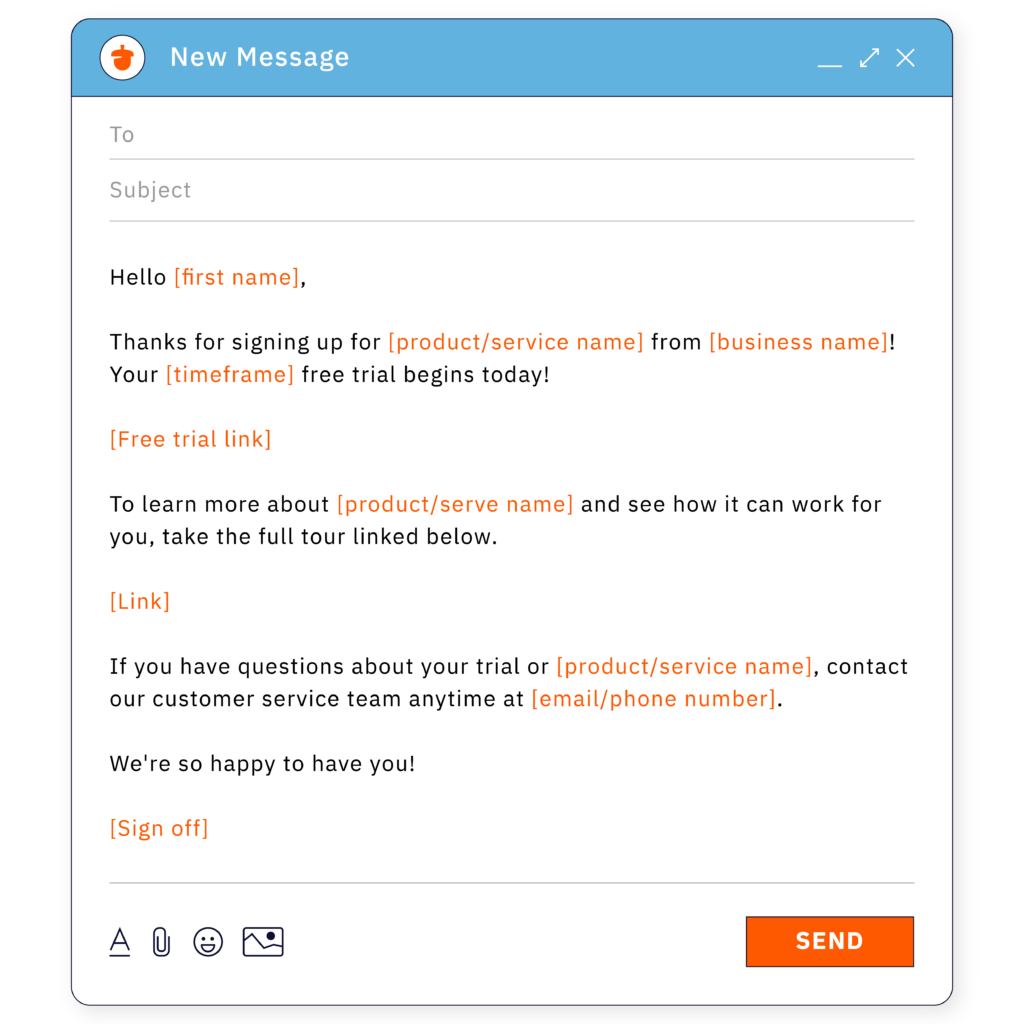
This example from a leading SaaS company demonstrates how to provide clear trial access, set expectations, and offer multiple support options. The structured format with clear sections makes it easy for trial users to understand what they can do and how to get help.
When to use this template:
- You offer a free trial of your product or service
- You want to increase trial activation rates
- You need to guide users toward experiencing product value
- You want to reduce support burden with self-service resources
- You’re converting trial users to paying customers
- You have good documentation and support resources available
How to customize this template:
- Replace [product name] with your actual product name
- Specify trial duration (e.g., 14 days, 30 days)
- List actual features available in trial
- Include real links to your trial access, tutorials, and support
- Customize support contact information
- Add specific getting started steps for your product
- Include links to your most helpful resources
- Test the email and all links before sending
- Set up follow-up emails for trial engagement tracking
4. Brand promise welcome emails
Best for: Mission-driven brands, nonprofits, and companies with strong values wanting to establish emotional connection and shared values with customers
Quick summary: Brand promise welcome emails focus on establishing an emotional connection by sharing your company’s mission, values, and vision. This template is ideal for mission-driven brands that want customers to feel part of something bigger than just a transaction. Use this when your primary goal is to build long-term loyalty and emotional engagement.
Key features:
- Personalized greeting acknowledging the subscriber by name
- Clear statement of company mission and core values
- Explanation of what the brand stands for
- Invitation to be part of the brand’s mission
- Social sharing opportunities with branded hashtags
- Incentive for sharing the brand promise with others
- Call-to-action to engage with the brand community
- Mobile-optimized design for easy sharing
Pros:
- Creates emotional connection beyond transactional relationships
- Builds brand loyalty and customer advocacy
- Attracts like-minded customers who share your values
- Encourages social sharing and word-of-mouth marketing
- Differentiates your brand from competitors
- Creates sense of community and belonging
- Increases customer lifetime value through emotional engagement
- Generates authentic brand ambassadors
Cons:
- Requires clear, authentic brand values and mission
- May not resonate with all customer segments
- Requires consistent delivery on brand promise
- May attract customers primarily for values, not products
- Requires ongoing communication about mission alignment
- May limit market reach to values-aligned customers only
- Requires authenticity—customers can detect insincerity
Brand promise welcome email template:
Subject line: [First name], welcome to the [Brand Name] mission
Hi there, [first name],
Thanks for joining the [business name] mission, and welcome!
At [business name], we believe in [core value 1], [core value 2], and [core value 3]. We’re committed to [specific mission statement] and providing [product/service] that makes a real difference.
When you joined us today, you became part of a community of people who share these values and want to create positive change. We’re thrilled to have you on this journey with us.
Here’s what we’re building together:
- [Mission impact 1]
- [Mission impact 2]
- [Mission impact 3]
Want to amplify our impact? Share the love on social media with [brand hashtag] or send [link] to a friend who shares our values. For every person who joins through your referral, we’ll [special offer/donation/impact].
What to expect from us: We’ll keep you updated on our mission progress, share stories from our community, and invite you to participate in initiatives that matter. We promise to stay true to our values in everything we do.
Questions or ideas? We’d love to hear from you. Reply to this email with your thoughts, suggestions, or stories about why our mission matters to you.
Thank you for being part of something bigger.
Best regards,
[Your name]
[Your title]
[Business name]
P.S. — Add us to your address book so you don’t miss updates about our mission and community initiatives.
Real-world brand promise welcome email example:
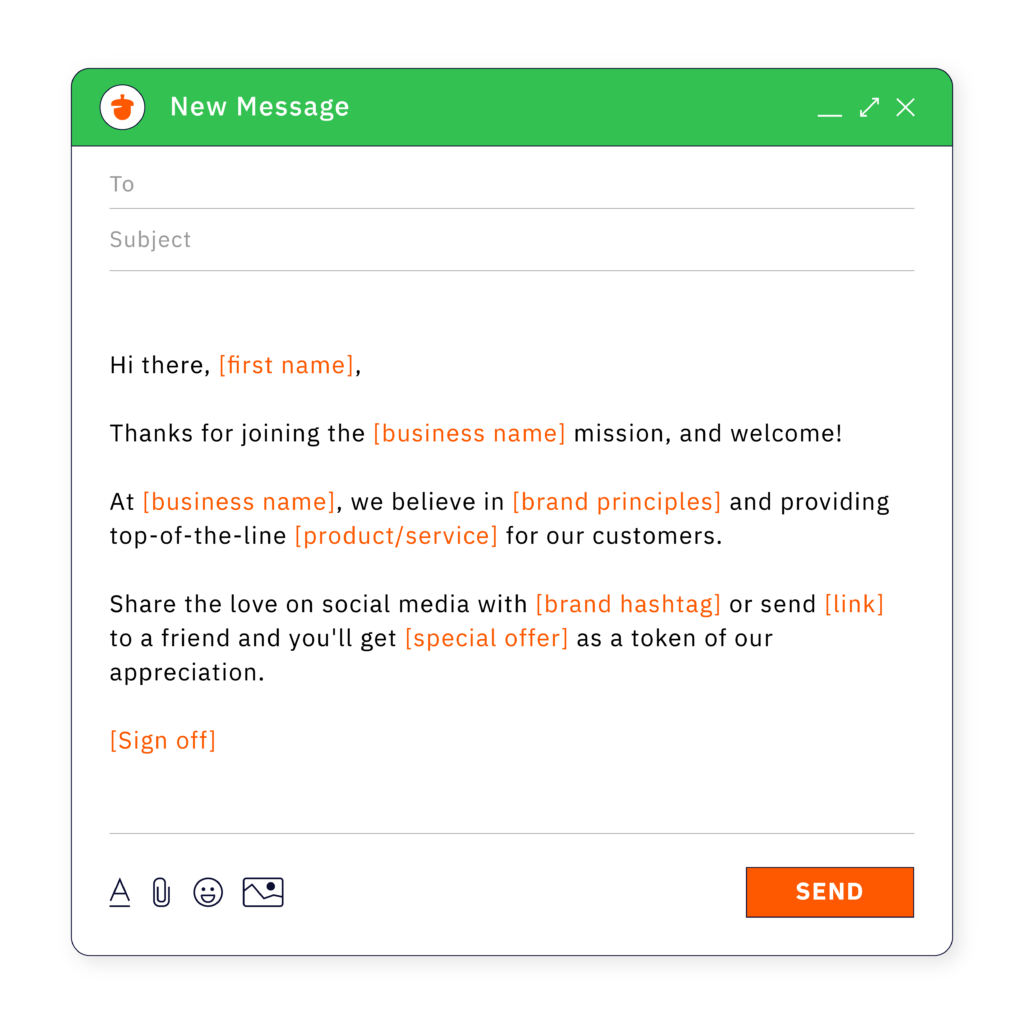
This example from a mission-driven brand demonstrates how to communicate core values clearly while inviting subscribers to be part of something larger. Notice how the email emphasizes shared values and community rather than product features.
When to use this template:
- Your brand has a clear mission and strong values
- You want to attract values-aligned customers
- Your primary goal is building long-term loyalty
- You want to create brand advocates and ambassadors
- You’re in a mission-driven industry (nonprofit, sustainability, social impact)
- You want to differentiate from competitors on values
How to customize this template:
- Clearly articulate your core values and mission statement
- Replace [core value 1-3] with your actual brand values
- Explain the specific mission impact in [mission impact 1-3]
- Create a branded hashtag for [brand hashtag]
- Decide on a meaningful incentive for referrals
- Customize the “what to expect” section based on your communication plan
- Include a clear way for subscribers to engage with your mission
- Test the email on mobile devices before sending
5. Storytelling welcome emails
Best for: Businesses with compelling origin stories, founder-led companies, and brands wanting to build emotional bonds through narrative and shared experiences
Quick summary: Storytelling welcome emails use narrative to create emotional connection by sharing your business’s origin story, challenges overcome, and vision for the future. This template is powerful for founder-led companies and businesses with authentic, relatable stories. Use this when your primary goal is to build trust and emotional engagement through authentic storytelling.
Key features:
- Personalized greeting acknowledging the subscriber
- Hook that introduces a relatable problem or pain point
- Origin story explaining why the business was created
- Challenges overcome and lessons learned
- How the product/service solves the original problem
- Vision for the future and impact
- Invitation to be part of the story
- Clear call-to-action to engage with the brand
- Mobile-optimized design for easy reading
Pros:
- Creates deep emotional connection through narrative
- Makes brand memorable and relatable
- Builds trust through authentic storytelling
- Differentiates brand from competitors
- Increases customer loyalty and advocacy
- Encourages sharing and word-of-mouth marketing
- Humanizes the brand and founder
- Increases engagement and time spent reading
Cons:
- Requires authentic, compelling story to be effective
- May not resonate with all customer segments
- Requires vulnerability and transparency
- Longer format may not work for all audiences
- Requires strong writing skills to tell story effectively
- May attract customers primarily for story, not product
- Requires consistency in brand narrative across channels
Storytelling welcome email template:
Subject line: [First name], here’s why we started [business name]
Welcome [first name],
Before starting [company name], I searched everywhere for a [product/service] that actually worked.
I was frustrated. I was struggling with [specific problem/pain point]. I tried [competitor 1], [competitor 2], and [competitor 3], but none of them solved the real issue. They were either too complicated, too expensive, or just didn’t understand what I really needed.
That’s when I realized: [insight about the market gap].
So I decided to build something different. Something that actually solved the problem I was facing. Something that [core value/mission].
It wasn’t easy. We faced [challenge 1], [challenge 2], and [challenge 3]. But we learned that [key lesson 1], [key lesson 2], and [key lesson 3]. These lessons shaped everything we built.
Today, [product/service name] helps [target audience] achieve [primary benefit]. But more importantly, it’s built on the belief that [core belief].
We hope that [product/service] can help you [specific benefit] and that you’ll experience the difference that comes from a [product/service] built with real understanding of your needs.
Thank you so much for being part of our mission. Your support means everything to us.
Best regards,
[Your name]
Founder, [Business name]
P.S. — I read every reply to this email personally. If you have questions or want to share your story, I’d love to hear from you.
Real-world storytelling welcome email example:
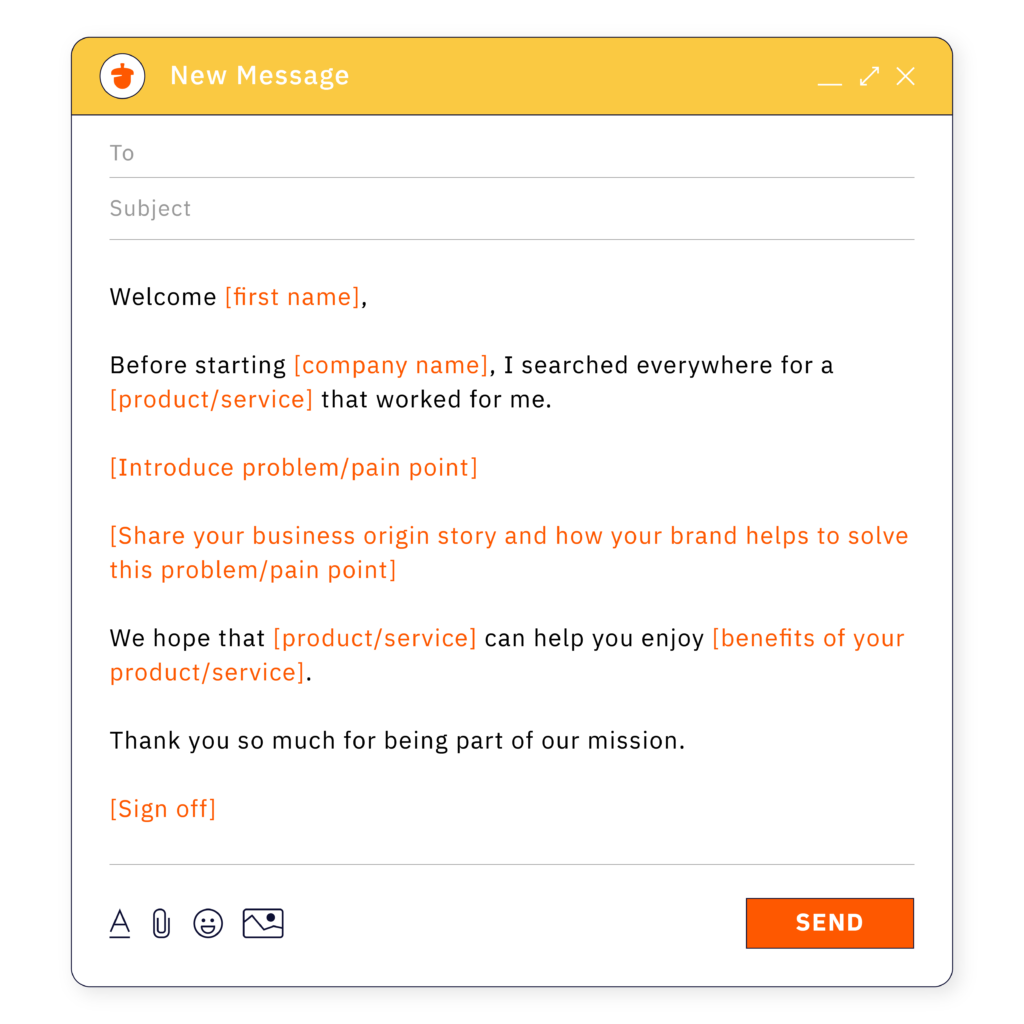
This example from a founder-led company demonstrates how to share an authentic origin story that connects emotionally with subscribers. Notice how the email focuses on the founder’s personal journey and the problem they were trying to solve, making it relatable and memorable.
When to use this template:
- Your founder has an authentic, compelling story
- You want to build emotional connection with customers
- Your primary goal is creating brand loyalty and advocacy
- You’re a founder-led or mission-driven company
- You want to humanize your brand
- You have a unique perspective or insight that shaped your business
- You want to differentiate from larger, impersonal competitors
How to customize this template:
- Identify the core problem you were trying to solve
- Share your authentic origin story and why it matters
- Replace [specific problem] with your actual pain point
- List competitors you considered or tried
- Articulate the market gap you discovered
- Explain the key challenges you faced and lessons learned
- Clearly state your core belief and mission
- Connect the story to how your product/service helps customers
- Keep the tone authentic and vulnerable, not overly polished
- Test the email on mobile devices before sending
6. Community-focused incentive welcome emails
Best for: Loyalty programs, membership-based businesses, community platforms, and companies wanting to encourage ongoing engagement and participation
Quick summary: Community-focused incentive welcome emails introduce subscribers to exclusive benefits, rewards, and community features available to members. This template is ideal for loyalty programs and membership-based businesses that want to emphasize the value of joining a community. Use this when your primary goal is to encourage ongoing engagement and participation.
Key features:
- Warm welcome message thanking them for joining
- Clear overview of the community or loyalty program
- List of exclusive benefits and rewards available
- Explanation of how to earn points, rewards, or status
- Introduction to community features and member perks
- Invitation to participate in community activities
- Clear call-to-action to explore community features
- Information about what to expect going forward
- Mobile-optimized design for easy navigation
Pros:
- Clearly communicates value of membership
- Encourages immediate engagement with community
- Creates sense of belonging and exclusivity
- Increases customer lifetime value through loyalty
- Generates repeat purchases and engagement
- Builds community and peer-to-peer connections
- Provides clear incentives for continued participation
- Easy to track engagement and participation metrics
Cons:
- Requires robust community features and benefits
- May attract customers primarily for rewards, not product
- Requires ongoing management and community moderation
- May require significant investment in community infrastructure
- Needs clear communication about earning and redeeming rewards
- May create complexity if too many benefit tiers
- Requires consistent delivery on promised benefits
Community-focused incentive welcome email template:
Subject line: [First name], welcome to the [Program Name] community!
Hello [first name],
Welcome to the [business name] [incentive program name]!
Thank you for enrolling in our community. You’ve just unlocked access to exclusive content, special deals, and rewards that are only available to our members.
Here’s what you can enjoy as a member:
- Exclusive Deals — Get early access to sales, special discounts, and limited-time offers before the general public
- Rewards Points — Earn points on every purchase and redeem them for discounts, free products, or exclusive experiences
- VIP Events — Attend exclusive member-only events, webinars, and community gatherings
- Priority Support — Get faster response times and dedicated support from our team
- Member-Only Content — Access guides, tutorials, and insider tips not available to non-members
- Community Forum — Connect with other members, share experiences, and get advice from the community
How to earn rewards:
- Earn 1 point for every $1 spent
- Earn bonus points for referrals, reviews, and social shares
- Unlock higher status tiers (Silver, Gold, Platinum) for additional benefits
- Participate in community challenges for bonus points
Your member dashboard: [CLICK HERE TO EXPLORE YOUR DASHBOARD]
In your dashboard, you can:
- View your current points and rewards balance
- Browse available rewards and redemption options
- Track your status tier progress
- Access exclusive member content
- Manage your community profile
What’s next: Over the next few weeks, we’ll be sending you exclusive member offers, community highlights, and tips to help you get the most out of your membership. You can manage your preferences anytime in your dashboard.
Questions? Our community team is here to help! Contact us at [email] or [phone number].
We’re so glad to have you on board and hope you enjoy these special perks!
Best regards,
[Your name]
[Your title]
[Business name]
P.S. — Refer a friend and you’ll both get [bonus reward]. Share your unique referral link: [link]
Real-world community-focused incentive welcome email example:

This example from a loyalty program demonstrates how to clearly communicate membership benefits while encouraging immediate engagement with community features. Notice how the email emphasizes both tangible rewards and community connection.
When to use this template:
- You have a loyalty program or membership model
- You want to encourage ongoing engagement and repeat purchases
- Your primary goal is increasing customer lifetime value
- You have exclusive benefits or rewards to offer
- You want to build community and peer connections
- You have community features or forums available
- You want to create a sense of exclusivity and belonging
How to customize this template:
- Replace [program name] with your actual loyalty program name
- List your actual exclusive benefits and rewards
- Explain your specific points earning structure
- Include real status tiers and their benefits
- Link to your actual member dashboard
- Customize the “what’s next” section based on your communication plan
- Include real contact information for community support
- Specify your referral reward structure
- Test the email on mobile devices before sending
- Ensure all links to community features are working
7. Hybrid confirmation and welcome emails
Best for: Newsletter signups, double opt-in processes, email list verification, and companies wanting to confirm subscription while welcoming new subscribers
Quick summary: Hybrid confirmation and welcome emails serve dual purposes: they confirm the subscriber’s email address (double opt-in) while also welcoming them and setting expectations. This template is ideal for newsletter signups and email list verification. Use this when your primary goal is confirming subscription while establishing the relationship.
Key features:
- Clear statement of purpose (confirmation and welcome)
- Prominent verification button or link
- Explanation of why verification is needed
- Welcome message and thank you
- Overview of what to expect from future emails
- Clear call-to-action to verify email
- Information about managing preferences
- Mobile-optimized design with large, tappable buttons
Pros:
- Confirms subscriber authenticity and engagement
- Reduces spam and invalid email addresses
- Complies with email marketing best practices
- Establishes expectations early
- Provides opportunity to set communication preferences
- Reduces unsubscribe rates by confirming intent
- Improves email deliverability
- Creates clean, engaged email list
Cons:
- Adds extra step that may reduce signup completion
- Some subscribers may not complete verification
- Requires clear communication about verification process
- May reduce initial list size
- Requires tracking of verification status
- May need reminder emails for non-verifiers
- May create confusion if not clearly explained
Hybrid confirmation and welcome email template:
Subject line: [First name], verify your email and get started
Hello [first name],
Welcome to the [business name] newsletter!
We’re thrilled to have you join our community. To make sure we have the right email address and to confirm you want to receive our emails, please verify your email by clicking the button below.
VERIFY YOUR EMAIL ADDRESS [VERIFICATION BUTTON]
Why we ask for verification: We use double opt-in to ensure that:
- You actually want to receive our emails
- We have the correct email address
- Your inbox stays clean and spam-free
- We comply with email marketing best practices
What to expect from us: Once you verify your email, you’ll start receiving:
- Weekly tips and insights on [topic]
- Exclusive offers and early access to new content
- Industry news and trends
- Special promotions for subscribers only
We promise to respect your inbox and only send you content that’s valuable and relevant. You can manage your preferences or unsubscribe anytime.
Didn’t receive the verification email? Check your spam folder or [click here to resend verification email].
Questions? Reply to this email or contact us at [support email].
Thanks for joining us!
Best regards,
[Your name]
[Your title]
[Business name]
P.S. — Add us to your address book so our emails don’t end up in your spam folder.
Real-world hybrid confirmation and welcome email example:

This example from a newsletter platform demonstrates how to clearly communicate the verification process while welcoming new subscribers. Notice how the email explains why verification is needed and makes the verification button prominent and easy to find.
When to use this template:
- You use double opt-in for email verification
- You want to confirm subscriber authenticity
- Your primary goal is building a clean, engaged email list
- You’re collecting emails through newsletter signups
- You want to comply with email marketing best practices
- You need to reduce spam and invalid addresses
- You want to set expectations early about communication frequency
How to customize this template:
- Replace [business name] with your actual company name
- Customize the “what to expect” section based on your actual email content
- Include your real support email address
- Add a link to resend verification email if needed
- Ensure the verification button is prominent and easy to click
- Test the verification link before sending
- Customize the topic in [topic] to match your newsletter focus
- Include clear instructions for managing preferences
- Test the email on mobile devices before sending
- Set up tracking for verification completion rates
8. Welcome emails that come from an actual human being
Best for: Founder-led companies, B2B businesses, personal brands, and companies wanting to build credibility and personal relationships with customers
Quick summary: Welcome emails from an actual human being (founder, CEO, or team member) create personal connection and credibility by showing a real person behind the brand. This template is powerful for B2B companies and founder-led businesses. Use this when your primary goal is building personal relationships and establishing credibility through human connection.
Key features:
- Email from a real person (founder, CEO, or team member)
- Personal greeting and introduction
- Brief explanation of the person’s role and background
- Story about why they started the company or joined the team
- Personal commitment to customer success
- Invitation to reply directly to the sender
- Authentic, conversational tone
- Clear call-to-action to engage
- Mobile-optimized design for easy reading
Pros:
- Creates personal connection and trust
- Increases credibility and authenticity
- 27% higher unique click rates than generic emails
- Builds relationships beyond transactional interactions
- Differentiates from impersonal corporate emails
- Encourages direct communication and feedback
- Humanizes the brand and company
- Increases customer loyalty and advocacy
Cons:
- Requires real person to be willing to engage
- May create expectation of personal responses
- Requires managing volume of direct replies
- May not scale well as company grows
- Requires authenticity—customers detect insincerity
- May expose personal information or opinions
- Requires consistency in personal engagement
- May create bottleneck if only one person responds
Welcome email from an actual human being template:
Subject line: [First name], it’s [Sender Name] from [Company Name]
Hey [first name],
I’m [sender name], the [founder/CEO/title] of [company name], and I wanted to personally welcome you to our community.
I started [company name] because [brief origin story]. We established [company name] in order to [mission/values of company], and I’m passionate about helping people like you [primary benefit].
I’d love to hear what you think of [product/service] and if there is anything we can improve. Your feedback helps us build exactly what customers need. If you have any questions, please reply to this email. I read every response personally and I’m always happy to help.
Over the next few weeks, you’ll hear from our team with tips, resources, and updates. But know that behind every email is a real person who cares about your success.
Thanks for giving us a chance. I’m excited to see what you’ll accomplish with [product/service].
Best regards,
[Sender name]
[Sender title]
[Company name]
P.S. — Seriously, reply to this email if you have questions or feedback. I want to hear from you.
Real-world welcome email from an actual human being example:
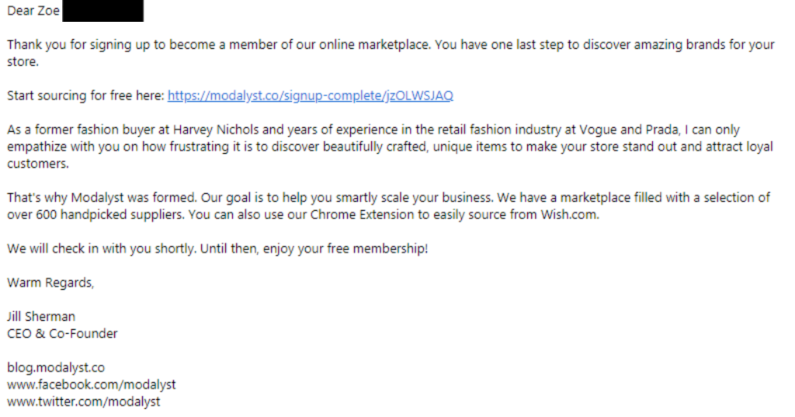
This example from a founder-led company demonstrates how to create a personal, authentic welcome email that builds credibility and encourages direct communication. Notice how the email is conversational and genuine, not overly polished or corporate.
When to use this template:
- You’re a founder-led or small company
- You want to build personal relationships with customers
- Your primary goal is establishing credibility and trust
- You’re in B2B or professional services
- You want to differentiate from larger competitors
- You’re willing to personally engage with customer replies
- You want to create brand advocates and loyal customers
- You have a compelling personal story or background
How to customize this template:
- Use a real person’s name and title
- Share an authentic origin story or personal motivation
- Explain why you’re personally committed to customer success
- Keep the tone conversational and genuine, not corporate
- Make it clear that you personally read and respond to replies
- Include a real email address or contact method
- Customize the product/service benefits to your offering
- Keep the email relatively short and scannable
- Test the email on mobile devices before sending
- Ensure you have a system to manage and respond to replies
9. “Welcome to your trial” emails
Best for: SaaS companies, software platforms, and businesses offering free trials to convert users to paid customers
Quick summary: “Welcome to your trial” emails are sent to users who have just started a free trial of your product or service. These emails set expectations about trial duration, highlight key features to explore, and guide users toward experiencing product value. Use this when your primary goal is converting trial users to paying customers.
Key features:
- Warm welcome message thanking them for starting trial
- Clear statement of trial duration and start date
- Direct link to access the trial product
- Overview of key features to explore first
- Tips for getting the most out of the trial
- Links to helpful resources (tutorials, documentation, webinars)
- Contact information for support and questions
- Information about what happens when trial ends
- Clear call-to-action to start using the product
- Mobile-optimized design for easy access
Pros:
- Sets clear expectations about trial duration
- Provides immediate access to product
- Reduces friction by including helpful resources
- Increases trial activation rates
- Helps users experience product value quickly
- Reduces support burden by providing self-service resources
- Creates opportunity to track trial usage and engagement
- Positions company as helpful and customer-focused
Cons:
- Requires good product documentation and resources
- May not convert all trial users to paying customers
- Requires follow-up emails to nurture trial users
- Needs clear communication about trial limitations
- May require support team to handle trial questions
- Trial period needs to be long enough for value realization
- Requires tracking of trial usage and engagement
- May need reminder emails as trial end date approaches
“Welcome to your trial” email template:
Subject line: [First name], your [product name] trial is live!
Hello [first name],
Your [product name] free trial is now active! You have [trial duration] to explore all the features and see how [product name] can help you [primary benefit].
Your trial access:
[CLICK HERE TO START YOUR TRIAL]
What you can do during your trial:
- Access all features of [product name]
- Import your data from [competitor/previous system]
- Create and manage [key feature]
- Collaborate with your team
- Generate reports and analytics
- Get priority support from our team
Getting started (takes 5 minutes):
- Click the link above to access your trial
- Complete your profile setup
- Explore our [guided tour/tutorial] to learn the basics
- Import your data or create a test project
- Reach out if you have any questions
Helpful resources:
- [Getting Started Guide] — Learn the basics in 10 minutes
- [Video Tutorials] — See how to use key features
- [Knowledge Base] — Find answers to common questions
- [Live Webinar] — Join us [day/time] for a product walkthrough
- [Webinar Recording] — Watch previous walkthroughs anytime
Questions or need help? Our support team is here to help! Contact us at:
[support email]
[phone number]
[live chat link]
What happens next: Your trial includes full access to all features for [trial duration]. After your trial ends, you can upgrade to a paid plan to continue using [product name]. We’ll send you a reminder before your trial expires so you have time to decide.
We’re excited to show you what [product name] can do for your [business/team]. Let’s get started!
Best regards,
[Your name]
[Your title]
[Business name]
P.S. — Need a longer trial period? Reply to this email and we can discuss options.
Real-life “welcome to your trial” welcome email example:
Check out this free trial welcome email from Shopify.

This example demonstrates how to provide clear trial access, set expectations, and offer multiple support options. The structured format with clear sections makes it easy for trial users to understand what they can do and how to get help.
When to use this template:
- You offer a free trial of your product or service
- You want to increase trial activation rates
- You need to guide users toward experiencing product value
- You want to reduce support burden with self-service resources
- You’re converting trial users to paying customers
- You have good documentation and support resources available
- You want to track trial usage and engagement
- You need to set clear expectations about trial duration
How to customize this template:
- Replace [product name] with your actual product name
- Specify trial duration (e.g., 14 days, 30 days)
- List actual features available in trial
- Include real links to your trial access, tutorials, and support
- Customize support contact information
- Add specific getting started steps for your product
- Include links to your most helpful resources
- Specify webinar dates and times
- Test the email and all links before sending
- Set up follow-up emails for trial engagement tracking
10. Product-focused welcome emails
Best for: Product introductions, feature highlights, SaaS companies, and businesses wanting to showcase product capabilities and benefits
Quick summary: Product-focused welcome emails help provide value by showcasing your product or service in a format that’s easy for new customers to digest. These emails highlight key features, benefits, and capabilities while guiding users toward product adoption. Use this when your primary goal is helping customers experience product value quickly.
Key features:
- Warm welcome message thanking them for joining
- Clear statement of product value proposition
- Overview of key features and capabilities
- Benefits of using the product
- Video or visual introduction to product
- Links to product tutorials and documentation
- Getting started guide or quick start steps
- Contact information for support and questions
- Clear call-to-action to start using product
- Mobile-optimized design for easy viewing
Pros:
- Showcases product capabilities visually
- Helps users understand product value quickly
- Reduces time to first value realization
- Increases product adoption rates
- Provides clear guidance on getting started
- Reduces support burden by providing self-service resources
- Creates opportunity to highlight key differentiators
- Increases customer satisfaction and retention
Cons:
- Requires good product documentation and resources
- May overwhelm users with too many features
- Requires clear prioritization of key features
- May need follow-up emails for deeper learning
- Requires video production resources if using video
- May not work well for complex products
- Requires testing across different user types
- May need customization for different user segments
Product-focused welcome email template:
Subject line: [First name], here’s what you can do with [product name]
Hi [first name],
Welcome to [product or brand name]. We’re thrilled to see you here!
We’re confident that [product/service] will help you [summary of key benefit or benefits of product/service]. Let me show you how.
Get to know [product name] in 3 minutes:
[VIDEO OR LINK]
In this video, our [name of employee and what they do] walks you through:
- How to [key feature 1]
- How to [key feature 2]
- How to [key feature 3]
- Tips for getting the most out of [product name]
Key features you’ll love:
- [Feature 1] — [Benefit of feature 1]
- [Feature 2] — [Benefit of feature 2]
- [Feature 3] — [Benefit of feature 3]
- [Feature 4] — [Benefit of feature 4]
Getting started (takes 5 minutes):
- Log in to your [product name] account
- Complete your profile setup
- Explore the [guided tour/tutorial]
- Create your first [project/item/campaign]
- Invite your team to collaborate
Learn more:
- [Getting Started Guide] — Step-by-step setup instructions
- [Video Tutorials] — Learn key features with videos
- [Knowledge Base] — Find answers to common questions
- [Webinar] — Join us [day/time] for a live product walkthrough
Questions or need help? Our support team is here to help! Contact us at:
[support email]
[phone number]
[live chat link]
You can also find more of our guides here to learn more about [product/service name].
Take care!
[Your name]
[Your title]
[Business name]
P.S. — Reply to this email with any questions. We love hearing from our customers!
Real-world product-focused welcome email example:
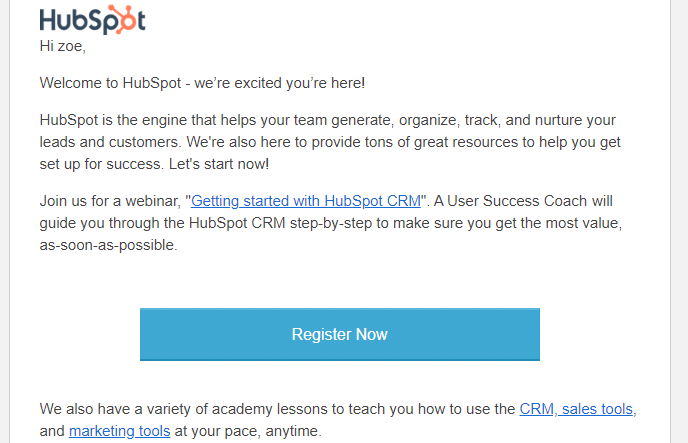
This example from a HubSpot, a leading SaaS company, allows customers to sign up for a free webinar and offers them alternative resources they can use at their own pace. The email balances product features with helpful resources and support options.
When to use this template:
- You want to introduce your product or service visually
- Your primary goal is helping users experience product value
- You have key features you want to highlight
- You have video tutorials or webinars available
- You want to reduce time to first value realization
- You’re in SaaS or software industry
- You want to increase product adoption rates
- You have good documentation and support resources
How to customize this template:
Consider creating different versions for different user types
Replace [product name] with your actual product name
Customize the key benefit statement
Create or link to a 2-3 minute product introduction video
List your actual key features and their benefits
Customize the getting started steps for your product
Include real links to tutorials, guides, and webinars
Include real support contact information
Specify webinar dates and times
Test the email and all links before sending
11. Free gift welcome emails
Best for: All industries, immediate value delivery, conversion-focused campaigns, and businesses wanting to generate first customer action
Quick summary: Free gift welcome emails provide immediate value to new subscribers by offering a special gift, exclusive content, or bonus offer. This template is highly effective for driving first purchases and generating quick conversions while the subscriber’s interest is at its peak. Use this when your primary goal is generating immediate action and creating goodwill.
Key features:
- Warm welcome message thanking them for joining
- Clear statement of the free gift or bonus offer
- Description of what the gift includes and its value
- How to claim or access the free gift
- Instructions for using or redeeming the gift
- Information about what to expect from future emails
- Clear call-to-action to claim the gift
- Mobile-optimized design for easy claiming
- Urgency element (limited time or limited quantity)
Pros:
- Provides immediate value and creates goodwill
- Drives first purchase or action quickly
- Generates excitement and positive first impression
- Increases customer lifetime value through early engagement
- Creates sense of reciprocity that encourages future purchases
- Easy to track redemption and engagement
- Works across all industries and business models
- Generates quick feedback on offer effectiveness
Cons:
- May attract customers primarily for the gift, not product
- Can reduce profit margins if gift is too valuable
- May train customers to expect free gifts
- Requires clear terms about gift limitations
- May need to manage inventory or fulfillment
- Requires tracking of gift redemption
- May create customer service issues if gift is unclear
- May not build long-term brand loyalty
Free gift welcome email template:
Subject line: [First name], here’s your free gift
Hi [first name],
Thanks for signing up to [product name]!
As a special thank you, we’re giving you [free gift/bonus/exclusive content] absolutely free—no strings attached.
Your free gift: [FREE GIFT DESCRIPTION]
This [gift type] normally costs [value], but it’s yours free when you join our community. It includes:
- [Benefit 1]
- [Benefit 2]
- [Benefit 3]
How to claim your free gift: Simply click the button below and [instructions for claiming gift]:
[CLAIM YOUR FREE GIFT]
How to use your gift: [Brief instructions on how to use or access the gift]
What to expect from us: We’ll send you helpful tips, exclusive deals, and updates about new products—but we promise to keep it relevant and not overwhelming. You can manage your preferences anytime.
Questions? Reply to this email or contact us at [support email/phone number].
Thanks for joining us. We hope you love your free gift!
Best regards,
[Your name]
[Your title]
[Business name]
P.S. — This offer is only available for [timeframe], so claim your gift today!
Real-world free gift welcome email example:
THAT’S PRO
Write less email, get more replies.
Are you falling off your prospects’ radars? With Nutshell’s personal email sequences, we’ll remember the follow-up for you.
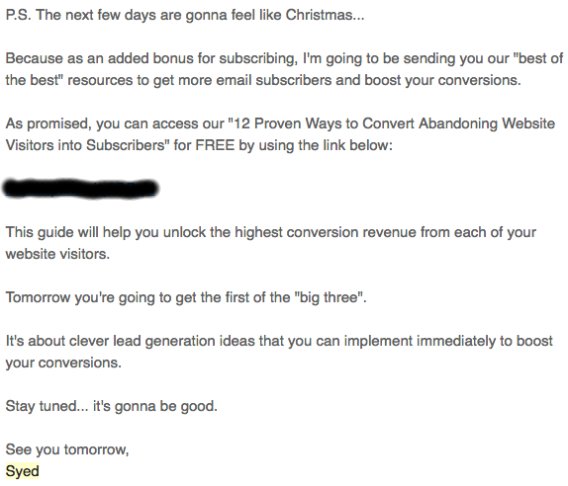
This example from a leading marketing platform gives subscribers a special offer in the form of exclusive content, adding value and establishing themselves as an authority figure within their market. The gift doesn’t have to be a tangible item like money or a free product—it can be exclusive content, templates, or tools.
When to use this template:
- You have a valuable gift or bonus to offer
- Your primary goal is immediate conversions
- You want to create goodwill and positive first impression
- You’re in a competitive market
- You want to incentivize first purchase or action
- You have exclusive content or tools to offer
- You want to generate quick feedback on offer effectiveness
- You want to build your email list quickly
How to customize this template:
- Decide on a valuable gift that aligns with your product
- Clearly describe what the gift includes and its value
- Create simple instructions for claiming the gift
- Set a timeframe for the offer (creates urgency)
- Explain how to use or access the gift
- Include real support contact information
- Customize the “what to expect” section
- Test the claiming process before sending
- Ensure the gift delivery is automated or easy to fulfill
- Track redemption rates and adjust offer if needed
12. “Thanks for subscribing” welcome emails
Best for: Newsletter signups, content download confirmations, lead magnet campaigns, and businesses wanting to confirm action while setting expectations
Quick summary: “Thanks for subscribing” welcome emails are sent to website visitors who complete a form to receive a content resource or subscribe to your newsletter. These emails confirm the action, deliver the promised content, and introduce the subscriber to your business. Use this when your primary goal is confirming subscription while introducing your broader offerings.
Key features:
- Warm thank you message for subscribing
- Confirmation of subscription action
- Direct link to download or access promised content
- Introduction to your business and offerings
- Overview of what to expect from future emails
- Links to other valuable resources
- Invitation to explore your website or products
- Contact information for questions
- Clear call-to-action to access content
- Mobile-optimized design for easy access
Pros:
- Confirms subscription and delivers promised content
- Establishes credibility by delivering on promise
- Provides opportunity to introduce broader offerings
- Reduces unsubscribe rates by setting clear expectations
- Creates opportunity to segment subscribers
- Increases engagement by providing immediate value
- Builds trust through transparency
- Easy to track content downloads and engagement
Cons:
- May not convert all subscribers to customers
- Requires follow-up emails to nurture leads
- Needs clear communication about future emails
- May require content creation and management
- Requires tracking of content downloads
- May need different versions for different content types
- Requires managing expectations about email frequency
- May need reminder emails for non-downloaders
“Thanks for subscribing” welcome email template:
Subject line: [First name], here’s your [content name]
Hi [first name],
Thanks for signing up for [newsletter name]!
As promised, here is the link for your free [name of free offering]:
[DOWNLOAD/ACCESS YOUR CONTENT]
What you’ll learn:
- [Key takeaway 1]
- [Key takeaway 2]
- [Key takeaway 3]
Want more helpful resources? Check out our other valuable content:
- [Resource 1] — [Brief description]
- [Resource 2] — [Brief description]
- [Resource 3] — [Brief description]
Or visit [website page] if you were interested in learning more about [product type you offer].
What to expect from us: You’ll receive [frequency] emails with helpful tips, insights, and resources on [subject]. We promise to keep it relevant and valuable. You can manage your preferences or unsubscribe anytime.
Questions? Reply to this email if you have any questions. I’m here to help!
Best regards,
[Your name]
[Your title]
[Business name]
P.S. — Add us to your address book so our emails don’t end up in your spam folder.
Real-world “thanks for subscribing” welcome email example:
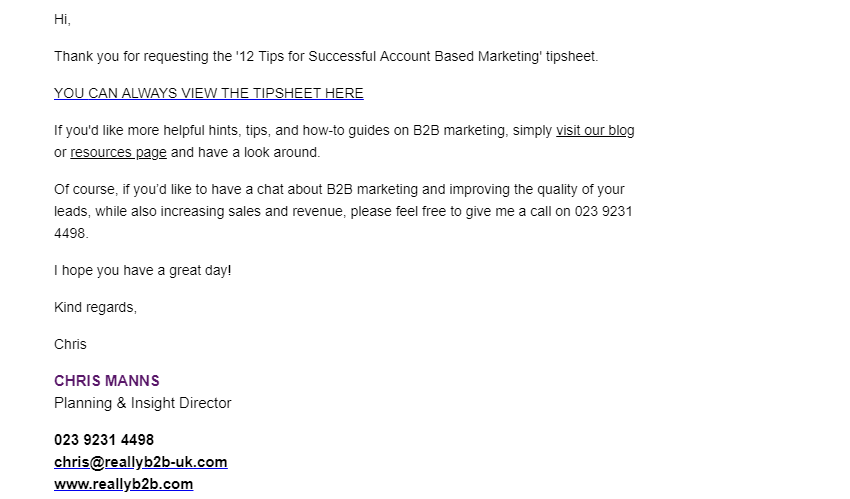
This example from a B2B company goes one step further by offering a phone number to discuss the topic related to the download—a great opportunity to turn a subscriber into a customer. The email balances content delivery with relationship building.
When to use this template:
- You offer content downloads or lead magnets
- Your primary goal is confirming subscription
- You want to introduce your broader offerings
- You’re building an email list through content
- You want to set clear expectations about future emails
- You have multiple resources to promote
- You want to nurture leads toward becoming customers
- You want to track content engagement
How to customize this template:
- Replace [newsletter name] with your actual newsletter name
- Specify the content being delivered
- Include real link to download or access content
- List actual key takeaways from the content
- Link to other valuable resources on your site
- Customize the “what to expect” section
- Specify email frequency (weekly, bi-weekly, monthly)
- Include real contact information
- Customize the product/service you’re promoting
- Test all links before sending
13. Reminder emails
Best for: Software companies, SaaS platforms, product-based businesses, and companies wanting to re-engage inactive users who haven’t taken action
Quick summary: Reminder emails are sent to users who haven’t engaged with your product or service after signup. These emails gently nudge inactive users to take action, provide helpful resources, and offer support. This template is important for reducing churn and re-engaging dormant users. Use this when your primary goal is re-engaging inactive users and preventing churn.
Key features:
- Friendly, non-judgmental tone
- Acknowledgment that they haven’t used product yet
- Reminder of product value and benefits
- Links to helpful resources and tutorials
- Getting started guide or quick start steps
- Contact information for support and questions
- Incentive or offer to encourage action
- Clear call-to-action to start using product
- Mobile-optimized design for easy access
- Option to pause or adjust communication
Pros:
- Reduces churn by re-engaging inactive users
- Provides opportunity to address barriers to adoption
- Offers support and resources to help users succeed
- Can recover lost revenue from inactive users
- Demonstrates that company cares about user success
- Provides feedback on product adoption challenges
- Increases product usage and engagement
- Can identify users who need additional support
Cons:
- May not re-engage all inactive users
- Requires understanding of why users are inactive
- May need multiple reminder emails
- Requires tracking of user activity and engagement
- May need different messages for different inactivity reasons
- May create negative impression if too aggressive
- Requires clear value proposition to motivate action
- May need to offer incentives to drive engagement
Reminder email template:
Subject line: [First name], we miss you! Come back to [product name]
Hi [first name],
We noticed you haven’t logged into [product name] yet, and we wanted to check in.
We know getting started with a new tool can feel overwhelming, so we wanted to make it easy for you. Here’s everything you need to know to get the most out of [product name]:
Get started in 3 steps:
- Log in here: [LOGIN LINK]
- Complete your profile setup (takes 5 minutes)
- Explore our [guided tour/tutorial]
We’re here to help: If you’re stuck or have questions, our support team is ready to help: [support email] [phone number] [live chat link]
Helpful resources:
- [Getting Started Guide] — Step-by-step setup
- [Video Tutorials] — Learn key features
- [Knowledge Base] — Find answers
- [Live Webinar] — Join us [day/time]
Special offer: As a thank you for giving us another chance, here’s [special offer/discount] to help you get started: [OFFER CODE]
We’re confident that [product name] will help you [primary benefit], and we’d love to show you how. Let’s get you up and running!
Best regards,
[Your name]
[Your title]
[Business name]
P.S. — If [product name] isn’t the right fit, just let us know. We’d love to hear your feedback so we can improve.
Real-world reminder welcome email example:
This email from Google Primer gives the recipient a gentle nudge, and includes social proof in the form of a user review, demonstrating the benefits of using the service:
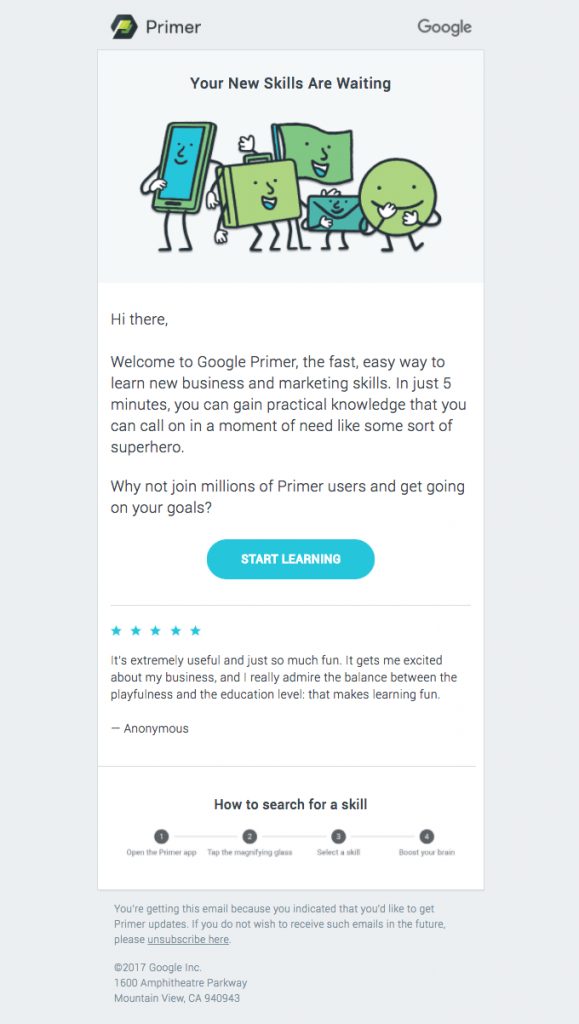
Here, the email gives the recipient a gentle nudge while providing social proof in the form of a user review, demonstrating the benefits of using the service. The email balances encouragement with helpful resources and support options.
When to use this template:
- You have inactive users who haven’t engaged
- Your primary goal is reducing churn
- You want to re-engage dormant users
- You have helpful resources available
- You want to understand barriers to adoption
- You’re in SaaS or software industry
- You want to prevent revenue loss from inactive users
- You have support resources available
How to customize this template:
- Replace [product name] with your actual product name
- Customize the primary benefit statement
- Include real login link
- Specify setup time accurately
- Include real support contact information
- Link to actual tutorials and resources
- Specify webinar dates and times
- Create a meaningful special offer or discount
- Personalize based on how long they’ve been inactive
- Test all links before sending
14. Onboarding welcome emails
Best for: SaaS companies, software platforms, service-based businesses, and companies wanting to guide customers through initial setup and help them achieve success
Quick summary: Onboarding welcome emails are the first message in a series intended to steer customers in the right direction after a purchase or signup, helping to engage and nurture them. These emails guide customers through initial setup, highlight key features, and help them achieve their first success milestone. Use this when your primary goal is ensuring customer success and reducing churn.
Key features:
- Warm welcome message thanking them for joining
- Acknowledgment of their decision and commitment
- Story about why the company was built
- Invitation to share feedback and preferences
- Overview of what to expect in the onboarding series
- Links to helpful resources and getting started guides
- Contact information for support and questions
- Clear call-to-action to engage with onboarding
- Mobile-optimized design for easy reading
- Personalization based on signup information
Pros:
- Guides customers through initial setup and success
- Reduces churn by ensuring early value realization
- Builds relationship through personalized communication
- Provides opportunity to segment customers
- Increases product adoption and feature usage
- Demonstrates company cares about customer success
- Creates feedback loop for product improvement
- Increases customer lifetime value
Cons:
- Requires well-planned onboarding sequence
- Needs clear understanding of customer goals
- Requires multiple follow-up emails
- May need different sequences for different customer types
- Requires tracking of customer progress
- May need to adjust based on customer feedback
- Requires coordination between sales and support teams
- May need significant content creation
Onboarding welcome email template:
Subject line: [First name], let’s get you set up for success with [product name]
Hi [first name],
Thanks for joining us at [name of company].
We built [product] as [story behind it]. We’re passionate about helping [target audience] achieve [primary goal], and we’re excited to help you get started.
Here’s what we’ll cover over the next few weeks:
Week 1: Getting started and initial setup
Week 2: Key features and best practices
Week 3: Advanced tips and optimization
Week 4: Success stories and next steps
We’d love to know more about you: Your feedback helps us make sure that we’re delivering exactly what you need. Just hit reply and let me know:
- What’s your primary goal with [product name]?
- What challenges are you hoping to solve?
- What would success look like for you?
Getting started:
- Log in to your account: [LOGIN LINK]
- Complete your profile setup (takes 5 minutes)
- Explore our [guided tour/tutorial]
- Check out our [Getting Started Guide]
Helpful resources:
- [Getting Started Guide] — Step-by-step setup instructions
- [Video Tutorials] — Learn key features with videos
- [Knowledge Base] — Find answers to common questions
- [Live Webinar] — Join us [day/time] for a product walkthrough
Questions or need help? Our support team is here to help! Contact us at:
[support email]
[phone number]
[live chat link]
Over the next few weeks, we’ll be sending you a few more emails to help you gain maximum value from [product]. We’ll share our favorite tips and provide some exciting behind-the-scenes information.
Thanks for choosing [company name]. We’re committed to your success!
Best regards,
[Your name]
[Your title]
[Business name]
P.S. — Seriously, reply to this email with your goals and challenges. I read every response personally and love hearing what our customers are trying to accomplish.
Real-world onboarding welcome email example:
This welcome email from Sleeknote asks users for their preferences, aiding segmentation:

Using segmentation in this email enabled Sleeknote to send relevant content to their users, increasing open rates by over 1,213% and converting more subscribers into customers.
When to use this template:
- You want to guide customers through initial setup
- Your primary goal is ensuring customer success
- You have a multi-week onboarding plan
- You want to reduce churn and increase retention
- You’re in SaaS or software industry
- You want to gather customer feedback early
- You want to segment customers based on goals
- You have helpful resources and support available
How to customize this template:
- Replace [product name] with your actual product name
- Share an authentic story about why you built the product
- Customize the onboarding timeline (weeks 1-4)
- Include real questions you want to ask customers
- Include real login link
- Specify setup time accurately
- Link to actual tutorials and resources
- Include real support contact information
- Specify webinar dates and times
- Personalize based on customer type or signup source
Elements of a quality welcome email
Crafting a compelling welcome email isn’t just about saying ‘hello’—it’s the opening act in a story of engagement, connection, and loyalty. To make that introduction unforgettable, here are some of the most important components to include in your welcome email templates.
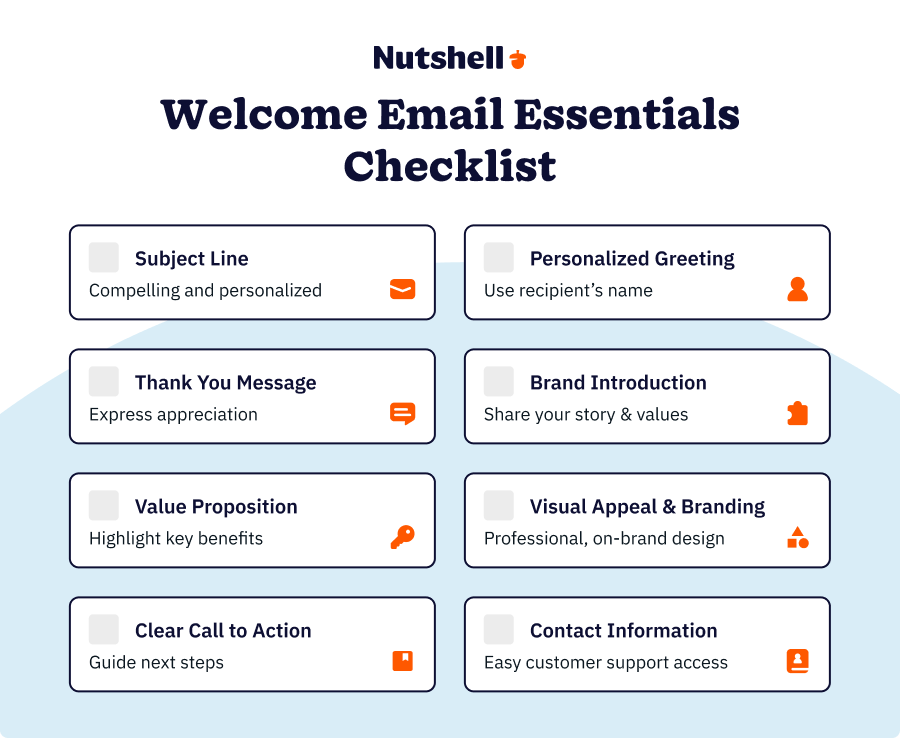
Some of these elements, like the subject line, should be part of every welcome email. Others are important to consider but may not make sense for every welcome email, depending on your goals and the type of email list.
- A compelling subject line: Every welcome email needs a subject line that gets readers’ attention, lets them know what to expect in the email, and encourages them to hit open. Subject lines are just as important for welcome emails as for other types of emails.
- A personalized greeting: Your welcome email should start with a warm and personalized greeting. Addressing the recipient by name creates an immediate connection, signaling that this isn’t just another generic message—it’s tailored to them.
- A thank you: Express gratitude for the recipient’s decision to join your community. A heartfelt ‘thank you’ creates a positive impression and encourages them to explore further.
- An introduction to your brand: Engage your audience by introducing your brand or service. Share your unique story, vision, or mission. This narrative paints a picture of who you are, establishing a relatable and human connection with your audience.
- Your value proposition: Clearly explain the value the recipient gains by being part of your community. Highlight exclusive benefits, discounts, or compelling content they can expect. Make it clear why they made the right choice by joining.
- Visual appeal and branding: Visual elements such as your logo, color scheme, and imagery reflect your brand’s identity. Consistent branding creates a familiar and welcoming atmosphere, reinforcing your brand’s presence.
- A call to action (CTA): Guide recipients on the next steps. Whether it’s exploring your products, completing a profile, or claiming a special offer, a clear and enticing CTA encourages immediate engagement, nudging them toward the desired action.
- Contact information: Building trust is key. Provide easily accessible contact information or links to customer support. This reassures recipients that help is just a message away, fostering a sense of reliability and care.
Skip the blank template—generate email campaigns with AI
Go from prompt to polished first draft in minutes with the 1-click AI email campaign builder!
Tips for effectively crafting your best welcome emails
People exchange over 333 billion emails every day. It’s crucial to make sure your welcome email stands out and has the highest chance of engaging your customers.
Whether you’re crafting B2C or B2B welcome emails, you’ll want to keep some general considerations in mind to enhance your brand message and keep your readers interested in your offerings.
The following are three essential tips for writing the most effective welcome email:
1. Prioritize your subject line
What you put in the subject line matters — after all, it’s the first part of your welcome email your reader will see. The subject line is a critical part of your message. You’ll want to write a brief, engaging, personable statement that indicates the purpose of your email, such as:
- Welcome to [business name]! You’re officially on the list.
- Hey, [customer’s first name]. Check out your loyalty perks!
- Hello, [customer’s first name]! Just one more step to verify your email.
- It’s official! Your discount code is active.
Subject lines are important because the wrong one can send your message to the recipient’s spam folder. Stay away from all capital letters and avoid using spam keywords.
2. Personalize whenever possible
Personalization makes your customer feel more connected to your brand. Including their first name in your welcome email will make the reader feel like you created the message specifically for them. It can effectively catch their attention.
A personalized message welcome email boosts open and click-through rates, making your email marketing more effective. The right software tools can help you automate the process and make it easy to include your customers’ names in your emails.
3. Proofread your message
Your welcome email should be professional and entirely free of typos. Take the time to comb through every word and proofread the message a few times. Having another team member read over it before hitting send is also helpful.
A misspelled word or grammatically incorrect sentence can hurt your brand’s credibility and make your email seem like spam. Use online tools to monitor your grammar and spelling and never send a message without reading over it carefully.
4. Use automation to send your emails automatically
With the right email tools, you can automatically send a welcome email as soon as someone signs up for your email list. This ensures that they receive their welcome email in a timely manner and saves your team time. With tools like Email marketing, you can even make your email part of a drip sequence—a series of emails that automatically sends based on triggers you set up, enabling you to keep readers engaged and move them through the funnel with less manual outreach.
5. Include social proof or testimonials
When sending a welcome email to a new customer, it’s important to remember that brand loyalty and trust are still being built. People naturally trust and value the opinions of others, which is why including social proof or testimonials in your email can be so impactful. Highlighting positive feedback from happy customers or endorsements from reputable sources helps establish trust and credibility right away. It reassures new subscribers that they’ve made the right decision in choosing your brand and sets the foundation for a strong relationship.
Best practices for welcome emails
As demonstrated in this blog post, the benefits of welcome emails are clear. To maximize their effectiveness and ensure their success, consider the following best practices:
- Timely Delivery: Ensure that the welcome email is sent directly after a new subscriber registers to your emailing list. This timing is important as the subscriber still has your brand top of mind, demonstrating promptness and efficiency.
- Audience Segmentation: Segmenting your audience for targeted messaging ensures a better customer experience. By tailoring your messages to meet specific needs, you can create a more personalized and effective communication strategy. For example a travel agency might send different welcome emails promoting destinations based on the recipient’s location and season.
- A/B Testing: Consider conducting A/B testing on different subject lines, CTAs, and content to see which welcome emails work best. Track open rates, click-through rates, and other metrics to continually improve your welcome email strategy.
- Include Call to Actions: Regardless of the welcome email template you choose, include a clear call to action (CTA). Guide your subscribers on what you want them to do next, whether it’s downloading your brochure, visiting your website or connecting with you on social media.
- Mobile-friendly design: Make sure your welcome email is optimized for mobile devices, as many users access their emails on smartphones. Since the welcome email is often one of the first interactions a new customer has with your brand, it’s essential that it displays properly on smaller screens. If the email appears distorted or difficult to read, it could leave a negative first impression. A mobile-friendly design ensures a smooth experience, setting the tone for your brand’s professionalism and creating a positive initial connection.
Start creating effective welcome emails using Nutshell
Nurturing customers via email is essential if you want to make a good impression. These welcome email templates are a great start and can open the lines of communication with your new customers. But don’t be afraid to think out of the box and find new ways to connect like a personal email sequence.
No matter which approach you decide to take, the aim of your welcome emails should be to focus on your customer, whether you’re providing more information on your product or sending free content. Think about how your initial first email will connect with customers and look for ways to provide added value whenever possible.
Consider using an email marketing tool like Nutshell’s email marketing. This platform seamlessly integrates with Nutshell’s CRM, making it easy to engage with prospects and existing customers. With the flexibility to create welcome emails from scratch or use prebuilt templates, you can save time while crafting effective emails. Start the journey with them by sending a welcome email and continue building strong connections.
Frequently asked questions about welcome email templates
-
What's the difference between a welcome email and an onboarding email?
A welcome email is typically a single message (or short series) sent immediately after signup to greet and thank the subscriber. Its primary goal is to establish the relationship and set expectations. An onboarding email is part of a longer series designed to guide customers through initial setup and help them experience product value. Welcome emails focus on relationship building, while onboarding emails focus on product adoption and success. Many successful strategies use both—a welcome email first, followed by an onboarding sequence.
-
How many welcome emails should I send in a sequence?
Research shows that a series of three welcome emails generates 90% more orders than a single welcome email. The optimal sequence includes:
- Day 0 (immediate welcome)
- Day 1 (value delivery)
- Day 2-3 (social proof or engagement)
Some companies also successfully use 5-7 email sequences. The key is to space emails 1-3 days apart and ensure each email has a clear purpose and value for the subscriber.
-
When should I send the first welcome email?
Send the first welcome email immediately after signup—ideally within minutes. This is when subscriber interest is highest and they’re most likely to open and engage with your message. Use automation to ensure instant delivery. Subscribers expect to receive a welcome email immediately (74% of subscribers expect this), so any delay reduces effectiveness.
-
Should I personalize welcome emails?
Yes, absolutely. Personalized welcome emails have significantly higher open and click-through rates than generic emails. At minimum, include the subscriber’s first name in the greeting. You can also personalize based on signup source, industry, company size, stated interests, or previous behavior. Personalization signals that you value the individual subscriber and increases engagement.
-
Can I use the same welcome email template for all my customers?
While you can use the same template structure, you should segment your audience and customize the content based on customer type, industry, signup source, or stated interests. Different customer segments have different needs and pain points. For example, a SaaS company might send different welcome emails to trial users versus paying customers, or to different industry verticals.
-
What's the best subject line for a welcome email?
Effective welcome email subject lines are personalized, clear, and create curiosity or urgency.
Examples include:
- “Welcome to [Company Name], [First Name]!”
- “Here’s your exclusive [discount/offer]”
- “Let’s get you started with [Product]”
- “[First Name], we’re excited to have you!”
Avoid all caps, spam trigger words (like “FREE” or “URGENT”), and misleading subject lines. Test different subject lines to see what resonates with your audience.
-
How do I measure the success of my welcome email sequence?
Track these key metrics:
- Open rate (target: 68.6%)
- Click-through rate (target: 26.9%)
- Conversion rate (target: 5x higher than standard emails)
- Revenue per email (target: $267+)
- Unsubscribe rate (should be <0.5%)
- Bounce rate
- Time to first action
Use your email platform’s analytics to monitor these metrics and compare against industry benchmarks. A/B test different elements to continuously improve performance.
-
Can I automate welcome emails?
Yes, and you should! Automation ensures welcome emails are sent immediately when someone signs up, without manual effort. Most email marketing platforms and CRMs like Nutshell offer automation features that trigger welcome sequences based on specific actions (like signup, purchase, or trial start). Automation also allows you to personalize emails at scale and track engagement metrics automatically.
-
How often should I update my welcome email templates?
Review and update your welcome email templates at least quarterly, or whenever you notice declining performance metrics. Test new subject lines, CTAs, and content variations to continuously improve results. Update templates when your product, pricing, or value proposition changes. Keep templates fresh by incorporating new customer success stories and testimonials.
-
What's the best way to get started with welcome email templates?
Start by choosing a template that matches your business model and goals. Customize it with your brand voice, specific offers, and value proposition. Set up automation to send it immediately after signup. Monitor performance metrics and iterate based on results. Consider using a CRM like Nutshell that integrates email automation with your customer data for better personalization and tracking.
-
How do I avoid welcome emails ending up in spam?
Follow these best practices:
- Use a recognizable sender name and email address
- Avoid spam trigger words in subject lines
- Include a clear unsubscribe link
- Authenticate your email domain (SPF, DKIM, DMARC)
- Keep your email list clean by removing inactive subscribers
- Encourage subscribers to add you to their address book
- Test your emails using spam checking tools before sending
-
Should I include a discount or offer in my welcome email?
It depends on your business model and goals. Including an offer (discount, free gift, exclusive content) increases conversion rates and generates immediate value for subscribers. However, it may attract price-sensitive customers. If your goal is immediate revenue, include an offer. If your goal is building long-term relationships, focus on value and relationship building instead. Test both approaches to see what works best for your audience.
Powerful email marketing, minus the headaches
Nutshell’s email marketing tool plugs directly into your CRM data, so you can create highly targeted audience segments, track the impact of your emails in real-time, and manage all your communications out of a single tool. Get started for free!
Updated on December 29, 2025
BACK TO TOP Written by
Cody Slingerland Senior Contributor, Sell to WinEdited by
Will Gordon Sr. Director of MarketingReviewed by
Andy Fowler Co-FounderReady to try
Nutshell for Free?Thank you! Your submission has been received!Oops! Something went wrong while submitting the form.


The 20 Digital Marketing Skills You Need to Excel in Your Marketing Career (2026)
Published on: November 10, 2022
Sales Performance Reviews: 9 Tips to Make Them Valuable
Published on: November 10, 2022Best AI Chatbots for B2B Lead Generation: Capture & Qualify Leads 24/7
Published on: December 29, 2025Join 30,000+ other sales and marketing professionals. Subscribe to our Sell to Win newsletter!