Closed-loop reporting gives marketing and sales teams a shared view of what’s working by linking campaign activity to real revenue outcomes.
Without it, teams risk wasting budget on channels that don’t convert or chasing leads that never close.
The takeaway? When your data flows in both directions, so does your progress—aligning efforts, tightening strategy, and making every lead count.
You must continuously improve your sales process and marketing strategies to attract more leads, close more deals, and drive revenue.
But how? With closed-loop reporting!
Closed-loop reporting helps your sales and marketing teams share information to make more informed, data-backed strategy decisions and process improvements, which allows you to earn more leads, sales, and revenue in the future.
Keep reading for even more information on this powerful process and how it can help your business grow!
Closed-loop reporting is the process of your sales and marketing teams sharing data and insights from their processes. In other words, your sales and marketing teams “close the loop” by keeping each other informed about which strategies and tactics drive the best results.
Closed-loop reporting helps your business implement strategies backed by data that enable you to expand your reach, generate more leads, and earn more conversions to grow your company.
Your sales team informs your marketing team about what happened to the leads they received, helping them understand which strategies work best for lead generation and conversions.
That helps your sales team learn which tactics and messages encourage leads to convert, so they can tweak their processes to close more deals.
We can break this process down into 11 steps:
A prospect visits your website for the first time.
The prospect is given a unique identifying tracking cookie so you can track their behavior.
The prospect browses and interacts with your website.
Your software tracks and records the prospect’s website activity and communication with your team.
The prospect eventually converts into a customer or client.
Your sales team reviews the data to understand the channels your customer interacted with that encouraged them to convert.
Your sales team relays their findings to your marketing team.
Your marketing team gains a better understanding of which channels drive leads and conversions for your business.
Your marketing team improves and optimizes their strategies to implement data-driven campaigns that drive more leads and conversions.
Your sales team analyzes customer and lead data to identify any holes in your sales funnel that cause leads to drop out of a sale.
Your sales team optimizes their processes to stay engaged with your leads and send them the right messages that encourage conversions.
Analytics software is essential to help you track your audience’s behavior on your website.
Why closed-loop reporting matters: 5 benefits of closed-loop reporting for your business
Now that you know the answers to the questions “What is closed-loop reporting?” and “How does closed-loop reporting work?” let’s dive into how it drives business growth.
Check out these five benefits it can bring to your business:
1. Connect your sales and marketing teams
Your sales and marketing teams must work together as one cohesive unit to help you implement sales-boosting processes and strategies. If they don’t, you’ll miss out on tons of potential leads and sales.
With closed-loop reporting, you can help your sales and marketing teams stay on the same page when it comes to driving leads and conversions.
For example, your sales team will share data and insights with your marketing team that explains which channels encouraged the lead to convert. Your sales team can also learn how leads first discovered your business, like on social media or from a search on Google.
With this information, your marketing team can better understand which strategies drive the best results for your business, so they work on improving them to drive more sales and revenue.
2. Gain deeper insights and data from your leads
To drive more sales, you need to understand more about your target audience to implement effective sales and marketing messages. That’s where closed-loop analysis and reporting come in.
It helps you analyze essential lead data and behavior to gain deep insights into your leads. For example, you can learn about their:
Location
Interests
Age
Job role
Company industry
And more
When both your sales and marketing teams have access to these insights, they can work on personalizing your audience’s experiences during sales pitches and when prospects visit your website.
For example, your marketing team can create more personalized content that addresses your leads’ pain points, showing them that you understand their problems and can offer them the solutions they need.
And your sales team can personalize your leads’ experience by tailoring their emails and pitches to your lead’s unique interests or company industry, helping them close more deals.
3. Improve your return on investment (ROI)
One of the biggest benefits of closed-loop analysis and reporting is that it helps you earn a higher ROI.
Keeping your sales and marketing teams informed with valuable data and behavioral insights is key to helping them improve their processes to generate more high-quality leads, close more deals, and drive revenue.
With a closed-loop analysis, your teams can analyze the steps each of your leads took on their path toward conversion, helping you identify the channels that drive the best results.
For example, you might discover that most of your leads first discovered your business on Google from your reports.
In this case, you’ll want to improve your search engine optimization (SEO) strategy to help more members of your target audience discover your company when they search online.
And as a result, you’ll earn more web traffic, high-value leads, sales, and ultimately, a higher ROI.
4. Enhance customer experience
Continuous closed-loop communication between sales and marketing teams allows for a tailored approach to customer interactions.
With real-time feedback gathered from sales, you get
A 360 view of the journey from prospect to customer,
Knowledge about specific preferences expressed by new customers,
And details you can use to map a concise customer journey with less guesswork.
Closed-loop reporting brings your attention to the highest-converting campaigns and channels.
Knowing which sources and offers draw new customers in allows you to identify the behaviors you can engage in to qualify leads and push them through the sales funnel.
Plus, you’ll be able to focus your marketing efforts on prospects who are more likely to convert into new customers.
Closed-loop reporting is all about connecting the dots between your marketing activities and your actual sales outcomes. Unlike traditional reporting, which often stops at metrics like website traffic or lead generation, closed-loop reporting tracks a customer’s entire journey—from their very first interaction with your marketing to becoming a paying customer.
Why it’s a game-changer:
True ROI: It allows you to see which specific marketing campaigns, channels, and content are actually driving revenue, not just generating leads.
Data-Driven Decisions: Instead of guessing, you make informed decisions about where to allocate your marketing budget and sales efforts for maximum impact.
Continuous Improvement: It creates a feedback loop, allowing both marketing and sales to constantly refine their strategies based on real-world results.
2. How does closed-loop reporting specifically help my marketing team prove their value and optimize their budget?
For marketing teams, closed-loop reporting is the ultimate tool for accountability and optimization. It shifts the focus from “how many leads did we generate?” to “how much revenue did our leads contribute?”
Identify High-Performing Channels: Pinpoint exactly which marketing channels (e.g., social media, email, paid ads, organic search) are bringing in the most qualified leads that convert into customers.
Optimize Content Strategy: Understand which content pieces (blog posts, whitepapers, webinars) are most effective at moving prospects through the sales funnel.
Justify Spend: Clearly demonstrate the direct financial return on your marketing investments, making it easier to secure budget and prove your team’s impact on the bottom line.
Improve Lead Quality: By seeing which leads convert, marketing can refine their targeting and lead nurturing strategies to deliver higher-quality prospects to sales.
3. My sales and marketing teams often feel disconnected. How does closed-loop reporting bridge this gap and foster better collaboration?
The “silo effect” between sales and marketing is a common challenge, but closed-loop reporting is a powerful antidote. It forces both teams to work towards a shared goal: revenue.
Shared Understanding of the Customer Journey: Both teams gain visibility into the entire customer lifecycle, from initial awareness (marketing) to conversion and retention (sales).
Common Language & Metrics: Instead of marketing focusing on MQLs and sales on SQLs, closed-loop reporting emphasizes the ultimate metric: closed-won revenue. This fosters a shared understanding of success.
Feedback Loop for Lead Quality: Sales can provide concrete feedback to marketing on the quality of leads, allowing marketing to adjust campaigns. Conversely, marketing can see how their efforts are directly impacting sales’ pipeline.
Improved Handoffs: With a unified system like Nutshell, sales reps have full context on a lead’s marketing history, enabling more personalized and effective sales conversations.
4. What are the biggest hurdles to implementing closed-loop reporting, and how can a CRM like Nutshell help overcome them?
While the benefits are clear, implementing closed-loop reporting can come with its own set of challenges:
Disconnected Systems: Data living in separate marketing automation, CRM, and analytics platforms.
Poor Data Quality: Inaccurate or incomplete data makes it impossible to draw reliable conclusions.
Lack of Team Alignment: Sales and marketing teams not agreeing on definitions or processes.
Complexity & Technical Know-how: Setting up the integrations and reporting can seem daunting.
Resistance to Change: Teams may be comfortable with old reporting methods.
How Nutshell helps overcome these hurdles:
All-in-One Platform: Nutshell combines CRM, marketing automation, and robust reporting, significantly reducing data silos and the need for complex integrations.
User-Friendly Interface: Designed for ease of use, Nutshell minimizes the technical burden and encourages team adoption.
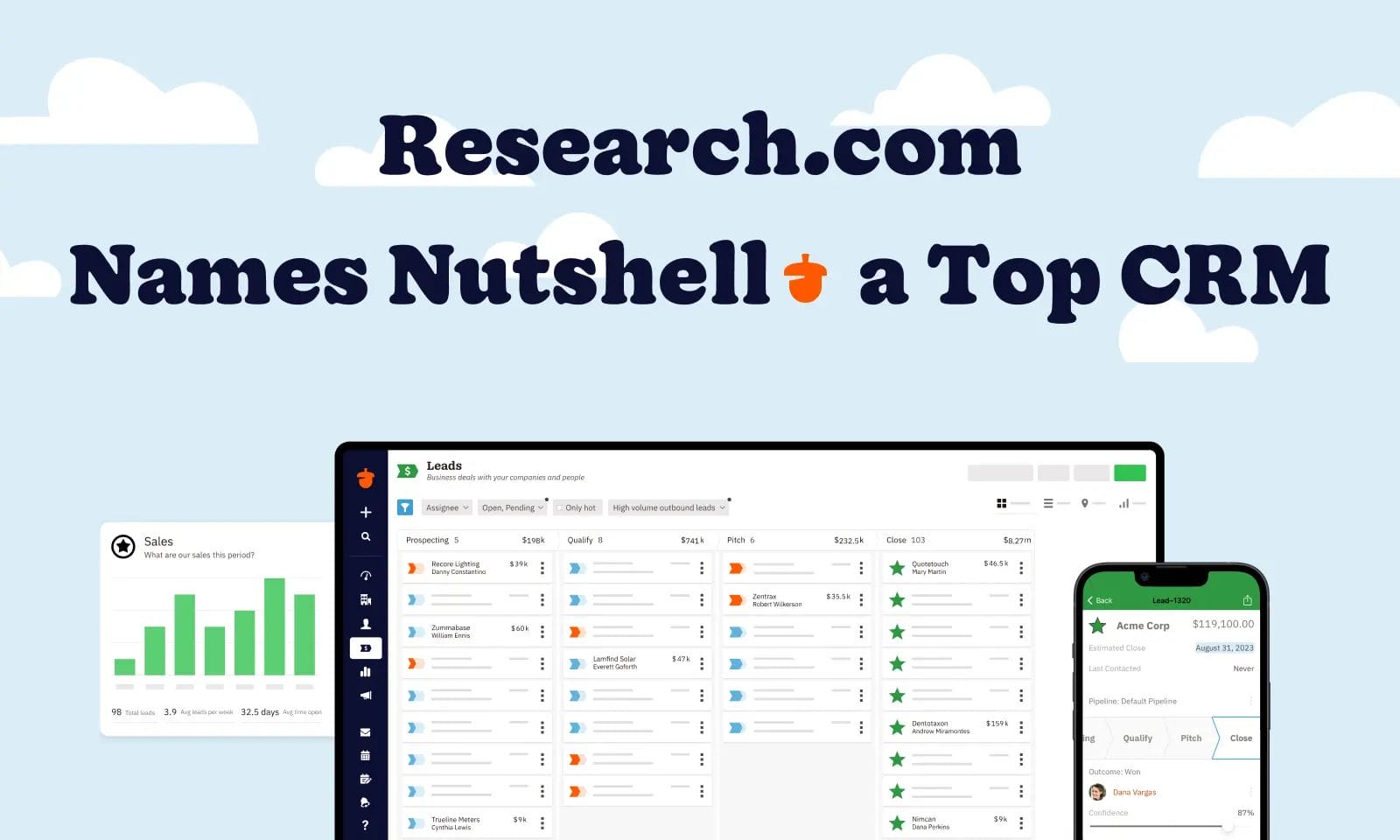
Built-in Reporting: Nutshell provides customizable dashboards and reports that automatically connect marketing activities to sales outcomes, simplifying analysis.
Dedicated Support: Nutshell’s free onboarding and customer support help you set up your tracking and reporting correctly, guiding you through the process.
5. What key metrics should I be tracking with closed-loop reporting to truly understand my business performance and make smarter decisions?
Moving beyond vanity metrics is crucial. With closed-loop reporting, you can track metrics that directly impact your bottom line:
Marketing-Originated Revenue: The total revenue generated from leads that originated from marketing efforts.
Marketing-Influenced Revenue: Revenue from deals where marketing had a significant touchpoint, even if sales sourced the lead.
Customer Acquisition Cost (CAC) by Channel: Understand the true cost of acquiring a customer through each marketing channel.
Lead-to-Customer Conversion Rate by Source: See which marketing sources produce the highest quality leads that convert.
Sales Cycle Length by Lead Source: Identify if certain marketing channels generate leads that close faster or slower.
Customer Lifetime Value (CLTV) by Initial Marketing Touchpoint: Understand the long-term value of customers acquired through different marketing efforts.
Use closed-loop reporting to power up your sales with Nutshell
Nutshell is an all-in-one growth platform that gives your sales and marketing teams all the resources they need to improve their strategies to drive more revenue.