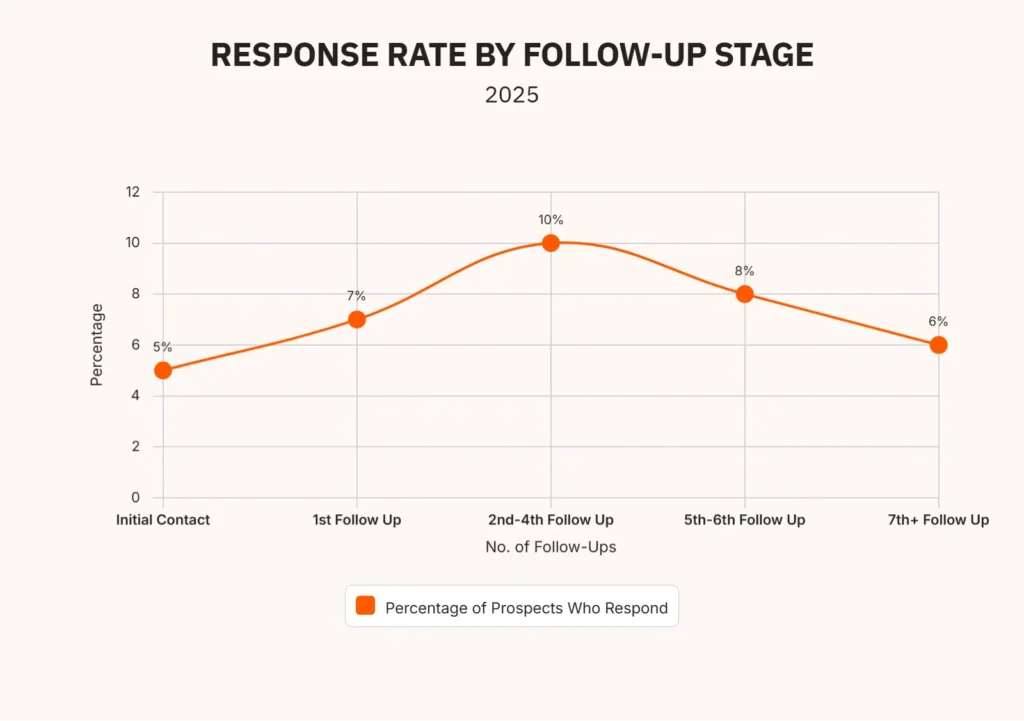
A strategic follow-up plan is vital for improving B2B sales. Diversifying outreach methods, from email to phone calls, and personalizing communication to each prospect are key tactics. By consistently providing value and maintaining a regular, but not overwhelming, contact schedule, you can significantly increase your chances of closing a deal
Driving sales is the endgame for any business. All your marketing, all your product and service development—it all leads to sales, which is where the revenue is earned.
But when you make a sale, it doesn’t happen all at once—it’s a process. Even once a prospect expresses an avid interest in your company, you still have to make a sales pitch. And even once you’ve made your pitch, there’s no guarantee that your leads will buy immediately. Many of them take time to decide.
That’s why you need sales follow-up strategies. Sometimes people will take a long time to decide if they want to become a customer, often to the point that they forget about you altogether. You obviously don’t want that to happen, so it’s good to follow up periodically.
But what should following up on a sales pitch look like? What are the best follow-up sales methods? Don’t worry—we’ve got you covered. Below, we’ll go over seven of the best sales follow-up strategies out there. Keep reading to learn more!
The foundation of effective follow-up lies in strategy and discipline. Let’s walk through seven proven techniques that will help your team stay top-of-mind, build stronger relationships, and close more deals.
1. Don’t follow up too frequently
Our first sales follow-up tip is to avoid badgering your prospects. You don’t want to send a follow-up email every day, or they’ll quickly become annoyed, choosing not to make a purchase. In short, an overly aggressive follow-up strategy can have the opposite of the intended effect.
Instead, carefully space out your contact attempts. How often you should follow up depends on the lead—for example, maybe someone tells you they need a week to decide, so you follow up after one week. Other times, they might not give an indication, in which case you’ll have to guess.
Use your best judgment when figuring out how often to contact leads. Just ensure that you don’t come off as pestering them.
2. Try using different channels
There are a handful of different ways to follow up with prospects. The two most classic methods are follow-up calls via phone and email. You can harness both of those channels when following up on a sales pitch.
If one channel isn’t yielding results for you, you can try a different channel in the hopes that it will be better at reaching your prospects. Alternatively, your leads might indicate a preference for a particular channel, in which case that’s the one you should stick to.
There are other channels besides just phone and email. Depending on your relationship with your prospects, some of them might be okay with you using SMS. You can also consider messaging leads through social media.
3. Keep things simple and brief
Another sales follow-up tip is to keep your follow-up messages short and sweet. Don’t send a lengthy email giving your whole sales pitch again. Limit yourself to a few sentences of text that get right to the point without being pushy.
Bear in mind your prospects don’t need you to tell them about the product or service—you’ve already done that. All they need is a gentle reminder that you’re still there and that they haven’t yet made a decision. It won’t take much to do that, so don’t overdo it on length.
4. Personalize your emails
One surefire way to drive more engagement through your emails, follow-up or not, is to personalize them. Users always respond better to emails that seem personalized just for them, and follow-up emails are no exception.
How much personalization should you use? Well, that entirely depends on the number of clients you have. If you’re a business-to-business (B2B) company that only works with a small number of clients, you can manually type out each email to cater directly to the relevant client.
On the other hand, if you sell to tons of businesses or consumers each week, you don’t have time to individually type out each email. In that case, you can simply program your email campaigns to autofill certain fields with personalized info, such as the prospect’s name.
5. Automate your campaigns
Building off the last point, you may have quite a large audience and not feel as though you have time to manually construct all your emails. In that case, the best thing to do is automate your campaigns.
When you automate your email campaigns, you basically create premade email templates that get automatically sent out at particular times or in response to a particular action. So, if you want to follow up with leads after one week, you can automate a particular email to go out to everyone one week after you give them a sales pitch.
6. Explain what action you want your leads to take
Another sales follow-up tip is to make it clear what action you want your prospects to take next. All bottom-of-funnel marketing should feature a call to action (CTA), and follow-up messaging is no different. Users can’t very well make a purchase if they don’t know that’s what you want them to do.
That doesn’t mean you should be pushy or aggressive about it. Even so, at least make it clear that you want your leads to buy your product or service. If you send out an email, it can be a good idea to include a CTA button with text like “Buy now” that users can click to go straight to the relevant page on your site.
7. Don’t push uninterested prospects
The last of our sales follow-up strategies is something we’ve already indicated—don’t be pushy. More specifically, don’t keep pushing follow-ups at prospects who are clearly uninterested. If you’ve sent six follow-ups and still haven’t heard back, it’s time to quit.
Furthermore, if a prospect directly contacts you to tell you that they’re no longer interested in your product or service, you should obviously leave them alone. Sending follow-ups past that point is spammy.
Cadence & Timing Strategies
Knowing when to follow up matters as much as how you follow up. The timing and frequency of your touchpoints can make or break your success rate. Here’s what the data shows, and how to structure your follow-up cadence for maximum impact.
The critical first window
Speed is everything in sales. Leads contacted within five minutes are 9x more likely to convert than those you reach later. Even waiting an hour cuts your odds dramatically.
Here’s the practical reality: when a lead hits your inbox or fills out a form, you have minutes—not hours—to make a first impression. This is why automation matters. Set up instant notifications, so your team can respond immediately. Even a quick “Got your message, calling you in 2 minutes” text buys you credibility and keeps momentum alive.
For subsequent touches, the timing shifts. Give prospects 2-3 days between emails so they have breathing room, but don’t let them forget you entirely.
The multi-touch cadence that works
Research shows 80% of sales require at least five follow-ups, yet most reps quit after two. This gap is where you gain your competitive edge.
Here’s a proven 14-day cadence you can adapt to your sales cycle:
Day 1 (Initial Contact): Send your first email or make your call. This is your main pitch—make it count.
Day 3 (First Follow-up): Send an email. Your first follow-up improves reply rates by 50%, so don’t skip this step. Add a new angle or piece of value they didn’t see before.
Day 7 (Phone or LinkedIn): Switch channels. A phone call or LinkedIn message keeps you from looking like just another email in their inbox. Reference something specific from your initial pitch.
Day 10 (Social or case study): Share a relevant case study or article on LinkedIn. This shows expertise without being pushy.
Day 14 (Closing loop): Send a final “breakup” email. Something like: “I haven’t heard back, so I’m guessing now isn’t the right time. If that changes, here’s how to reach me.” This removes pressure while leaving the door open.
The beauty of this cadence? You’re varying your approach. Email, phone, social, case study, email again. This variety increases your chances of reaching them on their preferred channel.
Multi-channel response rates
Not all channels perform equally. Your mix matters.
Combining email with social follow-up achieves an 11.87% reply rate, which beats email alone. SMS follow-ups deliver a 112.6% higher conversion rate than other single-channel approaches, making it a powerful addition for prospects who’ve opted in.
The takeaway: don’t rely on one channel. Mix email with calls, LinkedIn, and SMS (where appropriate) to meet prospects where they actually engage.
Optimal timing within the day
Wednesday and Thursday typically see the highest response rates, between 8:00 and 9:00 AM or 3:30 and 5:00 PM. These aren’t hard and fast rules—adjust them based on your audience. If you sell to manufacturing, they might be busiest at 6:00 AM. If you sell to tech startups, 10:00 PM might catch them when they’re catching up on email.
Test different send times, track what works, and adjust your cadence accordingly.
How AI Can Enhance Your Follow-Up Strategy
Manual follow-up is exhausting. Your reps spend hours crafting emails, logging calls, and trying to remember who they contacted last week. This is where AI changes the game.
Automating the grunt work
AI-powered CRM tools can automate the repetitive tasks that consume your day. Automated email sequences, call logging, and activity tracking free up hours that your team can spend actually selling. Sales reps using AI save 2+ hours daily, and 79% of teams report AI made them more profitable.
Think about it: if your rep saves 2 hours a day on admin work, that’s 480+ hours per year they can spend on high-value activities like building relationships and closing deals.
Behavior-based personalization
The most effective follow-up strategies utilize behavioral data to tailor your approach. Cisco Systems, for example, uses behavioral data to segment prospects—identifying which visitors are engineers versus product evaluators—and tailors follow-up content accordingly. Engineers get technical deep dives. Decision-makers get ROI-focused case studies.
AI can do this at scale. When a prospect clicks your pricing page, your next call that day is perfectly timed. When they download a technical whitepaper, your follow-up can be technical, not salesy. This level of personalization fosters trust and significantly enhances response rates.
Intent-driven timing
AI doesn’t just automate; it optimizes. By analyzing prospect behavior—which pages they visit, which emails they open, how long they spend on your site—AI tools can identify the perfect moment to follow up. Instead of guessing, you’re following up when they’re actually engaged.
The result? Better response rates, shorter sales cycles, and less wasted effort on cold prospects.
Getting started with AI follow-up
You don’t need a massive budget to leverage AI. Many CRM platforms, like Nutshell, now incorporate AI features, including email auto-logging, meeting summaries, and follow-up suggestions. Start by automating your most time-consuming tasks, then layer in behavioral insights as you go.
The teams winning in 2025 aren’t just following up more—they’re following up smarter.
Frequently asked questions
1. How long should you wait before following up with a lead?
Follow up within 24 hours of initial contact for best results—ideally within the first hour when leads are most engaged. For subsequent follow-ups, wait 2-3 days between emails. The best days are Wednesday and Thursday, between 8-9 AM or 3:30-5 PM, when response rates are highest.
2. How many times should you follow up before giving up?
Plan for 6-8 follow-up attempts over 2-3 weeks before considering a lead unresponsive. Research shows 80% of sales require at least five follow-ups, and 70% of responses come from the 2nd-4th email. Don’t give up too soon—persistence pays off when you provide value with each touchpoint.
3. What’s a good response rate for sales follow-up emails?
A good cold email response rate is 8-11%, with open rates around 24%. Follow-up emails typically perform better than initial outreach, increasing response rates by up to 49%. If you’re hitting these benchmarks with personalized, value-driven messages, you’re on the right track.
4. Should you call or email for sales follow-ups?
Use both strategically. Email works best for initial outreach and sharing detailed information, while calls are ideal for urgent matters or when deals stall. Most successful sales teams use a multichannel approach—combining email, phone, and even SMS—to meet prospects where they prefer to communicate.
5. What should you do if a prospect doesn’t respond to your follow-ups?
After 6-8 attempts with no response, send a “break-up” email asking if they’d like you to stop contacting them. If still no reply, move on and focus your energy on warmer leads. You can always re-engage them later with a fresh campaign or valuable content that addresses their pain points.
6. How can AI help with my follow-up process?
AI tools automate routine tasks, such as email logging and meeting notes, freeing up time for actual sales. More importantly, AI can identify the right moment to follow up based on prospect behavior—like when they visit your pricing page or download a resource. This means smarter follow-ups, not just more follow-ups.
7. What’s the best way to personalize follow-ups at scale?
CRM email automation enables you to use merge tags (such as prospect names and company names) to personalize communications at scale. However, true personalization goes deeper—referencing specific details from your initial conversation or tailoring your message based on their industry, role, or engagement behavior. Show them you actually know their business.
Nutshell can help you manage your email follow-up campaigns
Following up on a sales pitch can be a surprising amount of work, mainly because it takes time to craft and send out emails. But having the right tool to help you can make a huge difference, which is why you can benefit from using a CRM like Nutshell.
Nutshell does everything a normal CRM does, like helping you analyze your customer data. But it also boasts a killer set of email marketing automation features. You can easily create and send out email campaigns, with plenty of personalization options built in as well.
With Nutshell’s closed lead follow-up pipeline automation, you can go beyond email triggers. The moment a deal is marked Won, Lost, or Cancelled, Nutshell clones the lead—complete with contacts, notes, and email history—into a dedicated follow-up pipeline. That means your win-back, cross-sell, or customer-success team gets the context they need instantly, and no opportunity slips through the cracks.
Interested in trying out Nutshell, but not sure if it’s for you? No worries. You can see what Nutshell’s capable of with our 14-day free trial!