13 Best Free & Paid Keyword Research Tools for Businesses

-

Quick answer: What are the best keyword research tools for businesses?
The best keyword research tools for businesses include both free and paid options, depending on your needs and budget. On the free side, standouts include Moz Keyword Explorer for beginners, Ubersuggest for content ideas, and Google Keyword Planner for PPC planning. If you’re ready to invest, Ahrefs is great for competitor research, and Semrush is a strong pick for multichannel marketing.
Key takeaways
- Keyword research helps you target the right topics, improve relevancy, and boost conversions.
- Look for tools with real-time data, keyword suggestions, and competition analysis that integrate with your workflow.
- Choose tools based on your needs and budget, using free options to start and paid platforms for comprehensive data.
Keyword research is a routine part of online content creation. Whether you’re making videos for YouTube or creating a new company blog, you need to target the right keywords to help your pages rank. Keyword research tools help simplify that process for you.
93% of online experiences start with a search engine, and 49% of marketers credit organic search for providing the highest ROI. When you nail your keyword research, you’re setting yourself up to reach the people actively searching for what you offer.
This post will break down the best keyword research tools as well as the basics of keyword research for your business. You can go through the following sections to learn more:
Quick look: All 13 keyword research tools
Free tools
- Moz Keyword Explorer: Best for beginners
- KeywordsFX: Best for industry-specific insights
- Ubersuggest: Best for content ideas
- Answer the Public: Best for question research
- KeywordTool.io: Best for local targeting
- Mangools KWFinder: Best for local research
- VidIQ: Best for YouTube research
- Google Keyword Planner & Trends: Best for PPC planning
Paid Tools
- Keywords Everywhere: Best for browser-based keyword research
- LowFruits: Best for content gap analysis
- Serpstat: Best for niche markets
- Ahrefs: Best for competitor research
- Semrush: Best for multi-channel marketing
Table of Contents
-
- What is keyword research?
- What is a keyword research tool?
- The importance of a good keyword research tool
- Features to look for in a keyword research tool
- Selection methodology
- 13 best keyword research tools
- Artificial intelligence (AI) in keyword research
- Choosing the best keyword research tool
- Frequently asked questions
What is keyword research?
Keyword research is the process of finding keywords that your target audience searches for on a given platform. With keyword research, the goal is to develop a list of keywords you can then use to create content.
Why is keyword research important?
Keyword research is essential for any online operation. Since keywords are the terms that users search online, you need to know them to create content that ranks. They are also the backbone of SEO and help your pages rank in relevant search results.
Keyword research helps you avoid creating content for the wrong audience as well. If you know what your ideal user wants to see on your site, you will have better luck attracting and converting them.
What is a keyword research tool?
A keyword research tool is any software or website that helps you find the best keywords to target. They also offer insight into what queries your audience enters into Google or another search engine.
The importance of a good keyword research tool
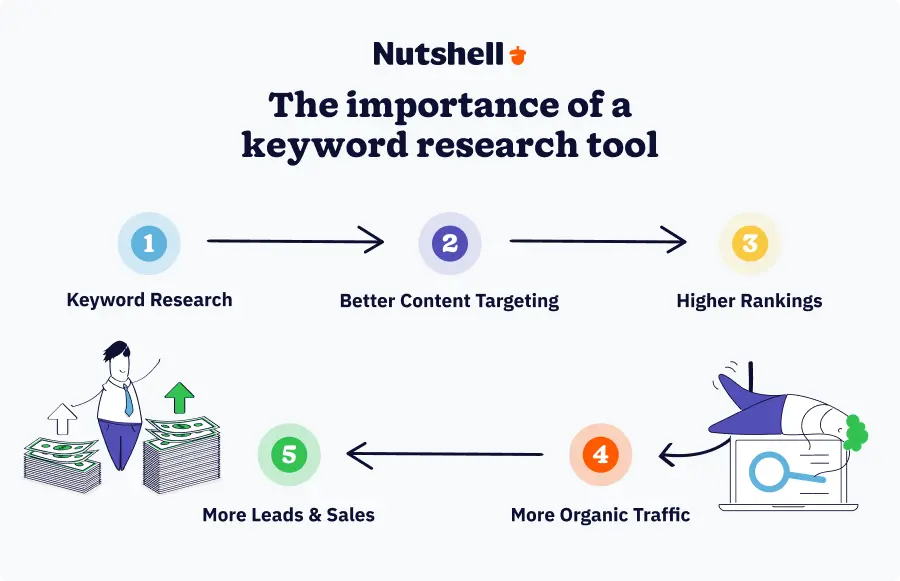
If you want to have success with your content, you need to know what keywords to target so you can rank for them. Keyword research tools help you identify which terms your audience is searching so you can include them in your content.
Other benefits you can expect from a good keyword research tool include:
- Less time spent on manually finding keywords
- Better understanding of keyword competition and cost-per-click (CPC)
- Easier access to related keywords
- More information on your competitors’ approaches
Want to generate more leads? (Of course you do.)
The B2B Marketer’s Toolkit collects 120+ of the best lead generation tips ever published on the Nutshell blog. Download it today!
Features to look for in a keyword research tool
When evaluating keyword research tools, certain capabilities matter more than others. Here are the core features that will directly impact your research quality and workflow efficiency:
- Search volume and keyword metrics: Accurate search volume data helps you understand keyword opportunity. Look for tools that provide real-time or near-real-time data and show search trends over time so you can spot emerging opportunities.
- Keyword suggestions and variations: The best tools generate comprehensive keyword lists including related terms, long-tail variations, and question-based keywords. This saves you time brainstorming and helps you discover angles you might have missed.
- Competitor analysis: Understanding what keywords your competitors target gives you strategic advantage. Look for tools that show competitor keyword rankings, traffic estimates, and gap analysis so you can find underserved opportunities.
- Platform-specific research: Different platforms require different keywords. Whether you need YouTube keyword data, local search optimization, or multi-platform targeting, ensure your tool covers the platforms that matter to your business.
- Ease of use: A powerful tool means nothing if your team can’t use it. Prioritize intuitive interfaces, clear reporting, and minimal learning curve so your team can start producing results quickly.
- AI-powered features: Modern keyword research tools increasingly leverage artificial intelligence for keyword clustering, intent analysis, and predictive scoring. These features can accelerate research and uncover patterns humans might miss.
How we selected the best keyword research tools
To create this comprehensive guide, we evaluated 15 keyword research tools across multiple dimensions to ensure we’re recommending solutions that truly serve different business needs and budgets.
Our evaluation criteria:
- Accuracy: How reliable and current is the keyword data? We prioritized tools with transparent sources and regular updates.
- Database size: How many keywords can the tool access? Larger databases mean more comprehensive research opportunities.
- User interface: Is the tool intuitive and easy to navigate? We favored tools that don’t require extensive training.
- Pricing flexibility: Does the tool offer options for different budgets? We included free, freemium, and paid options.
- Integration capabilities: Can the tool connect with other marketing and CRM platforms? Integration matters for workflow efficiency.
- Customer support: What level of support does each tool provide? We considered documentation, tutorials, and customer service quality.
- AI capabilities: Does the tool leverage artificial intelligence for keyword discovery, clustering, or analysis? We highlighted AI-powered newcomers.
We selected tools across three categories—free, paid, and AI-powered—to serve different use cases, skill levels, and budgets. These solutions range from basic options for beginners to comprehensive platforms for large enterprises.
The best keyword research tools
Now, let’s look at the best keyword research tools for whatever purpose you need. We’ve broken these keyword research tools into three categories for you: Free, Paid, and AI-Powered.
Free keyword research tools
First, we have general keyword research tools — those that can fit any purpose or budget.
Tool Name Starting Price Best For Key Features Moz Keyword Explorer Free Best massive keyword database with predictive metrics 1.25B keywords, predictive metrics, question keywords KeywordsFX Free AI-powered keyword research with industry insights AI scoring, industry context, intent analysis, CSV export Ubersuggest Free Best free tool for content ideas and backlink analysis Keyword suggestions, backlink analysis, site audit Answer the Public Free Question-based keyword research Question keywords, autocomplete data, visual insights KeywordTool.io Free Multi-platform keyword research Autocomplete data, global/local focus, multiple platforms Mangools KWFinder Free Intuitive interface and affordability Multiple locations, SERP analysis, local research VidIQ Free YouTube keyword research YouTube research, inline keywords, autocomplete suggestions Google Keyword Planner & Trends Free PPC planning and trending topics Forecasting, bid estimates, trend data, seasonal insights 1. Moz Keyword Explorer
Best for beginners
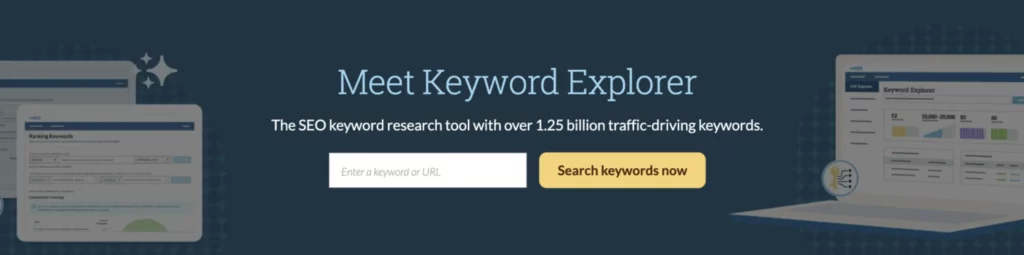
Moz Keyword Explorer is one of the best free keyword research tools. With this tool, you can access up to 1.25 billion keywords, according to Moz. This tool is a simple, straightforward option for keyword research that only requires a free account.
Key features
- Access to 1.25 billion keywords
- Keyword analysis by search volume
- Question format keywords
- Predictive keyword metrics
Pros
- Massive keyword database
- Simple, straightforward interface
- No credit card required
- Predictive metrics help forecast keyword performance
Cons
- Limited advanced features compared to paid tools
- Fewer filtering options than enterprise solutions
- Basic competitor analysis
Price
Free basic plan
2. KeywordsFX
Best for industry-specific insights
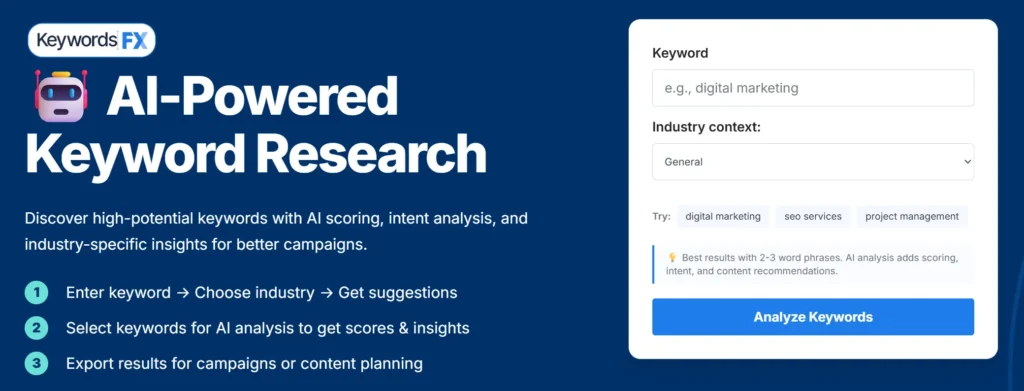
KeywordsFX is a free AI-powered keyword research tool from WebFX that combines traditional keyword suggestions with modern artificial intelligence analysis. Enter a keyword, select your industry context, and get instant suggestions along with AI scoring and intent analysis—all without requiring signup.
Key features
- AI-powered keyword scoring (1-10)
- Industry-specific context options (14+ industries)
- Intent analysis and quick-win identification
- Related keywords, questions, and keyword variations
- CSV export for campaign planning
Pros
- Completely free with no signup required
- AI analysis adds strategic context beyond basic suggestions
- Industry-specific filtering for more relevant results
- Question-based keywords included automatically
- Export results as CSV for easy integration
- No daily limits on basic searches
Cons
- Smaller database than enterprise tools
- AI analysis works best with 2-3 word phrases
- Limited competitor analysis features
- Fewer advanced filtering options than paid tools
Price
Free
3. Ubersuggest
Best for content ideas
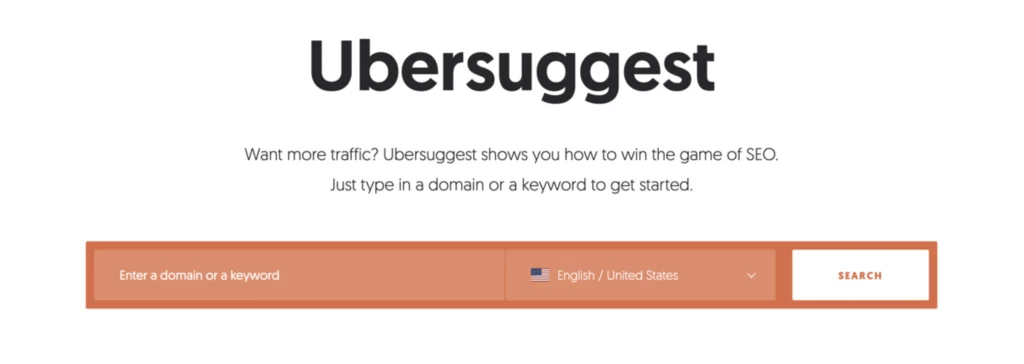
Ubersuggest is a free keyword research tool from Neil Patel that helps users find more information about their keywords as well as related terms. The free plan offers basic research features, and you can unlock more information about each term by signing up for a paid plan.
Key features
- Keyword suggestions and generation
- View average number of backlinks and domain authority for sites ranking
- See historical keyword data (requires upgrade for more than six months back)
- Compare organic clicks to paid ones
Pros
- Completely free with no usage limits
- Includes content idea generator
- Backlink analysis available
- Site audit tools included
- Keyword tracking capability
Cons
- Data isn’t as comprehensive as premium tools
- Limited historical data on free plan
- Requires upgrade for advanced features
Price
Free basic plan
4. Answer the Public
Best for question research
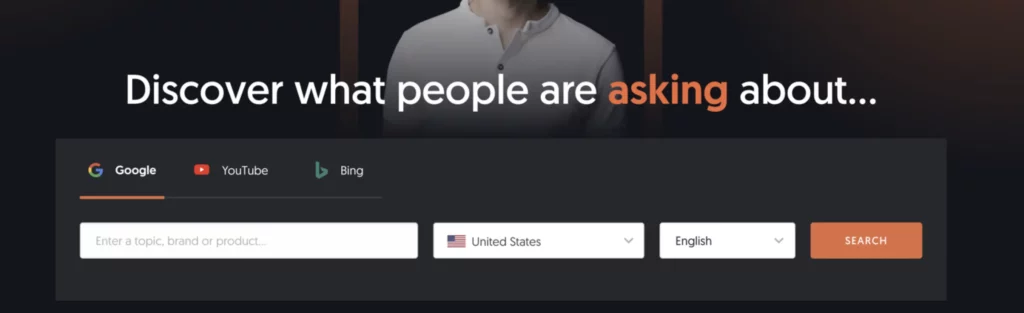
Another Neil Patel tool is Answer The Public. This tool lets you enter a topic, brand, product, and other terms to see what people are asking about it. This unique feature makes it one of the best free keyword research tools for question keywords specifically.
Key features
- Question keyword and phrase targeting
- Data from autocomplete searches
- Free searching for businesses
- Visual keyword insights
Pros
- Unique focus on question-based keywords
- Excellent for voice search optimization
- Free with no signup required
- Visual representation makes data easy to understand
- Great for content ideation
Cons
- Limited to question keywords (doesn’t show all keyword types)
- No search volume data on free plan
- No competitor analysis
- Limited filtering options
Price
Free
5. KeywordTool.io
Best for local targeting
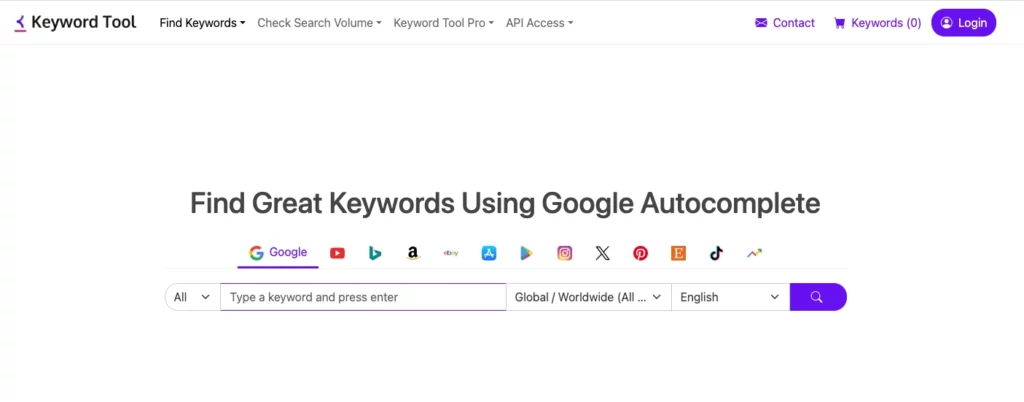
KeywordTool.io is a keyword research tool that makes it easy to find keywords. You can use the location preference setting to choose the area you want to focus on and narrow it even more by selecting a website. If you want more metrics, you must sign up for a plan, but you can get suggestions for free.
Key features
- Keywords based on autocomplete data
- Keyword research capabilities for different sites
- Global and local-focused options
- Multiple platform support
Pros
- Free plan offers solid keyword suggestions
- Location preference settings for local research
- Works across multiple platforms
- No signup required for basic searches
- Autocomplete data reflects real user behavior
Cons
- Limited metrics on free plan
- Requires paid plan for search volume data
- No competitor analysis on free tier
- Fewer advanced filtering options
Price
Free basic plan
6. Mangools KWFinder
Best for local research
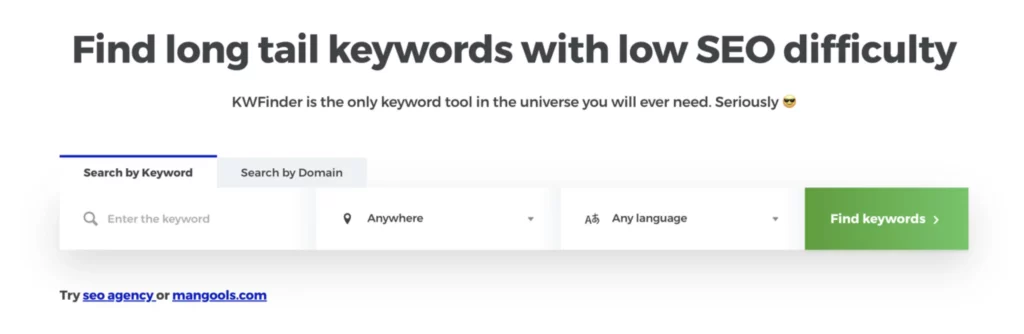
Mangools KWFinder is praised for its intuitive interface and affordable price for teams. You can use this tool for everything from generating new keywords to comparing local terms and how they rank in the SERPs.
Key features
- Multiple location and language options
- Intuitive interface for search
- Local keyword research and SERP analysis
- Keyword grouping to organize topics
Pros
- User-friendly interface (even for beginners)
- Affordable pricing for paid plans
- Great for local keyword research
- SERP analysis helps understand competition
- Multiple language support
Cons
- Free plan is more limited than some competitors
- Requires upgrade for full features
- Smaller keyword database than enterprise tools
Price
Free basic plan
7. VidIQ
Best for YouTube research
VidIQ lets you complete your keyword research while browsing YouTube, all while looking at the ranking results. You can also use this tool to measure your competitor’s keyword usage with inline keywords.
Key features
- Research directly in YouTube
- Inline keywords available for competitor analysis
- Autocomplete keyword suggestions
- Trending keyword and tag suggestions
Pros
- Affordable pricing starting at $7.50/month
- Seamless YouTube integration
- Competitor analysis directly on YouTube
- Autocomplete feature shows real search behavior
- Great for video SEO
Cons
- Limited to YouTube (not general keyword research)
- Smaller feature set than full SEO platforms
- Free version is limited
- Less useful for non-video content
Price
Free basic plan
8. Google Keyword Planner & Google Trends
Best for PPC planning
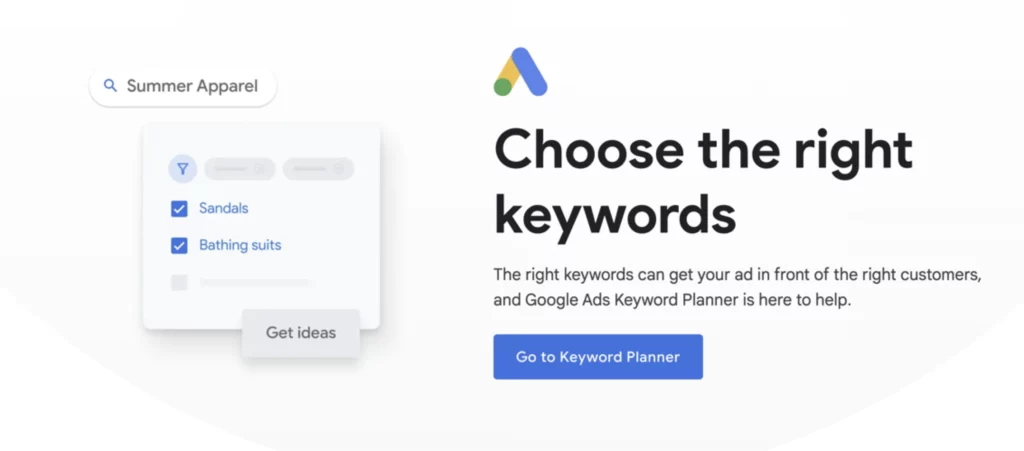
Google Keyword Planner helps you forecast keyword performance and get bid estimates for Google Ads campaigns. Google Trends shows real-time search trends and seasonal patterns so you can create timely content your audience is actively searching for.
Key features
- Integration with Google Ads (Keyword Planner)
- Forecasting keyword success based on ad spend (Keyword Planner)
- Bid estimates for PPC keywords (Keyword Planner)
- Real-time search trends and seasonal data (Trends)
- Historical trend comparisons (Trends)
Pros
- Data comes directly from Google
- Excellent for both PPC and content planning
- Bid estimates help with budget planning
- Shows real-time and seasonal search patterns
- No signup required for Google Trends
- Integrated with Google Ads platform
Cons
- Keyword Planner designed primarily for PPC, not organic SEO
- Trends doesn’t provide exact search volume
- Limited organic search metrics in Keyword Planner
- Requires Google Ads account setup for Keyword Planner
- Less detailed than dedicated keyword research tools
Price
Free
Get more tips to grow your small business
Join our 200K+ subscribers to learn more about how to grow your small business with exclusive marketing strategies, tips, and ideas from the top-rated experts at WebFX.

Paid keyword research tools
Tool Name Starting Price Best For Key Features Keywords Everywhere $7/month Browser-based keyword research Chrome/Firefox/Edge integration, real-time metrics, multiple sites LowFruits $29.90/month AI-driven SERP analysis and keyword gaps AI SERP analysis, keyword clustering, weak spot identification Serpstat $69/month Niche and industry-specific research Keyword metrics, competitor keywords, niche finder Ahrefs $129/month Competitive analysis and enterprise teams 10 search engines, keyword difficulty, SERP metrics, traffic potential Semrush $165.17/month All-in-one SEO toolkit Free trials, keyword generation, competitor rankings, multi-channel options 1. Keywords Everywhere
Best for browser-based keyword research

Keywords Everywhere is an exceptional browser add-on that makes it easy to search for keywords while on any site. As you enter terms into a search bar — whether in your browser or a supported site — you can access keyword suggestions and metrics right on the page.
Key features
- Available on Chrome, Firefox, and Edge
- Integration with your search browser and multiple websites
- Keyword suggestions, metrics, and more
- Real-time data as you browse
Pros
- Extremely affordable ($6/month)
- Seamless browser integration
- See keyword data while browsing Google, YouTube, and other sites
- No need to switch between tools
- Lightweight and fast
Cons
- Limited to browser extension functionality
- Smaller keyword database than full platforms
- No competitor analysis features
- Limited advanced filtering
Price
Starting at $7/month
2. LowFruits
Best for content gap analysis
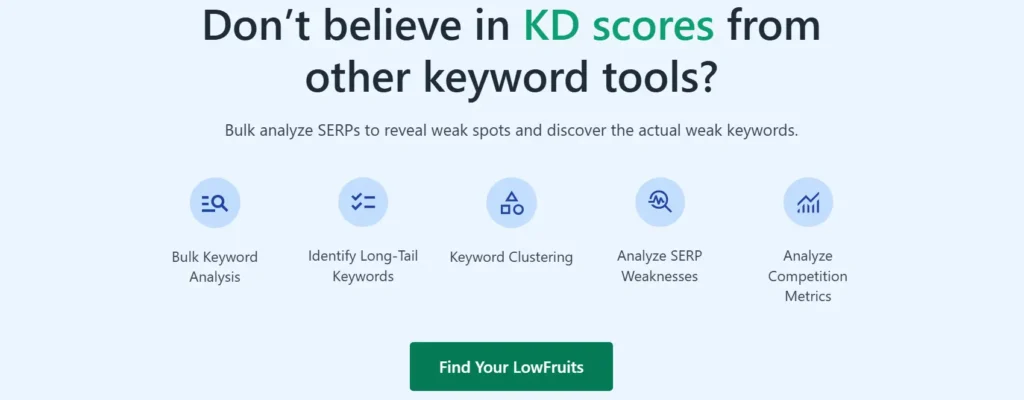
LowFruits uses AI to analyze search results and identify content gaps in your strategy. It automatically clusters keywords and highlights “weak spots” in competitor rankings where you can capture opportunities. This keyword research tool is ideal for SEO professionals and content strategists who want AI-powered insights to identify content gaps and weaknesses in competitor strategies without the overhead of enterprise tools.
Key Features
- AI-powered SERP analysis
- Automatic keyword clustering
- Content gap identification
- Weak spot finder for competitor content
- AI-driven insights on ranking factors
Pros
- AI-first approach to keyword research
- Excellent for identifying content gaps
- Helps find “weak spots” in competitor rankings
- Clustering happens automatically
- Great for finding long-tail opportunities
- Modern interface focused on actionable insights
Cons
- Smaller database than established tools like Ahrefs or Semrush
- Pay-as-you-go pricing can be unpredictable
- Newer tool with less brand recognition
- Fewer integrations than established platforms
- Limited customer support resources
Price
Starting at $29.90/month
3. Serpstat
Best for niche markets
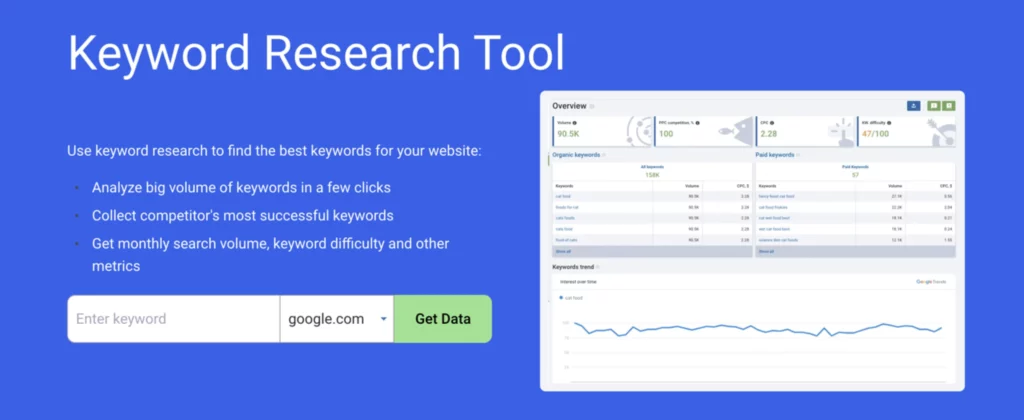
Serpstat is another one of the best keyword research tools for companies and teams. With the niche finder, you can explore specific areas of the internet. This is a unique feature that companies in small or specific industries can benefit from.
Key features
- Access to keyword metrics
- Competitor keyword collection
- Keyword niche finder for specific objectives
- SERP analysis and tracking
Pros
- Affordable compared to enterprise tools
- Unique niche finder feature
- Good competitor keyword analysis
- Solid keyword database
- Great for specific industries
Cons
- Smaller database than Ahrefs or Semrush
- Steeper learning curve than some tools
- Limited free trial
- Less brand recognition than competitors
Price
Free trial available with plans starting at $55.00/month
4. Ahrefs
Best for competitor research

Ahrefs is an all-in-one keyword research tool that focuses on search engine optimization (SEO) across the board. The keyword difficulty score tells you how challenging it will be to rank for a term, which can help you tailor your approach. You can also use this tool to find related keywords and rank them on importance.
Key features
- Thousands of keyword suggestions per query
- 10 different search engine options
- Keyword difficulty score
- Search engine results page (SERP) metrics and positioning
- Estimated traffic potential by topic
Pros
- Massive keyword database
- Excellent keyword difficulty scoring
- Strong competitor analysis capabilities
- Shows traffic potential for keywords
- Great for enterprise teams
- Comprehensive SERP analysis
Cons
- Higher price point ($129/month minimum)
- Steeper learning curve for beginners
- Credit-based system can be confusing
- Overkill for small businesses
Price
Starting at $129/month
5. Semrush
Best for multi-channel marketing
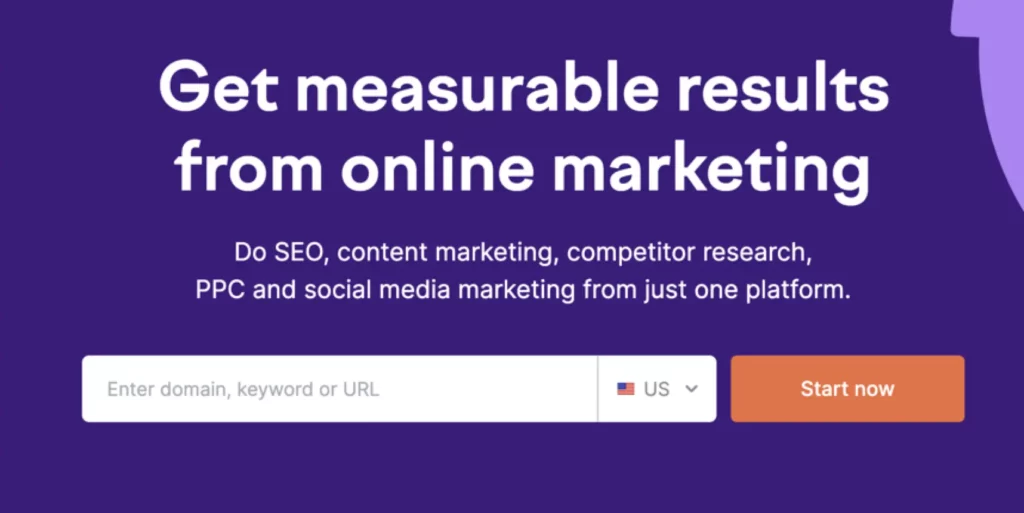
The Semrush keyword research toolkit includes several tools you can try for free. Between all the options, you can generate keywords for your campaign, compare organic traffic results, cluster keywords together, and look at competitor rankings.
Key features
- Free trials on multiple tools
- Keyword suggestions and generation
- Multiple marketing channel options (paid ads, SEO, and more)
- Competitor ranking analysis
- Keyword clustering and grouping
Pros
- True all-in-one platform covering SEO, PPC, content, and social
- Excellent keyword clustering features
- Strong competitor analysis across multiple channels
- Free trials available for testing
- Great reporting and visualization tools
- Ideal for teams managing multiple marketing channels
Cons
- Higher price point ($139.95/month minimum)
- Steep learning curve due to feature breadth
- Can feel overwhelming for small teams
- Credit-based usage system for some features
Price
Starting at $165.17/month
Artificial intelligence in keyword research
Artificial intelligence is fundamentally changing how keyword research works. In fact, 86% of SEO professionals are already integrating AI into their keyword research strategies. Instead of manually searching and analyzing keywords, AI algorithms now handle clustering, intent detection, and opportunity identification—often faster and more comprehensively than humans can.
What AI does in keyword research
Modern AI features in keyword research tools handle several critical tasks:
- Keyword clustering: AI automatically groups related keywords by intent, topic, or search pattern, helping you organize large keyword lists into actionable categories
- Intent analysis: AI identifies whether a search shows commercial intent, informational intent, or transactional intent, helping you prioritize high-value keywords
- Content gap identification: AI analyzes what competitors rank for and identifies holes in their coverage where you can capture traffic
- Predictive scoring: AI predicts which keywords will drive traffic based on difficulty, volume, and competition patterns
- Quick-win identification: AI surfaces keywords with high opportunity but low competition—the keywords that give you the fastest path to rankings
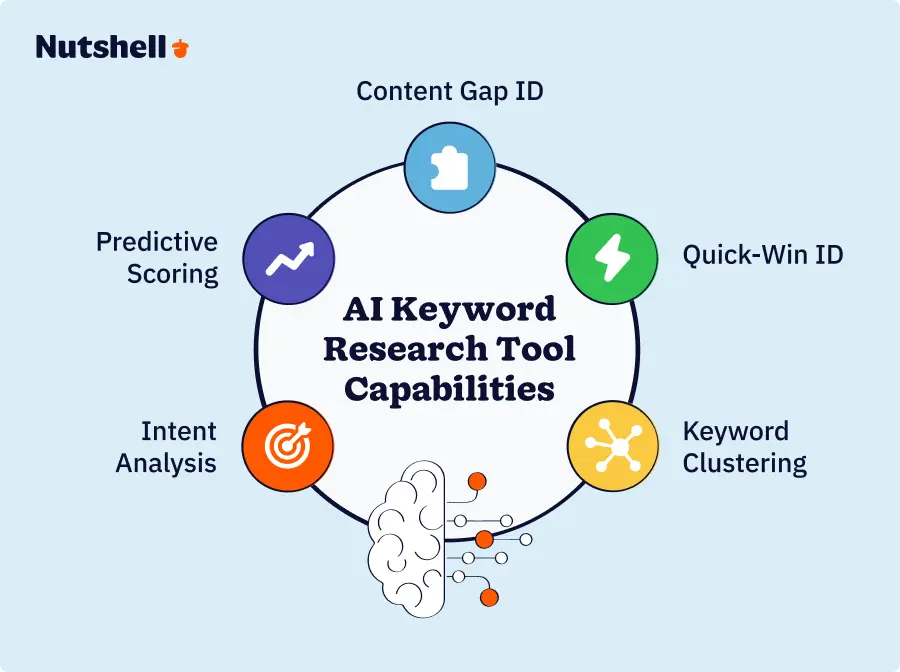
AI capabilities in the keyword research tools on this list
Several tools on our list now include meaningful AI features:
KeywordsFX stands out for its industry-specific AI scoring. After you enter a keyword and select your industry, the tool’s AI immediately provides a 1-10 opportunity score and flags quick wins specific to your market. This saves time on manual analysis and adds context generic tools miss.
Ahrefs uses AI to power its keyword difficulty scoring and traffic potential estimates. The AI learns patterns across millions of websites to predict how hard a keyword will be to rank for and how much traffic you could capture—predictions that are surprisingly accurate.
Semrush leverages AI for its keyword clustering and intent detection. Rather than manually organizing hundreds of keywords, the platform’s AI automatically groups them by search intent, then surfaces opportunities based on your business goals.
LowFruits takes an AI-first approach to keyword research. Its AI analyzes search results to identify content gaps and “weak spots” in competitor rankings—places where their content isn’t as strong as it could be. This helps you find easier ranking opportunities.
Why AI matters in your tool selection
AI features directly impact your research speed and accuracy. Tools with strong AI can cut research time in half while surfacing opportunities you’d miss manually. As AI continues advancing, tools that leverage it effectively will increasingly outpace those relying on traditional databases and manual analysis.
When comparing tools, evaluate their AI capabilities alongside traditional metrics. A tool with excellent AI clustering might save your team more time than a tool with a slightly larger keyword database.
Choosing the best keyword research tool for you
Selecting the right keyword research tool requires balancing your specific needs, budget, and team capabilities.
Assess your specific needs
Before comparing free versus paid options, clarify what your business needs:
- What’s your primary use case? Organic search, paid campaigns, content creation, or video optimization all have different tool requirements.
- How many campaigns are you managing? Solo creators have different needs than agencies running multiple campaigns.
- What’s your realistic budget? Free tools cost nothing. Paid tools range from $6/month to $200+/month. Determine what you can invest before evaluating.
- Who’s using it? Individual, small team, or enterprise? Team size affects feature and cost requirements.
Free vs. paid: Which is right for you?
Choose free if:
- You’re just starting with keyword research and want to learn basics without financial risk
- You have a limited budget and need to bootstrap your efforts
- Keyword research is a side responsibility, not your primary focus
- You need basic keyword suggestions and search volume data for occasional use
Free tools like Moz Keyword Explorer, Google Keyword Planner, and Google Trends work well for small businesses, freelancers, and content creators who don’t need advanced features.
Choose paid if:
- Keyword research directly impacts revenue and business growth
- You need competitor analysis and advanced metrics to stay competitive
- You’re managing multiple simultaneous campaigns and need coordinated data
- You require frequent research cycles and real-time updates
- You want advanced features like keyword clustering, intent analysis, or predictive scoring
Paid tools like Ahrefs, Semrush, and Serpstat justify their investment when keyword research is core to your strategy. Most SMBs find one paid tool sufficient.
Common mistakes to avoid when choosing a tool
- Choosing based on price alone: Balance cost with actual utility. A $10/month tool that doesn’t fit your workflow costs more in lost time than a $100/month tool that saves hours weekly.
- Not testing before committing: Most paid tools offer free trials. Test with your actual keywords and team before deciding.
- Overlooking specialized tools: If you’re primarily YouTube-focused, VidIQ outperforms general platforms. For local markets, Mangools KWFinder may be better than broader tools.
- Ignoring AI features: Automatic keyword clustering, intent analysis, and content gap identification are becoming standard differentiators. Consider these when comparing.
- Forgetting team adoption: The best tool fails if your team won’t use it. Prioritize intuitive interfaces and good support.
Consider outsourced keyword research
If keyword research feels overwhelming or you lack internal expertise, consider outsourcing to a digital marketing agency. Agencies like WebFX handle comprehensive keyword research, strategy development, and ongoing optimization as part of their service offerings. This approach eliminates software costs, training overhead, and the need to hire specialized staff—often proving more cost-effective than managing multiple tools internally.
Leave your marketing to the pros
Invest in digital marketing services like SEO, content marketing, website design, and more from WebFX to start generating high-quality leads ASAP.

Stack your keyword research tool with a CRM
As you drive more traffic to your site with effective keyword research and integration, you need a customer relationship management (CRM) platform that can capture and store customer data.
Nutshell is the perfect platform for capturing customer data. Once you capture the data, you can use Nutshell to manage your sales pipeline and encourage leads down the funnel.
That’s just the beginning. Start a free trial to see what Nutshell has to offer, or check out a live demo!
FAQs
Here are a few common questions about keyword research.
-
How do I choose the best keyword research tool?
Choose based on your specific needs, experience level, budget, and required features. Start with free tools like Google Keyword Planner to learn basics, then consider paid options like Semrush or Ahrefs for comprehensive data and competitor insights that integrate with your workflow.
-
Should I use a free or paid keyword research tool?
Free tools work well for beginners and basic keyword discovery. Paid tools provide deeper insights, competitor analysis, and advanced metrics that justify the investment when keyword research directly impacts revenue. Start free, then upgrade when you need comprehensive data.
-
How do keyword research tools help increase conversions?
Keyword research tools identify high-intent search terms your customers use when they’re ready to buy. By targeting keywords that match specific pain points and buying stages, you attract qualified traffic more likely to convert into leads and sales rather than just casual browsers.
-
Which keyword research tools are best for B2B companies?
Semrush and Ahrefs excel at B2B competitor analysis and industry research. KeywordsFX offers industry-specific context and AI scoring, while AnswerThePublic uncovers pain-point questions. Choose tools with industry glossary features and CRM integration capabilities for longer B2B sales cycles.
-
How do I integrate keyword research data with my CRM strategy?
Use UTM parameters and hidden form fields to track which keywords generate leads. Map this data to deals and revenue in your CRM to see which keywords drive actual sales, optimizing campaigns based on revenue impact rather than just traffic.
-
Why do different keyword tools show different search volumes?
Each tool uses different data sources and calculation methods. Google Keyword Planner rounds data into volume buckets and groups similar keywords. Third-party tools use clickstream data, machine learning, and historical trends. Search volumes are estimates, not exact numbers—focus on directionally accurate data for comparison.
-
Can I use multiple keyword research tools at the same time?
Yes, and it’s recommended. Combining multiple tools gives you more comprehensive data and reduces blind spots. Use free tools like Google Keyword Planner for trend monitoring, one paid platform (Ahrefs or Semrush) as your primary research hub, and specialized tools for specific needs like YouTube or local SEO.
-
How often should I update my keyword research?
Revisit keyword research every 3-6 months to identify new opportunities and shifting trends. Between full research cycles, use Google Search Console monthly to see which keywords your pages already rank for and optimize existing content before adding new topics. Search demand and competition change regularly.
See Nutshell in action!
Try Nutshell free for 14 days or let us show you around before you dive in.
 BACK TO TOP
 Written by
Jewell July Marketing SpecialistEdited by
Will Gordon Sr. Director of MarketingReviewed by
Andy Fowler Co-FounderReady to try
Nutshell for Free?Thank you! Your submission has been received!Oops! Something went wrong while submitting the form.





Nutshell 3.0 Launched for the iPhone, Featuring Next-Level Filtering and Map Capabilities
Published on: November 10, 2022What Is Revenue Intelligence? An All-Encompassing Guide
Published on: January 24, 2024Highly Effective Strategies for Elevating Sales Team Performance
Published on: November 10, 2022Join 30,000+ other sales and marketing professionals. Subscribe to our Sell to Win newsletter!