The 11 Best Customer Database Software Solutions

-

Quick answer: What are the best customer database software solutions?
The best customer database software gives you a centralized place to store, organize, and act on your customer and lead data, so your team always has the context they need to build better relationships and close more deals. The right solution depends on your business size and needs, but look for software that’s easy to use, integrates with your existing tools, and scales with you as you grow.
Key takeaways
- Customer databases centralize customer information to improve sales efficiency, personalize marketing, and enhance service—with 91% of companies with 10+ employees now using CRM systems to manage this data.
- High-quality customer data drives better business outcomes. For every dollar invested in CRM technology, businesses see an average return of $8.71, while poor data quality costs companies an average of $406 million annually.
- The most effective customer database solutions offer usability, automation, and seamless integrations, turning scattered contact lists into strategic assets that fuel revenue growth and customer loyalty.
The customer database software at a glance
- Nutshell CRM – Best for small to midsize B2B teams seeking all-in-one sales and marketing automation.
- Zoho CRM – Best for businesses needing AI-powered data enrichment features.
- HubSpot CRM – Best for companies wanting a free CRM with a clear upgrade path.
- Salesforce – Best for enterprises requiring advanced customization and scalability.
- Flowlu – Best for managing customers alongside projects, tasks, and invoicing.
- Pipedrive – Best for teams prioritizing visual sales pipeline management.
- Zendesk – Best for customer service-focused teams needing CRM and support integration.
- Freshsales – Best for startups and medium-sized companies seeking AI-powered lead scoring.
- Apptivo – Best for businesses needing a suite of integrated business applications.
- Keap – Best for small business owners requiring marketing automation.
- Microsoft Excel – Best for bootstrapped early-stage businesses with minimal budget.
When you’re a growing business, you’ve got to effectively manage and update your leads in a way that’s organized and efficient. You can do just that with a client database and intuitive customer relationship management (CRM) software.
Read on to learn more about the basics of a customer database, the benefits of customer database management, and how you can use a CRM like Nutshell to manage your customer data.
Table of Contents
-
- How we selected the best customer database software
- What is a client database?
- What can you store in a customer database?
- What types of customer data should you collect?
- Benefits of a client database
- The growing importance of customer databases
- Challenges in managing a client database
- What you should look for in a customer database
- Our top 11 picks for client database software
- Tips for using a customer database to supercharge sales and marketing efforts
- FAQs
How we selected the best customer database software
Choosing the right customer database software can feel overwhelming with so many options available. To create this guide, we evaluated solutions based on criteria that matter most to small and medium-sized businesses: usability, integrations, pricing transparency, automation capabilities, and unified data access across teams.
Our research process included analyzing user reviews on G2, Capterra, and other third-party review platforms, along with hands-on testing where possible. We prioritized solutions that offer strong value for businesses with 5 to 100 employees—companies large enough to need robust customer data management but small enough to require straightforward, affordable tools.
We evaluated each platform across five key dimensions:
- Ease of use: How quickly can your team get up and running? We prioritized solutions with intuitive interfaces and short learning curves, recognizing that SMBs often lack dedicated IT staff for lengthy implementations.
- Integration ecosystem: Does the software connect seamlessly with tools you already use? We assessed the breadth and quality of native integrations, as well as API flexibility for custom connections.
- Transparent pricing: Are costs clear and predictable? We favored solutions with straightforward pricing models and no hidden fees that can surprise growing businesses.
- Automation features: Can the platform save your team time on repetitive tasks? We evaluated workflow automation, email sequences, task creation, and data entry reduction capabilities.
- Data accessibility: Can all team members access the customer information they need? We looked for solutions that provide unified, real-time data across sales, marketing, and service teams.
Full disclosure: We’re including our own solution, Nutshell, in this roundup. To ensure fairness, all solutions are evaluated against the same objective criteria, and ratings are based on third-party user reviews and documented features. We’re committed to helping you find the right fit for your business—whether that’s Nutshell or another solution on this list.
The ratings you’ll see throughout this guide are based on aggregated user reviews from multiple platforms, weighted toward recent feedback from businesses similar in size to our target audience. We’ve also ensured meaningful differentiation between solutions rather than artificially clustering ratings close together.
What is a client database?
A client or customer database is a detailed, organized collection of customer information and contact details, such as names, email addresses, and demographics, all stored in a single place. Such a customer information database is critical for organizing data and can be used by companies to optimize their marketing and sales efforts.
Customer database software – also known as customer relationship management (CRM) software – stores and organizes your client database for ease of reference and use between customer-facing teams.
What can you store in a customer database?
Customer databases house general customer information like:
- First and last names
- Email addresses
- Phone numbers
- Basic demographic information like age and/or gender identity
Every business’s customer database will look a bit different, though. The data you collect for your customer database depends on three key factors: your business goals, the leads in your pipeline, and how you plan to use that information.
For example, some companies’ databases may include more behavioral data than others, like what devices a customer primarily uses to browse your site or what social media platforms they’re most active on.
What types of customer data should you collect?
Below are three common types of customer data businesses can collect to better understand their audience:
- First-party customer data: First-party data is collected directly from your audience. This data includes information your customers willingly share when they interact with your business. This might include names, email addresses, phone numbers, company details, purchase history, website behavior, and communication preferences. You can collect this data through website forms, email signups, sales conversations, customer support interactions, and purchase transactions.
- Second-party customer data: Second-party data consists of the same information as first-party data but comes from a trusted business partner or second party who collected the information straight from their audience. This data is collected through methods like sweepstakes and giveaways where more than one company is involved.
- Third-party customer data: Third-party data is collected by an outside entity that’s separate from your own. Some third-party customer data is publicly available, like census records or labor statistics. Third-party data includes information like social media handles, demographic data, user interests and behavior, and basic job information.
With customer database software like a CRM, it’s easy to collect and manage all of this information.
Benefits of a customer management database
These are just a few of the many benefits of a customer database that you can enjoy when you begin to organize your customer and lead information.
1. Organized customer profiles
One of the most obvious perks of managing a customer database is the organization it provides. Whether you want to organize your customer information by name, priority level, or another metric of your choice, you can organize it in whichever way works best for you and your sales team.
This increased organization is also going to save you a lot of time. Gone are the days of flipping through endless pages or sticky notes of customer contact information. With a customer database, you can easily input information and look it up seconds later.
2. Better customer service
Having all of your customer information organized in one place allows you to provide better service to your customers. With customer data easily accessible for your sales team, they can better understand the individuals they’re talking to and ensure they’re providing customers with the services they need every time.
In turn, better customer service is going to help you build more brand loyalty within your customer base and foster long-lasting customer relationships. Word of these positive customer experiences will travel to the ears of other prospective customers and potentially push them toward working with you too. It’s a win-win for everyone!
3. Targeted campaigns
When you maintain a customer database, you can gain a better understanding of who your customers are, from demographic and geographic location to user behaviors and interests. This information can help you to create more targeted marketing campaigns.
Targeted marketing strategies can yield better results for your business and give you a better return on investment (ROI) for your campaigns because they appeal to your audiences in a way that encourages them to act.
Powerful email marketing, minus the headaches
Nutshell’s email marketing plugs directly into your CRM data, so you can create highly targeted audience segments, track the impact of your emails in real-time, and manage all your communications out of a single tool. Get started for free!

The growing importance of customer databases
Customer database management has evolved from a nice-to-have organizational tool to a strategic business requirement. As companies navigate increasing competition and rising customer expectations, the ability to centralize, analyze, and act on customer data has become critical for survival and growth.
Market growth and adoption statistics
The numbers tell a compelling story. The CRM market is projected to reach $262.74 billion by 2032, growing at 12.6% annually—a clear signal that businesses across industries recognize the strategic value of proper customer data management. This isn’t just an enterprise trend: 91% of companies with 10 or more employees now use some form of CRM system to organize their customer information.
The financial impact of customer database software speaks for itself. Research by Nucleus Research found that for every dollar invested in CRM technology, businesses see an average return of $8.71. Companies implementing customer database systems report a 29% average increase in sales, along with improved customer retention rates of up to 27%.
The SMB opportunity
Yet adoption among small and medium-sized businesses still lags behind potential. Just 26% of SMBs currently use a CRM, despite 83% of those who do reporting positive ROI. This presents a significant competitive opportunity: small businesses that implement customer database solutions today can gain measurable advantages over competitors still managing contacts in spreadsheets.
Key trends shaping customer database management
- AI-powered automation is becoming standard: Gartner predicts that by 2026, 80% of B2B sales interactions will occur in digital channels powered by AI—from lead qualification to pipeline conversion. Modern customer database platforms are embedding AI capabilities to automate data entry, suggest next actions, and identify patterns humans might miss.
- Data quality is emerging as a critical differentiator: As businesses collect more customer information, the quality of that data matters more than quantity. Forward-thinking companies are investing in automated data cleansing, enrichment, and validation to ensure their customer databases remain reliable foundations for decision-making.
- Customer expectations are evolving faster than businesses can adapt: Research by PwC found that 70% of executives say customer expectations are changing faster than their companies can respond. The same study revealed that 52% of consumers stopped using a brand due to poor product or service experiences, while 29% left due to subpar customer experience. These statistics underscore why maintaining accurate, accessible customer data has become a competitive necessity.
- Mobile and real-time access is non-negotiable: Sales teams increasingly work remotely and need instant access to customer information. Mobile CRM usage increases sales productivity by 14.6%, and businesses using mobile CRM solutions are 150% more likely to exceed their sales goals.
The message is clear: customer database management isn’t just about organization anymore. It’s about equipping your team with the real-time insights, automation, and intelligence they need to compete in an increasingly data-driven marketplace.
Challenges in managing a client database
As discussed, a comprehensive customer database can be a powerful asset for your business, offering numerous benefits. However, if not managed properly, it can also pose significant challenges.
Here are several customer database challenges that often present itself:
1. Data overload
When your customer database is too detailed and large, it can become overwhelming and make it hard to extract meaningful insights. When it’s flooded with data, it may be tough to spot trends or figure out what your customers really want. This could slow down decision-making and negatively impact your business.
2. Data maintenance
Once you’ve gathered your customer data, maintaining it is just as important. This involves spotting and removing duplicates, correcting errors, and updating outdated information.
An over-cluttered or outdated customer database can result in miscommunication, ineffective marketing, and a poor experience for your customers. While keeping your data current may take time, it’s essential for successful customer relationship management.
3. Data privacy and security
A customer database usually contains sensitive information, making it tough to keep data private and secure. With regulations like CCPA, businesses have to deal with complicated compliance rules to safeguard customer information. It’s also crucial to control who can access specific data.
Striking the right balance between easy access and strong security can be challenging. If security measures are too strict, they can frustrate users. On the other hand, if they’re too lenient, businesses might face significant risks.
4. Training and user adoption
Unfortunately, having a perfect customer database won’t be much help if your team isn’t trained to manage it effectively. Training on the database and related software, along with fostering user adoption, is essential.
Without proper training, your team might find it difficult to navigate the system or make the most of its features, leading to frustration and lower productivity. However, when your team is well-trained and feels confident using the database, they’re more likely to input data accurately, keep it updated, and fully utilize the database’s capabilities to improve customer interactions.
By choosing customer database software that meets your needs and fits your available resources, you can tackle the challenges mentioned above.
Let’s explore what to consider when selecting the right customer database for you.
Learn how to get the most from your CRM
Register for the weekly Intro to Nutshell webinar to discover CRM tips that will boost business growth.

What you should look for in a customer database
While your organization’s needs are unique, there are a few features you should definitely look for in a customer database that will make using it much easier:
1. Usability
Whether everyone on your team has used a customer database before or not, usability is an important trait to look for. A client database platform that’s easy to learn and use will set your team up for quick implementation.
2. Integrations
Your company likely already uses multiple tools to gather its customer data. Look for a customer database that offers lots of integrations with other applications and tools so you can reduce manual data entry and easily keep your records updated.
3. Pricing
Pricing is a vital consideration for businesses of all sizes. Find the plans that are as comparable as possible across tools and compare their prices. Also, consider whether the features a customer database offers align with your company’s budget.
4. Automation
Managing tasks should be as easy as possible for your team. Whether you need to add or update contact information or create marketing lists from your contacts, automation features on your customer database software can streamline your workflows and put more time back into your day.
5. Unified customer data
The information stored in your customer database should also be totally synced. When different users and teams can access the same customer records, this improves efficiency and streamlines workflows across your company.
After exploring the various challenges of managing customer data and what to keep in mind, here’s our list of the best customer database software out there.
Our top 11 picks for customer database software
Knowing about the ins and outs of a customer database is one thing, but creating one and putting it into action is another. We’ve gathered 11 of our favorite customer database software options—for various budgets and purposes—to help you start collecting or organizing customer data like a pro.
1. Nutshell CRM
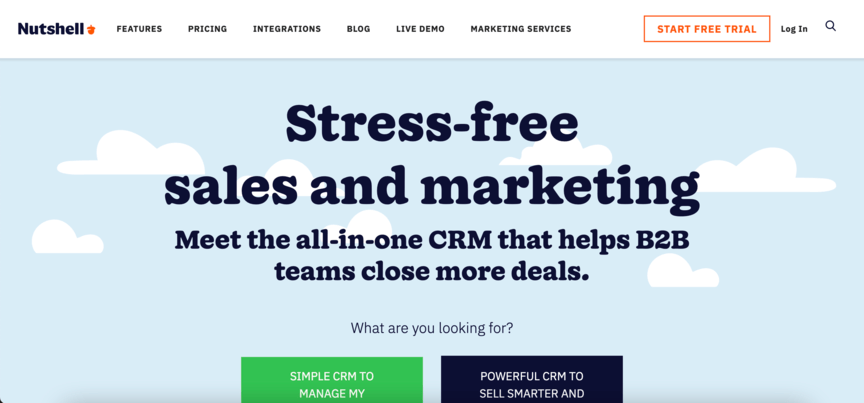
Nutshell’s all-in-one CRM helps you collect customer information and take it a step further, turning leads into wins for your brand. More than just a customer database, Nutshell’s contact management features find the customer information you’re looking for fast, while features like sales automation, email automation, a meeting scheduler, marketing tools, and more get your team back to doing what you do best: making your customers happy.
Nutshell takes your team from just having a customer database to implementing targeted marketing campaigns, engaging with contacts across multiple channels, and strengthening relationships at every stage of the customer journey so you can drive revenue. The numbers prove it: on average, businesses using Nutshell see 14.9% faster close times, 13.4% increase in won leads, and 26.4% increase in new sales revenue.
Key Features
- Centralized customer data: Every team has access to customer updates and information as they happen – which means that your marketing and sales teams can coordinate their actions regarding a lead.
- Intuitive sales automation: Reduce time-wasting tasks by automating your sales process and put your email outreach on autopilot.
- Multi-team collaboration: One customer database with customized pipelines and tasks for your teams to collaborate on converting your leads.
- Insightful reports: Measure your performance and pinpoint areas for improvement with easy to customize reports.
- Personalized email automation: Nutshell comes with pre-built email templates you can use to automate your email sequences.
Pricing
- 14 Day Free Trial available
- Foundation: Starts at $13 per user/month (annual pricing)
- Growth: Starts at $25 per user/month
- Pro: Starts at $42 per user/month
- Business: Starts at $59 per user/month
- Enterprise: Starts at $79 per user/month
- Learn more about Nutshell’s pricing options here.
G2 review rating
4.3 out of 5 stars
See Nutshell in action by attending a live product demo or starting a free trial today.
See Nutshell in action
Give our powerful, easy-to-use CRM a try for free for 14 days! Or join a live demo to see Nutshell at work!

2. Zoho CRM
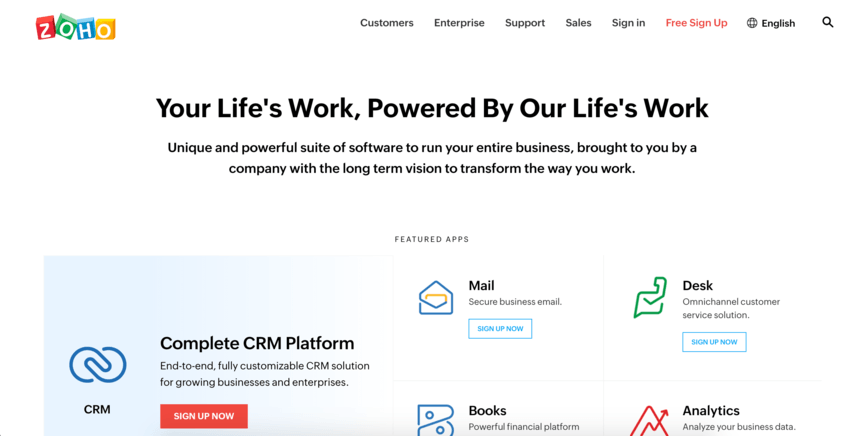
The Zoho CRM is another great customer database management tool. This CRM helps you track leads in real time and organize customer information with maximum efficiency. Import customer data with ease, and even enrich your data with Zoho’s built-in artificial intelligence (AI) software that assists you in improving the quality of your data.
Zoho’s dashboards help you maintain an organized customer database that’s easy to navigate and makes reorganization a breeze (because, let’s be honest, sometimes a change is needed when your business is always moving forward).
Key Features
- Track leads in real time: track every lead or opportunity in the pipeline down to the last detail with comprehensive reports.
- Artificial intelligence software: Improve the quality of your data with AI
- Easy-to-navigate interface
Pricing
- Free version available
- Standard: $12 per user/month
- Professional: $20 per user/month
- Enterprise: $35 per user/month
- Ultimate: $45 per user/month
G2 review rating
4.1 out of 5 stars
3. HubSpot CRM
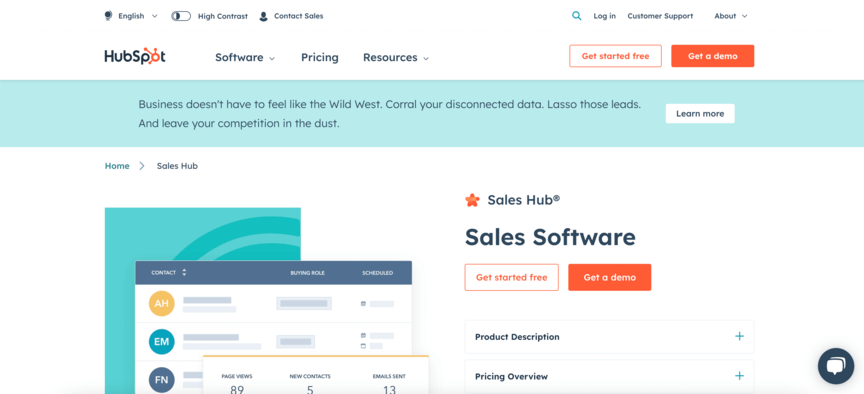
With HubSpot, you can import customer information with just a few clicks and easily keep your customer database up to date as your client list grows.
With easy-to-browse customer profiles, you can manage customer relationships, manage your sales pipeline, and start new conversations with customers in no time.
Key Features
- Convenient call tracking: Make, record, and log calls automatically for maximum efficiency when interacting with contacts.
- Document tracking: Build a library of sales content for your team to share, and track which documents close deals.
- Built-in artificial intelligence (AI) software: HubSpot’s AI-powered deal management tools help you to streamline your sales process.
Pricing
- Free plan available
- Starter: $15 per month per seat
- Professional: $90 per month per seat
- Enterprise: $150 per month per seat
G2 review rating
4.4 out of 5 stars
4. Salesforce
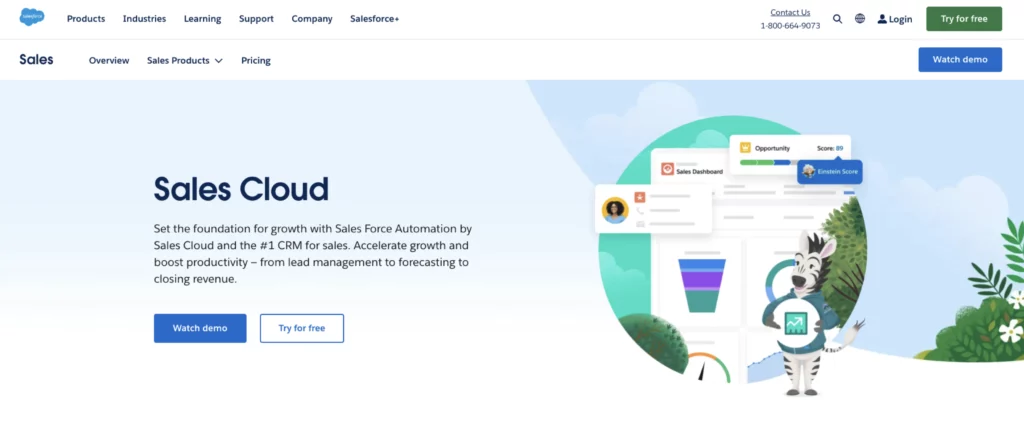
Salesforce lets users manage their leads, contacts, sales records, and more. Data can be organized based on different criteria, which makes searching for the right information easy.
Salesforce also offers advanced data segmentation features like dynamic segmentation that automatically updates segments when customer data changes.
Key Features
- Customizability: Organize your data on your unique company terms
- Dynamic segmentation: Automate segmentation based on customer actions
- Sales forecasting with AI: Sales Cloud’s generative artificial intelligence supercharges sales projection, forecast management, and sales enablement.
Pricing
- 30 Day free trial available
- Starter Suite: $25 per user/month
- Pro Suite: $100 per user/month
- Enterprise: $165 per user/month
- Unlimited: $330 per user/month
- Einstein 1 Sales: $500 per user/month
G2 review rating
4.4 out of 5 stars
5. Flowlu
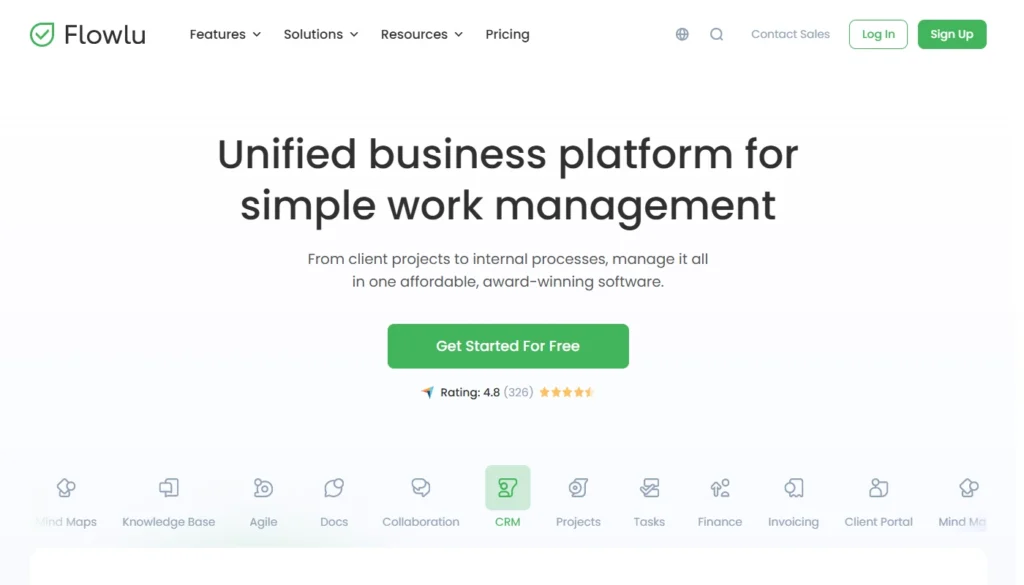
Flowlu is a cloud-based customer management platform with project, task, collaboration, and financial features. Built to help you work smarter, it enables you to manage every customer interaction from intake to final invoice payment within a single app.
It lets you organize your database with tags and custom fields to segment your audience effectively for marketing and sales campaigns. Visual pipelines simplify monitoring deal progress, while automations handle routine follow-ups and task assignments.
Key Features
- Total customer data control: See emails, calls, deals, projects, tasks, and payments in one contact profile for full context of every relationship.
- Smart segmentation: Use custom fields, tags, and filters to sort your database instantly and create targeted lists for sales outreach.
- Seamless workflow automation: Set up automations to assign sales reps, schedule meetings, update contact records, and even estimate revenue and expenses.
Pricing
- 7-day free trial available
- Free plan available (up to 2 users)
- Essential: $9 per user/month (billed annually)
- Advanced: $17 per user/month (billed annually)
- Ultimate: Contact for a personalized quote
G2 review rating
4.7 out of 5 stars
6. Pipedrive
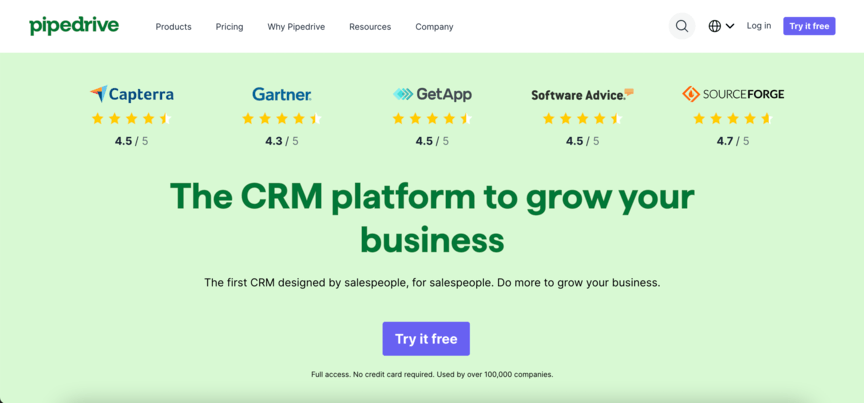
Another useful customer database is Pipedrive, a well-known CRM that supports sales teams as they work to close deals with leads.
Pipedrive makes contact and purchase history tracking easy. Lead segmentation allows users to personalize their email communication with contacts. Pipedrive also uses data enrichment to bring in new insights about your contacts from around the Internet.
Key Features
- App integration: Integrate with more than 400 business applications
- Customizable sales pipeline: You can use custom fields to create your own sales pipelines and deals to fit your business processes.
- Advanced sales reporting
Pricing
- 14 Day Free Trial available
- Essential: $14 per user/month
- Advanced: $34 per user/month
- Professional: $49 per user/month
- Power: $64 per user/month
- Enterprise: $99 per user/month
G2 review rating
4.3 out of 5 stars
7. Zendesk
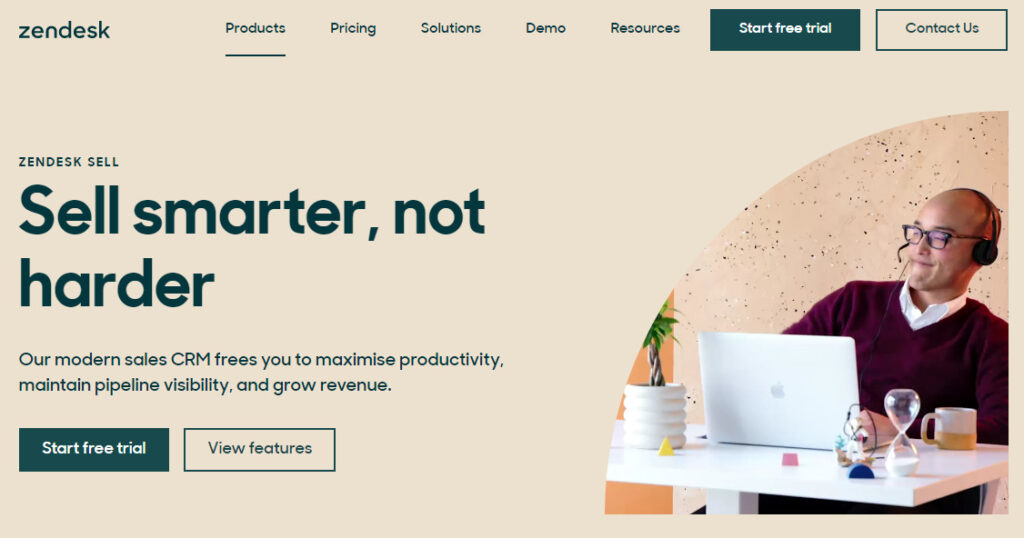
Zendesk is built to give companies a complete view of their customers and relationships. By having a single customer database, you can connect your sales and service teams and keep everyone on the same page.
Zendesk’s data analysis tools help you make the most of your prospect and customer data and keep contacts from slipping through the cracks.
Key Features
- Contact data analysis and segmentation: You can integrate Zendesk Sell and Support to exchange essential customer data between sales, marketing and support teams.
- Lead management: With Zendesk’s pipeline analysis tools, you can analyze lead and deal progression to identify and avoid bottlenecks across each stage of your pipeline.
- Prospecting tools: Email sequences, bulk outreach and sales trigger-based actions.
Pricing
- 14 Day Free Trial available
- Team: $19 per user/month
- Growth: $55 per user/month
- Professional: $115 per user/month
G2 review rating
4.2 out of 5 stars
8. Freshsales
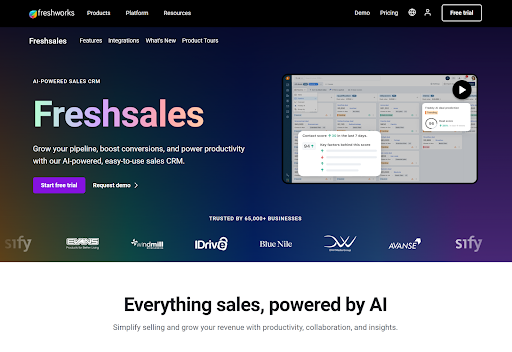
Freshsales CRM is a cloud-based customer database software that caters especially to startups and medium-sized companies.
Its easy-to-use, clean interface enhances focus and allows teams to fully their sales process with built-in email, phone, chat, and telephony.
Key Features
- Segmented sales campaigns with AI: Use Freshsales Freddy AI as an assistant for running campaigns to generate more leads, capture, qualify, route, and track them.
- Advanced deal management: Waste no time and have your team members know exactly what they need to do for the day with simple kanban views.
- Automate manual tasks: Increase productivity and adoption by automating mundane repetitive tasks.
Pricing
- Free version available
- Growth: $9 per user/month
- Pro: $39 per user/month
- Enterprise: $59 per user/month
G2 review rating
4.5 out of 5 stars
9. Apptivo
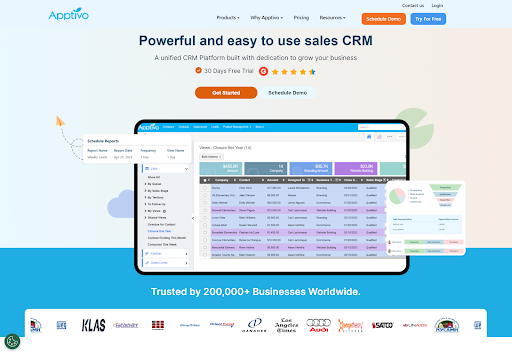
Apptivo CRM comes with a suite of business applications that help you manage your projects, contacts, and communications.
Its streamlined contact manager is simple to use and is the main draw for businesses that need to track their customer interactions.
Key Features
- Contact and lead list management: Qualify and nurture your leads through a tailored journey with round-robin task assignments, a lead qualification cycle, and lead score monitoring.
- Deal management: Streamline multiple sales cycles to take advantage of every opportunity with workflow automation, an intelligent sales dashboard and custom reports and views.
Pricing (Annual)
- 30-day free trial available
- Lite: $15 per user/month
- Premium: $25 per user/month
- Ultimate: $40 per user/month
- Enterprise: Price upon request
G2 review rating
4.4 out of 5 stars
10. Keap

Keap – formerly known as Infusionsoft – empowers sales and marketing teams for small businesses by helping them to automate their customer processes.
The CRM incorporates tools such as e-commerce, payments, and client management to help companies develop smoother workflows across teams.
Key Features
- Consistent, repeatable lead generation: Automated processes help you to scale without putting in more hours
- Personalized small business automation: Customize your pipeline to suit your business
- Access work calls and texts on your smartphone: Keep updated on new leads and customer activity while on the go
Pricing (Annual)
- 14 Day Free Trial available
- Starting at $299 per month for 2 users and up to 1500 contacts
Note that Keap no longer offers feature-based plans. Users now have access to the full Keap suite of features, with pricing based on your number of users and contacts.
G2 review rating
4.2 out of 5 stars
11. Microsoft Excel
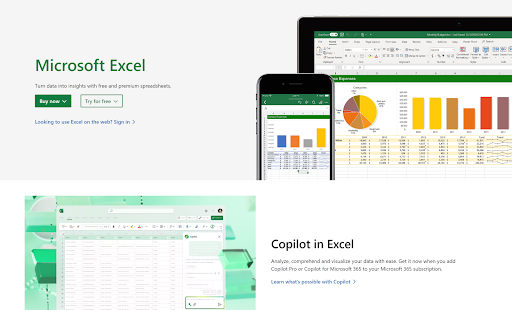
While there is a range of great software tools available for customer database management, not every organization has the time or funds to invest in CRM software.
When you need to bootstrap your customer database management in the early stages of your business, Microsoft Excel is a competent spreadsheet software that can be used as a minimalist CRM tool.
Key Features
- Data entry and importing: Add customer data manually in personalized fields or import data from CSV files
- Sorting and filtering: Find the exact customer information you need with advanced filtering and sorting capabilities
- Conditional formatting: Use built-in formulas to track changes in customer data and monitor potential sales and other opportunities
Pricing
- Excel only: $179.99 once-off fee for use on 1 PC or Mac
- Microsoft 365 Suite: From $6.00 per user per month
G2 review rating
4.7 out of 5 stars
Tips for using a customer database to supercharge sales and marketing efforts
Looking for ways to improve results from your customer database? These tips can help you take your sales and marketing efforts to the next level:
1. Break down data silos with a single source of truth
When your customer data lives in different tools, teams duplicate work, messaging becomes inconsistent, and deals slow down. A unified, shared view of every relationship—sometimes called a single customer view—lets marketing and sales see the same history of touchpoints, preferences, and next steps so they can act in lockstep. Unifying systems also makes it easier to define shared goals and KPIs, and to spot pipeline bottlenecks earlier.
In Nutshell, you can operate marketing and CRM in one place so everyone works from the same record. Start by centralizing contacts and activity on your CRM, then layer in Nutshell Marketing so campaigns and CRM data are connected by default. Use Email & calendar sync to capture conversations on the contact timeline and embed Nutshell Forms on your site so new people/companies/leads are auto‑created (no copy‑paste). The result is one source of truth across sales and marketing—updated in real time.
2. Capture clean, structured data at the source
Bad data compounds—if you collect inconsistent fields or incomplete records, you’ll struggle to segment audiences, automate nurture, or forecast accurately. “Structured” means deciding which fields matter (e.g., industry, buying role, renewal date), standardizing formats, and building guardrails so new records come in clean. Do this well and you reduce manual clean‑up, unlock better targeting, and build reports you actually trust.
In Nutshell, use Custom fields & forms to capture the specific data your teams need, then collect it automatically with Nutshell Forms. Supercharge accuracy with Form answer automations—map certain answers to actions like tagging contacts, assigning them to the right pipeline, or adding them to a marketing audience. When importing legacy lists, follow Nutshell’s import best practices so columns land in the correct fields from day one.
3. Turn profiles into dynamic segments and trigger journeys
Treat your database like a decision engine, not a rolodex. Build segments by lifecycle stage, behavior (opens/clicks/site visits), firmographics, or product interest, then tailor messaging and timing to each group. Dynamic lists that update as data changes (e.g., “trial users in last 14 days”) keep nurture paths fresh, and A/B tests help you learn what resonates before you scale.
In Nutshell, create marketing Audiences directly from your CRM tags and fields, then trigger drip sequences when a lead hits a specific pipeline stage—no exporting needed. Build, schedule, and measure campaigns inside Nutshell Email Marketing; and use built‑in A/B testing to optimize subject lines and content. Because campaign engagement writes back to the contact record, sellers immediately see who engaged and can follow up with context.
4. Enrich and maintain data quality
Even a well‑structured database decays—people change jobs, companies merge, accounts reorganize. Enrichment fills gaps (titles, company size, industry) and keeps profiles current, which improves routing, personalization, and forecasting. Pair enrichment with a simple hygiene routine (dedupe, required fields, and review cycles) to keep your data analysis‑ready.
Nutshell offers enrichment for both people and companies. Use PeopleIQ to instantly add key contact details, and turn on Company Enrichment to auto‑populate firmographic data—right on the company record. For cleaner workflows, consider per‑pipeline custom fields so teams see only the fields relevant to their stage, and use bulk‑edit tools periodically to standardize tags and values.
5. Automate handoffs and follow‑ups to protect pipeline velocity
Manual handoffs and “I thought you owned that” moments kill momentum. Define the events that should trigger action (new MQL, no‑show, demo completed, deal won/lost) and automate the next step—task creation, email sequence, status change, or routing. The more consistently you advance leads to the next best action, the more pipeline you’ll keep moving.
In Nutshell, you can trigger personal email sequences when a lead enters a pipeline stage (messages pause automatically when someone replies), auto‑create follow‑through leads when a deal is won/lost using closed lead follow‑up automations, and attach stage‑based task lists so reps never miss critical steps. Put simply: every milestone automatically triggers the right activity. See: automate personal email sequences, closed‑lead follow‑up automation, and automated task lists.
6. Close the loop with reporting & attribution
If you can’t connect campaigns to pipeline and revenue, you’re flying blind. Capture channel/source consistently, watch performance in a shared dashboard, and report on funnel KPIs (lead quality, conversion rates, velocity, LTV/CAC) that both sales and marketing own. With the right attribution in place, you’ll know what to scale and what to stop.
Nutshell makes this straightforward: enable Nutshell Analytics to attribute channels (including UTM parameters) to new leads, then review results in your marketing dashboard and CRM reports. Nutshell’s lead attribution and pricing include buyer‑journey/channel attribution; the Analytics snippet ties website activity to leads; and integrations like Google Ads complete the picture—so you can prove which campaigns create revenue.
7. Respect preferences & compliance while improving deliverability
List churn usually spikes when people feel trapped in “all‑or‑nothing” subscriptions. Give subscribers control over topics and frequency, honor opt‑outs, and maintain clear data‑handling practices (GDPR/CAN‑SPAM). Doing this well reduces unsubscribes, keeps audiences healthy, and protects your sender reputation over time.
Nutshell’s Email preference center lets contacts choose the audiences they want to receive—linked right from your emails—while Nutshell enforces required unsubscribe links and address info in marketing emails. Use the preference center to present 3–5 clear categories, and manage opt‑outs or bulk changes with the Audiences tools in the Help Center. See: Unsubscribe requirements and Unsubscribe & audiences management.
Make customer database management easy with Nutshell
Customer database management doesn’t have to be hard when you’ve got Nutshell by your side. Our contact management and marketing features help you keep track of who your leads are, where they’re coming from, and how close you are to turning them into loyal customers.
Learn more about what Nutshell’s CRM can do to help you with your customer database management efforts by starting a two-week free trial or attending a live demo today.
Customer database FAQs
-
1. What’s the difference between a CRM and a customer database?
A customer database simply stores contact information, while a CRM is a complete relationship management system. CRMs include databases plus automation, analytics, pipeline management, and integrations. Think of a CRM as a customer database on steroids—it doesn’t just store data, it helps you act on it.
-
2. How do I migrate my customer data from Excel to a customer database?
Start by cleaning your Excel data—remove duplicates, standardize formats, and organize columns to match your CRM’s fields. Export as CSV, then use your CRM’s import wizard to map fields correctly. Run a test import with a small sample first to catch errors before uploading everything.
-
3. How often should I update and clean my customer database?
Update customer records immediately when changes occur, and schedule deep cleaning quarterly. Set up weekly reviews for new entries and monthly checks for duplicates or outdated information. Regular maintenance prevents data decay—studies show 30% of contact data becomes inaccurate annually without consistent upkeep.
-
4. Can a customer database integrate with my existing business tools?
Yes. Modern customer databases integrate with hundreds of business tools through APIs or built-in connectors. Popular integrations include email platforms, accounting software, marketing automation, and e-commerce systems. These connections automatically sync data between systems, eliminating manual entry and keeping information current across your entire tech stack.
-
5. How long does it take to set up a customer database?
Setup time varies by complexity, but most businesses can launch a basic CRM in 1-2 weeks. This includes data migration, field customization, and team training. More complex implementations with custom workflows and integrations may take 4-6 weeks. Cloud-based solutions like Nutshell offer faster deployment than on-premise systems.
Get an easy-to-use CRM that’s intuitive yet powerful
Nutshell is the customizable, all-in-one CRM and marketing software that helps B2B teams close more deals.
Try it for yourself with a 14-day trial — no credit card required!
 BACK TO TOP
 Written by
Will Gordon Sr. Director of MarketingEdited by
Andy Fowler Co-FounderReady to try
Nutshell for Free?Thank you! Your submission has been received!Oops! Something went wrong while submitting the form.



Introducing Revenue Booster, Our New Add-On for Getting the Most Out of Your CRM
Published on: August 11, 2023

The 20 Digital Marketing Skills You Need to Excel in Your Marketing Career (2026)
Published on: November 10, 2022What Is Revenue Intelligence? An All-Encompassing Guide
Published on: January 24, 2024Highly Effective Strategies for Elevating Sales Team Performance
Published on: November 10, 2022Join 30,000+ other sales and marketing professionals. Subscribe to our Sell to Win newsletter!