5 of the Best CRM for Shopify: Top Integrations For Your E-commerce Business

-

Quick answer: What are the best CRMs for Shopify?
The best CRMs for Shopify include HubSpot, Salesforce, Zoho CRM, and Nutshell, which integrate directly with your store to sync customer data, order history, and shopping behavior into your sales pipeline. These integrations let you track the entire customer journey from first website visit to purchase and beyond, automate follow-ups for abandoned carts or repeat purchases, and segment customers based on buying patterns. A good Shopify CRM helps ecommerce businesses provide personalized service, increase customer lifetime value, and turn one-time buyers into loyal repeat customers.
Key Takeaways
- A Shopify CRM is crucial for centralizing customer data, automating marketing and sales workflows, and personalizing the customer journey to significantly boost revenue and retention.
- Nutshell is the top all-in-one CRM, offering a powerful blend of sales and marketing automation with a user-friendly interface and seamless Shopify integration.
- Klaviyo excels in data-driven marketing automation with advanced segmentation, while Pipedrive is ideal for sales-focused teams that need robust pipeline management.
- Brevo offers a strong budget-friendly solution for multichannel marketing (email, SMS, WhatsApp), and Agile CRM provides a comprehensive feature set for startups.
- Your final choice should depend on your primary business goal—whether it’s all-in-one efficiency, sales process optimization, or marketing sophistication. Always use free trials to evaluate the integration depth and team usability before committing.
Table of contents
- Why do you need a CRM for your Shopify
- The benefits of integrating a CRM into your Spotify store
- Shopify CRM features you should look for
- How to choose the best CRM for Shopify
- How we selected and evaluated these CRM
- 5 Best Ecommerce CRMs for Shopify
- Making your final CRM selection
- Frequently asked questions
Shopify is a powerful e-commerce platform that allows even the smallest teams to grow into a long-lasting brand. But to truly scale your online business, integrating it with an equally powerful e-commerce CRM is the way to go.
A great Shopify CRM integration will centralize your customer and order data, eliminate tedious manual data transfers, and give you a comprehensive view of your sales and customers.
Keep reading to learn more about the benefits of having a Shopify CRM, e-commerce CRM features you should look for, and five CRM platforms you can integrate with your Shopify store.
Why do you need a CRM for your Shopify site?
The CRM software market was valued at approximately $112.91 billion in 2025 and is projected to reach $262.74 billion by 2032.
Millions of businesses rely on CRMs to increase sales, and for good reason. A CRM turbocharges your marketing, sales, and customer service efforts so you can enjoy increased revenue without putting in double the work. It also eliminates the need for manual data transfer between each platform, allowing you to focus on your core business activities.
With a Shopify CRM, you can elevate each step of the customer journey:
- Increase awareness about your business and your products
- Convert more leads into customers
- Efficiently address your customers’ after-sales concerns

Summarize this content with AI:
The benefits of integrating a CRM into your Shopify store
Staying competitive in the e-commerce space requires your business to keep up with the current trends, which center on personalization, automation, and seamless tool integration.
A Shopify CRM can help you automate tasks so your team is more efficient and you don’t miss follow-ups with leads and customers. But the benefits don’t end there.
Let’s look at the advantages of integrating a CRM into your Shopify store:
1. Effective customer data management
A CRM is more than just an organized repository of your customers’ information. It’s also a nifty tool that lets you know your customers and leads better by logging customer interactions, purchase history, and after-sales tickets.
With the fast-paced nature of e-commerce sales and customer influx, a CRM can save enormous amounts of time for your team by automating tedious data entry and enrichment.
2. Cross-sell opportunities
Want to know which customers might be interested in your new offers? A CRM’s contact management feature can help you filter your customers according to sales history so that you can cross-sell among them.
3. Marketing and sales automation
When evaluating CRM options, 98% of CRM buyers consider robust sales automation features essential.
Save time from sending emails and follow-ups. With a CRM, you can create email drip sequences and automate follow-ups. If a user leaves an item in their cart without checking out after a certain number of days, an automated email reminding them of their pending purchase will reach their inbox.
4. Streamlined marketing, sales, and customer service processes
Because Shopify CRMs can collect data, you can pinpoint customer journey bottlenecks and identify which strategies are effective. As a result, you can improve your marketing, sales, and customer service processes.
5. Improved customer retention and increased revenue
When you understand your customers’ experiences, you can keep them happy and coming back. As a result, you retain more satisfied customers who will likely purchase from you again and refer you.
E-commerce businesses implementing CRM systems typically experience a 27% boost in customer retention rates and a 29% increase in sales revenue within the first year. When you consider that the average cart abandonment rate across e-commerce hovers around 70%, the automated follow-up and engagement tools in a CRM become essential for recovering lost revenue and maximizing every customer interaction.
6. Enhanced customer insights and analytics
A CRM provides deeper insights than your storefront alone. For instance, CRM software can reveal which channels your leads come from, conversion/win rates, and each customer’s lifetime value, insights that go beyond Shopify’s default reports. These analytics help e-commerce managers make more data-driven decisions to boost sales.
7. Personalization capabilities for targeted marketing campaigns
With a CRM, you can filter your customers based on specific attributes to spot trends and segment them so that you can personalize your marketing efforts. For example, with custom fields, you can identify a customer’s shopping preferences, and send tailored offers and discounts.
Fostering a sense of connection–through personalization–increases the likelihood that your customers remain brand-loyal and make repeat purchases.
See Nutshell in action!
Try Nutshell free for 14 days or let us show you around before you dive in.
🎉 No credit card required!

Shopify CRM features you should look for
You can choose from several CRM options that integrate with Shopify. Each has unique strengths. To find the best CRM for Shopify, first identify your business needs and budget. Then find one that meets all your requirements.
If you’re looking for the best CRM for Shopify, you must first identify your business needs and budget. Then, look for one that ticks all the boxes. You want to steer clear of CRM solutions that you can’t integrate into Shopify, CRM software that doesn’t have the features you need, or a powerful CRM that overwhelms your team.
Not sure where to start? Here are some Shopify CRM features that you should look for:
1. Shopify integration
Since your business is on Shopify, the first feature you should check is its Shopify integration. Rule out any CRM that doesn’t seamlessly sync with Shopify–disjointed systems will drain your time with manual work and can lead to poor CRM adoption. If your sales and customer data aren’t connected, your team might even abandon the CRM altogether.
2. Integration with your other existing tools
Are you currently using other sales, marketing, and customer service tools? The average organization uses 897 applications across departments to conduct business. A CRM can help you consolidate and organize your tech stack to ensure everything is working in harmony to increase sales – as long as that CRM syncs with all your tools.
Make sure you choose CRM software that integrates with your preferred platforms so that you can work more efficiently.
3. Workflow automation
Pick a Shopify CRM that lets you automate recurring tasks, thus helping you streamline your processes and lowering the risks of human error.
4. Ease of use
Select a CRM that offers robust features yet remains user-friendly. If a Shopify CRM is too complex, your team might resist using it–ideally, it should empower your sales reps to automate tasks and close deals enthusiastically, not frustrate them.
How to choose the best CRM for Shopify
Ready to start looking at tools? Not so fast. To pick the right one, you need a plan. Use this simple checklist to evaluate your options and find the perfect fit for your business.
- Depth of Shopify integration: This is the most important factor. Does the CRM offer a native, one-click app in the Shopify App Store? Does it provide a two-way data sync, so updates in one system are reflected in the other? Check which data is synced—customers, products, orders, and abandoned carts are all critical.
- Sales & marketing automation capabilities: A great CRM should let you build automated workflows based on Shopify events. Can you automatically enroll a new customer in a welcome email series? Can you create a task for a sales rep when a high-value order is placed? Look for robust email and SMS marketing tools to bring these automations to life.
- Customer data management & segmentation: The real magic of a CRM is how it helps you use your data. How easily can you filter customers based on Shopify data like total spend, last order date, or products purchased? The ability to create custom fields to store unique information is also a sign of a flexible, powerful system.
- All-in-one vs. best-of-breed: Think about the tools you already use. Are you looking for a single platform that handles sales, marketing, and customer service? Or do you need a sales-focused CRM that plays nicely with your existing email marketing and helpdesk software? There are great options for both approaches.
- Ease of use & support: A CRM is only valuable if your team actually uses it. Is the interface intuitive and designed for a busy team, or does it feel like it requires a PhD to manage? Don’t underestimate the value of free, friendly, human support—it’s a lifesaver when you have questions.
- Scalability & pricing: CRM pricing should be clear and predictable. Watch out for hidden costs like mandatory onboarding fees or expensive add-ons for features that should be standard.
How we selected and evaluated these CRMs
To identify the best Shopify CRMs for e-commerce businesses, we conducted a comprehensive evaluation process focused on real-world usability, integration quality, and value delivery.
Our research methodology included:
- Integration testing: We evaluated the depth of each CRM’s Shopify integration, testing data sync capabilities, automation triggers, and workflow compatibility. We prioritized CRMs offering native Shopify apps or robust API connections that enable two-way data flow.
- Feature analysis: We assessed core e-commerce CRM capabilities including contact management, sales automation, email marketing, customer segmentation, and reporting. We specifically looked for features that address common e-commerce pain points like cart abandonment, customer lifetime value tracking, and post-purchase engagement.
- Pricing transparency: We analyzed total cost of ownership, including base pricing, required add-ons, user limits, and hidden fees. We favored CRMs with straightforward pricing that scales predictably as businesses grow.
- User experience review: We evaluated interface design, learning curve, mobile functionality, and team adoption potential. CRMs that overwhelm users with complexity or require extensive training received lower marks.
- Verified user ratings: We aggregated ratings from trusted third-party review platforms including Gartner Peer Insights, G2, Capterra, and industry-specific sources. We weighted recent reviews (2024-2025) more heavily to reflect current platform performance.
- Customer support quality: We assessed available support channels, response times, documentation quality, and onboarding assistance. E-commerce businesses need responsive support during critical sales periods.
Our rating system (out of 5.0) considers:
- Feature completeness: Does the CRM provide essential e-commerce functionality without requiring multiple tool integrations?
- Ease of use: Can a small team implement and maintain the system without dedicated IT resources?
- Value for money: Does the pricing align with the features provided, particularly for small to medium-sized e-commerce businesses?
- Integration quality: How seamlessly does it sync with Shopify and other common e-commerce tools?
- Reliability and performance: Does the platform maintain consistent uptime and data accuracy?
Each CRM review includes transparent pros and cons based on real-world testing and verified user feedback. We’ve ordered the CRMs from highest to lowest rating to help you quickly identify top performers, though the “best” choice ultimately depends on your specific business priorities and budget.
5 Best e-commerce CRMs for Shopify
Today’s e-commerce CRMs include marketing automation, AI analytics, and tools to communicate across multiple channels. A well-integrated CRM helps online retailers boost sales, improve customer retention, and deliver the kind of personalized shopping experience customers now expect.
We’ve evaluated dozens of CRM platforms and narrowed the field to five solutions that offer genuine value for Shopify merchants. Each excels in different areas—from comprehensive all-in-one functionality to specialized marketing automation to budget-friendly options—so your ideal choice depends on where your business needs the most help.
Comparison Table
CRM Rating Best For Starting Price Nutshell 4.8/5 All-in-one sales and marketing automation $13/user per month Pipedrive 4.6/5 Sales-focused teams needing pipeline visibility $14/user/month Klaviyo 4.5/5 Data-driven marketing with segmentation $20/user per month Brevo 4.3/5 Budget-friendly multichannel marketing $12 per month Agile CRM 4.1/5 Most affordable comprehensive CRM $8.99/user per month 1. Nutshell
Rating: 4.8/5
Price: Starts at $13 per user/month
Free plan: 14-day free trial
Why we chose it: Best overall CRM for Shopify with built-in marketing automation
Best for: All-in-one sales and marketing automation for e-commerce businesses seeking comprehensive CRM functionality without platform complexity
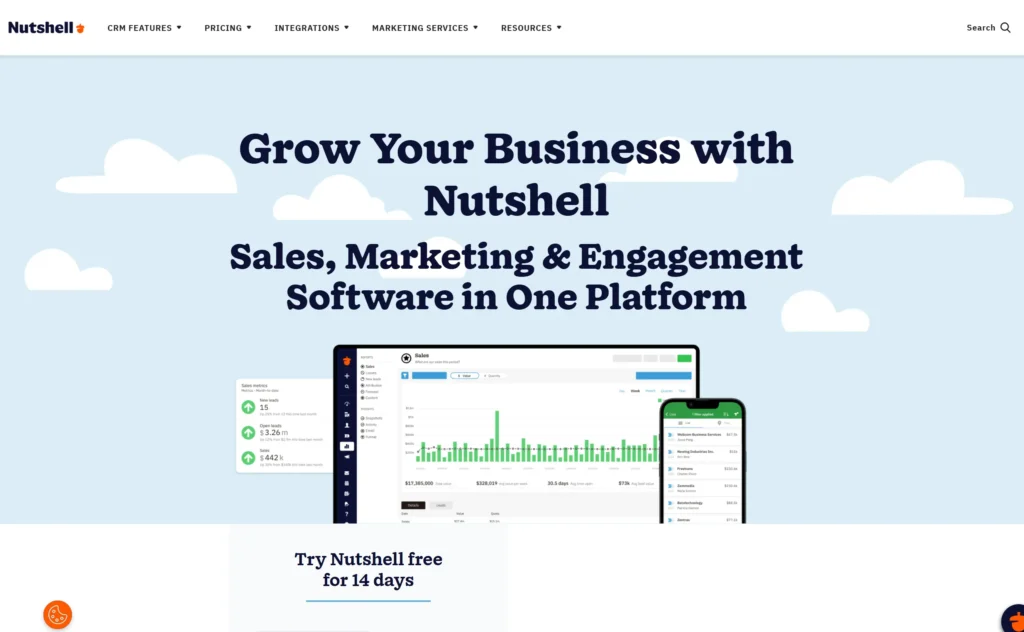
Quick Summary: Nutshell stands out as the best overall Shopify CRM by combining sales pipeline management with built-in marketing automation in a user-friendly platform that teams actually enjoy using. Unlike marketing-only platforms or sales-only CRMs, Nutshell provides end-to-end visibility from first website visit through repeat purchase, helping teams close more deals and retain more customers. The platform integrates directly with Shopify to automatically sync customer data, order history, and purchase patterns into detailed contact profiles, eliminating manual data entry while providing complete customer intelligence. For e-commerce businesses that value simplicity, predictable pricing, and exceptional support, Nutshell delivers enterprise-level functionality at small business prices.
Key Features:
- Seamless Shopify integration: Automatic synchronization pulls customer information, order details, purchase frequency, and total customer value into centralized profiles, eliminating manual data entry and providing a complete 360-degree customer view that updates in real time.
- Sales pipeline management: Visual pipeline tracking shows exactly where each prospect stands in your sales process, with customizable stages that match your specific e-commerce sales workflow from initial inquiry to closed deal, ensuring nothing falls through the cracks.
- Built-in email marketing: Create automated email drip sequences, trigger campaigns based on pipeline stages, schedule follow-ups, and nurture prospects without needing a separate marketing automation platform—everything lives in one unified system.
- Contact management: Organize customers and prospects with custom fields to track shopping preferences, product interests, purchase history, and engagement levels, enabling targeted segmentation for personalized outreach that increases conversion rates.
- Reporting and analytics: Real-time dashboards track sales performance, conversion rates, revenue by product line, and lead source effectiveness, with drill-down capabilities to identify bestsellers and top-performing marketing channels for data-driven decision making.
Task automation: Automate repetitive activities like follow-up reminders, lead assignment, data entry, and status updates so your team focuses on selling and relationship building instead of administrative busywork.
Need a user-friendly CRM to boost sales and team efficiency?
Take our guided tour to explore Nutshell’s incredible features!

2. Pipedrive
Rating: 4.6 out of 5
Pricing: Starts at $14 per user per month
Free plan: 14-day free trial
Best for: Sales-focused teams that need strong pipeline visibility
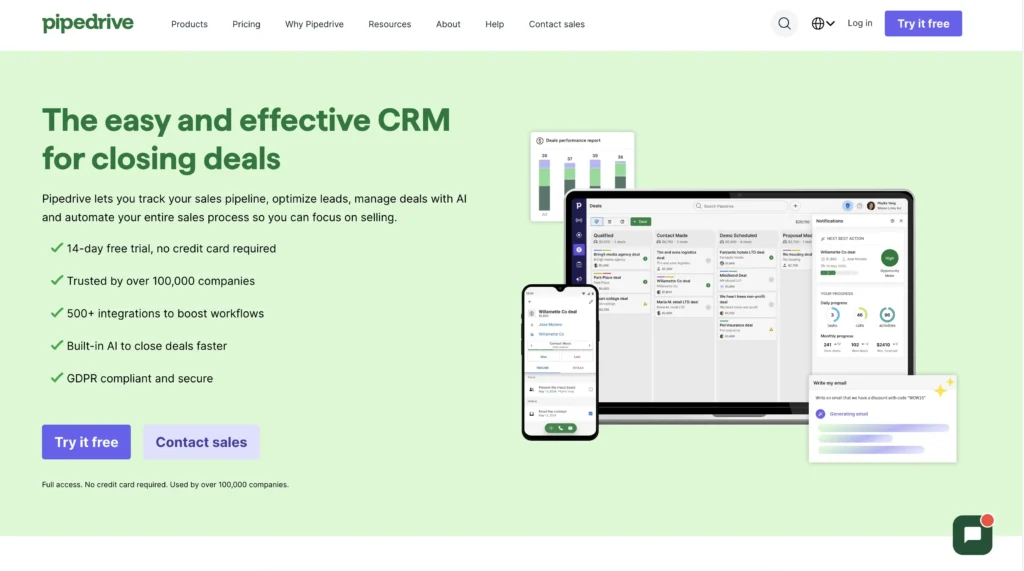
Quick Summary: Pipedrive built its reputation on making sales pipelines visual and intuitive. For Shopify merchants with complex B2B sales processes, wholesale accounts, or partnership deals running alongside retail orders, Pipedrive’s Kanban-style deal boards make it easy to see where every opportunity stands.
The Shopify integration syncs customer and order data into Pipedrive, allowing your team to track the entire customer journey from first contact to repeat purchase. While not as deeply integrated as some Shopify-native solutions, Pipedrive shines when you need to manage multi-step sales processes.
Key features:
- Kanban-style pipelines: Visual boards show exactly where each deal stands and what action comes next
- Activity-based selling: Built around the philosophy that the right activities at the right time drive sales
- Smart contact data: Automatic company and contact enrichment from public sources
- Email integration: Track emails, schedule sends, and use templates directly within the CRM
Mobile app: Comprehensive mobile experience for managing deals and activities anywhere
3. Klaviyo
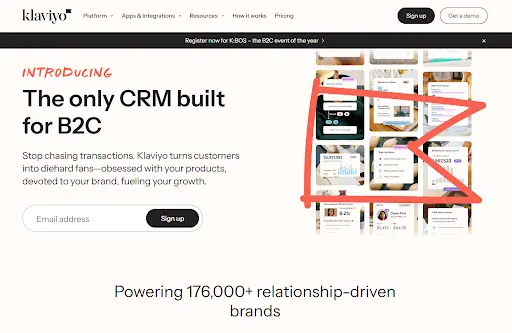
Rating: 4.5/5
Price: Starts at $20 per user per month
Free plan: Free, limited plan available
Best for: Data-driven e-commerce marketing with advanced customer segmentation, predictive analytics, and sophisticated automation workflow
Quick Summary: Klaviyo has become the dominant marketing automation platform in the Shopify ecosystem, known for its powerful data integration and sophisticated segmentation capabilities. While categorized primarily as a marketing platform, its deep customer data management and predictive analytics give it strong CRM functionality specifically designed for e-commerce growth. Klaviyo excels at turning customer behavior data into personalized marketing campaigns that drive revenue, making it the top choice for businesses that prioritize marketing sophistication over all-in-one functionality.
Key Features:
- Native Shopify integration: Deep two-way sync pulls product data, purchase history, browsing behavior, and customer profiles automatically, creating comprehensive customer records that update in real time without manual exports or imports.
- Advanced segmentation engine: Build dynamic customer segments based on purchase frequency, average order value, product preferences, browsing behavior, engagement levels, and predictive lifetime value—enabling hyper-personalized campaigns that feel individually crafted.
- Email and SMS automation: Create sophisticated multi-step flows triggered by customer actions, including welcome series, abandoned cart recovery, post-purchase follow-ups, win-back campaigns, and VIP customer nurturing with conditional logic and branching.
- Revenue attribution: Track exactly how much revenue each campaign, email, and SMS generates, with clear ROI reporting that shows which automation flows drive the most value so you can double down on winners.
- Predictive analytics: AI-powered predictions identify customers likely to make their next purchase, churn risk assessment, and expected customer lifetime value to prioritize high-value relationships and optimize marketing spend.
Product recommendations: Dynamic product recommendation blocks personalize emails based on browsing history, past purchases, and items frequently bought together, increasing average order values through intelligent cross-selling.
4. Brevo
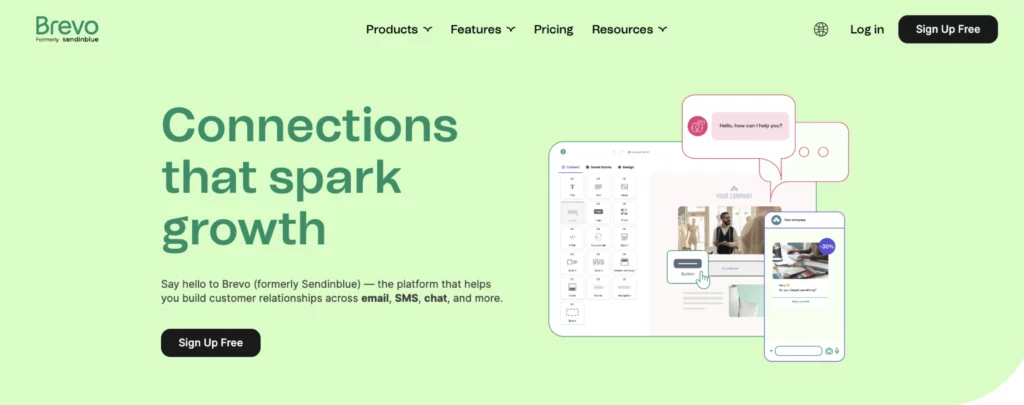
Rating: 4.3/5
Price: $12 per month
Free plan: Free, limited plan available
Best for: Budget-conscious e-commerce businesses seeking multichannel marketing automation across email, SMS, and WhatsApp
Quick Summary: Brevo (formerly SendInBlue) offers comprehensive marketing automation at an accessible price point, making it particularly attractive for small to medium-sized Shopify stores watching their budget. The platform combines email marketing, SMS campaigns, and WhatsApp messaging in one interface, enabling businesses to reach customers through their preferred communication channels. With Shopify integration, Brevo automatically syncs customer data and purchase history, allowing for behavior-based segmentation and targeted campaigns without expensive enterprise pricing.
Key Features:
- Multichannel marketing automation: Build automated workflows that trigger emails, SMS messages, and WhatsApp communications based on customer actions like abandoned carts, first purchases, or browsing specific product categories—all managed from one dashboard.
- Shopify integration: Native connection syncs customer profiles, order data, and product information, enabling segmentation based on purchase history and shopping behavior without manual exports or imports that create data lag.
- Drag-and-drop campaign builder: Visual editor makes creating professional email campaigns accessible to non-designers, with mobile-responsive templates optimized for e-commerce promotions and product showcases that display correctly across devices.
- Advanced segmentation: Filter customers by purchase frequency, total spend, product preferences, engagement levels, and custom attributes to create highly targeted audience segments for personalized messaging that increases conversion rates.
- Real-time reporting: Track email open rates, click-through rates, conversion metrics, and revenue generated by each campaign, with A/B testing capabilities to optimize subject lines and content for maximum performance.
Contact management: Centralized database stores customer information, interaction history, and behavioral data, with unlimited contact storage on paid plans to accommodate growing e-commerce businesses without sudden price jumps.
5. Agile CRM
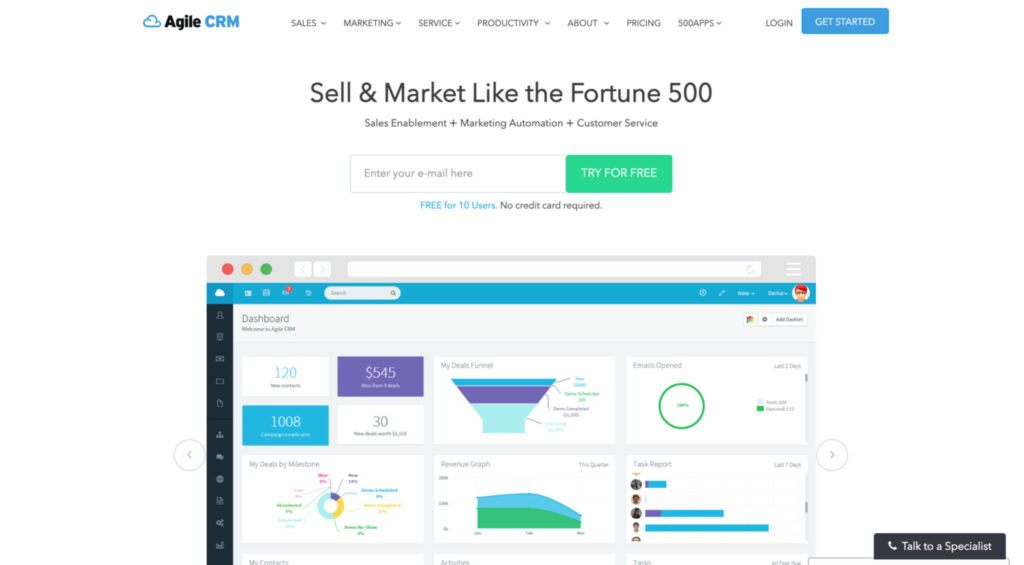
Rating: 4.1/5
Price: Starts at $8.99 per user per month
Free plan: Free for the first 10 users
Best for: Startups and small e-commerce teams seeking the most affordable comprehensive CRM with sales, marketing, and service features
Quick Summary: Agile CRM positions itself as an affordable alternative to enterprise-level CRM platforms, offering a surprisingly comprehensive feature set at startup-friendly pricing. The platform combines contact management, marketing automation, sales pipeline tracking, and customer service tools in one system. While it may not match the polish or specialization of higher-priced competitors, Agile CRM delivers solid core functionality for Shopify merchants who need CRM capabilities without breaking the budget.
Key Features:
- Shopify integration: Connects with Shopify to sync customer information and order data, though integration setup requires more manual configuration compared to plug-and-play competitors with native apps in the Shopify App Store.
- Marketing automation workflows: Drag-and-drop campaign builder creates multi-step email sequences triggered by customer actions, with visual workflow design that maps customer journeys from awareness to purchase and beyond.
- Contact management with social insights: Stores customer profiles enriched with social media activity, website behavior, and engagement history, providing context for personalized outreach that references recent interactions.
- Sales pipeline management: Visual pipeline boards track deals through customizable stages, with forecasting tools that help predict revenue and identify bottlenecks in the sales process requiring managerial attention.
- Built-in telephony: Make and receive calls directly within the CRM using integrated VoIP functionality, with automatic call logging that maintains complete communication records without manual note-taking.
Gamification features: Motivate sales teams with leaderboards, achievement badges, and performance tracking that turns sales activities into engaging competitions that boost productivity.
Making your final CRM selection
Choosing the best CRM for your Shopify store ultimately depends on your specific business needs, budget, and growth goals. Consider starting with free trials to test how each platform works with your existing workflow and team preferences.
Remember that the best CRM is the one your team will actually use. Focus on finding a solution that balances powerful features with ease of use, and don’t forget to factor in the quality of customer support when making your decision.
Next steps to make your decision:
- Start with free trials: Every CRM on this list offers a free trial or free tier. Test the platforms that match your business priorities rather than making decisions based solely on feature comparisons or marketing claims.
- Evaluate integration quality: The strength of the Shopify integration matters more than generic feature lists. Test how seamlessly each CRM syncs your customer data and whether the workflow feels natural for your team.
- Consider total cost of ownership: Look beyond base pricing to understand what features are included, which require add-ons, and how costs scale as your contact list and team grow over the next 12 to 24 months.
- Assess team adoption potential: The best CRM is the one your team will actually use. Prioritize intuitive interfaces and consider how much training time you realistically have available during busy seasons.
- Think six months ahead: Choose a platform that supports where your business is headed, not just where it is today. Switching CRMs mid-growth is painful and time-consuming—select a solution with room to scale.
Remember that the best CRM is the one your team will actually use consistently. Focus on finding a solution that balances powerful features with ease of use, and don’t forget to factor in the quality of customer support when making your decision. The right CRM should make your team more effective and your business more profitable, not add complexity to their daily workflow.
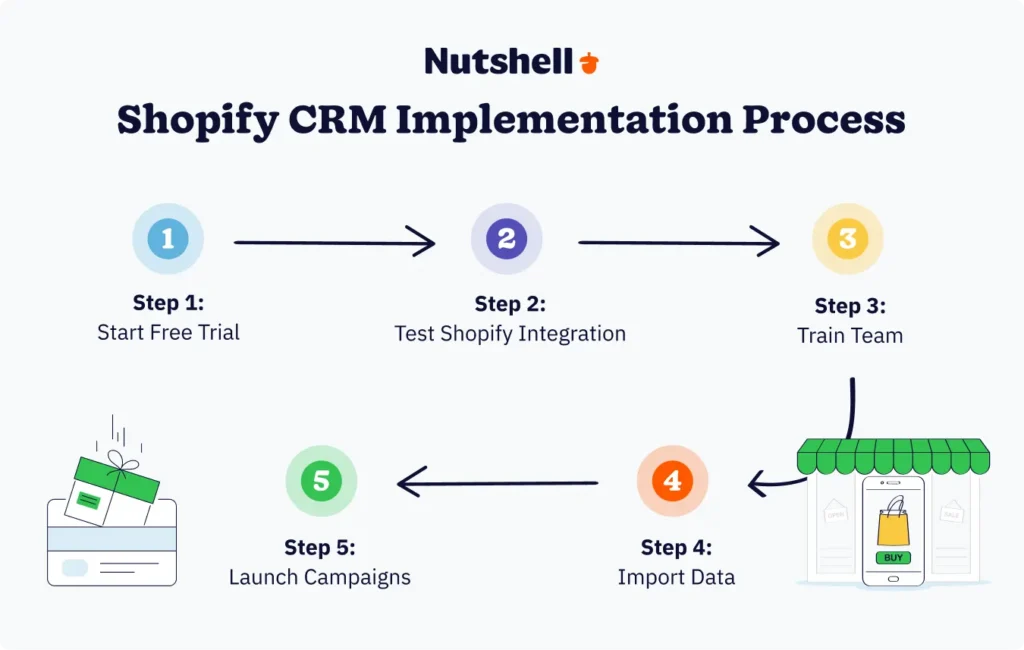
Eyeing the best CRM for Shopify?
A Shopify CRM can help you increase your revenue as it streamlines your marketing, sales, and customer service efforts.
If you’re looking for a CRM that you can integrate into your Shopify store, look no further than Nutshell. A user-friendly and affordable CRM, Nutshell has contact management, sales automation, and analytics tools that can help you drive sales and improve your customer service. Try Nutshell for free for 14 days.
Frequently asked questions
-
Does Shopify have a native CRM?
No, Shopify doesn’t include built-in CRM functionality. While Shopify excels at e-commerce features like inventory management and checkout, it requires third-party CRM integration for customer relationship management. This separation actually benefits merchants by allowing them to choose a CRM that fits their specific needs and budget.
-
How long does it take to set up a CRM integration with Shopify?
Most Shopify CRM integrations take 1-3 hours for basic setup through native apps or pre-built connectors. Simple integrations like Nutshell can be live in under an hour. Complex implementations with data migration and custom workflows typically require 1-2 weeks, while enterprise-level integrations may take 3-4 weeks.
-
What’s the typical ROI of adding a CRM to my Shopify store?
E-commerce businesses typically see 20-30% revenue growth within the first year of CRM implementation. Key metrics include 15-25% increase in customer retention, 10-20% boost in average order value through personalization, and 25% reduction in cart abandonment with automated follow-ups. Most businesses recover their CRM investment within 3-6 months.
-
Can I migrate my existing customer data from Shopify to a CRM?
Yes, migrating customer data is straightforward with most CRMs. Native integrations automatically sync existing customers, orders, and purchase history. The process typically involves exporting CSV files from Shopify, cleaning the data, and importing through your CRM’s data migration tools. Most CRMs offer free migration support for the initial setup.
-
Will adding a CRM slow down my Shopify store?
Modern CRM integrations have minimal impact on site speed when properly configured. Most CRMs use server-side API connections that don’t affect frontend performance. To maintain optimal speed, choose CRMs with native Shopify apps, limit frontend tracking scripts, and regularly audit your integrations. Well-optimized stores see less than 0.1-second impact on load times.
See Nutshell in action!
Try Nutshell free for 14 days or let us show you around before you dive in.
 BACK TO TOP
 Written by
Will Gordon Sr. Director of MarketingEdited by
Andy Fowler Co-FounderReady to try
Nutshell for Free?Thank you! Your submission has been received!Oops! Something went wrong while submitting the form.





8 Tips to Leave Better Professional Sales Voicemails & Boost Response Rates (With Examples)
Published on: November 10, 2022Highly Effective Strategies for Elevating Sales Team Performance
Published on: November 10, 2022Introducing Nutshell Forms Spam Prevention
Published on: April 22, 2024Curing the Tension Between Sales and Marketing: A Q&A With Nutshell Co-Founder Guy Suter
Published on: November 10, 2022Join 30,000+ other sales and marketing professionals. Subscribe to our Sell to Win newsletter!